The honest answer in 60 seconds
Plan for ninety minutes to two hours on the river or reservoir for a first session at an Irish club. The opening half-hour sits on a Concept2 erg with the coach drilling the four phases of the stroke. Then it shifts down to the pontoon for boat-handling drills, and most clubs finish with a short paddle in something wide and stable. Kit-wise, close-fitting workout clothes, a bottle of water and a small towel are enough. Fitness baseline is not a gate. Nobody is grading you. Roughly a third of beginners end up swimming at some stage over the course, and it is genuinely not a big deal.
From outside the gate, an Irish rowing club can look like a closed shop. The boathouse sits on the bank, the regulars are mid-conversation about a piece they did at Inniscarra last weekend, and the boats balanced on the slings look like something you should not touch. Walk through the door and the picture changes quickly. Clubs along the Lee in Cork, the Corrib in Galway, the Liffey in Dublin and the Shannon down through Limerick all run regular beginner intakes and quietly need the bodies. If you are at home now, weighing up whether to sign up for a local club's learn-to-row course, sign up. Here is what your first day will actually look like. The longer view on coming to the sport later in life sits in the how to start rowing guide.
What to wear (and what not to)
One rule above all the others: tight clothes. Anything loose will catch on something. The erg has a chain on a moving handle and a sliding seat under your backside. Sit into a boat and a metal rigger juts out roughly a foot either side of you. Both will happily grab a baggy hoodie and either rip it or pull you sideways at exactly the moment you wanted to stay balanced.
- Cycling shorts, running tights, or close-fitting leggings.
- A fitted t-shirt or vest. A long-sleeve base layer is sensible for an early-morning session in October.
- A thin jacket or zip-up to throw on before and after, easy on, easy off.
- Old runners (no spikes). The actual rowing shoes are screwed to the footplate inside the boat; the runners are just for the walk down to the pontoon.
- A water bottle. Most Irish boathouses do not have a tuck shop.
- A small towel. The Lee and the Liffey both splash.
Things to leave at home: anything with a hood, loose chains or earrings, watches you would mourn, and the phone in a back pocket. Most clubs have either lockers or a shelf inside the door for valuables.
What you will actually do on day one
A first session typically splits three ways: indoor on the erg, then pontoon-side basics, then a short outing if conditions allow. A handful of clubs hold the boat back to week two, especially if the river is up. Either way the running order is the same. Simplest movement first, water last.
1. Indoor work on the rowing machine
Plan on the first thirty minutes or so sat on a Concept2 - the ergometer, "erg" in every boathouse from Skibbereen to Killorglin. The coach walks you through the stroke piece by piece. Four phases: the catch (knees up, arms long, ready position), the drive (legs press, back opens, arms finish the pull), the finish (handle in to the bottom of the ribs), then the recovery (hands away, body follows, knees come up to start the next one). It feels robotic at first, and that is fine. The whole point of the erg block is to drill the sequence indoors before the water makes life complicated.
2. Pontoon-side basics
Down on the pontoon - the floating wooden or aluminium deck at the water's edge - the coach shows you how to lift a boat off its rack, walk it down, and lay it onto the water. On day one they will usually do most of that for you. Then the boat side of things: how to step in onto the footplate only (the hull is thin and unforgiving everywhere else), how to do the velcro straps on the shoes, how to sit balanced, how to push off cleanly. Written down it looks fiddly. In the flesh it takes about three minutes.
3. A short outing in a stable boat
If the water is on for day one, it will be in a wide, deliberately forgiving boat - a training double or a coxed quad with a coxswain calling the steering. These are nothing like the racing shells the senior squad take out at Inniscarra for championship trials. They are wide, heavy, hard to capsize. The cox will call basics on the way out - "easy oar" for stop rowing, "hold it up" for drag the blades in the water to brake - and you will paddle a few hundred metres, spin around, paddle back. Most first outings cover under a kilometre, all of it light.
The fears every beginner has
Four worries come up in every conversation with a first-timer. Here they are, and here is how each one actually plays out.
Fear: I will fall in the water
Reality: day one almost nobody goes in, because the boats picked for beginners are too wide to flip. Across the full course, the rough one-in-three rule applies. When it happens it is shallow water beside the pontoon, with a coach two metres away in a launch. You climb out, dry off, and either get back in or call it. Rowing Ireland's safety code sets explicit water-temperature thresholds for beginner sessions, and clubs do not run novice outings on the Liffey or Lough Rynn when the conditions step outside them.
Fear: I will be judged by the more experienced rowers
Reality: the senior squad have already forgotten you exist by the time they walk past the erg room. They are head-down on their own session, focused on their own boat, and the only attention you get is a quick hello in the kitchen. The other beginners are too busy fighting their own oars to notice anything you do wrong.
Fear: I will not be fit enough
Reality: a beginner session is technical, not aerobic. The pace is slow on purpose. Most newcomers are taken aback by how little puff a session actually needs in the early weeks. Fitness sneaks in later, once the technique is solid enough to handle real intensity. Every Irish learn-to-row group has at least one member who has not exercised properly in a decade, and they get through the block.
Fear: I will not understand the jargon
Reality: the coach explains every term as it lands, and the working vocabulary is small. Two weeks in and "catch", "drive", "finish", "recovery", "feathering", "easy oar" and "buttoning the gate" cover almost everything you will hear on the water. The rest you ask about.
How a 4-6 week learn-to-row course is structured
Most Rowing Ireland-affiliated clubs follow a similar arc: four to six weeks, one or two ninety-minute sessions a week, progressing from the erg through pontoon work to lightly-supervised outings.
- Week 1: Indoor on the erg learning the stroke. Pontoon-side handling of a wide stable boat. Maybe a very brief paddle if conditions invite it. A lot of stopping to talk through the catch position. You leave with one tangible skill, usually sliding back and forth on a fixed seat without falling off the runners.
- Week 2: Less time indoors, more time on the water. Real rowing in a wide stable boat with one or two other novices and a coach following in a launch. You learn to start, to stop, to steer if you are in the bow seat, or to follow a cox who steers for you.
- Week 3: Longer outings, less coaching at every stroke. Most of the session is now spent moving. A move into a slightly narrower double or quad is common. Practical drills come in - spinning the boat through 180 degrees, pausing at the catch, finding the rhythm with the other people in the boat.
- Week 4: On a four-week course this is the final outing. On a longer programme it is the doorway into bigger ideas - extended paddles, a bit of light pressure work, an introduction to the wider club and its routines. By now the decision about whether to stay around has usually made itself.
- Weeks 5-6: Available on the longer formats. A first lap of a larger stretch of water (a section of the Corrib, an out-and-back on the Lee), maybe a swap into a different boat class, sometimes a chance to row alongside the regular squad. By the end you should be able to take a stable boat out with another beginner, complete a structured session, and bring it back in good weather without anyone hovering.
At the end of the block, most Irish clubs slot graduates into a novice or development membership for the rest of the season, often at a discounted first-year rate, with a training schedule shared with the other recent graduates.
What happens after the course ends
When the beginner block wraps up, the standard step is into the club's novice or development squad. That is a separate training group, made up of recent learn-to-row graduates, training together two or three times a week with a dedicated coach. The aim of the novice squad is to take the basics and make them durable. Six to twelve months is the typical run before integration into intermediate or senior training begins.
From there the pathway runs novice (six to twelve months), then intermediate (one or two seasons), then senior. "Senior" in Irish rowing has nothing to do with age. It is a competitive grade. Plenty of senior rowers are in their twenties. Plenty are well past sixty, racing in masters categories. The age categories and the skill categories run on parallel tracks.
Staying in the novice squad indefinitely is a real option too, and a popular one. Not everybody is chasing a medal at Inniscarra. A large fraction of Irish club rowing is recreational - members who train two or three mornings a week on the Lee, the Corrib or the Liffey, never sign an entry form, and get exactly what they came for. The competitive narrative dominates the marketing, but the actual membership in any given club is mixed.
Equipment you will not need to buy
Cost of kit is the first worry for a lot of newcomers. For the learn-to-row block and most of season one, the kit problem is the club's problem. The list below is everything you can leave to the boathouse:
- A boat. Club fleet, shared, signed out on the rota.
- Oars. Stacked in racks against the wall.
- Rowing shoes. They live in the footplate of each boat. You step in, you step out.
- A cox box (the amplifier coxswains use to call commands). The cox group passes one between them.
- A heart-rate monitor or GPS watch. Worth it eventually. Pointless at week two.
- A lycra all-in-one. Your normal gym kit will do for the first season.
Three things genuinely worth picking up in the first year: a pair of close-fitting shorts or leggings you are happy to soak, two base layers for cold Irish mornings (the early-morning crew at Neptune are out in November), and a club kit set if you choose to buy in. Most clubs sell branded kit through their Row HQ store at or near cost.
What it costs in Ireland
Beginner courses at Irish clubs land in the EUR 80 to EUR 150 range for the full block of four to six weeks. The fee usually wraps in coaching, equipment use, insurance and a temporary affiliation for the duration. Some clubs roll the cost of the beginner course directly into the first year of full membership instead of charging twice.
After graduation, adult club subs typically sit between EUR 150 and EUR 300 a year, paid annually or in two or three seasonal instalments. The range is wide because facilities vary widely - a small rural club running off a couple of boats and a tin shed is a very different cost base to UCC or Commercial. Junior and student rates are universally lower. SEPA Direct Debit is the standard collection method at clubs running Row HQ.
On top of subs, you might cover regatta entries if you race. Total first-year spend for someone who does the learn-to-row and stays on usually lands somewhere between EUR 250 and EUR 500 all in. Roughly the same order of magnitude as a GAA club subscription or a mid-tier gym membership.
How to find a learn-to-row near you
Two routes work for finding an Irish beginner course. Start in the Row HQ rowing clubs directory to see which clubs cover your area, then cross-reference against the Rowing Ireland club finder and the club's own site for current course dates.
- Row HQ rowing clubs directory (Ireland) - county-by-county listings of Rowing Ireland-affiliated clubs with practical notes on what each club actually runs.
- Rowing Ireland club finder at rowingireland.ie/clubs - the governing body's official register, searchable by county and province.
- The club's own website and socials - beginner courses tend to bunch in spring (April-May) and a second wave in late summer (August-September). The "Join Us" or "New Members" page on the club site will list dates and a registration form.
Most clubs welcome a pre-signup visit. Drop them an email or a message saying you are thinking about the learn-to-row block and ask if you could call down on a Saturday morning to walk around the boathouse. The answer is nearly always yes, and a kettle usually goes on. The wider view on joining a club for the first time is in the how to start rowing guide.
Find an Irish rowing club running learn-to-row this season
Search the Row HQ directory of Rowing Ireland-affiliated clubs by city and county, and find a beginner course opening up near you.
Browse Irish Rowing ClubsCommon questions
Do I need to be fit to start rowing?
No fitness gate. Irish beginner programmes are built for absolute novices and the first few outings barely lift the heart rate. The early weeks are about the movement, not the burn. Clubs from Garda RC in Dublin out to the Skibbereen boathouse in west Cork take on plenty of beginners in their fifties, sixties and beyond every spring. If you can stand up, sit down and pull a handle, you can start.
How likely am I to fall in the water on my first day?
Almost zero chance on day one. The training double or coxed quad you sit in has been chosen because it is genuinely hard to flip. Across the full four-to-six week course, about one beginner in three takes a dip once. When it happens it is metres from the pontoon, the coach is alongside in a launch, and you are back up the steps in two minutes. Every learn-to-row group has the swim story by week four. It is the running joke, nothing more.
What should I wear to my first rowing session?
Close-fitting workout gear, full stop. Cycling shorts, leggings or tights paired with a fitted top is the working uniform. Loose t-shirts snag on the erg chain and on the rigger when you sit into the boat. Pack a thin layer for the standing-around moments, a bottle of water, and a small towel. Old runners get you to the boat - actual rowing shoes are bolted to the footplate. Anything with a hood or a loose drawcord stays in the bag, jewellery off, watch off if you mind it getting splashed.
How long does a learn-to-row course usually last?
The standard Rowing Ireland-affiliated beginner block runs four to six weeks. One or two ninety-minute sessions a week is typical. By the end you should be sitting in a stable boat with a small group, hearing commands like "easy oar" and "hold it up" without needing them translated, and in a position to decide whether you want to roll into the club proper.
Will the other beginners be much fitter and better than me?
Everyone in the group is at zero. That is literally the point of the cohort. By week three you will look back at the week-one version of yourself and barely recognise the person who could not synchronise a leg drive with an arm pull. Nobody in the room is judging anyone else for not knowing what feathering means on day one, because nobody in the room knew either a week ago.
Do I need to buy any equipment for the course?
Nothing beyond what is in your gym bag. The club supplies the boat, the oars, the shoes that live in the footplate, buoyancy aids where the venue requires them, and the erg. You bring yourself, the kit on your back, a bottle and a towel. Most Irish clubs do not expect new members to invest in personal gear until well into the first full season.
What if I do not like it after the first session?
You walk away with no awkwardness. Most Irish clubs collect one fee for the whole block and do not lock you in. Treat session one as a two-way trial. If the coach is rushing you, if the room feels cliquey, or if the water genuinely does not appeal, that is information worth acting on. Plenty of people try it once, decide rowing is not for them, and that is a perfectly fine outcome.
What is the difference between sculling and sweep rowing?
Sculling is two oars per rower, one in each hand. Sweep is a single oar held in both hands. Irish beginner courses almost always start in a sculling boat because the symmetry keeps it level and lets you learn the stroke without depending on a partner. The sweep boats - the coxed fours and eights you see lined up at Inniscarra on championship weekend - arrive once the basics are in place.
Sources & references
- Rowing Ireland - Find a Club — Rowing Ireland
- Rowing Ireland - Go Rowing beginners programme — Rowing Ireland
- Rowing Ireland - Safety code and beginner guidelines — Rowing Ireland
- Rowing Ireland - Club development and learn-to-row resources — Rowing Ireland
- Rowing Ireland - Safeguarding and welfare guidance for clubs — Rowing Ireland
- RNLI - Cold water shock guidance — Royal National Lifeboat Institution
- Concept2 - Rowing machine technique guide — Concept2 UK
- Sport Ireland - Club development and participation resources — Sport Ireland
- Row HQ rowing clubs directory (Ireland) — Row HQ
- Row HQ guide - how to start a rowing club — Row HQ
From the RowHQ shop
Printable PDFs written for club rowers. Buy once, keep forever.
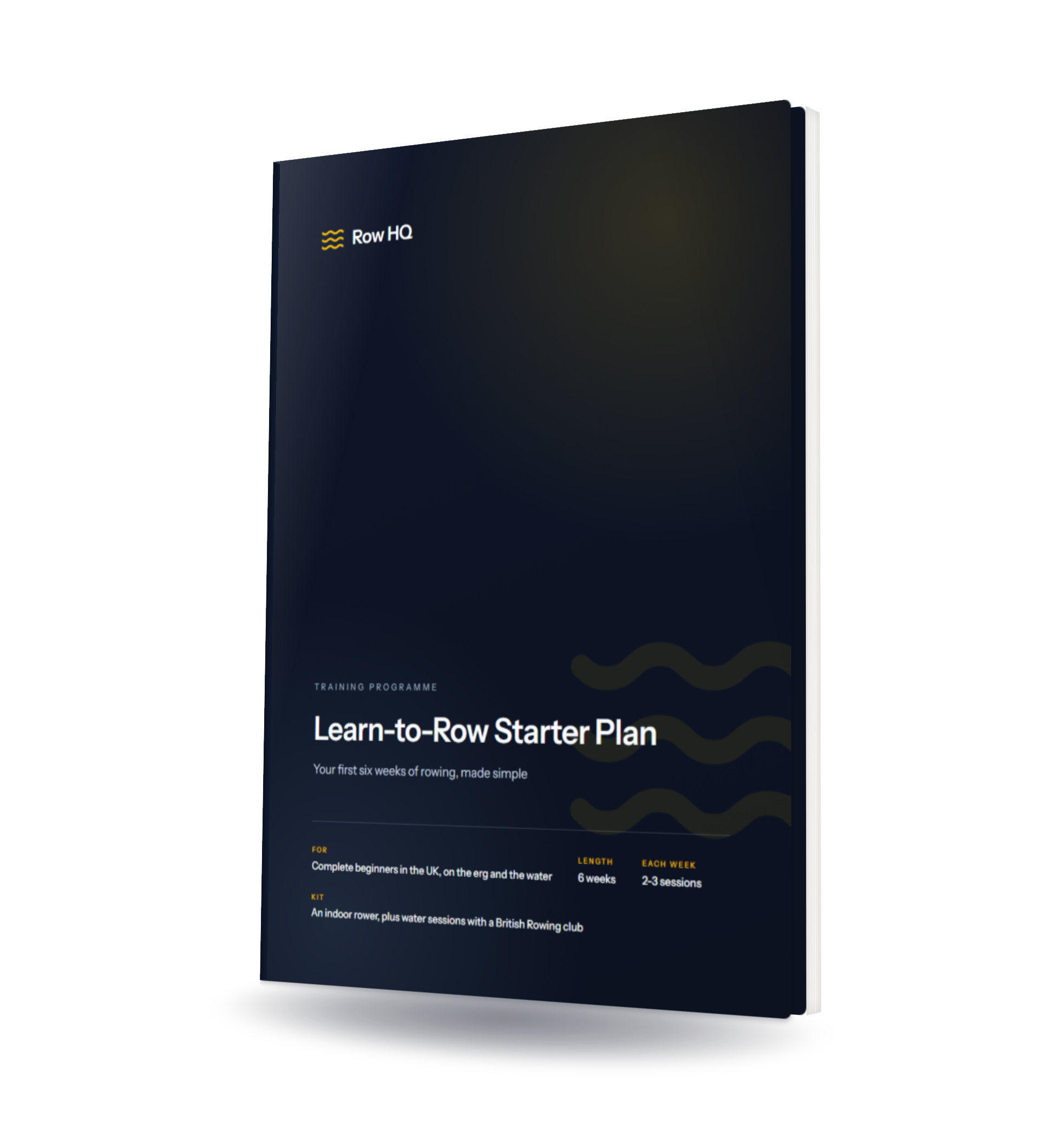
Learn-to-Row Starter Plan
A free 6-week introduction plan for brand-new rowers - on the water and on the erg.

Steady in the Single
Why you cannot balance a single, diagnosed properly - find out when in the stroke the boat goes down, check whether the rigging is doing it, then drill the actual cause.