Short version
Your first session at a Kiwi boatshed runs 90 minutes to two hours. The opening 30 to 40 minutes happen on a Concept2 RowErg in the shed while the coach walks you through the stroke sequence and the RNZ-required safety induction. Then you walk down to the pontoon for boat-handling basics, and finish with a short paddle in a wide, deliberately stable training boat (usually a Sykes touring quad with a cox, or a tub-pair) covering well under a kilometre. The kit is whatever you would wear to a gym session, plus a water bottle and a towel. You do not need to arrive fit and you are not being graded. About one in three beginners gets damp at the pontoon at some stage during the course. It is genuinely fine. The water near the pontoon is shallow, the coach is right there, and clubs from Karapiro through to Otago Harbour all run the same warm-water cohort schedule deliberately to keep that splash from being a problem.
I started rowing at university back in England and walked into the boatshed assuming everyone else there had been rowing since they were twelve. They had not. We were all equally clueless together. I have since coached enough beginners across enough sessions to know the questions never change: what do I wear, what will the coach actually make me do, will I end up in the water, and will I look ridiculous in front of the regulars? This piece is the answer to all of them, written for somebody who has just clicked through to a Kiwi club's Learn to Row page and is wondering whether to commit. The short answer is yes, sign up, and here is what walking into the boatshed at Lake Karapiro, Star Boating Club on Wellington Harbour, West End RC in Christchurch or Otago RC in Dunedin will actually look like. For the wider question of whether rowing as a sport is right for you, the how to start rowing guide covers that ground.
What goes in the bag
Rule number one: nothing baggy. The RowErg has a handle that moves forward and back on a sliding seat. The boat has a metal rigger that projects roughly half a metre on either side of where you sit. Loose fabric will find one or the other, and the consequence is either a torn shirt or being pulled off balance at the catch.
- Cycling shorts, running tights or fitted leggings. Anything that stays close to the leg.
- A snug t-shirt or singlet. A long-sleeve base layer if the morning is cool, particularly in Wellington or down south.
- A light layer that comes off easily once the warm-up starts.
- Running shoes for the walk from the carpark to the pontoon. The boat has its own footwear built into the footplate.
- A drink bottle. Boatsheds in Aotearoa do not run shops.
- A small towel. Splashing is part of the deal.
Things to leave in the car or at home: anything with a hood (it catches), loose jewellery, a watch you would mind getting wet, and your phone if it lives in a back pocket. Most NZ boatsheds have a shelf or a small locker for personal kit during the session.
What the session looks like
A first Learn to Row session at a Kiwi club breaks into three blocks: indoor work on the RowErg, pontoon-side handling basics, and a short paddle in a stable training boat. Some clubs - particularly those running in colder months or on harbours with variable conditions - hold back the water component until session two. Either way the logic is identical: simplest movement first, most complex environment last.
1. Indoor work on the Concept2 RowErg
The first half-hour happens on the Concept2 RowErg - the ergometer, universally shortened to "erg" - in the shed. The coach demonstrates the stroke phase by phase, gets you moving through each segment slowly, then links them into a continuous stroke. Four phases: catch (knees bent, arms straight, the blade would be at the water), drive (legs push first, then back swings open, then arms pull through to the body), finish (handle drawn to the lower ribs), recovery (arms away first, then body forward, then knees rise). The movement feels mechanical because it genuinely is. The point of starting on the erg is removing the water as a variable so the brain can lock the sequence in without also having to balance a hull.
2. Pontoon basics and the RNZ safety induction
Down at the pontoon (the floating platform at the water's edge) the coach runs through the RNZ safety induction. This is required by Rowing NZ and not optional: what to do if the boat tips, where the buoyancy aids live, what the cox's commands actually mean, and what the cold-water protocol is. After that, you learn how to lift the boat off the rack, carry it down four-person style, and place it in the water. You see which part of the hull takes weight when you step in (the footplate, never the thin skin of the hull), how to fasten the moulded footwear, how to sit balanced, and how to push off cleanly. Written down this all sounds elaborate. In practice it takes about five minutes once the coach walks through it once.
3. A short paddle in a stable Sykes-style training boat
If the session reaches the water on day one, it happens in a wide, deliberately stable training shell. Most Kiwi clubs use a Sykes touring quad with a coxswain steering, or a tub-pair (a two-person sculling boat with a rounded, beamy hull section). These are emphatically not the narrow racing shells you see at Lake Karapiro on Maadi week. They are purpose-built training boats that do not tip easily even when you do something wrong. The cox will call simple commands - "easy oar" (stop rowing), "hold it up" (drag the blade flat across the water to brake), "row on" (start again) - while you paddle a short distance, turn the boat around, and come back. A typical first paddle covers around 500 to 800 metres at very low intensity.
The worries that turn out to be nothing
Four worries come up in every single Learn to Row cohort I have seen. Here is what each one actually looks like once the session is under way.
Fear: I will end up in the water
Reality: on day one almost nobody does, because Sykes training quads and tub-pairs are designed not to tip. Across the full four-to-six week block, roughly one beginner in three has a swim at some point. It always happens close to the pontoon in shallow water with a coach right there. You climb back onto the pontoon, get the towel out of your bag, and either carry on or call it a day. Water Safety NZ publishes clear cold-water shock guidance and Kiwi clubs schedule their Learn to Row programmes in the warm summer months for exactly this reason. The clubs do not run beginner sessions in conditions where a capsize would actually be dangerous.
Fear: the experienced rowers will be watching and judging
Reality: experienced rowers are entirely wrapped up in their own session. The senior squad turn up at 5:30am, train, and leave. They are not paying any attention to the Learn to Row group in the next bay. The only time they notice you is to say "morning" in the boatshed on the way past. The other beginners in your cohort are too busy trying not to drop their oars to be tracking what anyone else is doing.
Fear: I will be too unfit
Reality: Learn to Row sessions are technical rather than aerobic. The opening sessions barely raise a sweat in the cardiovascular sense because they are focused on movement patterns rather than effort. Aerobic load comes much later, once your technique is solid enough to support real intensity without falling apart. People who have not exercised seriously in a decade complete Kiwi Learn to Row programmes every summer.
Fear: I will not follow the jargon
Reality: any coach worth learning from explains terms as they use them. By session two you will know what catch, drive, finish, recovery, feathering and easy oar mean. That covers most of what gets said in a beginner boat. Anything else, ask. Coaches genuinely prefer questions to silent confusion.
How a Kiwi Learn to Row programme is built
NZ clubs typically structure the Learn to Row block as a four-to-six week programme aligned with the RNZ Rower Connect learner pathway. Specifics vary by club but the progression is consistent.
- Week 1: Indoor work on the Concept2 RowErg learning the stroke sequence. RNZ safety induction at the pontoon. Boat handling drills on land. Possibly a very short paddle in a stable training boat. Lots of pausing to talk through technique. You leave session one with one solid new skill (moving the seat back and forth on the slide without losing balance).
- Week 2: Less erg time, more water time. You start rowing properly in a Sykes touring quad or tub-pair alongside one or two other novices, while the coach follows in a motorised launch. You practise starting, stopping and basic direction holding.
- Week 3: Longer outings, fewer interruptions per stroke. Most of the session is now on the water. You may move from the tub-pair into a slightly narrower double or quad. Skills like spinning the boat around the bow, pausing at the catch, and rowing in time with the rest of the crew start feeling natural.
- Week 4: The final session on a four-week programme, or the kick-off for the harder content on a longer one. Longer paddles, some light pressure work, an introduction to the boatshed routines and the wider club community. By now you will know whether you want to continue.
- Weeks 5-6: On longer programmes, this is where you might tackle a bigger stretch of water (a longer reach on the river, a different harbour bay), try a different hull type, or row alongside the regular novice squad. By the end you should be able to take a stable boat out with another graduate, complete a short session and return without a coach following in the launch (in good conditions).
Most Kiwi clubs offer a novice or beginner membership at the end of the programme, often at a reduced rate for the rest of the first season, which slots you into a structured training pattern alongside other recent graduates.
What comes next once the course finishes
Once the Learn to Row block wraps, you typically move into the club's novice or beginner group: a collection of recent graduates who train together two or three times a week with continued coaching while the fundamentals settle in. Most NZ clubs keep novices in that group for six to twelve months before integrating them into the main intermediate or senior squad.
The pathway from novice goes roughly: novice (six to twelve months), intermediate (one to two seasons), senior squad. "Senior" in rowing terminology means a higher competitive level, not an older age band. A senior club rower in NZ might be 22 or 72. Masters rowers compete in age-graded categories at events like the NZ Masters Championships at Lake Ruataniwha and run their own racing calendar in parallel.
You are under no obligation to follow the competitive track. A large slice of every Kiwi club membership rows recreationally for fitness, fresh air and the simple pleasure of being on the water in the early morning, never enters a regatta, and gets enormous satisfaction from it. Promotional material tends to push the racing side, but on the morning of any given training session at any given club, the recreational members are usually the larger group.
Kit you do not need to buy
The cost of personal gear is a common pre-signup worry. For the Learn to Row programme and almost all of your first season after it, the club supplies everything that matters. You do not need to buy:
- A boat. Club hulls are shared. You sign one out when you want to row.
- Oars. The shed has racks of them.
- Rowing footwear. Already moulded into the boat and stays with the boat.
- A cox box (the small amplifier coxswains use). The cox group shares one.
- A heart rate monitor or GPS watch. Useful well into a competitive build, completely unnecessary for Learn to Row.
- Specialist all-in-one lycra rowing kit. Your normal gym gear is fine.
The only kit worth buying in your first season is a decent pair of close-fitting shorts or tights that you do not mind getting splashed, a couple of base layers for cool Wellington and southern mornings, and eventually a club kit set if you want one (most clubs sell branded kit close to cost rather than as a markup line).
What it costs in NZD
Learn to Row programme fees at Kiwi clubs typically land between NZ$80 and NZ$200 for the full four-to-six week block. Equipment, coaching and a temporary membership for the duration of the programme are usually bundled into that fee. The bigger urban clubs in Auckland, Wellington and Christchurch sit toward the upper end. Smaller regional and rural clubs frequently run closer to actual cost.
After the programme, full adult club subscription typically runs NZ$200 to NZ$500 a year, paid annually or by instalment. The range reflects real differences in facilities, location, and whether ongoing coaching is bundled in. A small recreational club operating from a simple shed might charge NZ$200. A larger club with a full fleet, paid coaching and a clubhouse might charge NZ$450 or higher. Junior and tertiary student rates typically come in at a third to half of the adult rate.
On top of the annual subscription, expect a small additional levy of NZ$20 to NZ$50 a year, plus RowIT regatta entry fees for any events you choose to enter. Total first-season cost for somebody who does the Learn to Row programme and then takes up full novice membership typically lands in the NZ$300 to NZ$700 range all up.
Tracking down a programme near you
Three reliable starting points for finding a Kiwi Learn to Row programme. Begin with the Row HQ rowing clubs directory to see what is operating near you, then cross-check against the Rowing NZ club finder and the individual club's own website for current intake dates.
- Row HQ rowing clubs directory - city-by-city listings of Kiwi rowing clubs with notes on what each club actually offers (juniors, masters, Learn to Row, recreational, adaptive).
- Rowing NZ club finder at rowingnz.kiwi - the national federation's searchable directory, organised by region across all ten regional rowing associations.
- The club's own website or social channels - Learn to Row programmes in NZ typically run during the summer rowing season (November through February), often with a shorter autumn or winter cohort if conditions allow. The "Join Us" or "New Members" page lists current intake dates and registration links. Many clubs also advertise one-off "have-a-go" sessions as a low-commitment first taste before signing up to a full block.
Almost every Kiwi club welcomes a visit before sign-up. Email or message the club to say you are considering the Learn to Row programme and ask whether you can drop by on a Saturday morning to have a look around. The answer is nearly always yes, and seeing the shed and the pontoon in person is the fastest way to know whether the club fits you. For the wider question of whether rowing suits you as a sport, the how to start rowing guide covers that ground.
Find a New Zealand rowing club running Learn to Row this season
Browse the Row HQ directory of Kiwi rowing clubs by city and find a programme near you running a beginner cohort.
Browse NZ Rowing ClubsCommon questions
Do I need to be fit to start rowing?
No. Kiwi Learn to Row programmes are built for absolute beginners with no fitness baseline. The opening sessions barely register as cardio because they are about stroke mechanics rather than aerobic effort. Clubs in Karapiro, Wellington and Otago all run Learn to Row cohorts that include people in their 60s and 70s starting from no exercise base. If you can sit, stand and hold a handle, you can row.
How likely am I to fall in the water on my first day?
Very unlikely on session one because the training boat is wide and deliberately stable. Over the full Learn to Row block, roughly one beginner in three ends up in the water at some point. Every time it happens it is in shallow water next to the pontoon with a coach within two metres. Kiwi clubs follow Water Safety NZ cold-water guidance and schedule Learn to Row cohorts in the warm summer months (typically October through February) so that an unexpected swim is uncomfortable rather than hazardous.
What should I actually wear to my first session?
Snug-fitting workout gear. Cycling shorts or running tights work well, paired with a fitted top. Loose fabric catches on the moving handle of the RowErg and on the metal rigger of the boat. Bring a thin layer for before and after, a water bottle and a small towel. Running shoes for walking from the carpark down to the boatshed. The boat has its own footwear moulded into the footplate. Leave behind anything baggy, anything with a hood, and any jewellery you cannot remove easily.
How long does a Kiwi Learn to Row programme actually run?
Most NZ clubs run a four-to-six week programme with one or two 90-minute sessions a week. By the closing session you should be able to row in a stable boat alongside one or two other beginners, follow basic commands from the cox, and decide whether you want to convert to a novice membership for the rest of the season. Several clubs also offer single "have-a-go" sessions as a lower-commitment first taste before signing up to the full block.
Will the other beginners be visibly fitter and more skilled than me?
No. The whole cohort is at zero. The programme is designed around shared total inexperience. By week three you will be visibly more capable than you were on day one, and so will everyone else in the boat. Nobody has any basis to judge anyone else in session one because nobody knows what they are doing yet.
Do I need to buy any equipment to do the course?
No. The club supplies the boat, oars, footwear moulded into the boat, buoyancy aids where used, and the indoor ergometer. You bring yourself, fitted workout gear, a water bottle and a towel. Even well into the first season after the course finishes, most Kiwi clubs do not expect novice members to own personal rowing gear.
What if the first session is not for me?
Then you stop. NZ clubs charge a flat fee for the Learn to Row block and do not lock you into anything further. A single session is enough to tell you whether you enjoy being on the water, whether the boatshed atmosphere feels right, and whether you trust the coach. If any of those answers is no, walking away is completely fine and the club would rather you make that call early than three months in.
What is the difference between sculling and sweep rowing?
Sculling puts two oars in each rower's hands, one per hand. Sweep rowing puts one larger oar in both hands. Most Kiwi Learn to Row programmes open in sculling boats because the symmetry makes the stroke easier to feel without depending on a partner. Sweep boats - the fours and eights you see racing at Maadi Cup and the NZ Championships - usually come once the basics are settled.
Sources & references
- Rowing New Zealand - learn to row and club finder — Rowing New Zealand
- Rowing NZ - Rowing Connect member registration system — Rowing New Zealand
- Water Safety New Zealand - cold water and capsize guidance — Water Safety New Zealand
- Maritime NZ - on-water safety requirements — Maritime New Zealand
- Concept2 - rowing machine technique videos — Concept2
- Sport NZ - safeguarding in sport framework — Sport NZ
- Rowing NZ - regional associations directory — Rowing New Zealand
- Row HQ rowing clubs directory — Row HQ
- Row HQ guide - how to start a rowing club in New Zealand — Row HQ
- Rowing NZ - Get Into Rowing pathway — Rowing New Zealand
From the RowHQ shop
Printable PDFs written for club rowers. Buy once, keep forever.
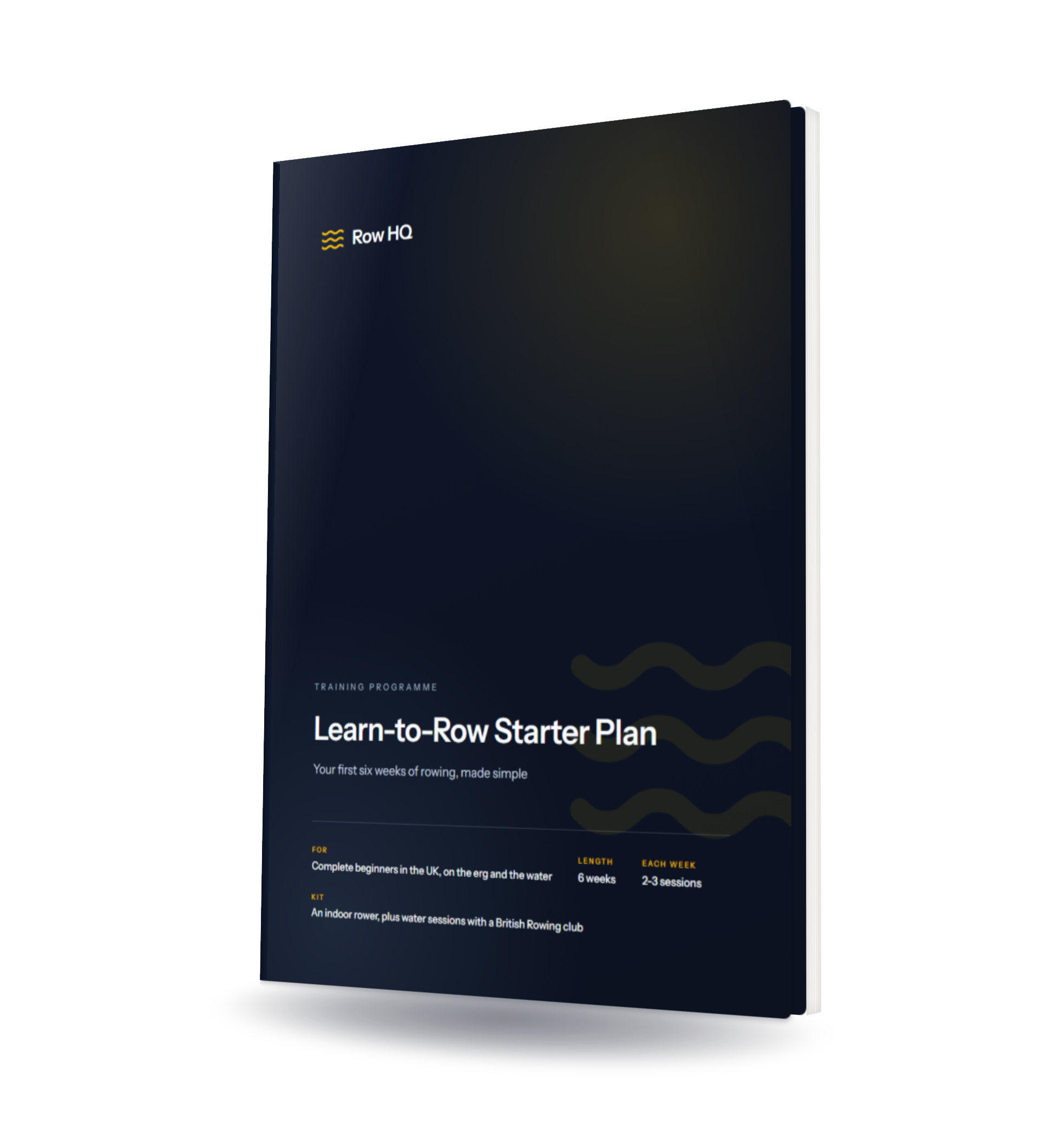
Learn-to-Row Starter Plan
A free 6-week introduction plan for brand-new rowers - on the water and on the erg.

Steady in the Single
Why you cannot balance a single, diagnosed properly - find out when in the stroke the boat goes down, check whether the rigging is doing it, then drill the actual cause.