Erg Percentile Tool for Irish Crews
Keep your raw rowing time, weight-adjusted score and illustrative age adjustment together. Compare actual times with example pace bands. The bands are not official rankings or squad selection standards.
Last updated:
How a percentile standing is built from a raw erg score
A weight-adjusted erg score multiplies your raw rowing time by (body weight in pounds / 270)^0.222. Concept2 publishes this correction to help compare potential on-water performance. A 70 kg rower with a 6:30 result has an adjusted time of about 5:44.5. Keep the original score for online rankings and use the corrected score only for the comparison it describes.
Your test result
Adjusted score (weight + age)
| |
Raw-time example band
Illustrative raw-time bands. These are not published Concept2 percentiles or qualification standards. Compare like-for-like distance and category.
| Standard | Time | Split | Watts |
|---|---|---|---|
Saved to this device
The last five percentile reads are kept locally. Your numbers never leave the browser. To keep a whole squad's standings in one place across a winter Inniscarra build, that is Row HQ's job.
Which erg score should you compare?
Keep your original rowing time beside every adjusted score. A weight adjustment answers a different question from an online ranking. Rankings compare recorded performances within a selected distance, age group and category. An adjusted score is a coaching calculation, so it should never replace your actual time in a results list.
The score table also shows average watts. Average watts describe the mechanical power behind a result; they are not a fitness percentile. Use your actual test distance and time to calculate average watts before comparing adjusted scores.
| Measure | Useful for | Limit |
|---|---|---|
| Raw time | Tracking the same test distance | Use the same machine and test conditions |
| Weight-adjusted score | Comparing the effect of body weight | Not eligible for Concept2 online rankings |
| Age-adjusted estimate | An illustrative age comparison | This page uses a local approximation |
| Online ranking | Comparing a defined category and season | Depends on submitted results |
The example bands on this page are not population percentiles or selection standards. A 270 lb reference weight is part of the Concept2 correction, not a target body weight. Use raw results and coaching judgement when selecting a crew.
Check the weight calculation alone with the bodyweight-adjusted erg calculator before combining adjustments.
Convert your total time into an average split with the erg pace calculator to set a repeatable test target.
Use your actual recent 2k split in the training pace calculator rather than entering a corrected score.
Method and further reading: Concept2 weight adjustment guidance
Frequently asked questions
How is a weight-adjusted erg score calculated?
Multiply actual time by (body weight in pounds / 270)^0.222. This is the published Concept2 weight correction. A 70 kg rower with a 6:30 raw time has an adjusted time of about 5:44.5. Adjusted results cannot be submitted to the Concept2 online rankings.
What is age-adjusted erg scoring?
It applies an age factor to a raw time. This page divides the time by a local illustrative factor; it does not claim an official Concept2 age standard. At age 50, the factor is 1.110, so a 7:00 raw time becomes about 6:18.4.
Does this calculator tell me my rowing percentile?
No. A percentile requires a dated dataset and a clearly defined category. The bands shown here are illustrative raw-time thresholds. For an online ranking, compare actual times within the same distance, age group and category.
Why keep both raw and weight-adjusted scores?
They answer different questions. The raw score records what you completed on the erg. The weight-adjusted score applies a model intended to help compare potential on-water performance. Neither calculation replaces technique assessment, local selection criteria or a real race result.
Building the percentile from weight and age inputs
The Concept2 weight handicap
The published Concept2 formula is adjusted time = raw time x (weight in lb / 270)^0.222. The 270 lb denominator is a reference within the model, not an average athlete weight or a target weight. Concept2 explains the correction as a way to discuss potential speed in an eight.
A 70 kg rower completing 2,000 metres in 6:30 has a weight-adjusted time of about 5:44.5. The same raw time at a higher body weight produces a higher adjusted time. Neither corrected result can be submitted as a raw Concept2 ranking score.
Illustrative age adjustment
This page uses a local piecewise age factor, not an official Concept2 age standard. The factor is 1.000 through age 30, 1.034 at 40 and 1.110 at 50. Divide raw time by that factor. Under this illustrative model, a 50-year-old rowing 7:00 has an age-adjusted time of about 6:18.4.
Use age-adjusted values as a discussion aid. For a real ranking comparison, select the correct age group and category in a current results list. A local approximation cannot establish a percentile, selection decision or equivalent performance for every athlete.
Stacking the two handicaps
The combined calculation is raw time x weight factor / age factor. It keeps both assumptions visible. The example pace table compares raw times only, so it does not mix a corrected score with an unadjusted reference.
Why these bands are not percentiles
A percentile needs a defined population and a dated set of results. This calculator has neither. Its five example bands simply divide a set of illustrative time thresholds. They do not establish an athlete's national standing, university selection prospects or international rank.
What the percentile tool will not do
A calculation cannot establish racing eligibility or replace crew selection. Governing bodies and events set their own categories. Technique, boat balance and conditions affect on-water performance. Use the training pace calculator with your actual 2k result when planning sessions.
From the RowHQ shop
Printable PDFs written for club rowers. Buy once, keep forever.

2k PB Push - 6-Week Peaking Block
Six weeks that turn an existing aerobic base into a 2k personal best - race-specific work, a proper taper, every pace scaled to your own time.
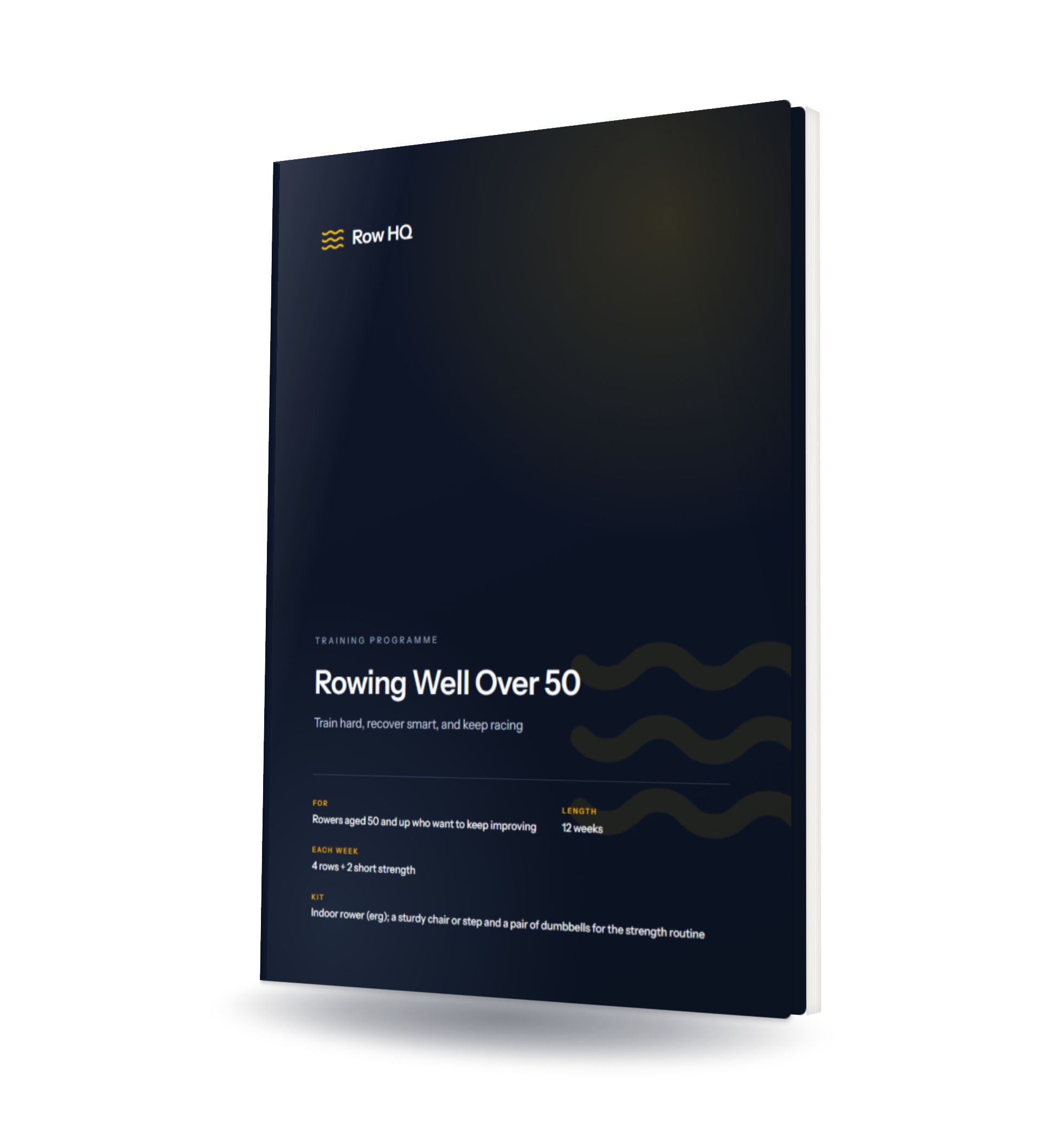
Rowing Well Over 50
A 12-week masters plan for rowers over 50 - recovery-spaced training plus an illustrated home strength routine, so you keep getting faster while your peers slow down.
One percentile read is arithmetic. A whole squad across a winter is a system.
Row HQ writes a weight-adjusted, age-graded percentile against every member the moment an erg score lands, so the coach pulls crew lineups from live data, catches a U19 quietly flatlining via the admin dashboard, and stops trawling WhatsApp threads on Irish Champs trial week. See how Oundle Town RC runs selection off real data, then work through the practical playbook on getting real value from squad erg metrics.
The handiest home for a score like this is the club account. Members on Row HQ log erg results directly, so nothing goes missing between test days.
More rowing tools
Concept2 Erg Tool
Turn a 500m split into watts, calories and projected times across every Irish test piece.
Training Pace Calculator
Spit out UT2, UT1, AT, TR and AN setpoints from your 2k for the boathouse whiteboard.
Rowing Pace Chart
Single-screen pace lookup with intensity zone bands.
2k Prediction Calculator
Back-solve a credible 2k from a recent long aerobic piece.