Ergometer
An ergometer is an indoor rowing machine that measures the power an athlete produces per stroke. The Concept2 RowErg is the only model that matters in competitive Irish rowing. It has been the trial-standard machine at Skibbereen, Commercial, NUIG, UCD, Trinity and the National Rowing Centre at Inniscarra since the late 1980s. The PM5 monitor shows split per 500m, watts, calories per hour, distance, elapsed time and stroke rate. It is the machine every Rowing Ireland erg standard is set against.
The Ergometer: Concept2 in an Irish Boathouse
An ergometer is the indoor rowing machine used in competitive rowing to measure the work an athlete produces per stroke. The dominant model in Irish club, university and high-performance programmes is the Concept2 RowErg, which couples a flywheel and a damper lever to mimic the resistance of moving a hull through water. The PM5 monitor outputs split per 500m, watts, calories per hour, distance, stroke rate and elapsed time, and Rowing Ireland selection trials run on the same machine.
Also called: Erg, Rowing Ergometer, Indoor Rower, Rowing Machine
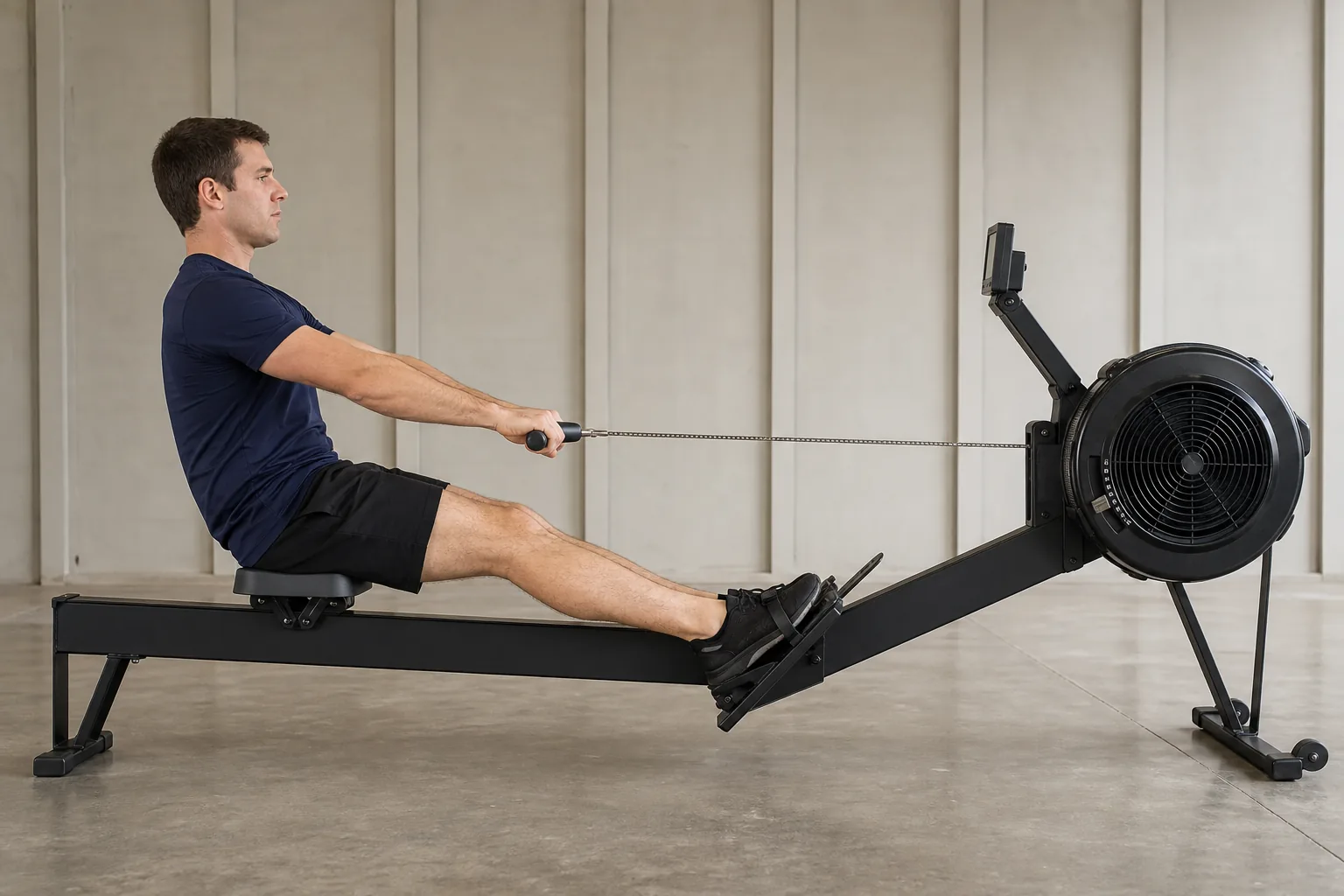
Erg, ergometer, indoor rower: same machine, three labels
Three names, one piece of kit. "Ergometer" is the technical term from the Greek ergon for work, and is the word that turns up in coaching documents and physiology papers. "Erg" is the everyday shorthand: a Skibbereen athlete will say "we did six by five hundred on the erg" or quote a 2k erg of 6:18. "Indoor rower" or "rowing machine" is what the wider gym market calls the same machine. Whichever label is used, the equipment is identical: sliding seat on tracks, footplate with straps, handle on a chain, flywheel in a cage that absorbs the pull.
How an ergometer actually works
Pulling the handle spins the flywheel through a chain. The flywheel meets resistance from air (Concept2), water (WaterRower) or magnets (Hydrow, Echelon). Sensors track how quickly the flywheel decelerates between strokes, calculate the work performed during the drive, and convert that work into a metres-rowed figure. The monitor shows the conversion in real time as split per 500m, watts, distance and calories.
On a Concept2 RowErg the felt resistance is set by the damper lever on the side of the flywheel cage. Range is 1 (low resistance, fast acceleration) up to 10 (high resistance, slow acceleration). Damper changes the feel of the catch but does not change the score. What matters for the score is the drag factor, a number the monitor measures and shows in the More Options menu. Drag factor adjusts for damper position and ambient air density and is the figure Irish coaches actually pin down for fair testing. The erg pace calculator turns any split into watts, calories and projected splits across every test distance an Irish squad runs.
Why the Concept2 RowErg rather than anything else
The Concept2 RowErg (formerly Model D, now Model E and RowErg) has dominated competitive rowing since the mid-1980s. It is the machine used at the World Rowing Indoor Championships, the C.R.A.S.H.-B Sprints in Boston, the Irish Indoor Rowing Championships, the British Indoor Rowing Championships and effectively every Rowing Ireland selection protocol. The longevity comes from a simple repairable mechanical design and a calibration that has stayed consistent for decades. That consistency is what lets coaches compare an erg score pulled at NUIG in 2014 against one pulled at UL today, or pit a Junior 18 score against the previous Junior intake at Garda RC.
Other manufacturers (WaterRower, Hydrow, NordicTrack, Echelon, Aviron) build rowing machines for the home fitness market, but none of them calibrate to the Concept2 standard. A 2k personal best pulled on a WaterRower is not directly comparable to a 2k on a Concept2, and no Irish coach will accept the score for trial purposes.
Reading the PM5 monitor
- 500m split: the time the monitor projects it would take to cover 500m at the current rate of work. A 1:45 split means 500m would land in one minute forty-five seconds at this effort. This is the primary pacing number in rowing, water or erg.
- Watts: instantaneous power on the flywheel. Concept2 uses watts = 2.80 / (split_seconds / 500)^3. A 1:45 split lands around 270 watts. A 1:30 split lands around 425 watts. The cube term means small split improvements cost a lot of extra watts.
- Calories per hour: approximately four times watts plus 300 for resting metabolism. Useful for relative training load. Treat as an approximation rather than a dietitian-grade calorie figure.
- Stroke rate: strokes per minute. UT2 sits at 18 to 20, UT1 at 20 to 24, anaerobic threshold at 26 to 28, race pace at 32 to 38.
- Distance: metres of work, derived from flywheel deceleration. Not a literal distance, but a unit of work expressed in metres-equivalent.
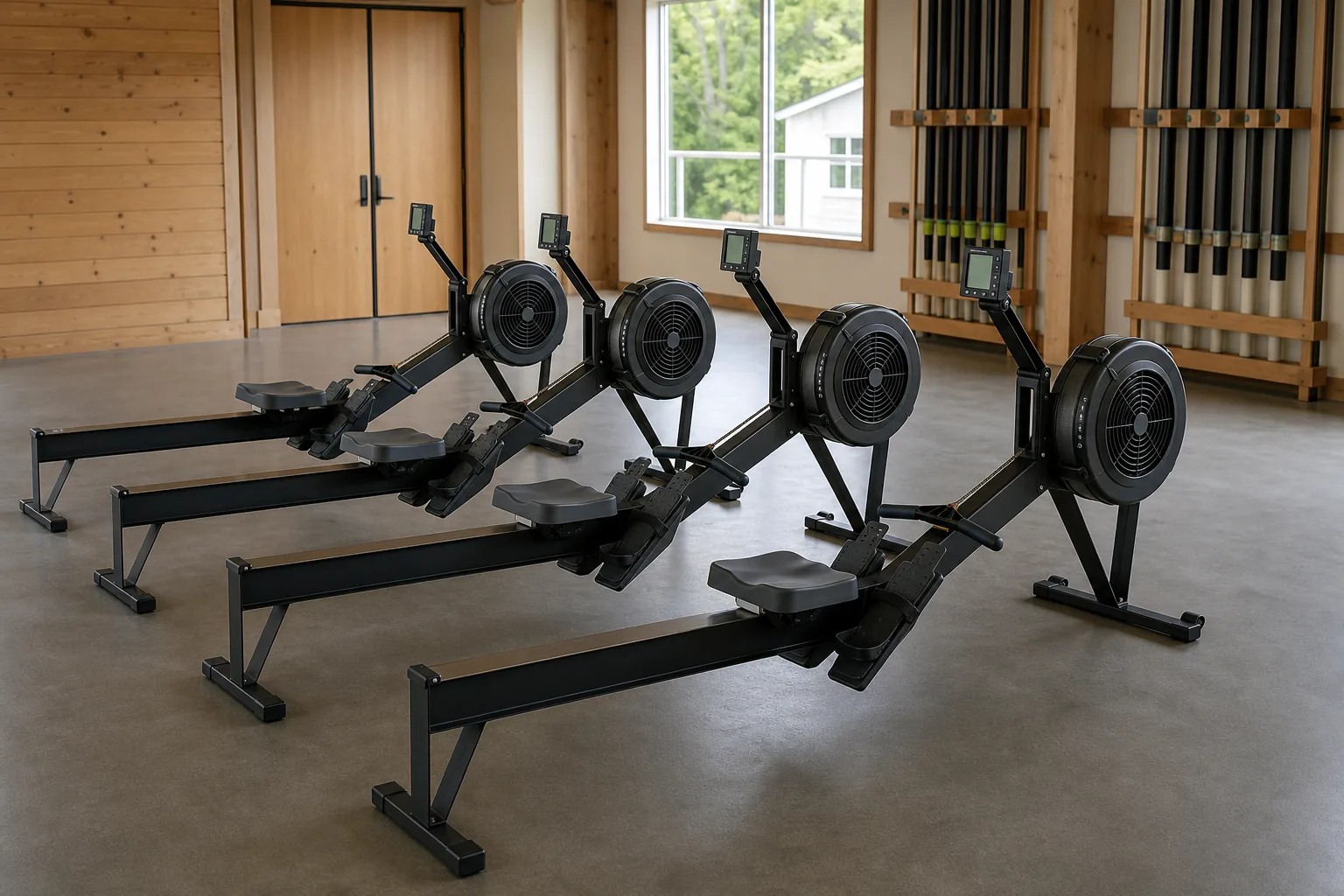
How Irish rowing clubs actually use the ergometer
The erg does three jobs in an Irish club. First, it lets the squad train when the water is unsafe or unavailable: westerlies on Lough Ree, fog at Inniscarra, flooded sections of the Erne, the lake frozen over for a fortnight, or boats out for service before the autumn season. Second, it gives coaches a controlled environment for measuring fitness through standardised test pieces (the 2k, the 5k, the 6k aerobic anchor, the 30-minute trial and the 60-minute base test are the staples). Third, it feeds crew selection alongside seat-racing and on-water timed pieces.
Erg scores belong in the squad management system, not on a spreadsheet that moves between coach laptops. Capturing every test, watching improvement over a winter block, comparing athletes against age, weight and gender standards: that is the data work that makes selection defensible at trial week. Row HQ coach tools store erg scores against each athlete profile so coaches can read fitness trajectory across the season at a glance.
The erg test pieces an Irish squad runs
Standard ergometer test pieces in competitive rowing:
- 2,000m (2k): the gold-standard fitness test and the Olympic race distance. Maximum effort. Senior openweight men typically 6:00 to 6:30, senior openweight women 7:00 to 7:30. Rowing Ireland shortlisted athletes run faster.
- 5,000m (5k): aerobic capacity test. Senior openweight athletes typically 17 to 19 minutes.
- 30 minutes: distance covered in thirty minutes at sustainable threshold pace. The classic endurance gauge.
- 60 minutes: longer aerobic test, typically rowed at UT1 or UT2 pace through a winter block.
- 4 x 2,000m or 8 x 500m intervals: race-specific power and recovery testing for Irish Champs prep.
Each test is logged with the athlete's bodyweight on the day (lighter rowers carry a power-to-weight handicap that the Concept2 weight-adjusted formula corrects for) and the drag factor the machine was set at.
Indoor rowing as a sport in its own right
Indoor rowing has grown well beyond its original role as a winter training tool for water-based athletes. The C.R.A.S.H.-B Sprints in Boston (running since 1982) is the original indoor 2k championship and still attracts over 2,000 entries annually. The Irish Indoor Rowing Championships, the British Indoor Rowing Championships at Lee Valley, the European Indoor Rowing Championships and the World Rowing Indoor Championships now run alongside the Concept2 online season challenges. Many CrossFit gyms across Ireland host their own indoor erg leagues, broadening participation well beyond rowing clubs.
Ergometer questions Irish rowers ask
Is an ergometer the same as a gym rowing machine?
Yes. In rowing, ergometer or erg is the technical name for what every gym calls a rowing machine. Competitive Irish rowers say erg almost exclusively. The wider gym market says rowing machine. The dominant make in competitive rowing is the Concept2 RowErg, which has been the trial-standard machine since the late 1980s and is the only machine used at any world championship indoor rowing event or any Rowing Ireland selection process.
What does an ergometer actually measure?
An ergometer measures the work the athlete does per stroke and converts it into a panel of readouts on the PM5 monitor: 500m split (the time it would take to cover 500m at the current rate of work), watts (instantaneous flywheel power), calories per hour, total distance, elapsed time and stroke rate. Concept2 ties split to power via watts = 2.80 / (split_seconds / 500)^3. Calories per hour is approximately watts times four plus 300 for resting metabolism. The monitor stores the workout for download later.
What is a respectable 2k erg score in Ireland?
Senior openweight men target under 7:00 for a 2k erg (1:45 split or sharper), with under 6:30 considered elite (1:37 split). Senior openweight women target under 8:00 (2:00 split), with under 7:15 considered elite (1:48 split). Junior under-19 standards are 6:30 to 7:00 for boys and 7:30 to 8:00 for girls. Masters scores need to run through age-adjusted standards before they make sense, and Rowing Ireland publishes its high-performance erg standards annually. The erg pace calculator converts any 2k to its equivalent split, watts and projected longer-distance times.
How does the erg measure distance when the machine never moves?
The erg measures distance through the flywheel. Each stroke pulls the chain, which spins the flywheel against air resistance. Sensors track how quickly the flywheel decelerates between strokes, calculate the work performed per stroke, and convert that work into metres-rowed as though the athlete were actually moving a hull through water. The drag factor (a measurement of how the flywheel decelerates) lets the monitor adjust the conversion for damper position and air density. The metres on the display are a unit of work expressed in metres-equivalent, not literal distance travelled.
What damper setting should I run on a Concept2?
Most rowers train at damper 3 to 5 on a Concept2, not 10. Damper changes how the catch feels (5 feels like a heavier boat, 1 feels like a racing single) but does not affect the score. What affects the score is the drag factor, which is shown in the More Options menu. Lightweight men typically target a drag factor of 110 to 130, heavyweight men 130 to 150, lightweight women 105 to 120, heavyweight women 120 to 135. Indoor world championship pieces are usually pulled at drag factors below 130.
Does the erg score predict on-water speed?
Loosely, and never one-for-one. The erg measures the athlete in a fixed environment. On-water speed depends on power, blade technique, hull balance, crew synchronisation, water state and steering. A faster erg score generally means a faster athlete in the boat, but the conversion is approximate. Irish coaches treat the erg score as one input alongside seat-racing, on-water timed pieces and direct coach assessment. The athlete with a strong erg and weak boat moves is a familiar profile, and so is the inverse. Selection trials almost never lean on the erg alone.
Related
Regatta: Sprint Racing on a Multi-Lane Course
A regatta is sprint racing on a buoyed multi-lane course. Crews line up side by side, the starter calls the start, and t...
The Coxswain: Steering and Race-Calling in the Stern
The coxswain is the person in the stern of an eight or coxed four driving the boat. Rudder lines in each hand, microphon...
Sculling: Two Oars, One Athlete
Sculling is the discipline of rowing where each athlete handles two oars, one in each hand. Sweep is the other disciplin...
Stroke Rate: Strokes Per Minute Cadence
Stroke rate is the cadence of strokes per minute a crew rows. Anywhere from 18 on a long base paddle on Lough Ree to 44...
From the RowHQ shop
Printable PDFs written for club rowers. Buy once, keep forever.

Learn-to-Row Starter Plan
A free 6-week introduction plan for brand-new rowers - on the water and on the erg.
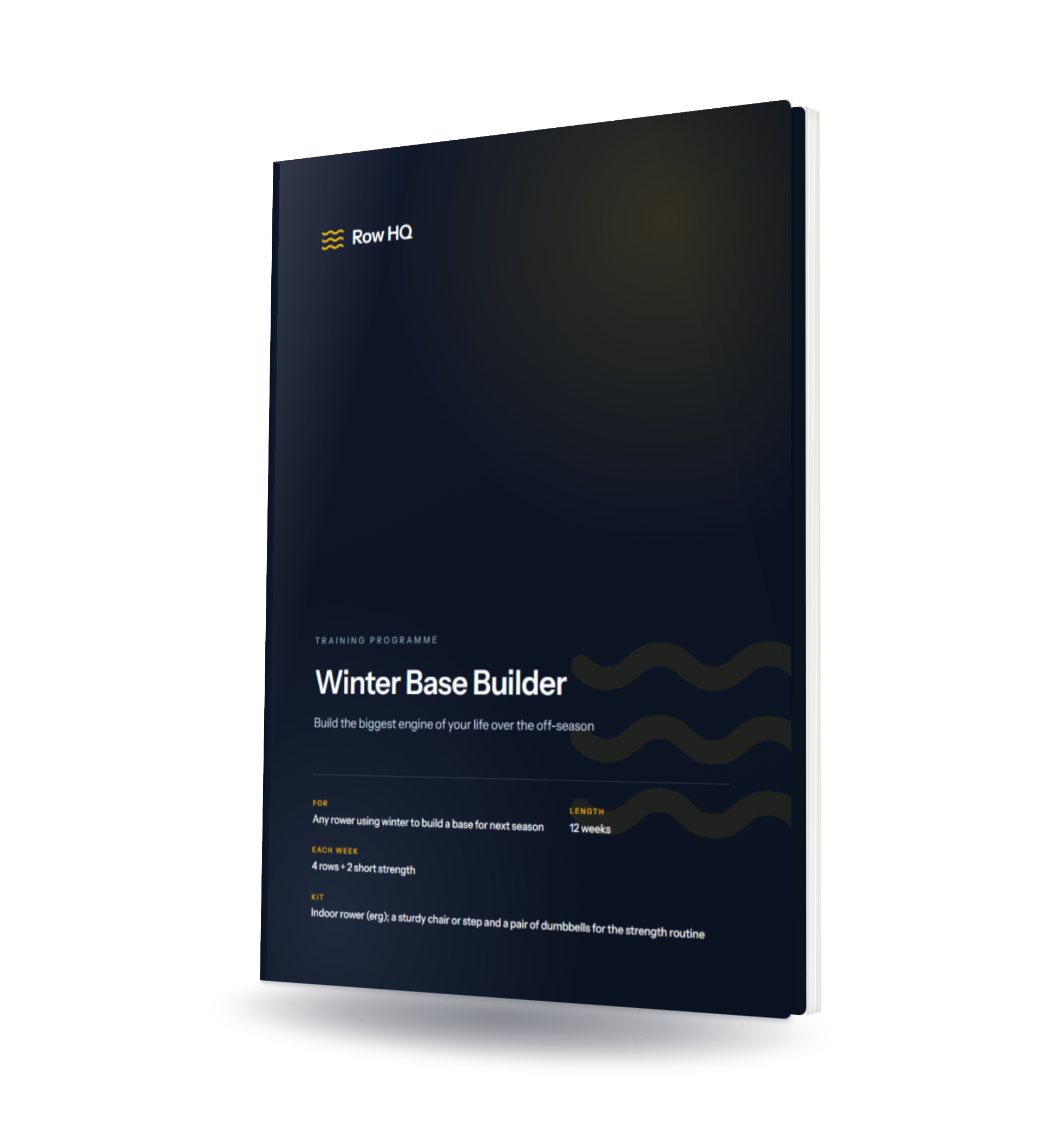
Winter Base Builder
Build the biggest engine of your life over the off-season - 12 weeks of mostly-easy volume plus a strength routine, so you arrive at spring fast.
Keep learning
Erg scores help with crew selection when coaches can compare like with like. rowing management software for Irish clubs gives clubs one place for those records. The rowing glossary covers the related language used in training and racing.
Every erg score, every athlete, one place.
Row HQ logs erg tests against every athlete profile, plots fitness trajectory across the season, and feeds the data into crew selection. Built by rowers, used at Oundle Town Rowing Club.