Concept2 Erg Tool for Irish Crews
Every Concept2 erg in an Irish boathouse reads in 500m splits, the time the PM5 monitor projects across the next half-kilometre at the current rate of work. Drop that number into the box below and the tool returns watt output, the per-hour calorie estimate that matches the screen, and projected splits across every test piece an Irish crew runs: the Olympic 2k, the 5k and 6k aerobic pieces that anchor winter testing, the long base pieces that build toward Inniscarra, and the head-race pace work that fills the autumn calendar from Castleconnell through the Erne Head.
Last updated:
A focused Concept2 converter for Irish erg testing
A one-page tool that takes the 500m split off a Concept2 monitor and returns the watt, calorie and projected-split numbers Irish programmes lean on for erg trials. The watt figure comes straight from the canonical Concept2 cubic relationship between pace and power. Long-piece projections use the Riegel endurance fade, so a sharp 2k input maps to a realistic 5k or 6k target. Skibbereen, Commercial and UCD squads lean on it through Irish Champs trial blocks, Trinity and NUIG crews calibrate to it before IURC selection, and Garda RC masters scullers use it to back out age-graded targets through the dark winter months.
Inputs
Most squad-grade efforts in Irish programmes sit between 1:25 (Rowing Ireland shortlist) and 2:30 (first session of winter trial block).
Jump to a typical squad band
Indicative bands: social masters 100-200W; trained Irish open-club and IURC squads 250-350W; Rowing Ireland shortlisted athletes routinely above 400W.
Split per 500m
Total time at this 500m split
Score predictor
These are Riegel model estimates. The exponent is an assumption about sustainable pace, not a guarantee for your next test.
| Test piece | Projected finish | Predicted 500m split time | Average watts |
|---|---|---|---|
How do split time, total time and distance fit together?
Your split time is the time for 500 metres. Multiply that split time by distance divided by 500 to get total time. For example, a 1:50 split gives 7:20 over 2,000 metres. The rowing pace calculator also converts power output into an average split using the Concept2 formula.
Enter distance in metres and total time to calculate split time. Alternatively, enter your 500m split and distance to find total time. A 500m split of 2:00 means 120 split seconds. Keep split seconds separate from total seconds when checking the formula. For intervals, calculate split time from work distance and work time only.
| 500m split time | 2,000m total time | 5,000m total time | Average watts |
|---|---|---|---|
| 1:40.0 | 6:40.0 | 16:40.0 | 350 |
| 1:50.0 | 7:20.0 | 18:20.0 | 263 |
| 2:00.0 | 8:00.0 | 20:00.0 | 203 |
| 2:10.0 | 8:40.0 | 21:40.0 | 159 |
These are calculated pace equivalents, not ability ratings. Holding a split for 500 metres does not prove you can maintain it for 5,000 metres. Total time assumes an uninterrupted piece. Rest periods belong outside the calculation.
For a printable overview, use the rowing pace chart to compare split time across distances.
For a measured longer test, try the 2k prediction calculator to allow for a change in sustainable pace.
Once you have a recent 2k result, use the training pace calculator to choose starting paces for your sessions.
Method and further reading: Concept2 pace calculator and formulas
Method behind the numbers
How do you read a 500m split time?
A 500m split time is the time needed to cover 500 metres at your current pace. Concept2 ergometer displays use this measure. A lower split time means faster rowing. At a 1:45 split time, 2,000 metres takes 7:00 if you hold the pace. Record the session average as well as individual intervals when using ergo data to track training.
Turning 500m split into watts on a Concept2 RowErg
Concept2 ties pace to power through a single cubic relation: P = 2.80 / (sec_per_500 / 500)^3. The cube on the denominator is brutal. Halve the pace number and watt output goes up by a factor of eight, which is why the climb from a 1:50 toward a 1:40 costs roughly four times the energy of the climb from a 2:00 toward a 1:50. Irish programmes that benchmark on watts (rather than leaning on split alone) spot lightweights overreaching on short pieces and openweight athletes coasting on long ones, then feed the corrected scores into the squad practice record.
Where the kcal/hr figure on the PM5 actually comes from
Concept2 monitor Calories use kcal/hr = (watts * 4) + 300 for a 175 lb reference person. The fixed term is part of that model, not your measured resting metabolism. Multiply the rate by exercise duration in hours for the session estimate. Body weight and individual efficiency affect actual calorie burn. Store the monitor value consistently in your training records.
How does the pace calculator convert split time to finish time?
Multiply the 500m split time by distance divided by 500. For a 1:50 split time, the results are 7:20 over 2k, 18:20 over 5k and 22:00 over 6k. To reverse the calculation, divide total time by distance and multiply by 500. The pace calculator shows this constant-pace result separately from the endurance prediction.
Behind the longer-distance predictor
The predictor applies T2 = T1 x (D2 / D1)^1.06. This assumes that sustainable pace changes with distance. Use a recent continuous effort as the starting result. The exponent is a model choice, and rowers differ in endurance, sprint power, technique and test conditions. Compare predictions with real results before using them as targets.
The five intensity bands an Irish programme actually runs
Rowing Ireland coach pathways and most IURC and club squads run a five-band weekly structure pegged to the 2k split. Numbers below are typical setpoints (rate, then pace offset relative to your 2k):
- UT2 - steady aerobic: rate around 18-20, sit roughly 12 to 15 seconds slower than race pace per 500.
- UT1 - firm aerobic: rate around 22-24, run about 8 to 10 seconds slower than race pace per 500.
- AT - anaerobic threshold: rate around 26-28, hold within 4 to 5 seconds of race pace per 500.
- TR - transport (race pace): rate climbs into the 30-34 band, pace lands on the 2k split itself.
- AN - anaerobic: rate above 36, splits drop below 2k pace, usually short pieces only.
Once the 2k split is locked in, every other zone falls out of it. The standard fix when the 2k is months stale is to drive a recent long aerobic piece through the predictor table, take that as the working figure, and feed it into the training pace tool to lift out the 500m splits, rates and watts a coach actually writes on the whiteboard.
Example finish times and their average 500m split
These examples translate finish times into split time. They are calculated equivalents, not rankings or selection standards. Compare results within the same distance and test conditions.
- 500m in 1:30: 1:30.0 average 500m split.
- 1,000m in 3:20: 1:40.0 average 500m split.
- 2,000m in 7:00: 1:45.0 average 500m split.
- 5,000m in 20:00: 2:00.0 average 500m split.
- 6,000m in 24:00: 2:00.0 average 500m split.
- 10,000m in 45:00: 2:15.0 average 500m split.
Use the erg score calculator to compare raw and adjusted scores. For a longer test, use the 2k prediction calculator to estimate a different-distance result. Neither tool establishes your percentile in a real ranking dataset. Irish crews should check Rowing Ireland event information and their club selection criteria.
One athlete on one erg is arithmetic. A whole squad across a winter is a system.
One split is a pocket-calculator job. A whole squad's erg history across a winter erg block, a Castleconnell head-race build and the Irish Champs taper is a database problem. Row HQ writes every score against the right athlete the moment it lands, so the coach pulls crew lineups from live data, catches a Junior 18 quietly going backwards via administrator-side dashboards, and stops trawling WhatsApp threads or last fortnight's spreadsheet to find a personal best.
Take a look at the Oundle Town RC case study for how a working club turns erg numbers into seat-racing decisions, work through the practical guide to getting actual value out of squad erg data, or step through the practice tracking features that record every split with zero coach data entry. Set that next to the shared spreadsheet routine still running in most Irish boathouses and the case writes itself.
Working out the pace is the easy bit. Keeping it is where rowing club software for Irish clubs earns its place: every split filed to the member's record, not lost in a group chat.
Frequently asked questions
So what does the 500m split number actually mean?
It is the rolling projection the PM5 monitor shows in mm:ss.t format, so a reading of 1:42.7 means one minute, forty-two seconds and seven tenths. The number forecasts the finishing time over the next half-kilometre at the current effort. Smaller number, faster boat. Irish squads anchor zones, race plans and athlete comparisons on the 500m split because it is unambiguous, repeatable across machines, and converts straight to boat speed the moment a crew pushes off at Inniscarra, Lough Ree, Lough Erne or the Lee. Programmes that capture every practice split automatically spot slumps weeks before they surface in race results.
How do I work out watts from a given 500m split?
Concept2 publishes the relationship as watt output equal to 2.80 divided by the cube of pace-seconds-per-500 normalised by 500: P = 2.80 / (sec_per_500 / 500)^3. Run the equation at 1:55 (115 seconds total): the maths gives you around 230 watts. Drop to a 1:35 (95 seconds total) and the figure climbs to roughly 408 watts. The cube term on the denominator is what hurts. Halve the pace number and watt output multiplies by eight. That is precisely why dragging the 500m split number down from 1:50 toward 1:40 is a fundamentally different ask than the climb from 2:00 toward 1:50. The tool runs the canonical equation, so the watt column reconciles cleanly with the PM5 in front of you and with the values piped into your programme's coach dashboard.
Where should an Irish rower expect a 2k erg score to land?
A useful benchmark needs a defined age group, category, season and test protocol. Compare your raw 2k result with an appropriate official ranking or your own previous tests. The examples on this page convert time and pace; they are not population percentiles or selection standards.
Translating an Olympic 2k score into a projected 6k or Inniscarra pace?
The predictor applies T2 = T1 x (D2 / D1)^1.06. It assumes a change in sustainable pace as distance increases. Use a completed continuous test as the source. The chosen exponent is a planning assumption, so check the estimate against your own results rather than applying a fixed correction for body weight.
How does the kcal/hr number on the PM5 monitor get calculated?
The monitor uses Calories per hour = 4 x average watts + 300 for a 175 lb reference person. The fixed term belongs to the model; it is not your measured resting metabolism. Multiply by rowing duration in hours to estimate session Calories. Personal calorie burn can differ.
What 5k score should an Irish squad rower be chasing?
Judge a 5k result within a defined category and test protocol. For a pace check, 20:00 means a 2:00 average 500m split, and 18:20 means 1:50. These are arithmetic examples rather than ability grades. Use a recent comparable test when setting your next target.
Where does a good 6k erg score land in Irish programmes?
A 6k contains twelve 500m segments. At a 2:00 split time, total time is 24:00; at 1:50 it is 22:00. Compare the raw result within the relevant category and keep rate restrictions or other test conditions consistent.
Companion tools in the Irish erg suite
Erg Score Percentile Tool
Compare raw, weight-adjusted and illustrative age-adjusted scores.
Training Pace Calculator
Spit out UT2, UT1, AT, TR and AN setpoints with rate windows and clean interval blocks ready to write on the boathouse whiteboard.
Rowing Pace Chart
Single-screen pace lookup across every test distance, colour-banded by intensity zone for winter training and Inniscarra prep.
2k Prediction Calculator
Back-solve a credible 2k target from a recent long aerobic test (5k, 6k, 10k, or a thirty-minute trial).
Rowing terms worth knowing
Plenty more in the Row HQ rowing glossary, including the ergometer, the rowing shell explained, sculling versus sweep, every Irish boat class from single to coxed eight, a definition of regatta, the role of the coxswain, and why catching a crab buries a crew.
From the RowHQ shop
Printable PDFs written for club rowers. Buy once, keep forever.
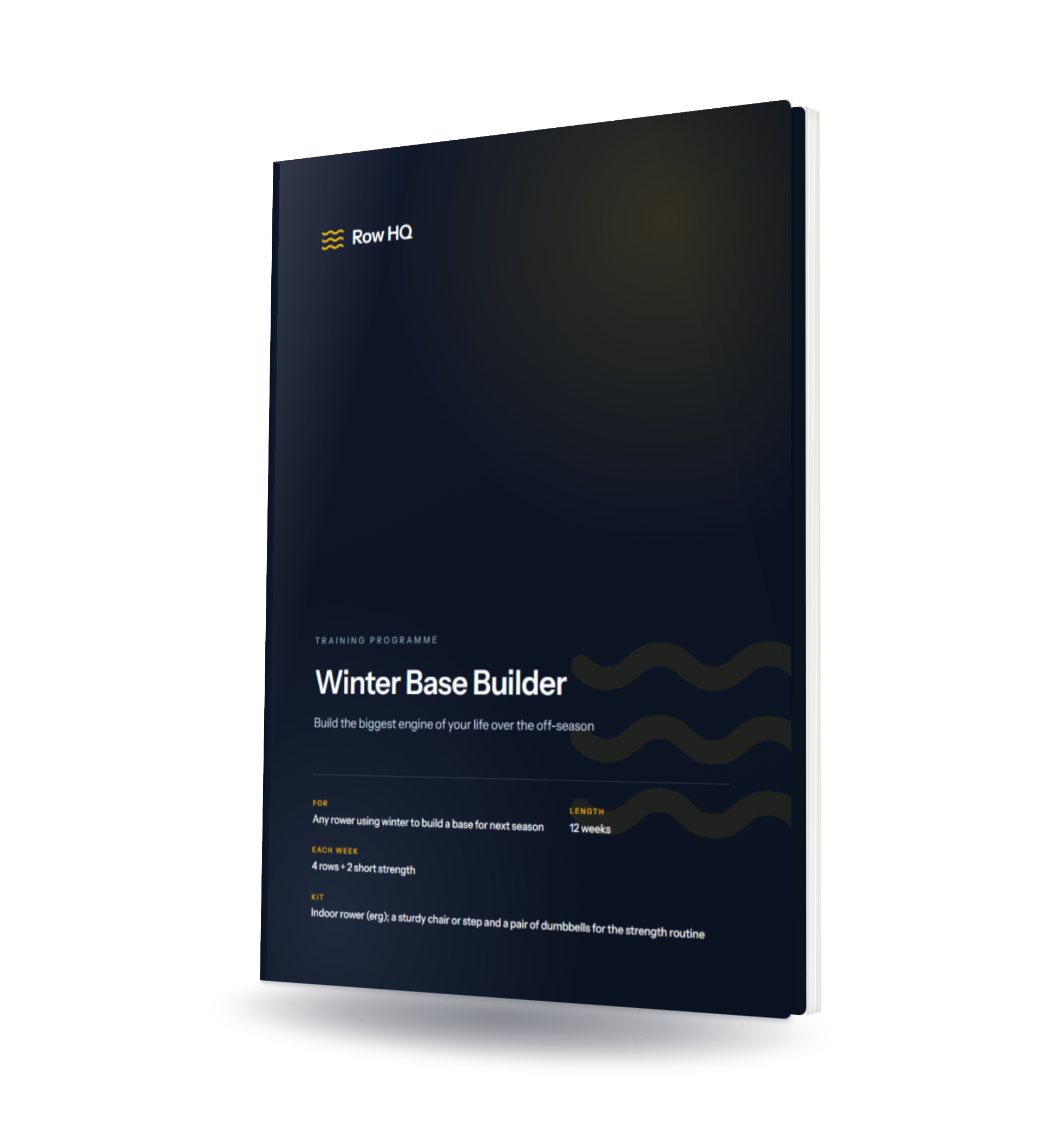
Winter Base Builder
Build the biggest engine of your life over the off-season - 12 weeks of mostly-easy volume plus a strength routine, so you arrive at spring fast.
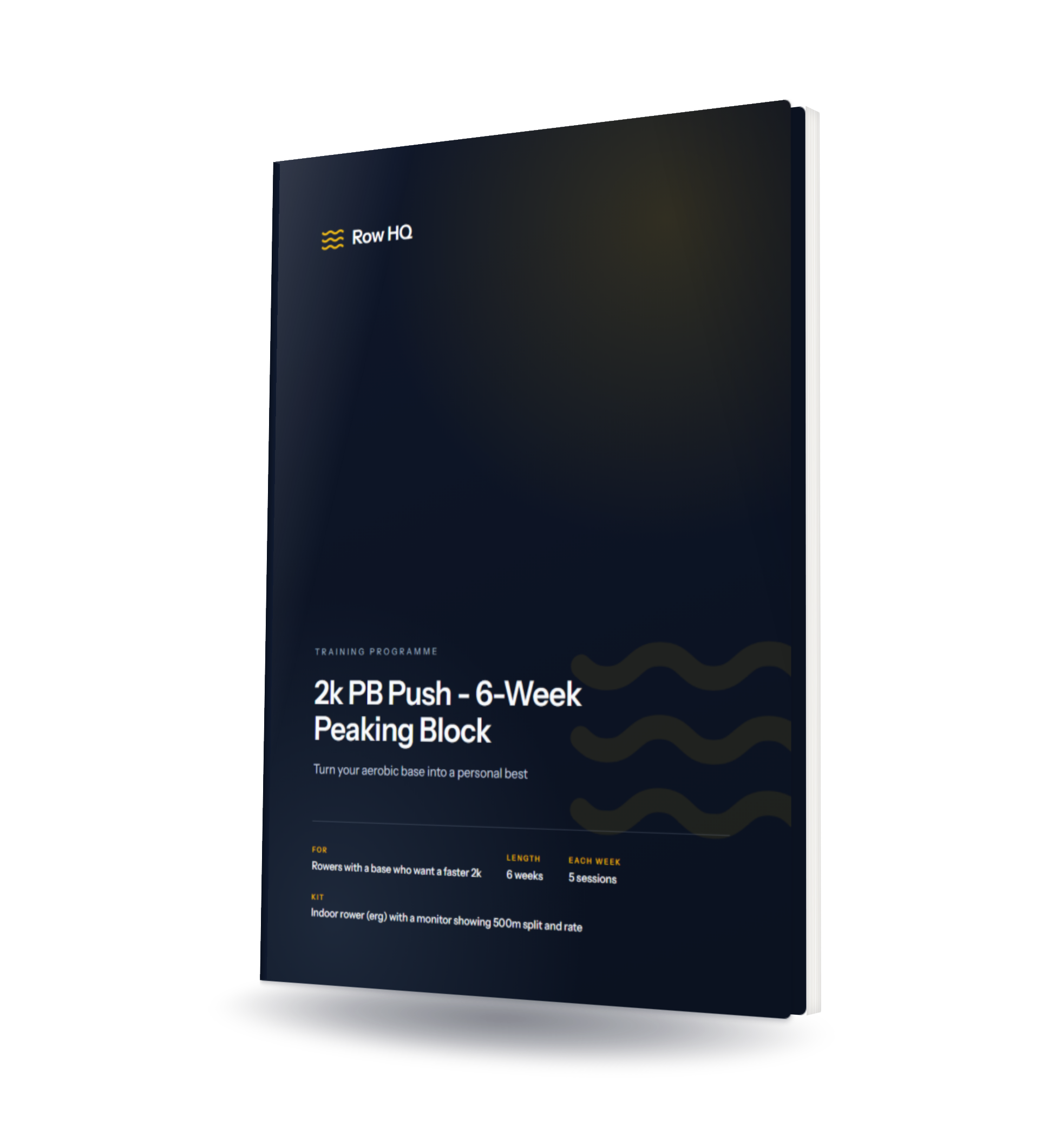
2k PB Push - 6-Week Peaking Block
Six weeks that turn an existing aerobic base into a 2k personal best - race-specific work, a proper taper, every pace scaled to your own time.
One athlete, one calculator. Thirty athletes, one Row HQ.
Row HQ stores every erg test, split and personal best next to the right athlete automatically, sized for selection nights and trend monitoring through winter erg blocks and the Irish Champs taper. Built by rowers, deployed at the OTRC flagship club.
Or jump into: practice tracking | coach toolkit | plans and pricing | common questions | replace your spreadsheets