Coxswain
The coxswain is the person in the stern of an eight or coxed four driving the boat. Rudder lines in each hand, microphone wired to the cox box, race plan in their head, eyes on the line and the field. Coxes do not row. They make every other person in the boat row faster.
The Coxswain: Steering and Race-Calling in the Stern
The coxswain is the person who sits in the stern of an eight or a coxed four steering, calling the race plan and pushing the crew. Coxes do not row. They drive the boat through the rudder lines, run the race tactics from inside the boat, and the live conditions through the cox box microphone. Essential in the eight (8+) and the coxed four (4+). In Irish rowing the cox is often the difference at the TCD vs UCD Colours Race on the Liffey and at the Irish Champs A-finals at Inniscarra.
Also called: Cox, Cox'n
What a cox actually does in the boat
Three jobs running in parallel every second the boat is on the water: steer the line, run the tactics, push the crew.
Steering is the constant background task. Rudder lines run from each of the cox's hands to a small rudder under the stern. Good Irish coxes hold a line with almost invisible rudder use, because dragging the rudder back and forth pulls the boat sideways and scrubs hull speed. On a winding river course like the Liffey through Islandbridge, or the lower Lee through Cork city, or a strong-current head race on the Erne, a clean line is the difference between a winning time and a slow one.
Tactics are what separate an experienced cox from a Junior 14 on their first race day. The cox carries the race plan, knows when to call the move, watches the rate, watches the field, watches the wind and the chop, and pulls the trigger on each phase shift. In a 2k race that takes six minutes, the cox is the only person not gasping for air and the only one with a complete view of the situation.
Voice and feedback happen between every stroke. Rhythm calls, technical cues for individual rowers ("bow seat sharper at the catch"), morale calls when the boat starts to come apart through the third 500m at Inniscarra. The best Irish coxes know each rower's temperament and pitch the tone to the person. The bow seat at UCD who needs quiet precision is a different rower from the four seat who needs a roar.
Cox weight: check the rules for your Irish event
Cox weight is real. Every kilogram the cox is over the minimum is a kilogram the rowers push through the water for the full race. The minimums exist to stop crews stacking lighter coxes for an unfair edge.
British Rowing requires 55 kg for all crews except J15 and younger crews, where the minimum is 45 kg. Its 2025 rules remain unchanged for 2026. See rule 7-2-7. These figures do not establish local rules in other countries.
USRowing sets 120 lb for men's and mixed crews and 110 lb for women's crews. Required deadweight stays close to the cox's torso in the boat throughout the race. See the current Rules of Rowing. The youth weigh-in exemption concerns USRowing-hosted youth regattas; check your event packet.
Check the governing rules for your actual event. British Rowing and USRowing figures are examples, not local rules for this country. Ask your coach to confirm the minimum, any exemption and the accepted ballast arrangement before racing.
The cox box: voice, rate and split in one unit
The cox box is the cox's electronics rack. Voice amplifier driving speakers along the spine of the hull, stroke-rate counter reading off a magnetic switch on the stroke seat, interval timer, and on GPS units a live readout of boat speed and 500m split.
Standard fit at Irish clubs is the NK CoxBox, used everywhere from Commercial RC and Garda RC to Trinity, UCD, NUIG and UCC. Senior squads at Skibbereen and the National Rowing Centre often run the Active Tools Empower Oarlock system on top, which adds per-oar force-curve data the coach reviews after the outing. Coxmate GPS is the next most common unit, particularly in junior and masters programmes.
In training, the cox uses the readouts to call precise rate moves ("up two for the next twenty"), report 500m splits mid-piece, and timestamp drills. In a race, the rate display confirms the crew has actually responded to a call (lots of crews lift the cadence in their heads without lifting the actual rate), and the timer anchors each phase of the race plan against the elapsed clock.
Which Irish boat classes carry a cox?
Different boat classes steer differently:
- Eight (8+): always coxed. There is no coxless eight in standard competition.
- Coxed four (4+): cox in the stern or the bow. Bow-loaded coxed fours give the cox a clearer sightline on a winding course like the lower Lagan or the Garavogue.
- Coxless four (4-): foot-steering. One rower has a shoe on a pivot wired to the rudder. A small heel movement steers the boat.
- Pair (2-): coxless. One of the two rowers steers with the foot.
- Quad (4x), double (2x), single (1x): all coxless. Sculling boats steer with foot-pedals, except for the single, which has no rudder at all and steers by varying pressure between the two blades.
For the boats that do carry a cox, the gap in race quality between a sharp cox and a weak one is enormous. Crew planning at most Irish clubs comes down to matching the most capable available cox to the boat that needs them most, then working back from there.
How to become a cox in Ireland
Almost every Irish cox starts by accident. A coach notices a smaller, confident person at a club open day, a school programme or a Rowing Ireland talent ID session and asks if they want to try the seat. The first session is usually shadowing an experienced cox on a steady outing, getting a feel for the boat and the rudder. From there it is repetition. Calling drills, sitting through dozens of outings, learning what each rower in the boat sounds like when they are tired.
Formal pathways in Ireland:
- Rowing Ireland: club-level cox induction covering steering, safety commands, emergency procedures and basic race calling. Required at affiliated clubs before a cox runs a race-day boat.
- University and school programmes: TCD BC, UCD BC, the Skibbereen Rowing Club junior pathway, and most school programmes run their own internal cox induction alongside the Rowing Ireland framework.
- Club mentorship: most Irish clubs pair a new cox with an experienced one for the first season. By a long way the fastest practical development route, and the one that builds the local knowledge a Rowing Ireland module cannot.
The shortcut to becoming a useful cox is the same in every boathouse: take every outing you can get. Fifty outings in a year and you will know how the boat moves under different wind and water. Irish clubs are almost always short of coxes, so a committed learner gets water time quickly. See the crew selection guide for how coaches plan crews around the cox pool they have.
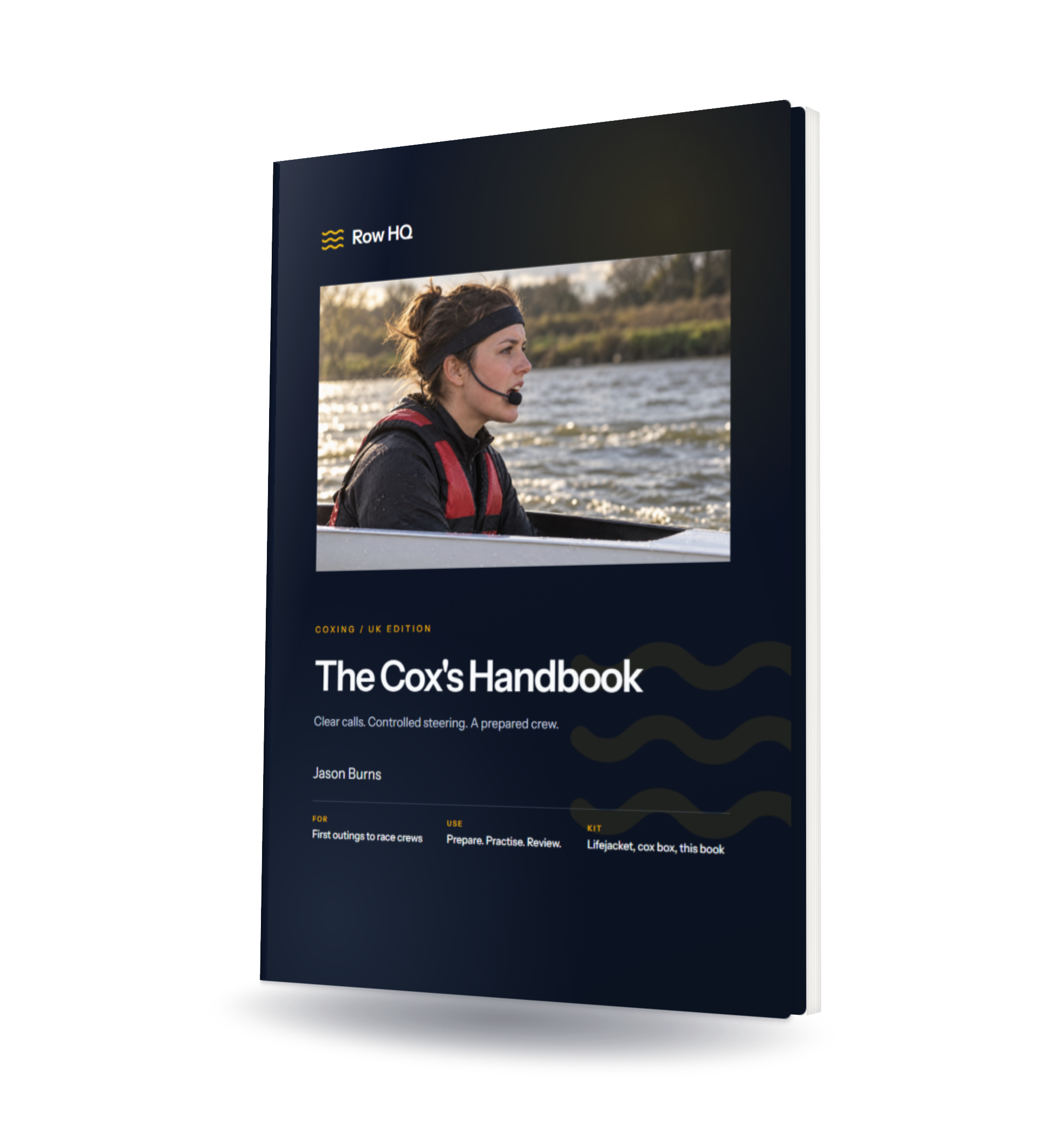
Taking the seat for the first time? Our coxing guide for first-time coxswains covers the calls, steering and kit before you leave the slip.
pages/glossary/coxswain.body.college.heading
pages/glossary/coxswain.body.college.intro_html
pages/glossary/coxswain.body.college.ira_html
pages/glossary/coxswain.body.college.high_school_html
pages/glossary/coxswain.body.college.roles_html
pages/glossary/coxswain.body.certifications.heading
pages/glossary/coxswain.body.certifications.intro_html
- pages/glossary/coxswain.body.certifications.safety_html
- pages/glossary/coxswain.body.certifications.coxswain_series_html
- pages/glossary/coxswain.body.certifications.safe_sport_html
pages/glossary/coxswain.body.certifications.reality
Famous coxes in international and Irish rowing
The most decorated cox in Olympic history is Garry Herbert (Great Britain), who steered the gold-medal coxed pair of Greg and Jonny Searle at Barcelona 1992, one of the most emotional Olympic finishes ever broadcast. Mary Whipple (United States) coxed the US women's eight to back-to-back Olympic golds in 2008 and 2012 and is the touchstone reference for modern race-day coxing. Pete Cipollone coxed the US men's eight to Athens 2004 gold. Closer to home, the TCD versus UCD Colours Race on the Liffey has produced cox performances that become Irish rowing folklore, and the Trinity boathouse keeps a quiet cabinet of cox-specific memorabilia for the standout calls.
pages/glossary/coxswain.body.rowhq.heading
pages/glossary/coxswain.body.rowhq.intro_html
pages/glossary/coxswain.body.rowhq.training_html
pages/glossary/coxswain.body.rowhq.portal_html
Get the free Cox Calls Sheet
Coxswain FAQs
What does a coxswain do?
A cox has three jobs running in parallel: steer the line through the rudder, run the race tactics from inside the boat, and push the crew through the rough patches with calls pitched to each rower. Training outings add a fourth: lead the warm-up, call drills, and feed back to the coach what the boat felt like.
How heavy should a coxswain be?
Your event's published rules set the minimum, including any junior exemptions. Confirm them with the organiser and coach. Do not assume World Rowing, British Rowing or USRowing rules apply automatically. A lighter cox carries accepted deadweight only where the governing rules require it. Check weighing, certification and ballast placement before race day.
Do coxswains row?
No. The cox steers, calls and runs tactics. The rowers move the boat. Some coxes train in a single or pair to understand technique from the rower's seat, but they do not pull an oar in a coxed boat. This is the line between coxed boats (8+ and 4+) and coxless boats (4-, 2-, quad, double, single), where a rower steers with a foot-pivot.
What does a cox box do?
A cox box is the electronics unit that pushes the cox's voice through the boat speakers, counts stroke rate live from a magnetic switch on the stroke seat, and times the session. GPS-enabled models add boat speed, 500m split and distance. NK CoxBox is the standard at every Irish university and senior club.
Which boats need a coxswain?
The eight (8+) is always coxed. The coxed four (4+) carries a cox in bow or stern. Everything else, the coxless four (4-), the pair (2-), the quad scull (4x), the double scull (2x) and the single scull (1x), is coxless and steered by a rower's foot-pivot.
How do you become a coxswain?
Most Irish coxes start when a coach notices a smaller, confident person at a club open day or school programme and suggests the cox seat. The first step is a Rowing Ireland-aligned club induction covering steering, commands, safety and emergencies. After that it is repetition: shadow an experienced cox, call drills, build a race-call vocabulary. Irish clubs are perpetually short of coxes, so a committed learner gets water time fast.
Related
Regatta: Sprint Racing on a Multi-Lane Course
A regatta is sprint racing on a buoyed multi-lane course. Crews line up side by side, the starter calls the start, and t...
The Ergometer: Concept2 in an Irish Boathouse
An ergometer is an indoor rowing machine that measures the power an athlete produces per stroke. The Concept2 RowErg is...
Racing Shell: The Imported Carbon Hull
Every racing shell in Ireland was built somewhere else. Empacher in Germany, Filippi in Italy, Hudson in Canada, Sykes i...
The Eight Standard Racing Boat Classes
Every World Rowing event lines up in one of eight standard racing classes. Four sculling (1x, 2x, 4x, 8x) where each row...
Sculling: Two Oars, One Athlete
Sculling is the discipline of rowing where each athlete handles two oars, one in each hand. Sweep is the other disciplin...
Catching a Crab: The Stuck-Blade Failure
A crab is a blade-stuck failure. The oar locks in the water, the hull keeps moving, and the handle gets driven backwards...
The Cox Box: Voice Amp, Rate Counter, GPS Display
A cox box is the electronic unit a cox uses to push voice through the boat speakers, count stroke rate live off a magnet...
Stroke Rate: Strokes Per Minute Cadence
Stroke rate is the cadence of strokes per minute a crew rows. Anywhere from 18 on a long base paddle on Lough Ree to 44...
From the RowHQ shop
Printable PDFs written for club rowers. Buy once, keep forever.
Keep learning
Before a crew pushes off, the cox needs to know the boat, rowers and work for the session. Record that outing in club management software for rowing clubs, so the same plan reaches everyone. Read the rowing glossary for more terms heard on the water.
Coxes deserve better than a WhatsApp group.
Row HQ tells a cox which crew they are with, what the session plan is and where to be, automatically, before they leave the house. Built by rowers, deployed at Oundle Town Rowing Club.