Scull
Sculling is the discipline of rowing where each athlete handles two oars, one in each hand. Sweep is the other discipline, where each athlete handles one oar with both hands. Sculling has been the engine of Ireland's Olympic rowing success: every Irish Olympic rowing medal has come in a sculling boat, every one of those in the LM2x, every one of those through Skibbereen Rowing Club. Four sculling classes exist (1x, 2x, 4x, 8x), and they are the boats most Irish novices learn the sport in.
Sculling: Two Oars, One Athlete
Sculling is the discipline of rowing in which every athlete uses two oars, one in each hand. The opposite discipline is sweep rowing, where each athlete uses a single oar held with both hands. The four sculling boat classes are the single (1x), double (2x), quadruple (4x) and octuple (8x). Sculling is the discipline that delivered Ireland's most successful Olympic rowing programme through Skibbereen RC: silver at Rio 2016 (Paul and Gary O'Donovan, LM2x), gold at Tokyo 2020 and gold again at Paris 2024 (Paul O'Donovan and Fintan McCarthy, LM2x).
Also called: Sculling, Sculling Oar, Scull Boat
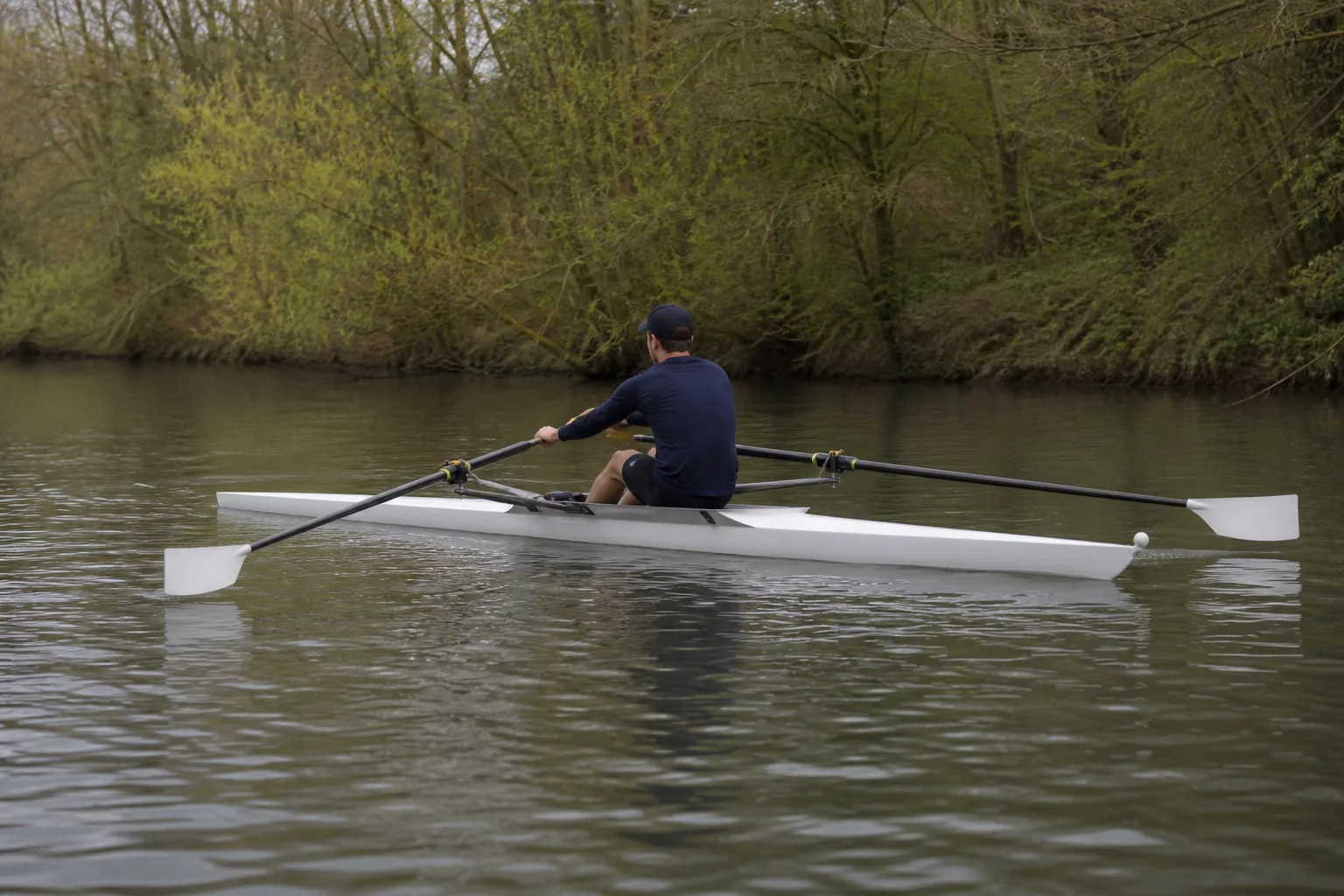
The two disciplines that make up rowing
Rowing splits neatly into two disciplines. In sculling, every athlete in the boat carries two oars. In sweep, every athlete carries one oar with both hands, alternating which side of the hull they pull on down the length of the boat. Both disciplines race at every level of the sport, from the Olympics and World Championships down to club fixtures. The Irish racing calendar runs through the Cork Regatta Head and Erne Head in the autumn, the Irish Indoor Rowing Championships through the winter, the regional regattas in spring, and culminates at the Irish Rowing Championships at the National Rowing Centre at Inniscarra each July.
Symmetry is the mechanical headline. Sculling loads the body evenly on both sides through every stroke. Sweep commits the athlete to one side and the body adapts to that asymmetric loading over years. The rigging follows the mechanics. Sculling hulls run a rigger each side per rower, sweep hulls run alternating riggers along the gunwale. The full breakdown of hull and rigging geometry is in the rowing shell entry.
The four sculling boat classes
- Single scull (1x): 8.2m, one rower, two oars. The cleanest technique mirror in the sport because every flaw shows up immediately as a wobble. Paul O'Donovan won the world title in this class at Sarasota in 2017.
- Double scull (2x): 9.8m, two rowers each with two oars. Standard step-up boat from the single, and an Olympic event in its own right. The LM2x is Ireland's Olympic gold medal class from Tokyo 2020 (Paul O'Donovan and Fintan McCarthy) and Paris 2024, and the silver medal class from Rio 2016 (Paul and Gary O'Donovan).
- Quadruple scull (4x): 12.5m, four rowers each with two oars. Usually abbreviated "quad". Fast crew boat. Coxless at senior level.
- Octuple scull (8x): 17m, eight rowers each with two oars, plus a coxswain. Junior, masters and developmental class only. Not an Olympic event.
Sculling hulls are typically narrower than the matching sweep hulls because the symmetric oar load needs less width to balance against. A double is faster than a pair, a quad is faster than a coxless four, because two oars per rower puts more power into the water than one oar per rower can.
Sculling oars: anatomy and dimensions
A standard scull is 285cm to 290cm long. Every oar has the same parts: a handle at the rower's end, a hollow carbon shaft, a sleeve and collar where the oar sits in the swivel, and a blade at the water end. Concept2, Croker, Braca, Apex and Dreissigacker are the manufacturers Irish clubs source from, all through European or UK dealers. Blade shape varies. The Macon (the original tulip shape, mostly historical now), the Big Blade (the dominant modern shape), the Vortex (with ridges on the back to grip the water) all suit slightly different rowing styles.
A pair of sculls weighs around 1.6kg, so the rower handles about 3.2kg of total oar mass through every stroke. Inboard length (handle to oarlock) is adjustable by sliding the button along the sleeve, which lets a club fit one set of oars to athletes of different height without buying separate equipment for each squad member.
Why most Irish rowers learn to scull first
Junior squads, learn-to-row courses and university freshers' weeks across Ireland almost always put novices in sculling boats. Three reasons line up to explain why.
Balance is the first reason. Two oars give the rower an automatic correction mechanism: too much weight to one side, push harder on the opposite oar to right the boat. Beginners pick up balance in a single or a double far faster than they ever do in a pair or a four.
Symmetric body work is the second reason. The torso rotates equally to both sides through every stroke, so technique faults show up plainly and are easy to coach out. Sweep rowing builds side-specific habits, and habits learned wrong in the first six months can take years of follow-up coaching to clear.
Solo training is the third reason, and the practical one. A single scull is a one-person boat. The athlete can take it out any time the river or the lake is clear, no crew assembly needed. Sweep boats need four or eight to launch plus a cox for the coxed classes, so timetable friction is much higher. "I can take the boat out this evening on my own" is what carries a new rower at Garda RC, Neptune, NUIG or UCC through their first six months.
How Irish clubs structure sculling pathways
Most Irish club sculling pathways run a recognisable sequence. Novice course in wide-beam tubs (deliberately stable, almost impossible to capsize), then a graduation onto club-level singles and doubles, then quads as crew rowing develops, and finally specialisation into single sculling for the athletes who want to chase it competitively. Skibbereen RC is the high-end version of this pathway. Three consecutive Olympic Games of LM2x medals out of a small club in West Cork is the empirical proof. Session scheduling matters more in sculling than in sweep because singles and doubles training is largely individual: athletes book the boat, the timeslot and the safety boat coverage themselves rather than being assigned to a fixed crew on a fixed outing.
Coaches running a sculling pathway need to track which athletes are progressing through which boats, who has completed the Rowing Ireland capsize drill and water safety quals, and who is cleared for what. All of that lives in Row HQ's coach tools. Pair it with boat booking and the right athlete is in the right boat at the right time without the coach having to spend Friday evening cross-referencing three spreadsheets and a club WhatsApp thread.
Sculling questions Irish rowers ask
Sculling and rowing, are they the same thing?
Sculling is one of the two disciplines that make up the umbrella sport of rowing. The other is sweep. The defining difference is oar count per athlete: two in sculling (one in each hand), one in sweep (both hands on a single oar). Sculling boats are the single (1x), double (2x), quadruple (4x) and octuple (8x). Sweep boats are the coxless pair (2-), four (4-, 4+) and eight (8+). Almost every Irish novice learns to scull first because the symmetric balance feedback makes the first six months less brutal. Ireland's three Olympic rowing golds and one silver have all come in sculling boats, all in the lightweight men's double, all through Skibbereen RC.
Mechanically, what changes between sculling and sweep?
The rig and the body. A sculling boat is rigged symmetrically with both oars at the same height and pitch on either side of the hull, and the rower sits on the centreline. A sweep boat is rigged asymmetrically with the rower's seat offset toward the rigger side. The body work differs. Sculling rotates the torso equally to both sides through the stroke, so the spine loads evenly. Sweep commits to a side, so the torso rotates one way every catch and the body adapts to that asymmetric load over years of training. Sculling is generally easier to learn because the balance corrects itself. Sweep is harder to start but offers a different rhythm once the technique locks in.
Which boat classes use sculls?
Four. The single (1x) carries one rower with two oars. The double (2x) carries two rowers with four oars between them. The quad (4x) carries four rowers with eight oars between them. The octuple (8x) carries eight rowers with sixteen oars between them, plus a coxswain, and is restricted to Junior and masters racing. Sculling hulls are typically narrower than the equivalent sweep hulls because the symmetric oar load needs less width to balance. Ireland's Olympic sculling medals have all come in the LM2x: silver at Rio 2016 (O'Donovan brothers), gold at Tokyo 2020 and gold at Paris 2024 (Paul O'Donovan with Fintan McCarthy).
How long is a sculling oar?
A standard scull comes in around 285cm to 290cm. That is about 30cm shorter than a sweep oar (370cm to 376cm) because the arc each scull travels through is smaller and the outboard load on the body is lower. Concept2, Croker, Braca and Apex are the main manufacturers Irish clubs source from. The inboard length (handle to oarlock) is adjustable via the button on the sleeve so a club can rig the same set of oars for athletes of different height. Blade shapes (Macon, Big Blade, Vortex, Comp, Apex) all suit slightly different rowing styles and water conditions.
Should a beginner start in sculling or sweep?
Sculling. The view across Irish coaching is more or less unanimous. Two oars give the beginner instant feedback if they are pulling harder on one side, because the boat reacts immediately. Sweep commits the athlete to one side, and side-specific technique faults developed in the first six months can take years to undo if learned wrong. Junior programmes at Skibbereen, Neptune, NUIG and UCC typically scull-only for the first eighteen months before introducing sweep. Singles and doubles are the standard learn-to-row platforms in almost every Irish boathouse.
What does 'feathering a scull' mean?
Feathering is the wrist rotation that turns the blade flat to the water during the recovery (the part of the stroke when the blade is out of the water and the rower is moving back to the catch). Flat blades reduce wind resistance and stop the blade catching the surface on choppy water. The rower turns the handle with the fingers as the hand comes away from the body, then squares the blade (rotates it back to vertical) just before the next catch. In sculling each hand feathers independently, which is one reason sculling rewards good wrist mobility and clean handle work. Beginners are commonly taught square-blade rowing first so they learn the catch without the extra rotation.
Related
Racing Shell: The Imported Carbon Hull
Every racing shell in Ireland was built somewhere else. Empacher in Germany, Filippi in Italy, Hudson in Canada, Sykes i...
The Eight Standard Racing Boat Classes
Every World Rowing event lines up in one of eight standard racing classes. Four sculling (1x, 2x, 4x, 8x) where each row...
The Coxswain: Steering and Race-Calling in the Stern
The coxswain is the person in the stern of an eight or coxed four driving the boat. Rudder lines in each hand, microphon...
Regatta: Sprint Racing on a Multi-Lane Course
A regatta is sprint racing on a buoyed multi-lane course. Crews line up side by side, the starter calls the start, and t...
Catching a Crab: The Stuck-Blade Failure
A crab is a blade-stuck failure. The oar locks in the water, the hull keeps moving, and the handle gets driven backwards...
Feathering: The Quarter-Turn That Lays the Blade Flat
Feathering is the quarter-turn wrist roll that lays the blade flat to the water between strokes. Square in the water on...
From the RowHQ shop
Printable PDFs written for club rowers. Buy once, keep forever.
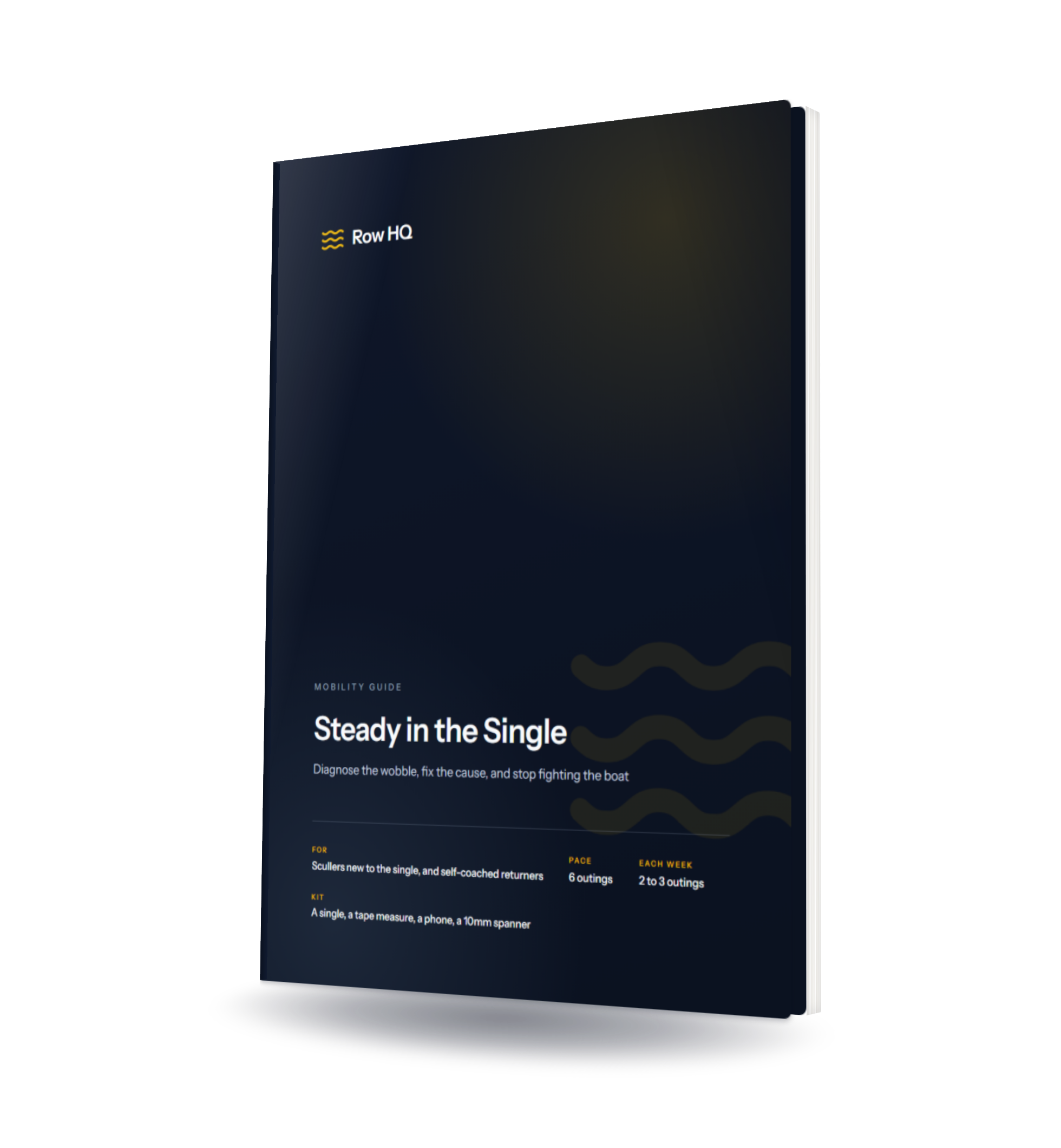
Steady in the Single
Why you cannot balance a single, diagnosed properly - find out when in the stroke the boat goes down, check whether the rigging is doing it, then drill the actual cause.
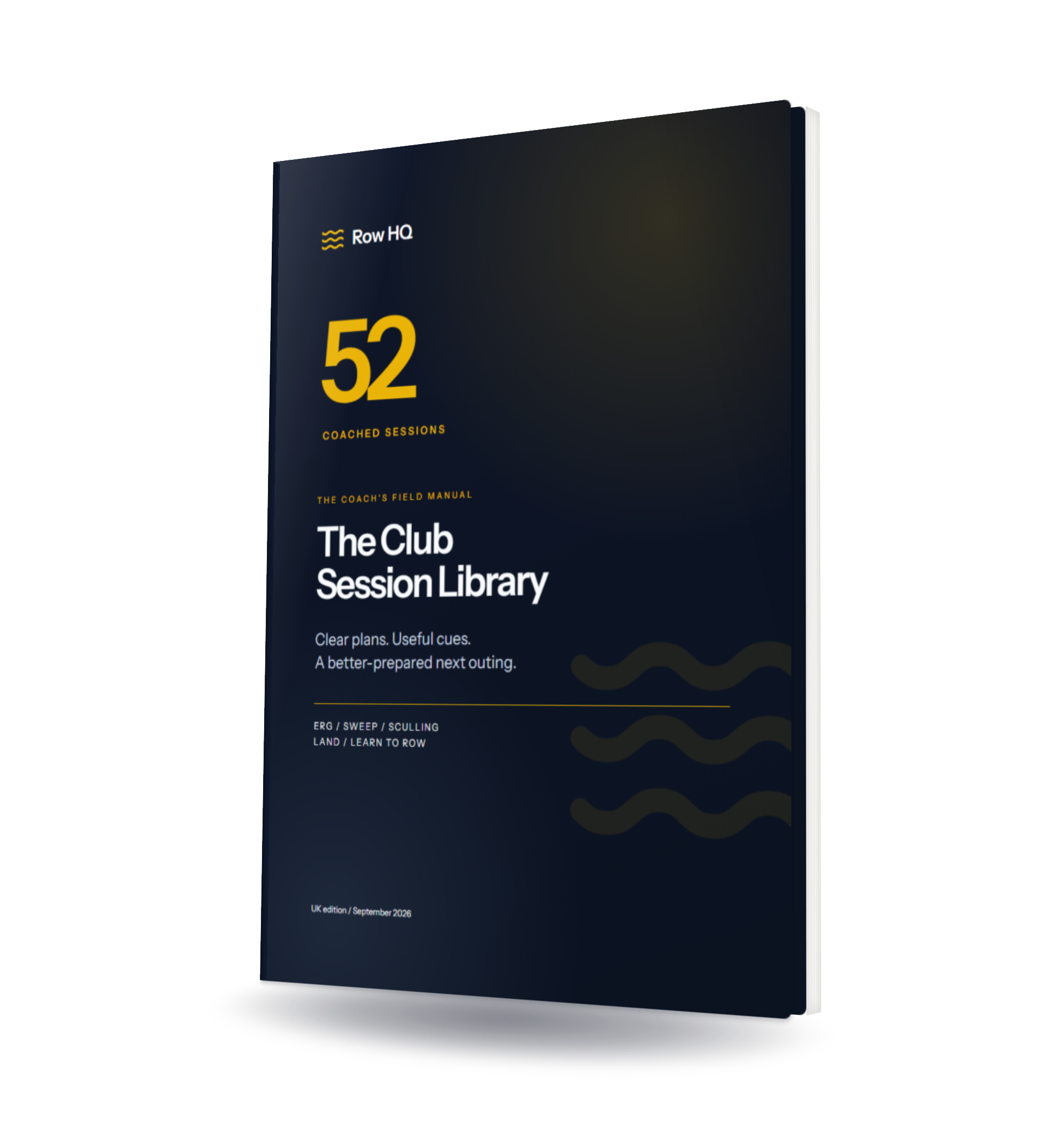
The Club Session Library
52 rowing sessions for club coaches, with an illustrated coaching PDF, editable CSV plans, two seasonal blocks and a printable coaching cheat sheet.
Keep learning
Scullers build confidence by moving into narrower boats only when their balance and safety skills are ready. Clubs can record those permissions through rowing management software for Irish clubs and keep bookings tied to the right rower. The rowing glossary covers the other terms used on the river and at regattas.
Run sculling sessions without the spreadsheet.
Row HQ handles boat bookings, sculling sign-out, safety boat coverage and athlete qualifications in one place. Built by rowers, used at Oundle Town Rowing Club.