The honest answer in 30 seconds
Lineup planning should take fifteen minutes a session, no more. Most Irish clubs lose far more than that because they rebuild from scratch every week. The fix is a six-step routine that compounds: lock availability before you plan, group rowers by weight class and side preference, match crews to the boats sitting in the shed rather than the other way round, reuse lineups that worked, push the result out at a fixed time the night before, and write down what happened. Do it privately, never on the slip with the squad watching. Software that stores saved lineups compresses the routine. A notebook still works at a small Cork or Galway club.
Lineup planning eats hours every week at most Irish rowing clubs. It does not have to. The job itself is genuinely tangled: availability, technical ability, weight class, side preference and crew chemistry all need matching to a finite fleet of boats on the Lee, the Shannon, Lough Erne or down at Inniscarra. The process around the job can be compressed to a repeatable six-step routine that runs under fifteen minutes per session once it is in place.
The six-step crew organisation method
The pattern below works across most Irish clubs. The principles hold whether you have eight rowers or two hundred. Time saved scales with club size, and the routine compounds across a season.
Step 1 - Capture availability before you start
The single biggest delay in selection is not knowing who is available. Start by chasing replies and you have lost the first half-hour already. Treat availability as something the membership owns and that you collect.
Push outing calls out at least a week in advance. Require an active confirmation - a tap, a click, a one-word reply that means yes. Treat anyone who has not confirmed by 24 hours before the session as unavailable. The rule sounds strict; in practice it cleans up confirmation behaviour inside two weeks because rowers learn that ambiguity costs them their seat in the boat.
The reverse pattern - assume everyone is in unless they opt out - puts the work back on the coach to chase. It does not scale. Active confirmation scales naturally because every rower owns their own status.
Step 2 - Group rowers by category
Once the confirmed list is in, sort it. The categories that carry weight at most Irish rowing clubs are:
- Weight class - lightweight or heavyweight. Some clubs add a middle band for J18 selection.
- Side preference - bow side, stroke side, or bilateral. Bilateral rowers are gold dust at any small Irish club running one or two boats per category.
- Experience level - novice, intermediate, senior. This maps to your boat access policy.
- Erg score band - if you use performance criteria for any of your boats.
- Sweep or sculling - relevant at clubs running both disciplines.
Most clubs settle on five or six categories that combine in predictable ways. A senior heavyweight bilateral sculler is usable in nearly any boat. A novice lightweight bow-side sweep rower has fewer options. Knowing the matrix in advance flips selection from a creative problem into a constraint-matching one. IURC programmes work the same way - the Trinity Colours Race lineup logic versus a UCD selection sheet looks different on the surface but the constraint-matching engine underneath is identical.
Step 3 - Match crews to available boats
Every boat carries constraints: weight limit, novice access, maintenance status. List your available boats first with their constraints, then fit crews to them. Pick the crew first and the boat second and you hit the boat-shuffle problem - two coaches simultaneously wanting the same eight for different squads. At a small Galway or Cork club running maybe one boat per category, this is where the planning either works or breaks.
Leave one fewer crew than you think you need. A late dropout, a rib injury, a boat back from repair later than promised - one of these will always show up. A spare boat is a buffer. An overcommitted fleet is a problem on the slip on Saturday morning.
Step 4 - Assign seats with deliberate pairings
Within a crew, who sits where matters more than most coaches admit. The bow-stroke partnership in a four sets the rhythm for the whole boat. The middle pair in an eight is the engine room. Two rowers who work well together in a pair will usually work well in larger boats. Two who clash will keep clashing.
Use what you already know. If a four with a particular pairing rowed strongly before Irish Champs, open the next four from that lineup and only change the seats that need changing because of availability. This is the saved-lineup principle, and it is what makes selection compound across a season rather than starting from scratch every week. Coach tools that store saved lineups make this trivial. Doing it from memory or paper notes works but relies on one person's recall.
Step 5 - Send the lineup once it is final
Pick a fixed time the night before. Seven in the evening, nine in the evening - whatever fits your squad rhythm. Send the final lineup at that time and not earlier. Multiple updates as you negotiate the last seats erode trust and double the messaging load. The squad learns to ignore early versions because they always change.
Lock the lineup once it has gone out. The single exception is a genuine emergency - an injury reported that morning, a boat back damaged from the previous outing. For everything else, the lineup is the lineup. This discipline prevents hours of last-minute changes that cascade into other problems.
Step 6 - Record what worked
After the outing, take five minutes. Which pairings clicked. Which boat behaved well. Anything that went wrong. Save the lineup so it becomes the baseline next week. Most clubs skip this step and pay for it every week by rebuilding from scratch.
The compound effect across a full season is significant. By week eight you have a library of working lineups for different weather windows, different category combinations and different boats. Selection becomes choosing from known-good pairings rather than constructing them from first principles every time. Coaches at IURC level lean on this hard during the Colours Race build-up - the lineup that survived a hard 2k seat race in November is the lineup that starts the conversation in January.
Common mistakes that slow this down
A few patterns will break the method if you let them in. Watch for these:
Doing the selection on the slip. If you build crews at the boathouse with rowers watching, you will be interrupted and lobbied. Do it the night before, alone, with your notes in front of you. Send the result; do not negotiate it live.
Accommodating every personal preference. Most rowers have someone they would rather not row with. Sometimes the reason is real. Sometimes it is preference. Accommodate every preference and you run out of options inside two sessions. Be willing to pair people who are awkward together for at least one outing before deciding the pairing is wrong.
Selection by committee. If multiple coaches all want input on every lineup, decisions take ten times as long. One coach owns the selection for each squad. Others advise. Decisions get made by the owner.
When to break the rules
The method above is built for regular weekly training. It does not cover regatta crews for Irish Champs at Inniscarra or the IURC Championships, where you are optimising for a specific event and the constraints shift. Regatta selection brings in longer planning windows, formal erg trials, structured seat racing, weight management. That deserves its own treatment.
For weekly training, the goal is simple: get crews on the water reliably and quickly so they can actually train. The six-step routine is built around exactly that.
Tools that help
The method above runs with a clipboard and a notebook. It runs better with software that handles the data side. The specific tasks worth automating are availability collection (so confirmations roll up automatically), saved lineup storage (so you reuse rather than rebuild) and notification (so the lineup pushes out reliably the night before).
Row HQ's coach tools handle these three jobs together so the six-step method becomes a fifteen-minute weekly routine rather than a Sunday-afternoon project.
For a deeper look at selection specifically, read the crew selection guide. For the scheduling angle, see streamlining training sessions.
Cut crew selection to fifteen minutes a session
See how Row HQ's coach tools turn the six-step routine into a workflow every coach in your club can run consistently.
Request a DemoFrom the RowHQ shop
Printable PDFs written for club rowers. Buy once, keep forever.
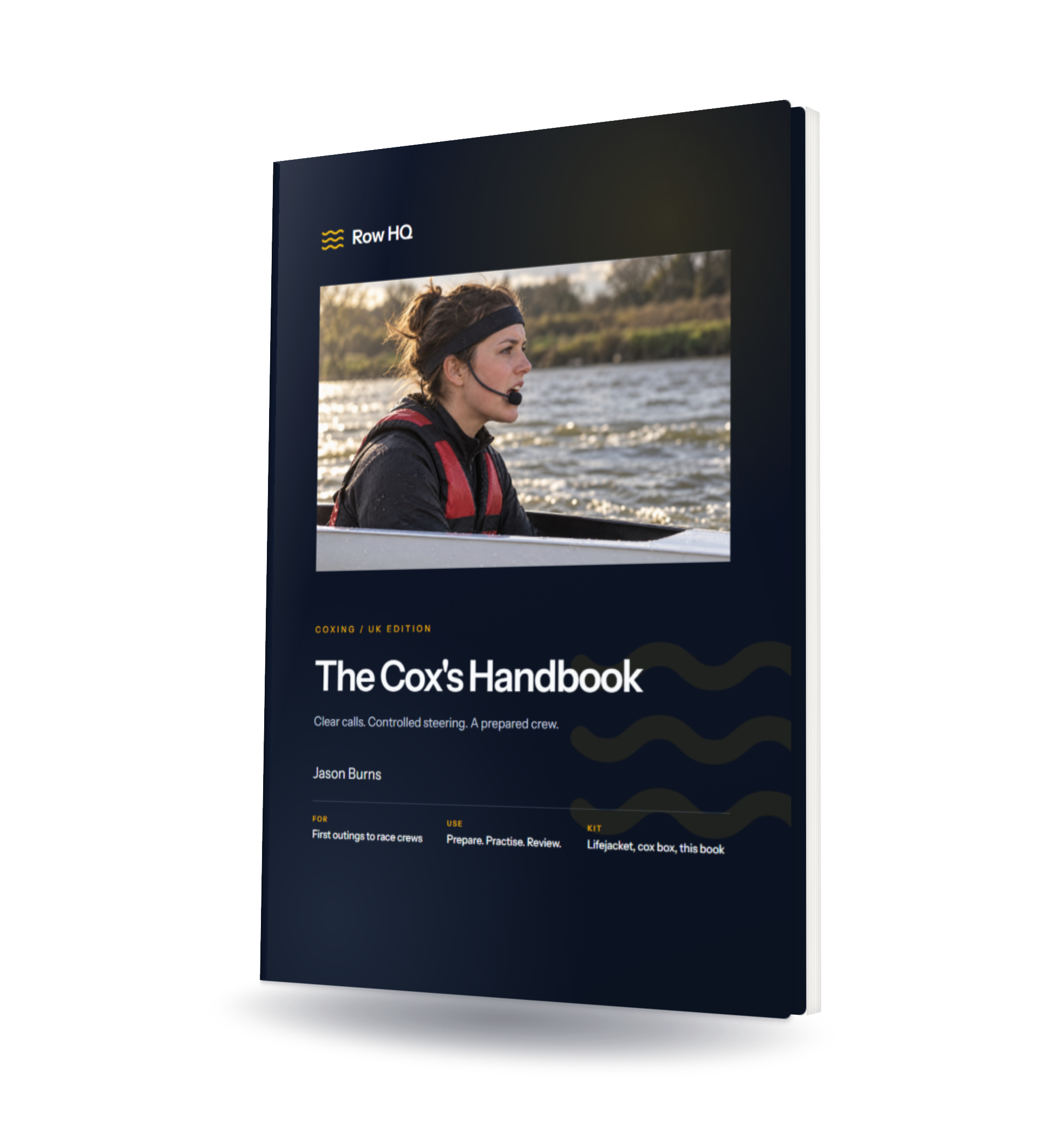
The Cox's Handbook
Practical calls, steering, session drills and race plans for new and improving coxes. Includes five printable worksheets.
The Club Session Library
52 rowing sessions for club coaches, with an illustrated coaching PDF, editable CSV plans, two seasonal blocks and a printable coaching cheat sheet.
Sources & references
- Rowing Ireland - Coaching and Athlete Development — Rowing Ireland
- Rowing Ireland - Club Support and Resources — Rowing Ireland
- British Rowing Plus - coaching articles and member content — British Rowing Plus
- British Rowing - Safe Coaching guidance — British Rowing
- Row HQ - Coach tools feature page — Row HQ
- Row HQ - Training sessions feature page — Row HQ
- Row HQ - Member portal feature page — Row HQ
- Row HQ - Crew selection guide — Row HQ
- Row HQ - Streamlining training sessions — Row HQ
- Rowing Ireland - National Rowing Regatta information — Rowing Ireland