Ergometer
Every boatshed from the Rowing NZ high-performance centre at Lake Karapiro down to a school gym in Ashburton runs the same indoor rowing machine: the Concept2 RowErg. Rowers call it the erg. The PM5 monitor on top measures the work done on each stroke and converts it into split, watts, calories, distance, time and stroke rate. Aotearoa squads lean on it heavily through the winter block, push it hard ahead of Maadi week, and refer to its numbers the rest of the year. A new RowErg sells for roughly NZD 2,000 to 2,400 through the Concept2 New Zealand distributor.
What is an Ergometer?
The Concept2 RowErg is the indoor rowing machine standardised across Rowing NZ clubs, secondary schools chasing the Maadi Cup, and NZURA university programmes. A flywheel, an air damper and the PM5 monitor combine to translate every pull into a 500m split, watts, kJ and calories per hour. The maths is identical machine-to-machine, which is why erg numbers travel between boatsheds and survive cross-shed comparison at trial time.
Also called: Erg, Rowing Ergometer, Indoor Rower, Rowing Machine
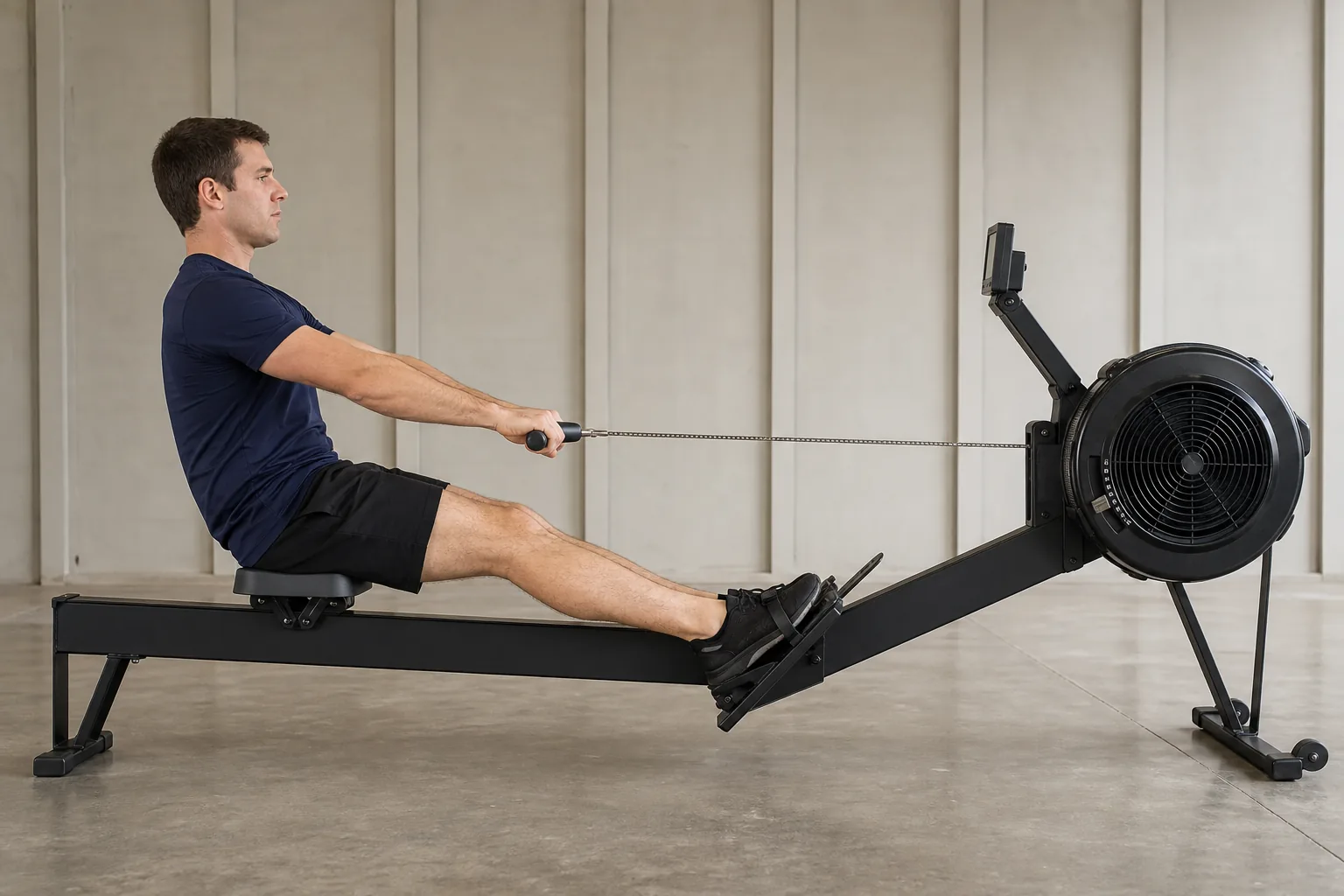
Ergometer, erg, indoor rower: same thing
Three labels, one machine. "Ergometer" is the term you will see in Rowing NZ coach education and any sports-science paper, and it comes from the Greek ergon, meaning work. "Erg" is the shorthand every Kiwi rower says out loud ("she pulled a sharp 2k erg before Maadi"). "Indoor rower" or "rowing machine" is how the wider gym market refers to it. Under all three labels sits the same kit: a sliding seat on a rail, a footplate with stretcher straps, a chain attached to a handle, and a flywheel that fights every pull.
How an ergometer works
Pull the handle and you spin the flywheel. Resistance comes from one of several sources depending on the brand: air on a Concept2, water on a WaterRower, magnets on a Hydrow, or some mix. Between strokes the wheel slows down. Sensors clock how fast it slows, the monitor turns that deceleration into work done, and the work is reported in metres rowed. Every figure on the screen - the split, the watts, the kJ, the calorie estimate - traces back to that single measurement of how fast the wheel is decaying.
The damper lever on the side of the flywheel cage runs 1 through 10. Drop it to 1 and the cage breathes in less air, so the wheel accelerates quickly and decays quickly (a light, twitchy stroke that mimics a fine single scull). Wind it to 10 and the wheel labours like a heavy eight in chop. The damper changes how each stroke feels and nothing else. The figure that actually governs the work is drag factor, displayed under More Options on the PM5. Push any split through the erg pace calculator to pull back watt output, calorie estimate and projected splits across every distance a Kiwi programme tests at.
The Concept2 standard
Concept2 set up shop in Morrisville, Vermont in 1976. The RowErg (originally the Model D, then the Model E) landed in NZ boatsheds by the late 1980s and has been the default ever since. It is the machine specified for the World Rowing Indoor Championships, the C.R.A.S.H.-B Sprints in Boston, every Rowing NZ trial, NZSSRA selection testing in the lead-up to the Maadi Cup, and NZURA Bond Cup ergs. The reason it stuck is dull but decisive: calibration has barely shifted in three decades, the chain and the flywheel are easy to repair in-shed, and a score pulled at Hamilton Boys, Saint Kentigern, Christ's College, St Andrew's or St Bede's reads the same as a score pulled at Karapiro or Ruataniwha.
WaterRower, Hydrow, NordicTrack and Echelon all build indoor rowers aimed at home fitness, but none of them are calibrated to the Concept2 score curve. A 7:00 on a WaterRower is not a 7:00 on a Concept2. NZ club coaches, NZSSRA selectors and Rowing NZ panels will only consider Concept2 numbers when ranking athletes for trials, which is worth knowing before a family buys the wrong machine for winter erg testing at home.
What the readouts mean
- 500m split: the projected time to cover 500m at the current rate of work. A 1:45 split reads as one minute forty-five over the next half-kilometre. Splits drive every conversation in a Kiwi boatshed.
- Watts: instantaneous power on the flywheel. Concept2 publishes the conversion as watts = 2.80 / (split_seconds / 500)^3. Worked through, a 1:45 split lands at roughly 268 watts and a 1:30 climbs to about 425.
- Calories per hour: a derived figure of roughly four times watts plus a flat 300 for basal metabolism. Useful for fuelling and load tracking, not a precise account of true energy expenditure.
- Stroke rate: strokes per minute. Steady aerobic UT2 sits at 18 to 20, firmer UT1 climbs to 22 to 24, threshold lands around 26 to 28, and race pace runs 32 to 38.
- Distance: metres-equivalent, worked out from the flywheel decay rate between strokes, not a literal measurement of travelled distance.
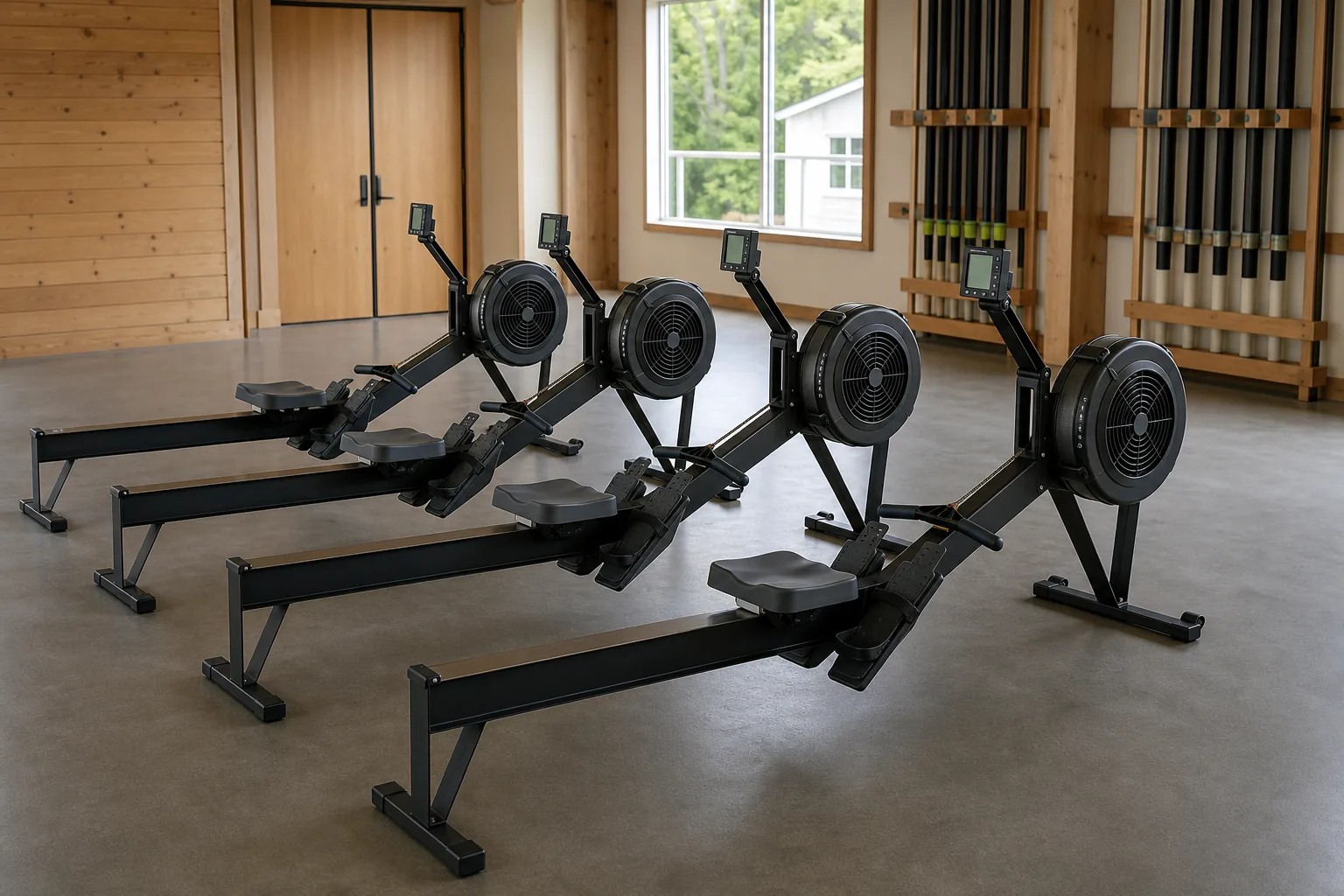
How New Zealand rowing clubs use ergometers
Three jobs, all year-round but most of them concentrated June to August when the rain is sideways at Karapiro and the dawn temperature at Ruataniwha is keeping the singles on the rack. First job: keep the squad fit when the water is unsafe, unrowable or the boats are out of the shed for maintenance. Second job: provide a controlled test environment for the standard pieces (2k, 5k, 30-minute for distance, 60-minute for distance). Third job: feed crew selection alongside seat-racing on the lake and coach observation through pre-Maadi blocks.
A test piece is data, and data only earns its keep when it lives somewhere a coach can find it six months later. Write every score against the athlete's profile, plot the trajectory across the season, normalise for body weight, and a selection meeting in February becomes a conversation about numbers rather than impressions. Row HQ's coach tools log every erg against the right athlete and surface who is improving fastest in the run-up to Maadi week.
Erg testing protocols
Standard erg pieces across NZ secondary school, club and university programmes:
- 2,000m (2k): the Olympic-distance benchmark and the test every NZ selector opens with. Maximum effort, six to eight minutes for openweight men and seven to nine for openweight women.
- 5,000m (5k): an aerobic capacity test, 17 to 22 minutes for most senior rowers and a fixture of the Karapiro winter block.
- 30 minutes for distance: hold a sustainable threshold pace and see how far the wheel turns. The standard aerobic-base check.
- 60 minutes for distance: a longer aerobic test, usually rated UT1 or UT2. Common across NZURA university squads in the winter.
- 4 x 2,000m or 8 x 500m intervals: race-specific work for power production and recovery economy.
Body weight on the day and the drag factor used both belong in the record. Lighter rowers fight a power-to-weight maths problem on the open figures (which the World Rowing weight-adjusted formula handles), and drag factor matters because a 2k pulled at 105 reads differently to one pulled at 145.
Indoor rowing as a sport in its own right
Indoor rowing is no longer just winter cross-training for water rowers. The C.R.A.S.H.-B Sprints have run in Boston since 1982 and still draw a couple of thousand entries each February. The World Rowing Indoor Championships, the Concept2 online Holiday and Million Metres challenges, and the indoor circuits run across Aotearoa now fill the off-season calendar. CrossFit boxes and commercial gyms around New Zealand stage their own erg leagues, which has pulled plenty of competitors onto the machine who have never set foot in a boat.
Ergometer FAQs
Is an ergometer the same as a rowing machine?
Yes, with a vocabulary gap. The technical term is ergometer; rowers shorten it to erg; the fitness market calls it a rowing machine. The kit is identical. In NZ competitive rowing the standard is the Concept2 RowErg, fitted in essentially every Rowing NZ club, every NZSSRA secondary school programme and every NZURA university squad since the mid-1980s. It is also the specified machine at every world-level indoor rowing event. A new unit retails for roughly NZD 2,000 to 2,400 through the New Zealand distributor.
What does an ergometer measure?
Work done per stroke, reported as six numbers on the PM5 monitor: 500m split, watts, calories per hour, distance, elapsed time and stroke rate. The split-to-watts conversion runs through Concept2's published equation, watts = 2.80 / (split_seconds / 500)^3. Calories per hour is a derived figure of approximately four times watts plus a fixed 300 for basal metabolism. The monitor stores the workout to memory and to the Concept2 Logbook when the machine is paired.
What is a good 2k erg time?
Bands shift with category. Openweight senior men in NZ club ranks chase under 7:00 (a 1:45 split), with under 6:30 (1:37) marking national-level fitness. Openweight senior women aim for under 8:00 (2:00), and the elite tier sits under 7:15 (1:48). NZSSRA secondary school under-18 boys typically target 6:30 to 7:00 ahead of the Maadi Cup; under-18 girls target 7:30 to 8:00. Masters athletes scale their figures using Concept2 age-grading. Push any 2k through the erg pace calculator to convert it into its equivalent split, watt output and projected longer-distance pieces.
How does the erg measure distance without moving?
Through the flywheel, not the seat. Each stroke spins the wheel against air resistance, and between strokes the wheel slows down. Sensors clock the rate of deceleration, the PM5 turns that into work done per stroke, and the work is reported in metres-equivalent as if the rower were moving a boat through water. Drag factor (a measure of how rapidly the wheel decays) lets the maths adjust for damper position and the air density in the room. The number on the screen is a normalised unit of work, not a literal travelled distance.
What damper setting should I use on an erg?
For training, sit somewhere between 3 and 5. The damper changes the feel of the stroke (a 1 mimics a fine racing single, a 10 mimics dragging a heavy eight) and has zero effect on the score the PM5 reports. The figure that matters is drag factor, displayed under More Options. Lightweight men typically calibrate to 110 to 130, heavyweight men to 130 to 150, lightweight women to 105 to 120, heavyweight women to 120 to 135. World Rowing Indoor Championships are usually rowed under a 130 drag factor across the field.
Can ergometer scores predict on-water speed?
Partly. The erg captures power production in a fixed setting and gives a clean number for it. On-water speed needs that power, but it also needs technique, balance, rigging, crew timing, water state, wind and steering. A faster erg score generally correlates with a faster rower, but the conversion is not one-to-one. Rowing NZ selection groups, NZSSRA panels and NZURA Bond Cup committees use erg scores as one signal alongside seat-racing and coach observation. Watch for both directions of the disconnect: athletes who pull big numbers and cannot transfer them to the boat, and athletes who row well above their erg.
Related
What is a Regatta?
A regatta is the side-by-side sprint format of rowing. Crews race in buoyed lanes over 2,000 metres (1,000 metres for ma...
The Coxswain: Steering, Strategy and the Other Voice in the Boat
A coxswain (cox) is the non-rowing crew member in the stern of a coxed shell who steers, calls the race plan and holds t...
What is a Scull?
A scull is an oar held in one hand. Every sculler pulls two of them, one in each fist, which is the line that separates...
Stroke Rate: The Cadence Number That Doesn't Equal Boat Speed
Stroke rate is the cadence number - strokes per minute (spm). NZ crews run anywhere from 18 spm in winter base work to 4...
From the RowHQ shop
Printable PDFs written for club rowers. Buy once, keep forever.

Learn-to-Row Starter Plan
A free 6-week introduction plan for brand-new rowers - on the water and on the erg.
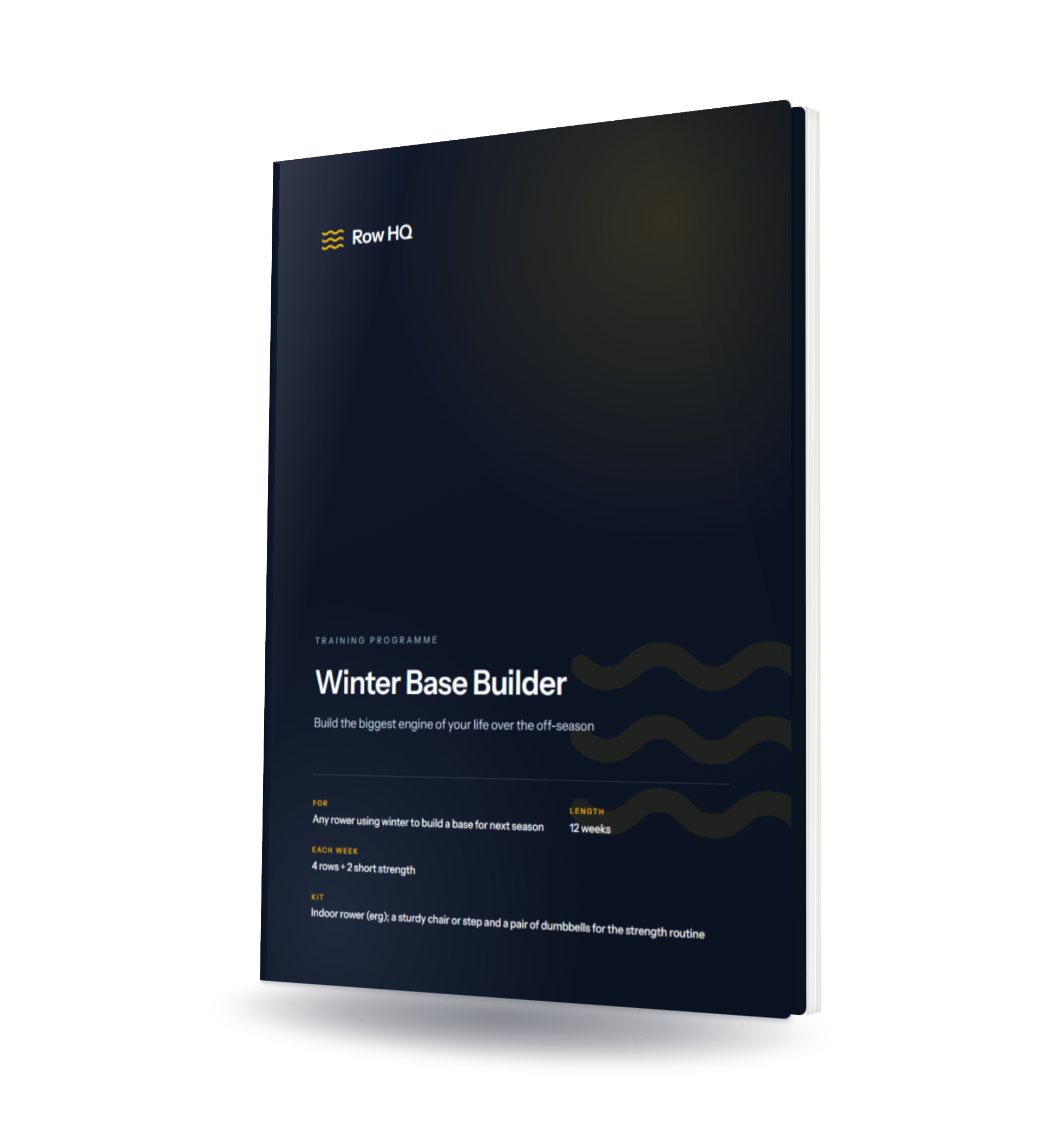
Winter Base Builder
Build the biggest engine of your life over the off-season - 12 weeks of mostly-easy volume plus a strength routine, so you arrive at spring fast.
Keep learning
One erg test is a result, while the trend across a season tells coaches more. rowing club management software keeps that testing history beside each rower's record. Find connected terms in the rowing glossary.
Track every erg score in one place.
Row HQ writes every erg test against the right athlete the moment it lands, plots the trajectory across the season, and feeds the data into crew selection. Built by rowers, used at Oundle Town Rowing Club.