Coxswain
A coxswain (cox) is the non-rowing crew member in the stern of a coxed shell who steers, calls the race plan and holds the crew together. The cox does not pull an oar - they hold the rudder, run the race plan and keep eight rowers moving as one unit. The role is central to the eight and the coxed four; pairs, singles, doubles and quads race without one.
The Coxswain: Steering, Strategy and the Other Voice in the Boat
A coxswain (cox) is the non-rowing crew member who sits in the stern of a coxed shell and runs everything except the oars. The cox steers a clean line with rudder lines held in each hand, executes the race plan call by call, and keeps the crew together when the third 500m starts to bite. Coxes are essential in the eight and the coxed four; pairs, singles, doubles and quads race coxless. At the Maadi Cup on Lake Karapiro - the New Zealand Secondary Schools Rowing Championships - a sharp cox can be the difference between a school making the final and missing it.
Also called: Cox, Cox'n
What does a coxswain do?
At every outing and every race, the cox carries three responsibilities: steer a clean line, execute the race plan, and hold the crew together when fatigue starts to bite.
Steering is the constant background task. Rudder lines run from the cox's hands to the rudder beneath the stern. A good cox steers with tiny, almost invisible adjustments - dragging the rudder costs boat speed and the cox knows it. On the winding course of a head race like the Head of the Waikato at Cambridge or the Head of the Harbour in Auckland, the difference between a clean line and a poor line is easily measured in seconds.
Race strategy is where experienced coxes separate themselves from beginners. The cox is responsible for turning the pre-race plan into live decisions: when to push the rate, when to settle, when to call the sprint in the final 500m. During a 2,000m race that lasts around six minutes, the cox is the only person in the shell who is not physically gasping and the only one with a clear view of what is actually happening across the field.
Motivation and feedback run between every stroke. The cox calls rhythm, technical reminders - catch placement, finishing cleanly, holding the LBA drive sequence - and morale when the crew starts to fracture under load in the third 500m. The best coxes know each rower personally and know exactly whose focus needs lifting at what point in the race.
Coxswain weight: rules and reality
Cox weight is a real performance variable. A heavier cox is additional mass the crew must accelerate through the water for the full race. Weight minimums exist to stop clubs fielding very light coxes purely as a hull-speed advantage.
British Rowing requires 55 kg for all crews except J15 and younger crews, where the minimum is 45 kg. Its 2025 rules remain unchanged for 2026. See rule 7-2-7. These figures do not establish local rules in other countries.
USRowing sets 120 lb for men's and mixed crews and 110 lb for women's crews. Required deadweight stays close to the cox's torso in the boat throughout the race. See the current Rules of Rowing. The youth weigh-in exemption concerns USRowing-hosted youth regattas; check your event packet.
Check the governing rules for your actual event. British Rowing and USRowing figures are examples, not local rules for this country. Ask your coach to confirm the minimum, any exemption and the accepted ballast arrangement before racing.
What does a cox box do?
The cox box is the cox's on-water electronics package. It handles three things at once: it amplifies the cox's voice through speakers mounted along the hull, it tracks stroke rate from a sensor on the stroke seat\'s slide, and it times the session or race.
The NK CoxBox is the long-established standard on NZ club, school and university shells. The Coxmate GPS is a lighter Australian-made alternative widely used in NZ for its GPS accuracy and the straightforward trans-Tasman supply path. The NK Speedcoach GPS turns up regularly as a smaller backup display, particularly on sculling shells. All connect to a microphone the cox wears and to compact speakers spaced along the hull.
During training, the rate display lets the cox call precise adjustments ("up two for the next twenty") and report 500m split mid-piece. During a race, the timer anchors the race plan and the rate sensor confirms the crew is holding the target number through each segment of the 2km course.
Which shells are coxed?
Steering arrangements vary by shell class:
- Eight (8+): always coxed. No coxless eight exists in competitive rowing.
- Coxed four (4+): carries a cox in the stern or the bow. Bow-loader fours give the cox a clearer sightline down the course.
- Coxless four (4-): foot-steered, with one rower's heel connected to the rudder via a small pivot. A sideways heel movement directs the shell.
- Pair (2-): coxless. One of the two rowers handles steering via the foot mechanism.
- Quad (4x), double (2x), single (1x): all coxless. Sculling shells use foot steering or, in the single, differential pressure between the two blades.
For the shells that do carry a cox, the performance gap between a sharp cox and a poor one is real and measurable. Crew planning at NZ clubs and schools regularly comes down to which lineups can be built around the strongest available coxes.
How to become a coxswain in New Zealand
Many coxes arrive in the role without planning it. A coach notices someone with good spatial awareness at a learn-to-row programme, asks them to try the cox seat, and the career begins. After that first outing, the path forward is time on the water, watching how experienced coxes run sessions, and absorbing feedback from coaches.
Formal training routes in New Zealand:
- Rowing NZ: cox safety and steering competencies sit within the Rowing NZ coaching and officiating framework, delivered through the regional rowing associations.
- NZSSRA: runs cox protocols and safety requirements specifically for school regattas, including detailed cox briefings for the Maadi Cup on Lake Karapiro and the North and South Island Champs.
- Club, school and university programmes: most NZ clubs, secondary schools and university squads (Otago, Auckland, Waikato, Victoria University of Wellington, Canterbury) run their own cox induction sessions covering local waterway rules, emergency procedures and standard drill calls.
The fastest way to become a useful cox is repetition - calling a hundred drills, sitting through dozens of race starts, and building the feel for how a shell responds to different rudder inputs. NZ clubs are almost always short of coxes, so anyone willing to commit to the seat will get plenty of water time. Read our crew selection guide for context on how coaches fit the available coxes into their lineup planning.
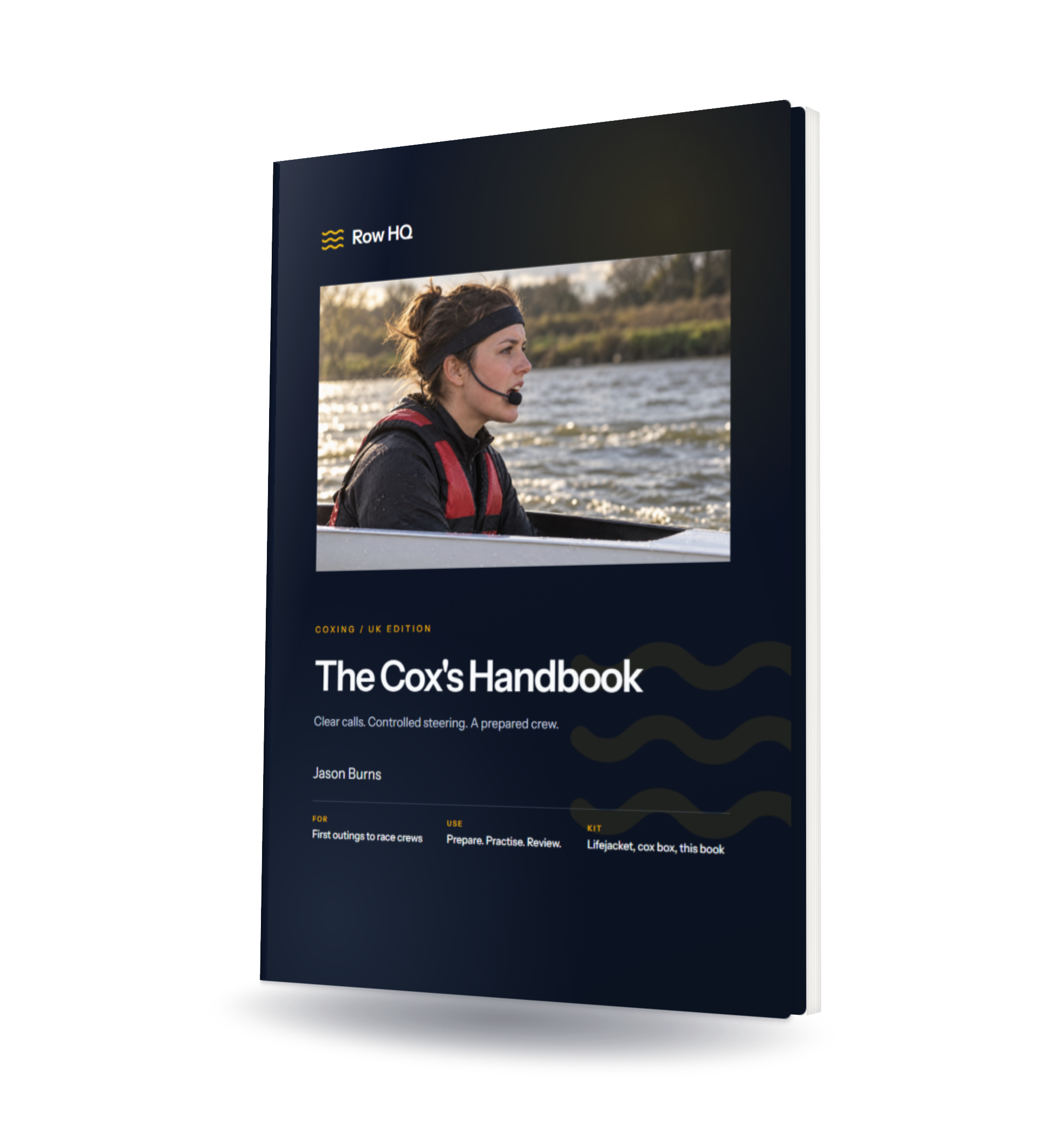
Before your first outing in the seat, the first-time coxswain guide covers the standard calls, steering and kit to sort beforehand.
pages/glossary/coxswain.body.college.heading
pages/glossary/coxswain.body.college.intro_html
pages/glossary/coxswain.body.college.ira_html
pages/glossary/coxswain.body.college.high_school_html
pages/glossary/coxswain.body.college.roles_html
pages/glossary/coxswain.body.certifications.heading
pages/glossary/coxswain.body.certifications.intro_html
- pages/glossary/coxswain.body.certifications.safety_html
- pages/glossary/coxswain.body.certifications.coxswain_series_html
- pages/glossary/coxswain.body.certifications.safe_sport_html
pages/glossary/coxswain.body.certifications.reality
Notable coxswains in rowing history
The most decorated Olympic cox is Garry Herbert (Great Britain), who called the famously dramatic coxed pair victory at Barcelona 1992 for Greg and Jonny Searle. Mary Whipple coxed the United States women's eight to consecutive Olympic gold medals at Beijing 2008 and London 2012 and is widely regarded as one of the best racing coxes of the modern era. Pete Cipollone coxed the US men's eight to gold at Athens 2004. New Zealand has produced strong club and school coxes through the Rowing NZ and NZSSRA development pipelines, and the Maadi Cup eight finals on Lake Karapiro routinely turn on sharp cox calls in the closing 500m.
pages/glossary/coxswain.body.rowhq.heading
pages/glossary/coxswain.body.rowhq.intro_html
pages/glossary/coxswain.body.rowhq.training_html
pages/glossary/coxswain.body.rowhq.portal_html
Get the free Cox Calls Sheet
Coxswain FAQs
What does a coxswain do?
A cox has three core jobs in any outing or race: steer the shell on a clean line, execute the race plan call by call, and keep the crew together when fatigue starts to break them up. Sitting in the stern facing the rowers, the cox holds a rudder line in each hand, watches the racing line and the competing crews, and calls rate, pressure and the race plan through a microphone wired to speakers along the hull. In training, the cox runs the warm-up, calls drills, gives individual technical feedback, and reports observations back to the coach after every outing.
How heavy does a coxswain have to be?
Your event's published rules set the minimum, including any junior exemptions. Confirm them with the organiser and coach. Do not assume World Rowing, British Rowing or USRowing rules apply automatically. A lighter cox carries accepted deadweight only where the governing rules require it. Check weighing, certification and ballast placement before race day.
Do coxswains row?
No, the cox does not row. The cox steers, directs the crew, calls the rate and manages race tactics while the rowers move the shell with the oars. Some coxes train in singles or pairs to build an understanding of technique from the rower's seat, but in a coxed shell the cox holds the rudder lines, the microphone and the race plan - not an oar. This is the defining difference between coxed events (8+, 4+) and coxless events (4-, 2-, quads and singles) where one of the rowers steers via a foot-operated rudder mechanism.
What does a cox box do for a coxswain?
A cox box is a compact electronic unit that combines a voice amplifier with a stroke-rate sensor and race timer. It feeds the cox's voice to speakers spaced along the hull so every rower hears the calls clearly regardless of wind, rain or boat traffic. Current units - NK CoxBox, Coxmate GPS and similar - also display live stroke rate, elapsed time, distance and 500m split, often with GPS data overlaid. During a race, the cox uses those readouts to call precise rate changes, manage the pace plan and confirm the crew is holding target rate through each 500m segment.
Which boats need a coxswain?
The eight (8+) is always coxed - no coxless eight exists in standard competition. Fours come in two variants: the coxed four (4+) carries a cox in the bow or stern seat, while the coxless four (4-, often called the straight four) is foot-steered by one of the rowers. Pairs (2-), single sculls (1x), double sculls (2x) and quads (4x) all race coxless. Many NZ club training shells and learn-to-row eights are coxed for safety reasons regardless of event format. Certain adaptive rowing categories also use coxed boats so the cox can handle steering for the crew.
How do you become a coxswain in New Zealand?
Most coxes come into the seat through a club's learn-to-row programme or a school or university squad - a coach spots someone with the right size and the right spatial awareness, asks if they want to try it, and the career starts there. The first step is a cox induction covering steering, standard boat commands, safety drills and on-water emergency procedures. From there it is time on the water - learning to hold a line with minimal rudder, call drills cleanly, and read how the shell responds. Rowing NZ and the regional rowing associations provide cox development resources and safety certification. NZSSRA runs cox protocols specifically for the Maadi Cup. NZ clubs are almost always short of coxes, so anyone willing to commit will get water time quickly.
Related
What is a Regatta?
A regatta is the side-by-side sprint format of rowing. Crews race in buoyed lanes over 2,000 metres (1,000 metres for ma...
What is an Ergometer?
Every boatshed from the Rowing NZ high-performance centre at Lake Karapiro down to a school gym in Ashburton runs the sa...
What is a Rowing Shell?
A rowing shell is the racing hull itself - the long, slender boat racked along the walls of every NZ boatshed from Rowin...
Rowing Boat Types
World Rowing recognises eight standard racing shells, and you will see every one of them on the Karapiro race lane durin...
What is a Scull?
A scull is an oar held in one hand. Every sculler pulls two of them, one in each fist, which is the line that separates...
What is Catching a Crab?
A buried blade. The hull keeps running, the oar does not, and the handle gets hammered back into the rower's chest. The...
The Cox Box: The Coxswain's On-Water Electronics
A cox box is the electronics package a coxswain runs every outing - voice amplification through the hull's speaker syste...
Stroke Rate: The Cadence Number That Doesn't Equal Boat Speed
Stroke rate is the cadence number - strokes per minute (spm). NZ crews run anywhere from 18 spm in winter base work to 4...
From the RowHQ shop
Printable PDFs written for club rowers. Buy once, keep forever.
Keep learning
A coxswain has enough to manage without chasing the latest crew list at the shed. Put the outing and cox assignment in rowing club software for New Zealand clubs. The rowing glossary covers the rest of the language used in the boat.
Coxes deserve better than a WhatsApp group.
Row HQ tells coxes which crew they're with, what session it is and where to be - automatically. Built by rowers, for rowing clubs.