Rowing Training Plan Template
An 8-week club training plan you can print and pin up in the boatshed: three sessions a week, built on a UT2 aerobic base and sharpening to race pace, with erg alternatives for every water session - because on a big lake, the wind gets a vote. Free. Enter your email and we send you the download link.
What does a good club rowing training plan look like?
For club rowers training around work, study and life, an effective plan is three to four sessions a week: two steady-state sessions (UT2, conversational pace, 18-20 strokes per minute) building the aerobic base, one harder interval or rate session (UT1 to AT), and ideally one land session for strength. The mix shifts over the weeks - long and steady early, shorter and sharper as racing approaches - and every water session needs an erg equivalent for the mornings when the lake is white-capped before the crews even arrive. This template lays that out over 8 weeks.
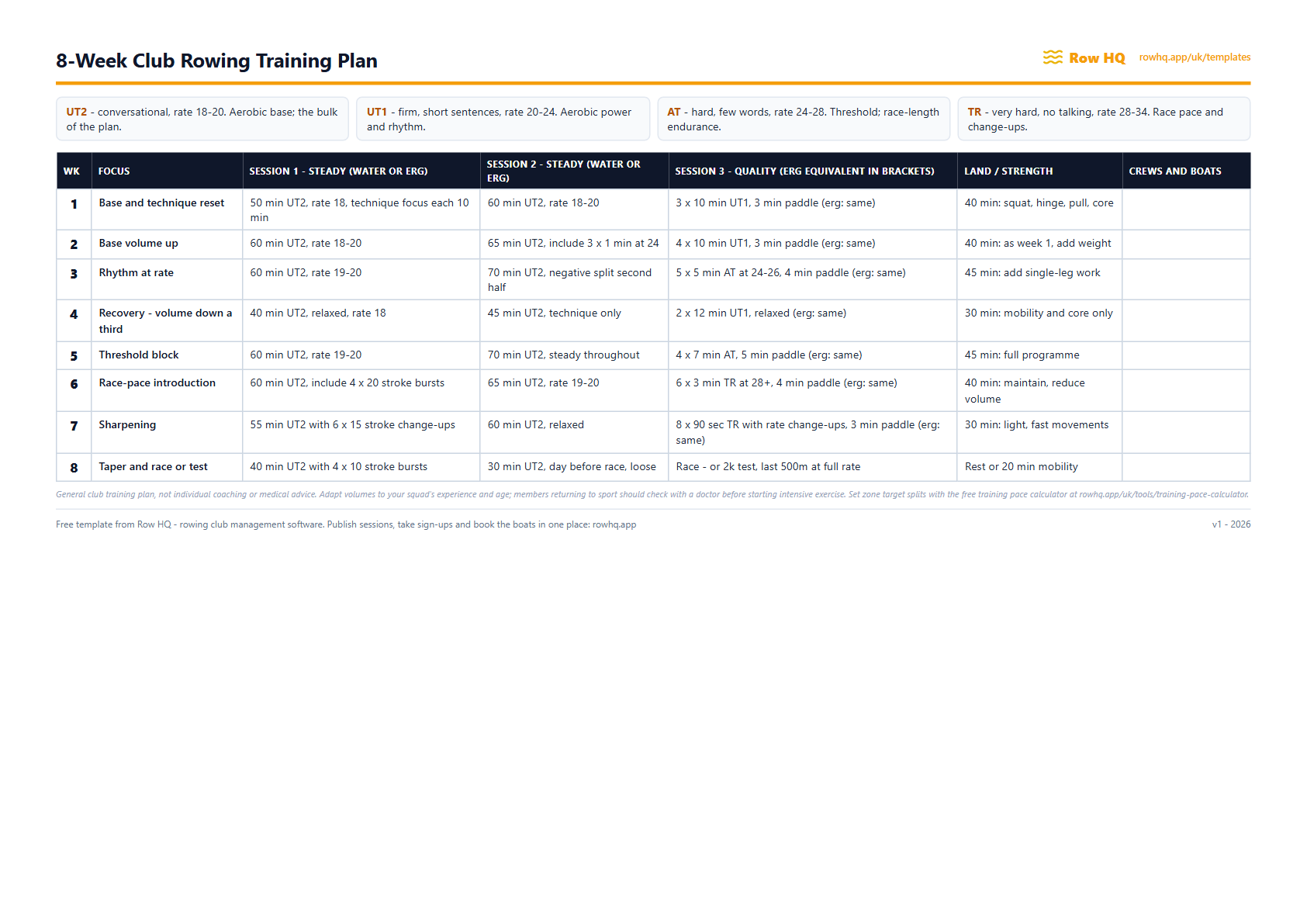
Download the plan
The training zones used in the plan
Zones are prescribed by feel and rate first, heart rate second - most club rowers do not train with lactate meters, and neither do most school squads. As a rule of thumb:
| Zone | Feel | Typical rate | What it builds |
|---|---|---|---|
| UT2 | Conversational - you can talk in full sentences | 18-20 | Aerobic base. The bulk of the plan. |
| UT1 | Firm - short sentences only | 20-24 | Aerobic power and rhythm under pressure. |
| AT | Hard - a few words at a time | 24-28 | Threshold. Race-length endurance. |
| TR | Very hard - no talking | 28-34 | Race pace and change-ups. |
To turn these into target splits for erg sessions, use the free training pace calculator - it takes a recent 2k score and gives you UT2, UT1, AT and TR splits per 500m.
The 8 weeks at a glance
Three rowing sessions a week. Session 1 and 2 are steady state, session 3 is the quality session that changes week to week. Swap any water session for its erg equivalent when the wind rules the lake out.
| Week | Focus | Quality session |
|---|---|---|
| 1 | Base and technique reset | 3 x 10 min UT1, 3 min paddle between |
| 2 | Base volume up | 4 x 10 min UT1, 3 min paddle |
| 3 | Rhythm at rate | 5 x 5 min AT at 24-26, 4 min paddle |
| 4 | Recovery week - volume drops a third | 2 x 12 min UT1, relaxed |
| 5 | Threshold block | 4 x 7 min AT, 5 min paddle |
| 6 | Race-pace introduction | 6 x 3 min TR at 28+, 4 min paddle |
| 7 | Sharpening | 8 x 90 sec TR with rate change-ups, 3 min paddle |
| 8 | Taper and race or test | Race, or 2k test with the last 500m at full rate |
The printable PDF adds the two steady sessions for each week, the land session, and space to write your own crew and boat assignments against every outing.
This is a general club training plan, not individual coaching or medical advice. Adapt volumes to your squad's experience and age - especially for school-age rowers - and have members check with a doctor before starting new intensive exercise, particularly after time away from sport.
The plan is the easy half. Running it is the work.
Printing a plan takes a minute. Publishing this week's sessions, seeing who has signed up, chasing the missing four, juggling crews when two pull out on Friday night, and booking the boats to match - that is the part that eats a coach's week. Row HQ's training sessions put the schedule, sign-ups, attendance and boat bookings in one place, so the plan on this page becomes sessions members actually see and sign up to. You write the training. Row HQ runs the admin. You coach.
Set up your club freeFree for clubs of up to 20 active members.
Training plan FAQs
How many sessions a week should club rowers train?
Three quality rowing sessions a week is enough for genuine progress for most club rowers, and it survives contact with real life - which is what makes it the right prescription for a club plan. Add a fourth session (usually land strength or an extra UT2 erg) if the squad is targeting a specific regatta. More than five sessions a week needs proper individual programming and recovery management - that is the territory of a full school or performance programme building towards Maadi, not a template.
Why is so much of the plan steady state?
Because aerobic base is what wins club races. The 2,000m regatta racing that defines the NZ season is overwhelmingly aerobic, and the engine that serves it is built at UT2 - low rate, conversational effort, long uninterrupted work. The temptation to make every session hard produces tired crews that plateau before the racing even starts. Roughly 70-80 percent of the plan's rowing time is steady by design; the quality session once a week is where the sharpening happens.
Can this plan be done entirely on the erg?
Yes. Every water session in the PDF has an erg equivalent listed alongside it, with the same zone and duration - the plan was built for winters and windy lakes alike. If you are erg-only, add ten minutes of mobility work after each session and consider dropping the rate 2 pips on steady work, since the erg does not reward rhythm the way a boat does. A 2k score is the natural test at week 8; the free 2k prediction calculator can set your target.
Related
Set your zone splits with the training pace calculator, test progress with the 2k prediction calculator, and browse the full templates library for the club's paperwork.