Rowing Training Plan Template
An 8-week club programme you can print and tape to the boathouse wall: three outings a week, laid on a UT2 aerobic base and sharpened toward race pace, with a matching erg session for every water session - because in Canada the erg room carries the crew from freeze-up through to spring launch. Free. Enter your email and we send you the download link.
What does a good club rowing training plan look like?
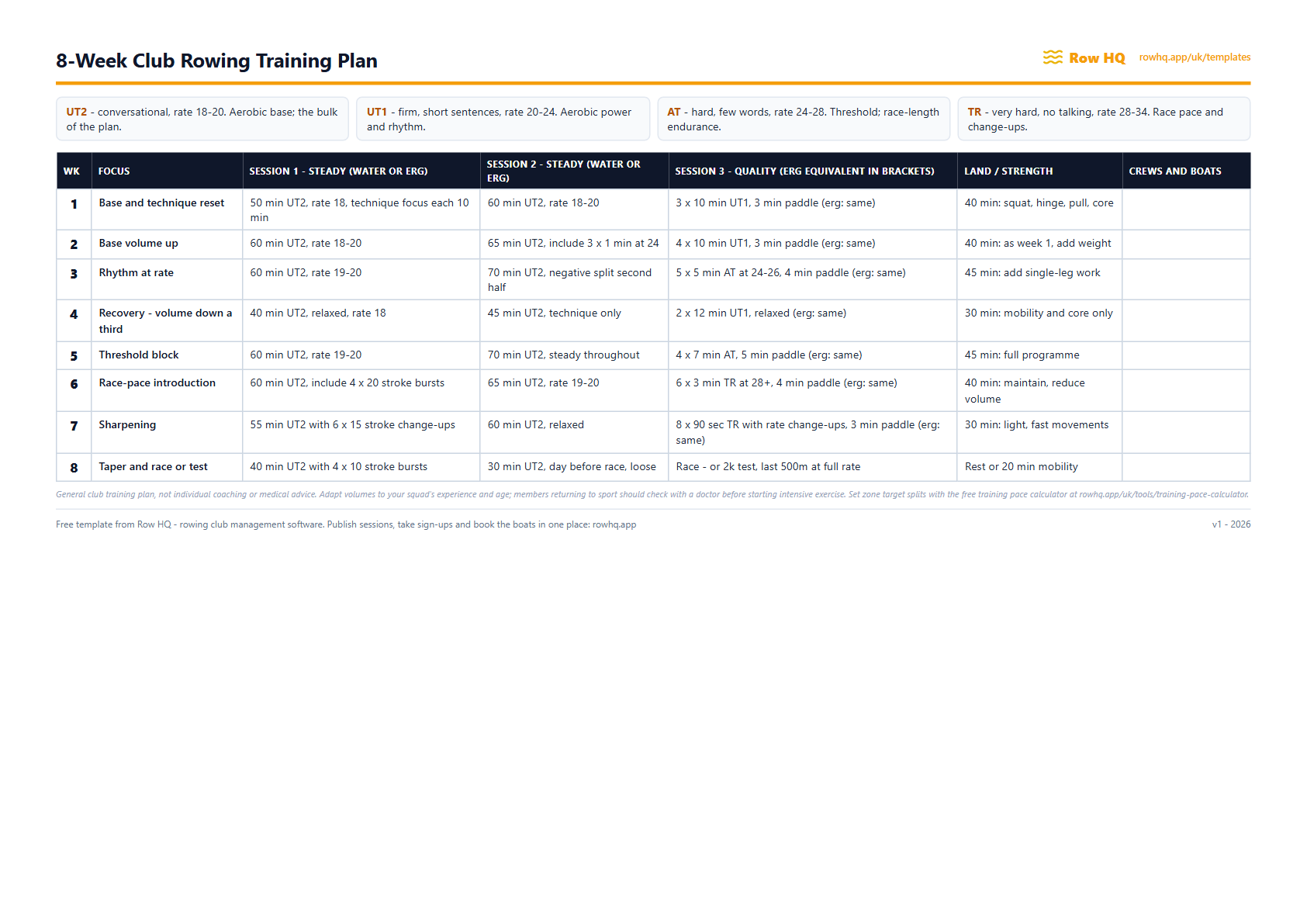
For members fitting rowing around jobs, school and family, three to four outings a week is the realistic dose: two steady-state sessions (UT2, conversational effort, 18-20 strokes per minute) laying the aerobic base, one harder interval or rate session (UT1 to AT), and where you can fit it a land session for strength. The balance moves through the block - longer and steadier at the start, shorter and sharper as the regatta nears - and every water session carries an erg twin, because a Canadian season means iced-over water for months, wind off the lake and the odd cold snap that scrubs a launch. This template maps all of that across 8 weeks.
Download the plan
The training zones used in the plan
Zones are set by feel and stroke rate first and heart rate second, since most club crews are not rowing with lactate meters clipped on. Working guide:
| Zone | Feel | Typical rate | What it builds |
|---|---|---|---|
| UT2 | Conversational - full sentences come easily | 18-20 | Aerobic base. Most of the plan sits here. |
| UT1 | Firm - short sentences only | 20-24 | Aerobic power and holding rhythm under load. |
| AT | Hard - a couple of words between breaths | 24-28 | Threshold. Endurance over the race distance. |
| TR | Flat out - talking is off the table | 28-34 | Race pace and rate change-ups. |
To convert these zones into target splits for erg work, run a recent 2k through the free training pace calculator - it returns your UT2, UT1, AT and TR splits per 500m.
The 8 weeks at a glance
Three rowing sessions a week. Sessions 1 and 2 hold steady state; session 3 is the quality piece that shifts week to week. Move any water session onto the erg when the lake is still locked in ice, the wind is dangerous or the launch cannot go out.
| Week | Focus | Quality session |
|---|---|---|
| 1 | Base and technique reset | 3 x 10 min UT1, 3 min paddle between |
| 2 | Base volume up | 4 x 10 min UT1, 3 min paddle |
| 3 | Rhythm at rate | 5 x 5 min AT at 24-26, 4 min paddle |
| 4 | Recovery week - volume drops a third | 2 x 12 min UT1, relaxed |
| 5 | Threshold block | 4 x 7 min AT, 5 min paddle |
| 6 | Race-pace introduction | 6 x 3 min TR at 28+, 4 min paddle |
| 7 | Sharpening | 8 x 90 sec TR with rate change-ups, 3 min paddle |
| 8 | Taper and race or test | Race, or 2k test with the last 500m at full rate |
The printable PDF fills in the two steady sessions for each week, the land session, and a column to pencil your own crews and boat assignments beside every outing.
This is a general club training plan, not one-to-one coaching or medical advice. Scale the volumes to your crew's age and experience, lean on NCCP coaching principles and Rowing Canada Aviron's Long-Term Athlete Development stages, and have members clear new intensive training with a doctor first - especially after a full winter off the water.
The plan is the easy half. Running it is the work.
Printing the plan takes a minute. Posting this week's outings, watching who has signed on, nudging the four who have not, rebuilding crews when a pair pulls out on the Friday night, and holding the right boats to match - that is the part that swallows a volunteer coach's week. Row HQ's training sessions gather the schedule, sign-ups, attendance and boat bookings into one place, so the plan on this page turns into outings members actually see and commit to. You write the training. Row HQ handles the admin. You coach.
Set up your club freeFree for clubs of up to 20 active members.
Training plan FAQs
How many sessions a week should club rowers train?
Three quality rowing sessions a week is enough for real gains for most club members, and it holds up against shift work, exams and family - which is exactly why it suits a club plan. Bolt on a fourth session (land strength or an extra UT2 erg) when a crew is pointing at a specific regatta such as the Royal Canadian Henley. Beyond five sessions a week you are into individual load and recovery planning, which is the territory of an NCCP-certified coach rather than a printable template.
Why is so much of the plan steady state?
Because the aerobic engine decides club races. Rowing distances, from a 1000m sprint to a long head course, run overwhelmingly on aerobic energy, and that engine is grown at UT2 - low rate, easy breathing, long unbroken work. Turning every session into a hammer-fest just produces flat, tired crews. So roughly 70 to 80 percent of the rowing time here is deliberately steady, and the single weekly quality session is where the edge gets put on.
Can this plan be done entirely on the erg?
Yes - and across most of Canada it has to be from freeze-up to spring launch, which is why the erg room is the winter home base. Every water session in the PDF has an erg twin beside it at the same zone and duration. If you are erg-only, tack ten minutes of mobility onto each session and drop the rate a couple of beats on steady work, since the machine does not reward boat rhythm. A 2k is the natural test at week 8, and the free 2k prediction calculator will set the target.
Related
Set your zone splits with the training pace calculator, test progress with the 2k prediction calculator, and browse the full templates library for the club's paperwork.