The honest answer in 30 seconds
Three jobs, in this order. Keep the crew safe. Steer a clean line. Use a short list of standard calls. Race rhythm, motivational craft and clever technical feedback all sit behind those three - earn them by nailing the first three. The basic vocabulary fits on one hand: "hands on", "ready to row", "row", "weigh enough", "easy oar". Steering is a push, not a pull: the rudder line on the side you want the bow to drift toward. Volume is not voice - normal conversation reaches stroke seat fine. Rowing Ireland and British Rowing both put the cox in charge of the boat on the water once it leaves the slip, which means the safe return of the crew sits with you. The rest of this article works through each piece in enough detail to actually use on Tuesday night at NUIG, UCC, Garda, Commercial or any Rowing Ireland-affiliated boathouse - read the RowSafe guidance alongside it.
What does coxing mean?
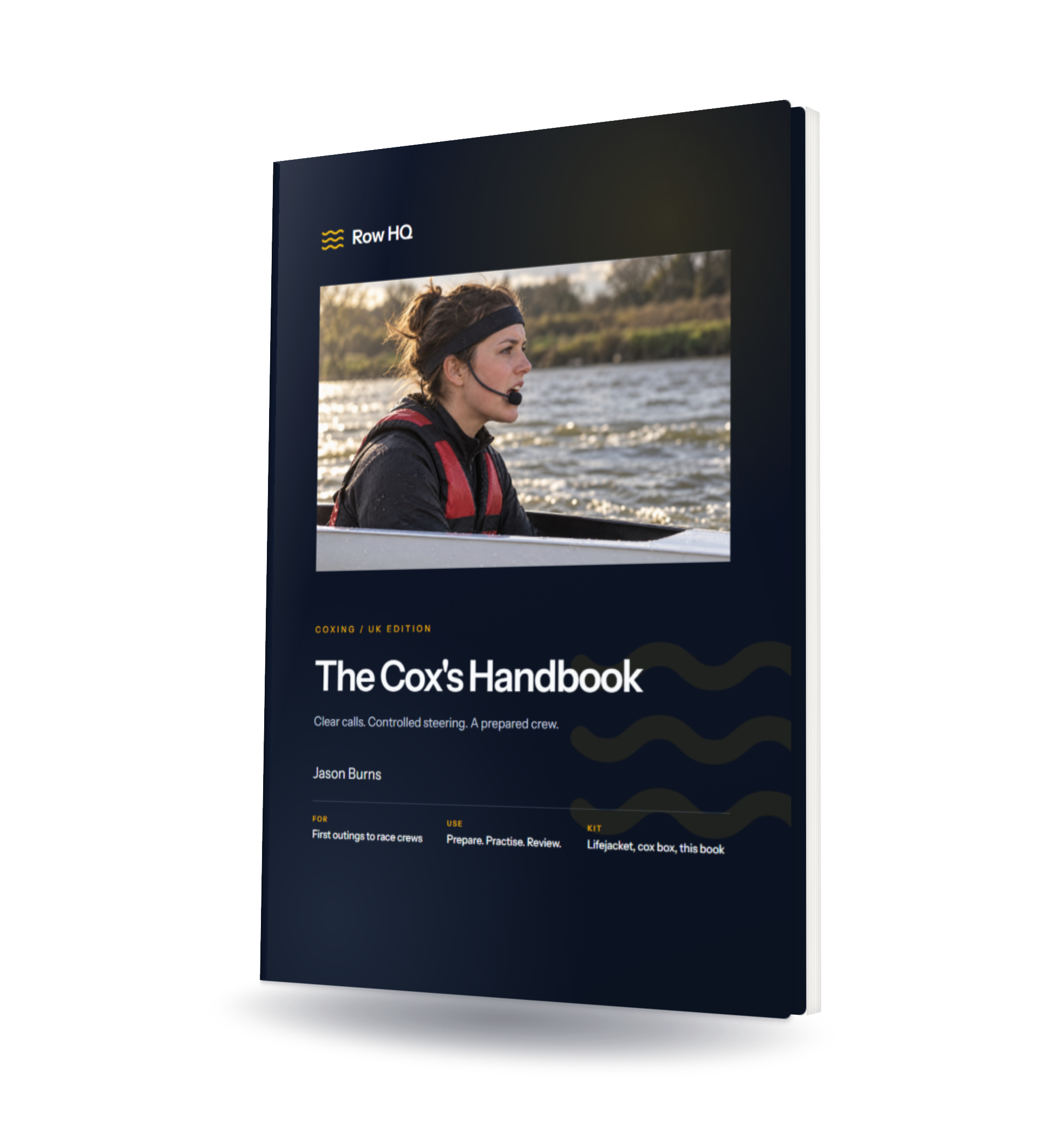
Coxing means acting as the cox, or coxswain, of a rowing boat: the crew member who steers and speaks rather than rows. The cox faces forwards, uses the rudder to hold a line, minds the safety of the crew, and calls the commands that run every session. Irish clubs, coastal and river alike, rely on coxes to keep crews safe and boats moving.
Your first outing in the cox seat
The job is not shouting. The job is steering, judgement, safety, and knowing which moments deserve silence. This is what an Irish boathouse should have told you on the slip before your first session - and rarely does.
Picture a wet October Tuesday at the National Rowing Centre. A novice eight is sitting at the start of the 2k buoyed course. Inniscarra is calm, the wind is light, and the cox in the saddle has never raced. Inniscarra is the most forgiving water on the island for a first race - 2 kilometres of wide buoyed lake with nothing in front of you - and even on water as kind as that, the difference between a calm cox and a panicky one shows up in stroke seat's face inside the first 500. After a decade in coxed boats I can pick that face out of any crowd. Calm coxes make crews faster without ever mentioning pace. Panicky coxes turn good crews into frustrated ones inside a 5k on Lough Ree. This is the guide I wish someone had handed the new coxes at Bann, NUIG, UCC, Garda and Neptune before they were sent out for the first time - what you actually do on day one, the calls in plain Hiberno-English, the Rowing Ireland weight rules, and the four or five mistakes nobody escapes. Read it alongside our coxswain glossary entry for the quick definitions.
Why coxing matters more than the rowers usually admit
A moored cruiser drifting on the wrong side of the Lee at dusk. A debris field on Lough Erne after a week of rain. A Trinity or UCD eight closing on you head-on at Heuston because someone misread the circulation. Eight rowers can do nothing about any of those - they are looking the wrong way. The cox is the only person in the boat with eyes pointed at the problem. That single fact is what makes the role load-bearing rather than decorative. Add the session running on behalf of the coach, the rhythm holding through a race at Castleconnell or Skibbereen, and the simple fact that the boat needs to get back to the rack unbroken, and you have the entire job. A bad outing with a competent cox is forgettable. A bad outing with a panicked cox is the kind of story that gets retold at the AGM. Where coxing development overlaps with coaching, the workflow we describe in coach tools treats the cox as part of the planning loop, not a separate handover.
What new coxes need on day 1
Forget the full call list. You need four things solid before you push off the slip at the National Rowing Centre, Belfast Boat Club or Castleconnell. Get these four right and the crew will quietly carry you while the rest builds in.
Safety first, always
From the moment the boat leaves the rack you are in charge of it. That means three things you know cold: the circulation pattern at your venue, the local hazards on that stretch of water, and what "weigh enough" and "easy oar" do. Never sit in the cox seat without a buoyancy aid or lifejacket matched to the boat type - the spec is different for stern-loaders and bow-loaders.
Steer first, talk second
A clean line down the Liffey beats any clever call. The rudder is a push, not a pull - finger pressure on the line for the side you want the bow to drift toward. Small early corrections. Centre the rudder the moment the bow settles. Steering during the recovery unbalances the boat.
A short set of standard calls
Seven calls covers a first outing at any Rowing Ireland-affiliated boathouse: "hands on", "ready to row", "row", "weigh enough", "easy oar", "back it down", "let it run". Everything else is optional until you have a reason to need it.
Do not shout for the sake of it
Stroke seat is a metre from your face. The whole boat hears a normal speaking voice. Save the lift for moments that deserve it - the build off the start, a planned move, a genuine safety call. Talk to the crew the way you would talk to anyone across a kitchen table in Cork or Galway.
Standard rowing cox calls and commands
Cox calls are a shared vocabulary. They mean the same thing whether you cox at Skibbereen one weekend and Belfast Boat Club the next - step in, give the call, the crew responds. That portability is the whole point. Below sit the calls you will use most, with what each one means and the moment it earns its keep. Spelling varies ("weigh enough", "way enough", "wayno") - the meaning does not.
| Call | What it means | When to use it |
|---|---|---|
| Hands on | Take hold of the boat to lift it. | Before lifting the boat off racks or trestles. |
| Ready to lift, lift | Lift the boat together on the second word. | Boat off the rack, or up to shoulders, or overhead. |
| Above head, ready, up | Press the boat overhead in unison. | Carrying the boat or clearing trestles. |
| Roll to waist, ready, roll | Lower the boat from heads to waist. | Walking with the boat or before launching at the slip. |
| Number off when ready | Each rower calls out when they are tied in and ready, starting from bow. | Sitting on the water before pushing off. |
| Ready to row, row | Start rowing on the second word. | Starting a piece or moving off after a stop. |
| Row on | Continue rowing or carry on after a pause. | Resuming after a short stoppage. |
| Weigh enough | Stop rowing now, blades out of the water. | Any controlled stop, especially mid-stroke. |
| Let it run | Stop rowing at the finish, hands away, blades off the water, let the boat glide. | Ending a piece cleanly so you can talk. |
| Easy oar (or easy all) | Stop applying pressure, sit at the finish with blades flat on the water. | Slowing down or holding the boat steady. |
| Hold water | Square the blades in the water to slow or stop the boat. | Emergency slow-down or stopping in traffic on the Liffey. |
| Back it down | Row backwards (push the handle away). | Reversing off a bank or turning. |
| Tap turn / spin | One side taps forwards, the other backs it down to spin the boat. | Turning around in narrow water on the Lee. |
| Half slide, three-quarter slide, full slide | Restrict the slide length on the recovery to that amount. | Building up off a standing start, or technical drills. |
| Add bow pair / stern four / all eight | Bring more rowers in to a build-up. | Layered starts, drills, or warm-ups. |
| Sit the boat | Keep blades flat on the water at the finish to stabilise the boat. | Stopped or about to push off. |
| Power 10 (or Power 20) | Ten (or twenty) strokes at higher pressure or higher rate. | In races, or in training to push a piece. |
Dozens more exist. These cover almost every situation a novice cox will meet across a season at an Irish club. Layer new ones in only when an outing actually demands them. If you misuse one, you will know inside the same outing - stroke seat will tell you on the way back to the slip.
Race calls vs training calls
A Tuesday-evening steady state on the Bann is one job. A 2k final at the Irish Champs is a different one. Training calls are quiet, technical and one-thing-at-a-time - rhythm fixes, drill instructions, what the coach in the launch is asking you to feed the crew. Your voice is the launch coach's voice once the launch falls back. The cox is, in effect, the third coach in the boat for the hour.
Race calls run on different rules. The crew is at the back end of what they can do, and they are in physical pain. You are not teaching - it is the wrong moment. You are holding the rhythm, calling the planned moves at the pre-agreed marks on the course, and selling the line back into the finish. The Phelan Hill version of this discipline is to write the race calls before you race and then make them at the agreed places. Improvising a race plan on the day is what gets you ignored at 750 to go.
You need to know how to push the buttons of these guys who are going through personal physical hell. You need to know what to say and when to say it to get them to squeeze that last fraction of effort from their bodies before they are completely spent. That is learned from working with people over time. It doesn't just happen.
Steering
Picture the rail bridge below Athlone on Lough Ree at low light. The arch is narrower than it looks. The boat is approaching at base pace. The rudder on a coxed eight is small and slow to bite, and the moment you realise you need it is later than the moment you should have moved it. That is the single biggest gap between a novice cox and a useful one. Wait until the bow is heading at the bank of the Lagan and the rudder will not save you - it never works that fast.
Move the rudder early. Move it small. Move it at the catch, when the blades are buried and the boat is most settled, not in the recovery. The moment the bow drifts onto the line you wanted, neutralise. Watch a senior cox at Garda or Commercial during a steady state and the rudder lines twitch constantly - tiny touches, never the single dramatic pull of a panicked novice.
Five steering rules new coxes should write on their hand
- The rudder is a push, not a pull - the line on the side you want the bow to drift toward.
- Steering happens at the catch, blades buried, not on the recovery.
- Small and early beats big and late, every time.
- Centre the rudder the second the bow settles on your line.
- Eyes 100 metres up the river, not on stroke seat and not on the rudder lines.
Cox weight and minimum weight rules
Cox minimums depend on the rules used by your event. The table below gives two verified federation examples, checked on 21 September 2026. They do not establish local rules for other countries, schools or colleges. Read your event packet before weighing in.
| Federation | Senior men's crews | Senior women's crews | Deadweight rules |
|---|---|---|---|
| British Rowing (UK) | 55 kg minimum | 55 kg minimum | Accepted ballast close to the cox, not worn. Keep the exit clear; use one weight or as few items as possible. |
| USRowing (US) | 120 lb minimum | 110 lb minimum | Accepted ballast close to the torso, remaining in the boat throughout the race. Do not distribute it through the shell. |
British Rowing uses 45 kg for J15 and younger crews. Its coxes weigh before their first race each day in expected race clothing, including flotation equipment. The cox box does not count. USRowing-hosted youth regattas have a specific weigh-in exemption. Other events need their own check. Confirm ballast and timing with officials.
Sources: British Rowing rule 7-2-7, USRowing rules 4-105.1 and 4-106, and the USRowing-hosted youth policy.
Cox kit
Boats, blades and most cox boxes live at the club. The list below is what the cox personally owns or is responsible for sourcing before a first outing. Even on a club-issued cox box you should know how to swap the battery, plug it in correctly and pair your own headset - the difference between a 30-second pre-outing setup and a flustered five-minute scramble on the slip.
-
Buoyancy aid or lifejacket: Required every outing, every boat type. Bow-loaders demand a manual auto-inflating lifejacket. Stern-loaders take a foam buoyancy aid. Check the club locker and what Rowing Ireland safety guidance specifies for the boat you are sitting in.
-
Warm and waterproof layers: You sit still while the crew works. Layer up: thermal base, fleece mid, windproof and waterproof outer. Lough Ree, Lough Erne and the Bann in February will find any gap in the kit inside ten minutes - cold hands and wet feet shut down judgement before they shut down comfort.
-
A watch: For timing pieces, stroke rates if you do not have a cox box, and giving the crew "30 seconds to row" warnings.
-
Cox box and headset: Nielsen-Kellerman boxes dominate Irish boathouses. The box amplifies you through speakers wired down the gunwale, and displays stroke rate and elapsed time. Most clubs own boxes - the personal item is usually the microphone-headset.
-
A whistle: Standard winter mornings on Lough Erne and Lough Ree come with thick fog. A whistle clipped to the buoyancy aid signals other crews when you cannot see them, and signals shore in the worst case. Cheap, light, no excuse not to have one.
-
Phone in a dry bag: Emergencies only. Never live in the cox seat. The launch coach usually carries one as well.
Common mistakes new Irish coxes make
Every novice cox falls into a version of these. The ones who actually get better are the ones who spot themselves doing it and stop, fast.
Talking too much
The instinct is to fill the silence. The result is a crew that tunes you out by stroke 30 and then misses the calls that mattered. Talk less. Cox craft lives in the spaces between calls - that is where the crew listens.
Over-correcting on steering
A novice cox pulls a fistful of rudder. The bow swings further than expected. Panic. Pull the other way. Repeat. The boat zig-zags down the Liffey or the Lee for ten strokes. The fix is the same every time: small early touches. If you find yourself yanking, you waited too long.
Steering on the recovery
Rudder during the recovery unbalances the boat, slows you, and tilts the run. The blades are out of the water - there is nothing to push against. Steer at the catch instead. If the recovery is the only window you have left, you missed the call earlier.
Coaching mid-piece
Long technical instructions mid-2k at Inniscarra land on no one. The crew is at the limit of what they can hear and process. Save the technique notes for the conversation on the slip. In the piece itself, short calls on rhythm and effort are what the crew can use.
Treating every outing like a race
A novice cox tries to bring race intensity to a Tuesday steady state on Lough Ree. The crew learns to ignore the lifted voice because it is always lifted. Then on race day at Skibbereen Regatta the gear shift is gone - they cannot hear the difference. Match the volume to the work.
How to learn fast
Coxes who improve quickly do not do it by trial and error in front of their own crew. They put themselves close to better coxes and study what those coxes do. The pattern is the same at every Rowing Ireland-affiliated club I have spent time around.
-
Ride in the launch with an experienced cox or coach: Sit next to someone good and watch how they pick the line, when they steer, what they say and (more importantly) what they leave out. Three launch sessions next to a senior cox at Garda, Commercial or DUBC will teach you more than ten solo outings ever do.
-
Get hold of a recording: Race tapes circulate through every Irish club. Castleconnell, Erne Head, Irish Champs and Colours Race recordings get shared in WhatsApp threads every spring. Listen for the architecture of the race - the start, the settle, the first move, the third 500, the sprint. Copy the structure, not the specific lines.
-
Ask your crew for one thing to work on each week: Stroke seat sees you closer than anyone else does. After every outing ask one specific question: "give me one thing to change for next time." Take it seriously. Work on it. The relationship deepens and your craft sharpens at the same time.
-
Read Rowing Ireland and British Rowing coaching resources: Both governing bodies publish free cox development material aimed squarely at beginners. Rowing Ireland runs a formal cox accreditation pathway worth knowing about even if you do not enrol straight away.
-
Record yourself: A cheap waterproof recorder taped to the buoyancy aid catches everything you cannot hear in the moment - filler "ums", repeated calls, calls that landed late, calls that ran too long. Brutal listening for the first month. Useful forever after.
Safety responsibilities
Rowing Ireland and British Rowing land on the same point in their safety guidance: the cox is responsible for the boat from the moment it leaves the slip. The crew, the boat and the other water users on the venue are all under that umbrella. In practice the responsibility breaks down into a short list of habits that should be automatic by the end of the first month.
- Know the circulation pattern at your home venue - where you go up, where you come down, where you turn. Different at Inniscarra, the Lee, Lough Ree, the Lagan and Castleconnell.
- Know the local hazards on that stretch: low bridges, fishing pegs, weirs, blind corners, regatta start lines, tidal flow on the Liffey and the Lagan.
- Buoyancy aid or lifejacket on, every single outing, matched to the boat type.
- A way to signal for help - whistle on the buoyancy aid, phone in a dry bag.
- Know what a swamping call sounds like and what you actually do if the boat takes on water.
- Check heel restraints before pushing off - the crew has to be able to release their feet if the boat goes over.
- Strong stream, fog, dark, hard frost on the slip: escalate to the captain or duty officer before launching, do not launch and hope.
If your club has not held a cox safety briefing recently, ask the captain for one. Most of these rules are obvious once you have heard them and unfindable until you have. Our free rowing risk assessment template is a reasonable starting point for any Irish club running on an out-of-date document.
Coxing FAQ
What does coxing mean?
Coxing means acting as the cox of the boat: steering a clean line, minding the safety of the crew and calling the commands that run the session. The cox faces forwards, does not row, and is in charge of the boat once it leaves the slip.
What does a rowing cox actually do in an Irish boathouse?
Eyes forwards, hands on the rudder lines, voice on the crew. The cox is in charge of the boat the second it leaves the slip. On the Lee at the Cork boathouses that means tour boats moored at Lapps Quay and a Brian Boru Bridge arch the boat barely fits through. On the Liffey at Trinity and UCD water it means a tidal current that swings direction twice a session. On the Lagan above Stranmillis Weir it means short, busy water and other crews coming the other way every two minutes. Add session running, race rhythm and getting the boat back unbroken, and that is the job.
Do you have to be small to be a cox?
Your event's rules set the cox minimum and any exemptions. If you weigh less than the applicable minimum, carry the accepted deadweight. British Rowing and USRowing figures are examples, not local rules for this country. Ask your coach to confirm the governing rules, weighing arrangements and safe ballast placement before racing. There is no reason to restrict food or fluids to satisfy a crew preference.
How do you learn to cox quickly at an Irish club?
Three habits, copied from every cox who has come through DUBC, NUIG, Skibbereen or UCC and ended up actually useful. First, sit in the launch beside a senior cox at your own club and watch them steer somewhere awkward - the Brian Boru arch on the Lee, the rail bridge below Athlone, the turn at the top of the Castleconnell stretch. Second, beg a race tape off whoever has one. Erne Head and Irish Champs recordings get passed around club WhatsApp groups every season. Third, ask stroke seat one specific question after every outing. Three sessions of that and you will be ahead of coxes who have been doing it twice as long on their own.
What is the most important thing a new cox should focus on?
Safety first, then steering. Everything else queues up behind those two. The crew can row a perfectly good session with a cox who barely says a word, as long as that cox keeps the boat in the right lane at Inniscarra and off the moored gigs at the Cork boathouses. They cannot row a session with a chatty cox who lines them up to hit a buoy. Motivation, race calls and clever technical feedback are luxuries. Earn them by getting the steering right first.
What is the difference between "weigh enough" and "let it run"?
Same end state, opposite use case. "Weigh enough" (you will also see it written "way enough", "weigh 'nuff", "wayno") stops the boat now - blades come out of the water, into the lap, mid-stroke if it has to be. Use it the moment a fishing punt appears in front of you on the Erne. "Let it run" stops you at the finish, hands away, blades flat, boat gliding under its own momentum. Use it to close out a piece you actually want to talk about before the boat slows. Wrong call, wrong tool.
Should a cox shout?
Match the moment, not the meter. Stroke seat is a metre from your mouth in a stern-loader and closer than that in a bow-loader. Normal speaking volume reaches the whole boat. Lift it for genuine moments - the build off the start, the first proper move, the last 250 into the line at Inniscarra, a safety call. Constant shouting through a steady-state on Lough Ree teaches the crew to tune you out, and then the one call you needed to land is the one they miss. The Skibbereen O'Donovan brothers and Sanita Puspure all talk about cox craft as choice of moment, not volume.
What kit does a new Irish cox need?
Lifejacket or buoyancy aid appropriate to the boat type. Warm layers that survive winter on an exposed lake (Lough Ree at 7am in November will tell you fast whether your kit is up to the job). A watch. A cox box headset if your club rigs for one, which most Rowing Ireland-affiliated boathouses do. A whistle clipped to the buoyancy aid. Phone in a dry bag for shore use, never in the boat. For a regatta day at the Irish Champs add racing kit you can weigh in wearing, plus your deadweight bag if you carry one.
Can I cox if I have never rowed?
Plenty of great coxes never pulled a stroke seriously. The job is steering, reading the boat, decisions under pressure and clean voice work - none of which require rowing experience. Technical vocabulary picks up in the boat inside a season. Trinity, UCD, NUIG and UCC have all selected coxes for Colours Race, Irish Champs and IURC crews who came in from athletics, sailing, debating, drama. The first month is the steepest part. After that the rowing language stops being foreign.
Key takeaways
- Safety and steering first. Race rhythm and motivational craft a long way behind.
- A short, well-used set of calls beats a wide vocabulary used clumsily. Build out from the basics.
- Steer small, steer early, steer at the catch. Centre the rudder the second the bow settles.
- Confirm the cox minimum and any exemption in the current event rules. British Rowing and USRowing figures do not establish Irish requirements.
- Launch rides, race tapes and a weekly question to stroke seat will accelerate any new cox faster than solo time alone.
- Book a Row HQ demo if you want to see how Irish clubs hand coxes the session plan, attendance and crew lineup in one place, or have a browse through the wider rowing glossary for the rest of the boathouse vocabulary.
Sources & references
- Rowing Ireland - safety and competitions resources — Rowing Ireland (accessed May 17, 2026)
- RowSafe - British Rowing safety guidance (2025 edition, cited for comparable standards) — British Rowing (accessed May 17, 2026)
- British Rowing 2025 Rules of Racing (PDF) — British Rowing
- British Rowing - Weighing Rowers and Coxes guidance (2023) — British Rowing
- Olympic champion Phelan Hill on what you need to know to be a great cox — British Rowing
- Uncovering the mystery of rowing's coxswain (Phelan Hill and Garry Herbert interviews) — Yahoo Sports
- World Rowing - Rules of Racing (coxswain weight standard adopted by Rowing Ireland) — World Rowing (FISA)
- USRowing Rules of Rowing (2023 edition, PDF) — USRowing
- How to Speak Coxswain - glossary of standard cox calls — row2k
- Coxing for the First Time. Ever. — RowSource
- Coxswains: Take better command of your boat — RowSource
- Weigh enough vs. let it run — Ready all, row
- Row HQ coxswain glossary entry — Row HQ
- Row HQ cox box glossary entry — Row HQ
- Row HQ coach tools - session plans, lineups, attendance — Row HQ
Calm voice, clean line.
- The Row HQ Team