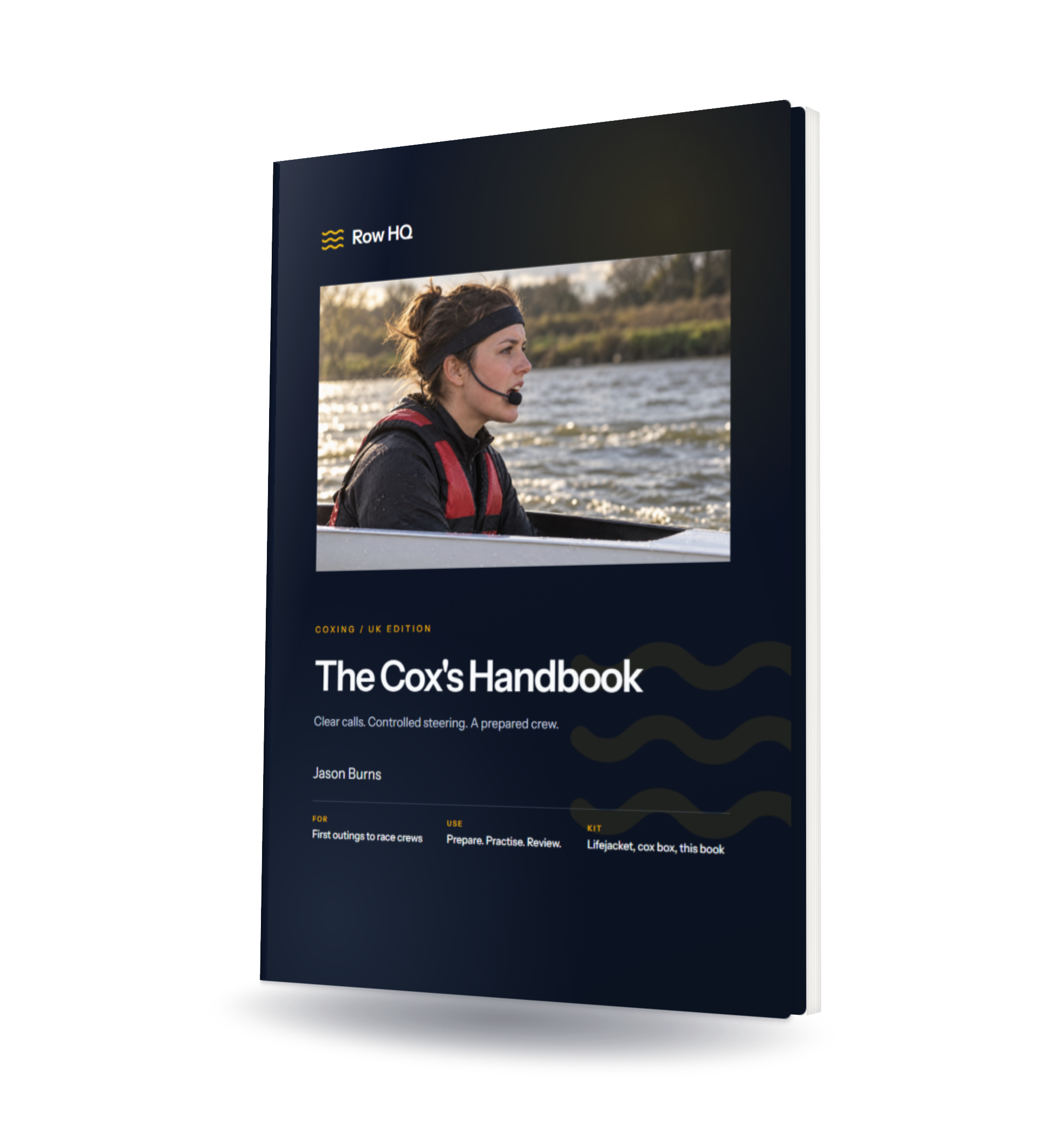
The honest answer in 30 seconds
Three jobs, in this order: keep the boat safe, hold a clean line, run a tight set of standard calls. Race talk, technique notes and clever rhythm calls sit behind those. Memorise the spine ("hands on", "ready to row", "row", "weigh enough", "easy oar"), remember the rudder line pulls the bow toward the side you push, and trust that the crew hears you without you having to lift your voice. Rowing NZ's safety material puts the coxswain on the hook for the shell from boat-up to boat-down, and Water Safety New Zealand guidance is the right baseline for any club working off open water. The rest of the page unpacks each piece into something usable on your first morning at the boatshed.
What does coxing mean?
Coxing means taking the cox's seat: steering the boat and leading the crew instead of rowing. The cox faces forwards, holds the rudder lines, keeps the boat clear of trouble, and delivers the calls that control rhythm and effort. In New Zealand club rowing the cox carries responsibility for the boat and crew for the whole outing.
Your first outing in the cox seat
Coxing is not noise. It is steering, safety, timing and the discipline of staying quiet between calls. This is what every new Kiwi cox should hear before they clip in for their first paddle.
I have sat behind enough coxes over the years to know the gap between a calm one and a frantic one is the biggest single thing a coxed crew can change without touching the rigging. The calm ones make a crew faster without ever talking about pace. The frantic ones turn a sharp eight into a mess of held-water restarts inside one ergometer-pace paddle. This handbook is the version I wanted handed to every new cox who walked into our boatshed - the four things that matter on day one, the calls in plain English, the Rowing NZ weight numbers, and the half-dozen rookie traps that catch almost everyone. It pairs with our coxswain glossary entry if you want the quick definitions first.
Why the coxswain matters more than the crew lets on
In any coxed shell the coxswain is the only seat looking forward. They are the only set of eyes that will spot a single sculler on the wrong line off the western shore at Karapiro, a moored launch tucked behind a buoy, or a clump of weed off Lake Hood after a southerly. They run each piece off the coach's plan, hold the rate through a race, and own the shell from the rack until it goes back. A flat outing with a sharp cox is a nuisance. A flat outing with a sloppy cox is a Sykes hull on a buoy chain. If you are also coaching, our coach tools notes build the cox into the planning loop rather than treating them as a passenger.
Four things every new cox needs on day one
You do not need the full call sheet before your first morning. You need four things to work. Get those right and the crew will paper over the rest while you learn.
Safety owns the boat
On the water you are the skipper. Know the circulation pattern on your home stretch, name the hazards out loud before the rack-up, understand exactly what "easy oar" and "weigh enough" demand from the rowers, and never push off without a buoyancy aid or lifejacket sized for the boat type and the water you are on.
Steer before you speak
A clean line beats any clever motivational call. Press the rudder string on the side you want the bow to swing toward, work in tiny early corrections, and keep the rudder out of the recovery whenever you can.
A spine of standard calls
"Hands on", "ready to row", "row", "weigh enough", "easy oar", "back it down" and "let it run" cover almost every first outing. Add the rest only when a situation actually demands it.
Volume earns the room
The crew can hear you. Stroke seat is a metre off your face and the cox box does the rest. Talk like you would over coffee, and lift the volume only for real moments - a build, a start, a safety call you cannot leave to context.
Standard cox calls and commands
The call vocabulary is small and standardised on purpose. The same words mean the same thing whether you are at North Shore, West End, Avon, Otago or a school programme on Karapiro, so any cox can drop into any shell and get a crew moving. The most common calls, plus what they ask for and when to use them, are below. You will hear spelling variants ("weigh enough", "way enough", "wayno") around the country - the action is identical.
| Call | What it means | When to use it |
|---|---|---|
| Hands on | Grip the shell ready to move it. | Standing at the rack or trestle before any lift. |
| Ready to lift, lift | Lift as a crew on the second word. | Off the rack, up to shoulders, or above heads. |
| Above head, ready, up | Press the shell overhead together. | Walking the boat past trestles or low obstacles. |
| Roll to waist, ready, roll | Bring the shell down from overhead to the hip. | Walking to the pontoon or about to set down. |
| Number off when ready | Each seat calls their number from bow once they are tied in and set. | Sitting at the pontoon before pushing off. |
| Ready to row, row | Take the first stroke on the second word. | Starting a piece or rolling away from a stop. |
| Row on | Pick rowing up again where you left off. | After a short pause for a coach instruction or traffic. |
| Weigh enough | Stop rowing immediately, blades out of the water. | Any controlled stop, mid-stroke included. |
| Let it run | Finish the stroke, hands away, blades off the water, and let the boat glide. | Closing a piece tidily so you can talk before the run dies. |
| Easy oar (or easy all) | Drop pressure, sit at the finish with blades flat on the water. | Slowing the boat or holding it steady. |
| Hold water | Square the blades in the water to brake the shell. | An urgent slow-down or a stop in traffic. |
| Back it down | Reverse-row by pushing the handle away from the body. | Backing off a bank, off the pontoon, or starting a spin. |
| Tap turn / spin | One side taps forward while the other side backs to swing the boat around. | Turning in a narrow channel or behind the start line. |
| Half slide, three-quarter slide, full slide | Cap the slide length on the recovery to the called amount. | Building strokes off a standing start, or technical drills. |
| Add bow pair / stern four / all eight | Layer additional rowers into a build. | Staged starts, drills and pre-piece warm-ups. |
| Sit the boat | Hold blades flat at the finish to balance the shell. | Sitting at a stop, or about to launch off the pontoon. |
| Power 10 (or Power 20) | Ten or twenty strokes at higher pressure or higher rate. | During a race move or to push a training piece harder. |
There are plenty more, and Karapiro race coxes pile on their own shorthand, but this set will carry you through almost any outing at a Kiwi club. Add fresh calls only when the situation forces it. The crew will let you know inside one stroke if you use one of these wrong.
Race calls vs training calls
Training calls are work-focused: technique fixes, pressure cues, rate moves, drill setup. They sit quiet, often barely above the bow wave, and aim at one thing at a time. In a training shell the coxswain is effectively a coach on the inside - eyes on the rowers, voice carrying whatever the launch is calling across the water.
Race calls run differently. The crew is at red line, somewhere between the 750 and the 1,500 of a Karapiro 2k, in genuine pain. You are no longer teaching. You are minding the last 5%, holding the rate, calling moves at the pre-planned markers, and selling the line home. Coxes who win Maadi A-finals or NZ Champs medals lean on a small set of pre-agreed messages, used at pre-agreed parts of the course. Improvising mid-1,500 is how you get tuned out.
You need to know how to push the buttons of these guys who are going through personal physical hell. You need to know what to say and when to say it to get them to squeeze that last fraction of effort from their bodies before they are completely spent. That is learned from working with people over time. It doesn't just happen.
Steering
Steering is the single biggest lever a coxswain has, and the one most first-timers misread. The rudder on a coxed shell is short and slow to bite. By the time the bow is pointed at the buoy line, you have already missed the correction window by ten strokes.
Steer small, steer early, steer with the blades buried at the catch when the hull is steadiest. Centre the rudder back the moment the bow lines up. Watch any senior Karapiro cox in the launch beside you - the rudder is twitching constantly in tiny inputs, almost never a single hard pull.
Five steering rules to scribble on the back of your hand
- Press the rudder line on the side you want the bow to swing toward - right line forward swings the bow to bowside.
- Steer at the catch with blades buried, never on the recovery.
- Tiny inputs early beat a big pull late, every time.
- Return the rudder to centre the instant the bow hits the line.
- Eyes 100m up the course, never down at your feet or at stroke seat.
Cox weight and minimum weight rules
Cox minimums depend on the rules used by your event. The table below gives two verified federation examples, checked on 21 September 2026. They do not establish local rules for other countries, schools or colleges. Read your event packet before weighing in.
| Federation | Senior men's crews | Senior women's crews | Deadweight rules |
|---|---|---|---|
| British Rowing (UK) | 55 kg minimum | 55 kg minimum | Accepted ballast close to the cox, not worn. Keep the exit clear; use one weight or as few items as possible. |
| USRowing (US) | 120 lb minimum | 110 lb minimum | Accepted ballast close to the torso, remaining in the boat throughout the race. Do not distribute it through the shell. |
British Rowing uses 45 kg for J15 and younger crews. Its coxes weigh before their first race each day in expected race clothing, including flotation equipment. The cox box does not count. USRowing-hosted youth regattas have a specific weigh-in exemption. Other events need their own check. Confirm ballast and timing with officials.
Sources: British Rowing rule 7-2-7, USRowing rules 4-105.1 and 4-106, and the USRowing-hosted youth policy.
Cox kit
Most of the gear lives at the club. The personal items below are the ones a new coxswain should square away before their first paddle. The cox box is almost always shared kit but every cox should be able to power it on, swap a battery and pair their own headset.
-
Buoyancy aid or lifejacket: A non-negotiable on every outing. Match the device to the boat type and the water - a coastal club out of Lyttelton or Mount Maunganui will set a different bar to an inland club on Karapiro. Follow Maritime NZ and Water Safety New Zealand guidance, and ask your club captain what is mandated for your home water.
-
Warm and waterproof layers: You are not rowing, so you do not heat up. Karapiro winter mornings sit near zero with mist on the lake, and Ruataniwha during Maadi week regularly drops to single digits before the first race of the day. Thermal base, fleece mid, windproof and waterproof outer. Cold hands and wet feet cost you sharp thinking.
-
A watch: For timing pieces, picking up stroke rate if the cox box is dead, and giving the crew a clean "30 seconds to row" countdown.
-
Cox box and headset: A cox box (Nielsen-Kellerman is the standard in most boatsheds) lifts your voice and shows rate and elapsed time. Most clubs own the boxes - you usually only need to buy your own microphone-headset.
-
A whistle: For emergencies, low-visibility mornings on Karapiro, and signalling another crew. Cheap, light, lives clipped to the buoyancy aid.
-
Phone in a dry bag: Emergencies only - not for use mid-paddle. The launch driver should carry one as well.
Common mistakes new coxes make
Every new coxswain runs through a version of these. The ones who become good are the ones who notice the pattern in themselves quickly and back off.
Talking too much
Filling silence with noise is the rookie tell. The crew goes deaf to the wash of words, and then misses the call that actually mattered. Say less. The gap between calls is the space the crew listens in.
Over-correcting on steering
New coxes throw a fistful of rudder, panic as the bow swings past the line, throw it the other way, and zig-zag down the lake. The fix is tiny corrections, applied early. If you are reaching for a big pull, the moment was ten strokes ago.
Steering on the recovery
Steering with blades out of the water is slow, unsettles the run and rocks the shell. Steer at the catch. If you are forced into a recovery correction to dodge a hazard, you missed the earlier window.
Coaching mid-piece
Long technique notes during a hard 2k are wasted. Save them for the debrief back at the boatshed. In the piece, short calls on rhythm and effort are the only thing a tired crew can actually use.
Treating every outing like Maadi week
Race-pitch volume across a steady-state paddle drains the crew and trains them to filter out your voice for the actual race. Match the volume to the moment.
How to climb the curve quickly
Coxing improves fast when you stand next to better coxes and pay attention. The new coxes who progress quickest at Kiwi clubs all do versions of the same five things.
-
Ride in the launch with a senior cox or coach: Watch how they pick the wind line on Karapiro, when they steer, what they say, and what they leave unsaid. Three mornings beside a senior cox in a tinny will teach you more than ten outings alone in your own boat.
-
Get hold of a recording: Maadi Cup, NZ Champs and Bond Cup A-finals turn up on YouTube every season. Rowing NZ shares race footage too, and most school programmes have race tapes from past Maadis. Listen to how an A-final cox shapes a 2k - the start, the settle, the first move, the third 500, the sprint - and copy the structure, not the lines.
-
Ask your crew for one thing each week: Stroke seat is your nearest mirror. After every outing put one specific question to them: "what is one thing I could do better next time?" Take the answer on, change it next session, and the working relationship hardens fast.
-
Read Rowing NZ coach development material: Rowing NZ and the regional associations (Auckland, Waikato, Bay of Plenty, Wellington, Canterbury, Otago among them) publish development content for coaches and coxes. It is pitched at what a beginner actually needs, not at what a senior cox already knows.
-
Record yourself: A cheap waterproof recorder taped to the buoyancy aid will surface things you cannot hear live - filler "ums", repeats, late calls, calls that ran on too long. Brutal listening for the first month, gold thereafter.
Safety responsibilities
Rowing NZ safety guidance is direct: the coxswain is responsible for the shell once it leaves the rack. That covers the crew, the boat and every other water user nearby. Your club also has obligations as a PCBU under the Health and Safety at Work Act 2015, and Water Safety New Zealand frames the wider club safety picture. In practice, every cox should do a handful of things on autopilot.
- Know the circulation pattern on your home water (up-river side, down-river side, where you turn, where you cross).
- Name the hazards out loud before launching (low bridges, weir gates, fishing zones, blind corners, regatta start lines, any Maritime NZ notice or temporary buoy field).
- Wear a buoyancy aid or lifejacket fit for the boat type and the conditions of the day, every outing.
- Carry a way to signal for help (whistle, phone in a dry bag).
- Know how to call a swamping and what to do if the shell takes water - especially relevant on the colder South Island lakes.
- Confirm every rower can release their feet - run a finger across the heel restraints before pushing off.
- In fog, strong current, lightning risk or a heavy southerly, escalate to the captain or safety officer rather than launching on a hunch.
If your club has not run a cox safety briefing this season, ask for one. Most of the rules read as common sense after you hear them, but no one is born holding them. Our free rowing risk assessment template is a sensible starting point for any club that has not revisited the document in a while.
Coxing FAQ
What does coxing mean?
Coxing means taking the cox's seat rather than a rowing seat: steering the boat, keeping it clear of trouble and making the calls that control rhythm and effort. The cox faces forwards and carries responsibility for the boat for the whole outing.
What does a rowing coxswain actually do?
A coxswain drives the shell, owns crew safety, runs each piece off the coach's plan, feeds back on rate and bladework, and lifts the crew through the second 1,000 of a 2k. They are the only seat facing forward and the only person who can read the water ahead, so on Karapiro or Ruataniwha they are effectively the skipper of that boat for the outing.
Do you have to be small to be a coxswain?
Your event's rules set the cox minimum and any exemptions. If you weigh less than the applicable minimum, carry the accepted deadweight. British Rowing and USRowing figures are examples, not local rules for this country. Ask your coach to confirm the governing rules, weighing arrangements and safe ballast placement before racing. There is no reason to restrict food or fluids to satisfy a crew preference.
How do you learn to cox quickly?
Three things move the needle. Ride in the tinny behind your top boat and watch how a senior cox reads the wind line on Karapiro. Pull up Maadi Cup or NZ Champs A-final video on YouTube and copy the shape of the race, not the exact lines. And after every outing ask stroke seat for one specific change to make next time. Coxes who do those three improve faster than coxes who only learn on the job in front of their own eight.
What is the most important thing a new coxswain should focus on?
Safety first, then a clean steered line. Race calls, motivation and rate work all sit behind those two. A quiet cox who keeps a Sykes eight in the right lane through a Karapiro cross-headwind is doing the job. A chatty cox who chats them into the buoy line of lane four during the senior schools final is not, and the umpire will tell you so before the crew does.
What is the difference between "weigh enough" and "let it run"?
"Weigh enough" (you will also hear "way enough" and the shortened "wayno") is an instant stop - blades come out of the water and drop into the lap. "Let it run" finishes the stroke first: hands away, blades off the water, and the shell glides on its own run. They are not swappable. Weigh enough is a controlled stop right now. Let it run is how you end a piece tidily so you can debrief before momentum dies.
Should a coxswain shout?
Volume tracks the moment. On a Tuesday steady-state lap of Karapiro your stroke seat is a metre away and hears a calm voice through the mic just fine. In the last 250m of a Maadi A-final you can lift, and at the start and the first move you should. Shouting flat through a 90-minute paddle just teaches the crew to mute you. Olympic cox Phelan Hill calls it "pushing the right buttons" - it is about timing, not decibels.
What kit does a coxswain need?
A buoyancy aid or lifejacket that suits the boat type and meets Maritime NZ guidance, warm waterproof layers (Twizel mornings get to single digits even in summer trial week), a watch, a cox box if the shell is wired, and a whistle clipped to the buoyancy aid. For racing you also need to be ready to step onto the scales with kit and any deadweight bag on the day.
Can I cox if I have never rowed?
Yes. Plenty of strong Kiwi coxes never rowed seriously and came through their school programme as a coxswain from year 9. Pulling on an erg helps with technical calls and crew empathy, but the actual job - steering, judgement, reading the boat, holding pressure under it - is independent of rowing background. Time in the shell and time with a coach will fill in the language inside a season.
Key takeaways
- Safety and steering carry the boat. Motivation and clever calls sit a long way behind those two.
- A short spine of standard calls beats a wide vocabulary used unevenly. Bed the basics in first.
- Steer at the catch, in tiny early inputs, and centre the rudder the moment the bow lines up.
- Know the cox weight numbers for your federation and pull the bulletin before any Karapiro or Ruataniwha event.
- Ride in the launch with senior coxes, watch Maadi and NZ Champs race footage, and chase one specific bit of crew feedback each week.
- Book a Row HQ demo to see how Kiwi clubs run cox session plans, attendance and crew sheets in one place, or browse the rowing glossary for the rest of the language you will pick up on the water.
Sources & references
- Rowing NZ - safety guidance and club resources — Rowing NZ (accessed May 17, 2026)
- Water Safety New Zealand - club water safety — Water Safety NZ
- Maritime NZ - safety on New Zealand waters — Maritime NZ
- British Rowing - Weighing Rowers and Coxes guidance (2023) — British Rowing
- Olympic champion Phelan Hill on what you need to know to be a great cox — British Rowing
- Uncovering the mystery of rowing's coxswain (Phelan Hill and Garry Herbert interviews) — Yahoo Sports
- Rowing Australia Rules of Racing 2025 (PDF) — Rowing Australia
- How to Speak Coxswain - glossary of standard cox calls — row2k
- Coxing for the First Time. Ever. — RowSource
- Coxswains: Take better command of your boat — RowSource
- Weigh enough vs. let it run — Ready all, row
- Row HQ coxswain glossary entry — Row HQ
- Row HQ cox box glossary entry — Row HQ
- Row HQ coach tools - session plans, lineups, attendance — Row HQ
- Rowing NZ - coach development and accreditation pathways — Rowing New Zealand
Calm voice, clean line.
- The Row HQ Team