Rowing Club Risk Assessment Template
A water-specific risk assessment written for rowing clubs, not adapted from a generic sports sheet. Download the PDF, walk your stretch of water with it, and adapt every line to your club. Free. Enter your email and we send you the download link.
What should a rowing club risk assessment cover?
A rowing risk assessment should cover the water (cold water immersion, capsize, currents, weirs, locks and obstructions), traffic (other craft, navigation rules, blind bends), conditions (darkness, fog, wind, lightning, heat), people (swim ability, medical conditions, juniors and supervision ratios) and land-side hazards (manual handling of boats, trestles, trailers and slippery ramps). Each hazard gets a likelihood score, a severity score and named controls, reviewed at least annually and after any incident. UK clubs should check their finished assessment against British Rowing's RowSafe guidance.
Download the template
How to use it
-
1
Walk your water. Do the assessment on your actual stretch - every club's hazards are different. A weir 400m downstream changes everything.
-
2
Score honestly. Likelihood (1-5) times severity (1-5) gives each hazard a risk rating out of 25. Anything above 15 needs a control that reduces it before crews go afloat.
-
3
Name the controls and the owner. "Be careful" is not a control. "No outings when the river is above amber board, checked by the duty coach before boating" is.
-
4
Set the review date. Annually as a minimum, plus after every incident or near miss, and whenever your circumstances change - new water, new boat types, new junior intake.
The hazards in the template
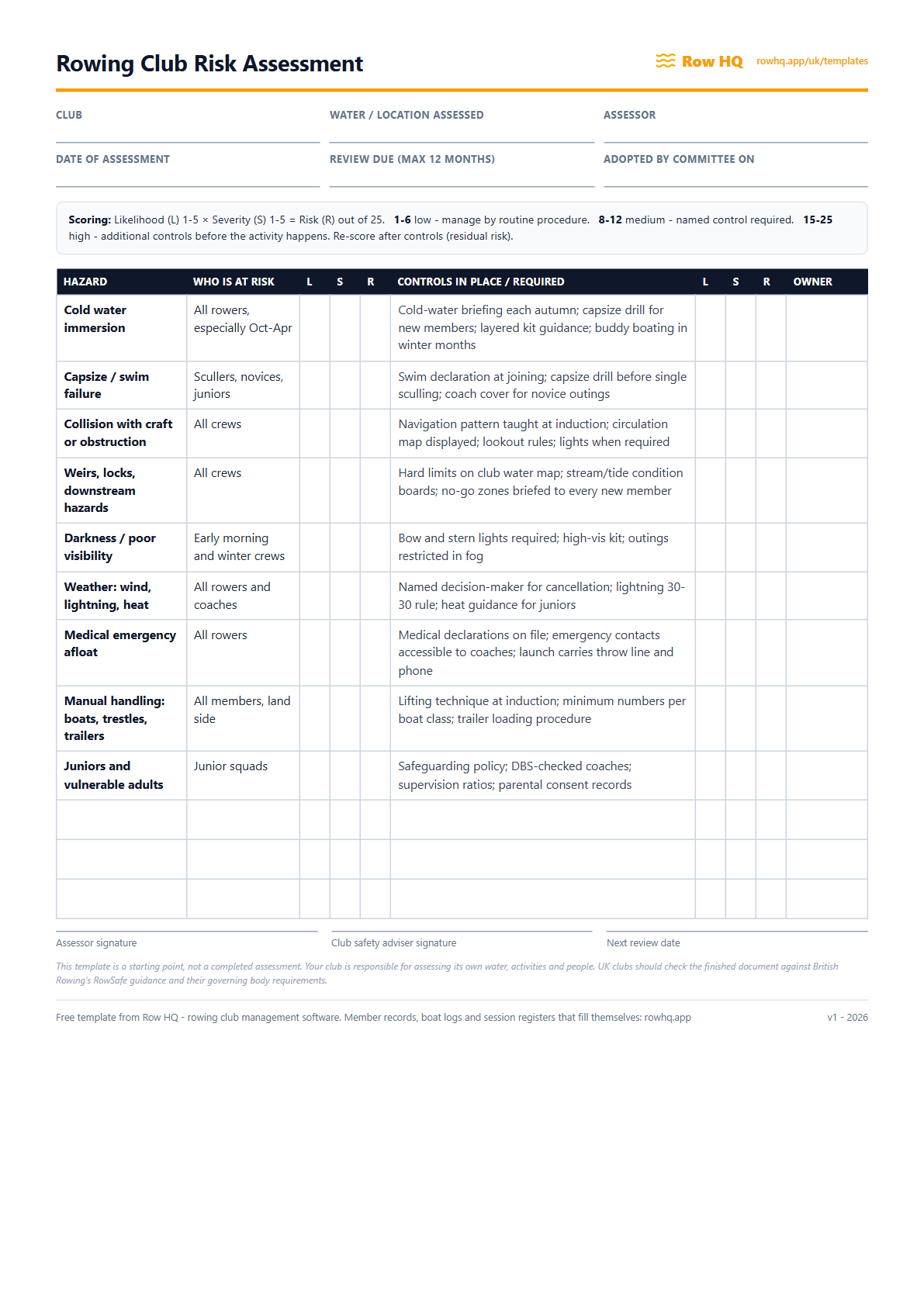
The PDF includes a scored row for each of these, with typical controls filled in as a starting point. Adapt every one to your own water and circumstances.
| Hazard | Who is at risk | Example controls in the template |
|---|---|---|
| Cold water immersion | All rowers, especially Oct-Apr | Cold-water briefing each autumn, capsize drill for new members, layered kit guidance, buddy boating rules in winter |
| Capsize and swim failure | Scullers, novices, juniors | Swim declaration at joining, capsize drill before single sculling, coach cover for novice outings |
| Collision with craft or obstruction | All crews | Local navigation pattern taught at induction, circulation map in the boathouse, lights and lookout rules |
| Weirs, locks and hazards downstream | All crews | Hard limits marked on the club water map, stream-condition boards, no-go zones briefed to every new member |
| Darkness and poor visibility | Early morning and winter crews | Bow and stern lights required, high-vis kit, restricted outings in fog |
| Weather: wind, lightning, heat | All rowers and coaches | Named decision-maker for cancelling, lightning 30-30 rule, heat guidance for juniors |
| Medical emergency afloat | All rowers | Medical declarations at joining, emergency contacts accessible to coaches, launch with throw line and phone |
| Manual handling of boats and trestles | All members, land side | Lifting technique at induction, minimum numbers per boat class, trailer loading rules |
| Juniors and vulnerable adults | Junior squads | Safeguarding policy, DBS-checked coaches, supervision ratios, parental consent records |
This template is a starting point, not a completed assessment. Your club is responsible for assessing its own water, activities and people. UK clubs should check the finished document against British Rowing's RowSafe guidance and their own governing body requirements.
The risk assessment is a document. The controls are data.
Half the controls in a rowing risk assessment are really record-keeping: who has done a capsize drill, whose swim declaration is on file, which members have medical flags, whether the launch driver's qualification is current, which boat is out and who is in it. That is exactly what Row HQ keeps live - member records, qualifications, emergency contacts and outing logs, filled in once and always current. Write the risk assessment with this template; run the controls in Row HQ; spend the time you save on the water. There is also a free interactive risk assessment tool if you want a guided version.
Set up your club freeFree for clubs of up to 20 active members.
Risk assessment FAQs
Does a rowing club legally need a risk assessment?
In the UK, any club with employees has a legal duty under the Health and Safety at Work Act to assess risks, and clubs with five or more employees must record the findings. Volunteer-run clubs are not usually caught by that specific duty, but they owe members and visitors a duty of care, and British Rowing expects affiliated clubs to have current risk assessments as part of RowSafe. Insurers commonly ask for them too. In practice: every rowing club should have one.
How often should the risk assessment be reviewed?
At least once a year, and immediately after any incident or near miss, any change to your water (new moorings, changed stream conditions, construction), or any change to your activities such as starting a junior programme or coastal outings. Put the review date on the document itself and name the person responsible.
Who should write the club risk assessment?
Someone who knows the water and the club - typically the club safety adviser or safety officer, with input from coaches and the committee. It should not be written by one person at a desk: walk the site, boat the stretch, and involve the people who coach on it. The committee should formally adopt the finished document so responsibility is clear.
What is RowSafe and how does this template relate to it?
RowSafe is British Rowing's safety guidance for rowing in the UK, covering topics from cold water and capsize to safeguarding and event safety. It is guidance rather than a template, so clubs still need to produce their own risk assessment documents. This template gives you that document structure with rowing-specific hazards pre-loaded; you should sense-check the finished assessment against the current RowSafe edition.
Related
Pair this with the incident report form - the risk assessment says what might happen, the incident log tells you what actually does. There is also a guided interactive rowing risk assessment tool and the full templates library.