Rowing Club Risk Assessment Template
A water-specific risk assessment written for rowing clubs, not adapted from a generic sports sheet. Download the PDF, walk your stretch of water with it - lake, river or harbour - and adapt every line to your club. Free. Enter your email and we send you the download link.
What should a rowing club risk assessment cover?
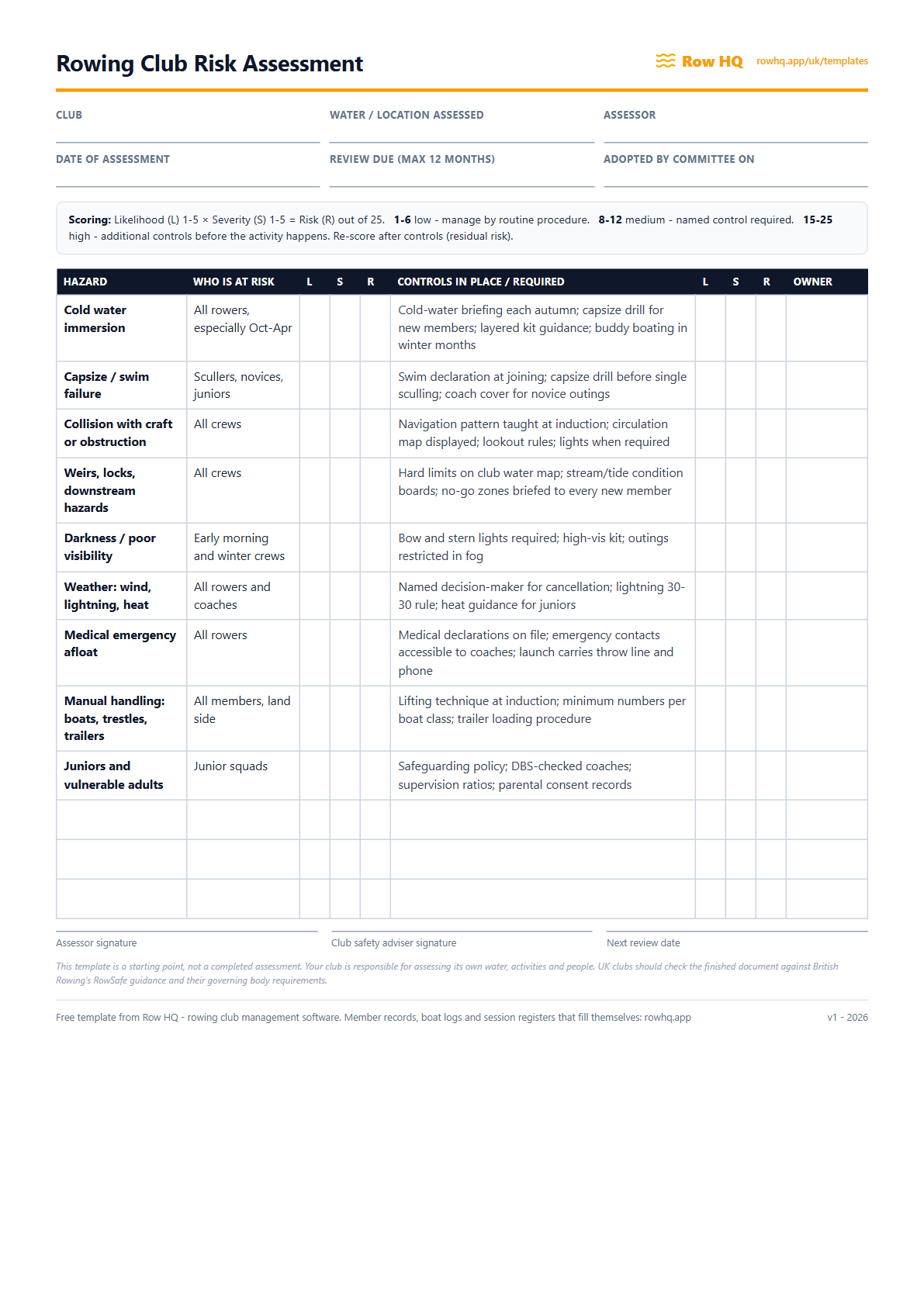
A rowing risk assessment should cover the water (cold water immersion - the defining Canadian hazard, especially around ice-out and freeze-up - capsize, currents, dams and obstructions), traffic (power boats, other craft, traffic patterns, blind points), conditions (darkness, fog, wind, lightning, heat), people (swim ability, medical conditions, juniors and supervision ratios) and land-side hazards (lifting boats, slings, trailers and icy docks). Each hazard gets a likelihood score, a severity score and named controls, reviewed at least annually and after any incident. Canadian clubs should check the finished assessment against Rowing Canada Aviron's safety guidance and their provincial rowing association's requirements.
Download the template
How to use it
-
1
Walk your water. Do the assessment on your actual stretch - every club's hazards are different. A dam 400m downstream, or a lake that only clears of ice in late April, changes everything.
-
2
Score honestly. Likelihood (1-5) times severity (1-5) gives each hazard a risk rating out of 25. Anything above 15 needs a control that reduces it before crews go on the water.
-
3
Name the controls and the owner. "Be careful" is not a control. "No rowing until the coach on duty has checked water temperature and posted the go/no-go call" is.
-
4
Set the review date. Annually as a minimum - the start of the season, right after ice-out, is the natural moment - plus after every incident or near miss, and whenever your circumstances change: new water, new boat types, new junior intake.
The hazards in the template
The PDF includes a scored row for each of these, with typical controls filled in as a starting point. Adapt every one to your own water and circumstances.
| Hazard | Who is at risk | Example controls in the template |
|---|---|---|
| Cold water immersion | All rowers, worst at ice-out and late fall | Water-temperature thresholds for the go/no-go call, cold-water briefing every spring, safety boat cover in the shoulder season, layered kit guidance |
| Capsize and swim failure | Scullers, novices, juniors | Swim test or declaration at joining, capsize and self-rescue session before single sculling, coach boat cover for novice outings |
| Collision with craft or obstruction | All crews | Local traffic pattern taught at orientation, circulation map in the boathouse, bow lights and lookout rules, awareness of power boats and paddlers |
| Dams, weirs and hazards downstream | All crews | Hard limits marked on the club water map, current and water-level checks before boating, no-go zones briefed to every new member |
| Darkness and poor visibility | Early morning and shoulder-season crews | Bow and stern lights required, high-visibility kit, restricted outings in fog |
| Weather: wind, lightning, heat | All rowers and coaches | Named decision-maker for cancelling, lightning 30-30 rule with everyone off the water, heat guidance for juniors in mid-summer |
| Medical emergency on the water | All rowers | Medical declarations at joining, emergency contacts accessible to coaches, safety boat with throw bag and phone |
| Lifting and moving boats on land | All members, land side | Lifting technique at orientation, minimum numbers per boat class, trailer loading rules, dock and ramp checks for ice in the shoulder season |
| Juniors and vulnerable adults | Junior crews | Safe sport policy, screened coaches with current criminal record and vulnerable sector checks, supervision ratios, parental consent records |
This template is a starting point, not a completed assessment. Your club is responsible for assessing its own water, activities and people. Canadian clubs should check the finished document against Rowing Canada Aviron's safety guidance, their provincial rowing association's requirements and their insurer's expectations.
The risk assessment is a document. The controls are data.
Half the controls in a rowing risk assessment are really record-keeping: who has done a capsize drill, whose swim declaration is on file, which members have medical flags, whether a coach's screening is current, which boat is out and who is in it. That is exactly what Row HQ keeps live - member records, qualifications, emergency contacts and outing logs, filled in once and always current. Write the risk assessment with this template; run the controls in Row HQ; spend the time you save on the water. There is also a free interactive risk assessment tool if you want a guided version.
Set up your club freeFree for clubs of up to 20 active members.
Risk assessment FAQs
Does a rowing club legally need a risk assessment?
Every club owes its members, volunteers and visitors a duty of care, and a current, written risk assessment is the clearest evidence that the club has taken that duty seriously. Rowing Canada Aviron and the provincial rowing associations expect affiliated clubs to manage safety systematically, and club insurers commonly ask to see risk assessments - some make coverage conditional on them. Clubs with paid staff carry workplace obligations on top. In practice: every rowing club in Canada should have one, and should be able to show it is reviewed.
How often should the risk assessment be reviewed?
At least once a year - the start of the season, when the ice goes out, is the natural point - and immediately after any incident or near miss, any change to your water (new docks, changed currents, construction, unusual water levels), or any change to your activities such as starting a junior program or moving to earlier mornings. Put the review date on the document itself and name the person responsible.
Who should write the club risk assessment?
Someone who knows the water and the club - typically the club safety officer, with input from coaches and the committee or board. It should not be written by one person at a desk: walk the site, row the stretch, and involve the volunteers who coach on it. The committee should formally adopt the finished document so responsibility is clear - in a volunteer-run club, that adoption is what turns a PDF into policy.
What safety guidance applies to rowing clubs in Canada?
Rowing Canada Aviron publishes national safety guidance for the sport, covering topics from cold water and capsize to coach screening and event safety, and the provincial rowing associations layer their own requirements for affiliated clubs on top - often tied to insurance. The guidance tells you what to manage; it does not write your document for you. This template gives you that document structure with rowing-specific hazards pre-loaded; sense-check the finished assessment against the current RCA guidance and whatever your provincial association requires.
Related
Pair this with the incident report form - the risk assessment says what might happen, the incident log tells you what actually does. There is also a guided interactive rowing risk assessment tool and the full templates library.