Short answer
A 200-athlete GPS, AGSV, CAS or IGSSA school programme plus the senior clubs alongside (Sydney Rowing Club, MUBC, Mosman, Banks BBC, Toowong) all face the same problem: thirty hulls, six tiers of lineup (1st VIII / 2nd VIII / 3rd VIII / U17 fours / development quad / learn-to-row), term-time clashes and a parent committee that reads every WhatsApp. Six habits compress the weekly workload into fifteen minutes a session. Pull confirmations early. Tier the fleet on rigging side, weight band and year-group. Pick hulls before crews, one short of capacity. Re-seat from last week's saved lineup, never start fresh. Publish at 8pm the night before via one notification in the app. Voice-note observations off the launch. An archiving coach toolkit compresses the routine; a printed depth chart still works.
Sunday afternoon disappears for most Aussie directors of rowing. Spreadsheet open, WhatsApp pinging, parents emailing, and the 1st VIII depth chart still has three question marks at 9pm. The job is harder than it looks. Rigging side, weight band, year-group, sculling capability, ergo PBs, championship eligibility, personal chemistry and parent politics all snap together against a fixed pool of Filippis, Hudsons and a couple of older Sykes coxed quads. The surrounding workflow still cuts to fifteen minutes a week if the right six habits hold. Here is the habit set that gets you there.
Six habits across the fleet
Whether the programme runs a 200-athlete GPS school like Riverview, an AGSV school like Scotch College, an IGSSA programme like Ascham, a CAS school like Cranbrook, or a senior club like MUBC, Mosman or Banks BBC, the same six habits apply. The bigger the fleet, the more the discipline pays. A director of rowing with eighty Year 9 athletes saves more than a club captain managing a single M8+. Both benefit.
Habit 1 - Confirmations land before you sit down to plan
Classic time sink: plan-then-chase. You start drafting Tuesday's session at 7pm Sunday, realise three athletes have not replied, lose forty minutes texting them individually. Reverse the order. Confirmations land first, the plan happens second, you never chase.
Drop the session call into the squad WhatsApp seven days ahead. Athletes hit thumbs-up to confirm or send a brief message if out. The 24-hour cutoff is non-negotiable. Silence reads as unavailable, and the seat goes to the next athlete in the depth chart. Two weeks of the rule holding and the squad self-corrects because nobody wants the seat lost to ambiguity.
School programmes add a parent angle. The fix is the same rule plus one extra step. Parents of Year 7-9 athletes confirm in a separate parent group; Year 10+ athletes confirm themselves. Mixing the two channels is where the chaos starts and where IGSSA captains lose the plot most often.
Habit 2 - Tier the fleet before filling seats
Aussie rowing programmes typically run on five or six dimensions. List them, populate them, and most lineup calls reduce to arithmetic:
- Rigging side - bow-side only, stroke-side only, or ambidextrous. Ambidextrous athletes are the secret weapon at Aussie school programmes because they unlock 4x+ depth and let you balance a 2nd VIII without binning the bow seat of the 1st VIII.
- Weight band - lightweight, open, heavyweight. Open is the dominant category at Aussie schools and most senior clubs.
- Year-group plus tier - Year 7-8 learn-to-row, Year 9-10 development, Year 11 senior, Year 12 1st VIII at schools. Senior clubs use M8+ / 2V8+ / 3V8+ / development. The IGSSA pathway through to a senior W8+ mirrors the boys-school structure beat for beat.
- Ergo PB - 2k for senior tiers, 1k or 500m for younger year groups. Track the trend, not just the absolute.
- Sculling capability - tracked separately because the coxed quad is central to Aussie junior rowing and the transfer from sweep is not automatic.
- Championship eligibility - for senior clubs running King's Cup, Queen's Cup or Australian Boat Race squads, this column matters. For school programmes, Australian Schools Championships eligibility plus inter-school regatta entry caps live here.
An ambidextrous open-weight Year 11 with a sub-7-minute 2k and a clean coxed-quad pedigree fits almost any boat in the shed. A bow-side novice still on a fixed-seat learn-to-row ergo has two boats. The matrix converts selection into pattern matching. You are not inventing crews, you are reading them off the grid. Old-school Aussie directors of rowing did the same thing on butchers paper for fifty years before the spreadsheet came along.
Habit 3 - Hulls before crews, and never to capacity
Walk the boatshed in your head before writing a single name. Which boats are race-ready, which are flagged for repair, which are booked out by another squad. Aussie clubs sharing a shed with sister schools or feeder programmes need this discipline more than most. Double-booking the only available 8+ at Mosman, Hawthorn or Toowong means somebody loses a session before the launch even starts.
Plan one hull short of capacity. The reasons it gets used: a heat policy trigger when the forecast hits 38C+, an athlete drops a phone in the Yarra and rides home with a parent, a tinny breaks down so launch coverage drops, a school bus runs late from the city campus across to the shed at the river. Plan for one of these to happen weekly because one of them does.
Habit 4 - Compound across weeks, do not start fresh
A 1st VIII that rowed cleanly last weekend is not a fresh selection problem this weekend. Open the saved lineup. Two athletes are unavailable Tuesday morning. Swap them out, leave the other six untouched. Three minutes of work, and the chemistry carries forward instead of being torn down and rebuilt each Sunday.
Same logic for coxed quads, U17 fours and pairs. The middle-pair partnership that anchored the 2V8+ at the GPS regatta carries forward into next weekend's pair. Athletes who clash on water keep clashing. Shuffling them around does not repair the chemistry, it merely relocates the friction. Lean on the data already in hand. A coach toolkit that archives reusable lineups makes swap-and-resend a thirty-second job; running it off a spreadsheet still works but eats ten minutes per crew, multiplied by every tier in the fleet.
Habit 5 - One WhatsApp message at 8pm, then radio silence
Pick 8pm and stick to it. Athletes and parents check phones around dinner, the message lands while people can act on it, and you have a clean cutoff for any reshuffles. Earlier than 8pm and availability changes are still bouncing around. Later than 9pm and athletes have already gone to bed for the 5am session.
After the message goes out, the lineup is locked. Real exceptions exist. An athlete reports a wrist niggle at 5am. A heat-policy trigger forces a move to ergos. A trailer hits a kangaroo on the way to Penrith. Outside those scenarios, the lineup stands. Squad members who used to negotiate seat changes via WhatsApp at 7am stop attempting it once the rule has been enforced twice.
Habit 6 - Voice-note observations from the launch ride home
After the session, while motoring back to the pontoon, voice-note what you saw. The bow pair in the 1st VIII finally locked in. Seven-seat in the 2V8+ blew through the rate change at 32. The coxed quad steered straight off the start for the first time in a fortnight. Filing the observation takes thirty seconds and means next Sunday's selection compounds on real data instead of memory.
The compound effect across a southern-hemisphere rowing year stacks fast. After roughly two months of disciplined capture an archive is in hand. Which lineups handle a chop on the Yarra, which crews need flat water at Penrith or West Lakes, which coxes pair cleanly with which strokes, which hulls have steering quirks that benefit from a steady sculler in bow. Selection becomes retrieval, not construction.
Patterns that wreck the workflow
A handful of failure modes show up across GPS, AGSV, CAS, IGSSA and senior club programmes. Watch for these:
Picking crews in the boatshed at 5:45am. Athletes are warming up, three of them lobby for seats, parents drop in via the carpark, and the launch coxswain needs the lineup before pontoon push-off. Fifteen minutes gone minimum. Make the call privately the previous evening once the depth-chart archive is open. Mornings are for coaching, not negotiating.
Letting parents redesign the depth chart. Aussie school programmes catch this more often than senior clubs do. A parent with strong views on their child's seat in the 1st VIII will email, message and corner the rowing master at the regatta. Polite but firm: selection rationale is documented, the director of rowing decides, and the appeal route is structured. Once the squad watches the rule hold twice, the background noise drops sharply.
Coach-by-committee. Three coaches each demanding sign-off across every boat will burn ten times the clock and still land on a poorer decision than one coach acting solo. A single name carries selection authority. Usually the director of rowing at a school, the head coach at a senior club. Assistant coaches contribute observations, the authority decides. Any other arrangement clogs the programme.
Ignoring summer camp data. Athletes at a December camp at Penrith International Regatta Centre or Lake Barrington produce more chemistry signal in two weeks than the previous month. Coaches who do not capture saved lineups during camp lose the data and start the autumn season cold.
When this method does not apply
The six habits cover regular weekly training across the fleet. They do not handle championship selection windows. The Australian Schools Championships, the Head of the Yarra, the King's Cup state-versus-state contest, the Queen's Cup, the Australian Boat Race between Sydney University and Melbourne University, the Australian Henley Regatta. Championship campaigns demand a longer planning horizon. Ergometer trials over weeks, on-water seat racing in matched fours, weight management programmes for the rare lightweight crew, and substantially more athlete consultation than weekly sessions warrant.
Heat policy weeks also break the routine. When the forecast triggers Rowing Australia's hot weather guidance and sessions move to indoor ergos or cancel outright, the saved lineup still matters. It tells the conditioning coach who pairs on the indoor bank. But the on-water selection workflow pauses.
For the rest of the year, weekly training is the dominant time sink. The six habits are built around making it disappear into a fifteen-minute Sunday window.
What to automate first
Pen, paper and a printed depth chart will run the six habits if necessary. Software earns its keep on three precise jobs. Rolling WhatsApp confirmations into a clean tally automatically. Archiving saved lineups so you re-use them rather than rebuild from zero. Pushing the 8pm message reliably even when the director of rowing is sideline at the Australian Schools Championships and out of phone reception. Australian Privacy Principles compliance also gets cleaner with a system that handles member data properly rather than ad-hoc spreadsheets shared across the coaching group.
The Row HQ coach toolkit stitches the three jobs into one workflow, so what used to be a Sunday afternoon becomes a quarter-hour Sunday evening task.
For a deeper dig into selection theory specifically, the earlier crew selection write-up walks through the three-leg sequence of ergo, on-water time piece and matched seat racing. For session attendance discipline across the AM water plus PM strength split, see streamlining training sessions.
Get your Sunday afternoon back
Directors of rowing across Aussie schools and senior clubs lean on the Row HQ coach toolkit to compress weekly lineup management from a Sunday afternoon into a quarter-hour window. Book a walkthrough.
Book a WalkthroughFrom the RowHQ shop
Printable PDFs written for club rowers. Buy once, keep forever.

The Cox's Handbook
Practical calls, steering, session drills and race plans for new and improving coxes. Includes five printable worksheets.
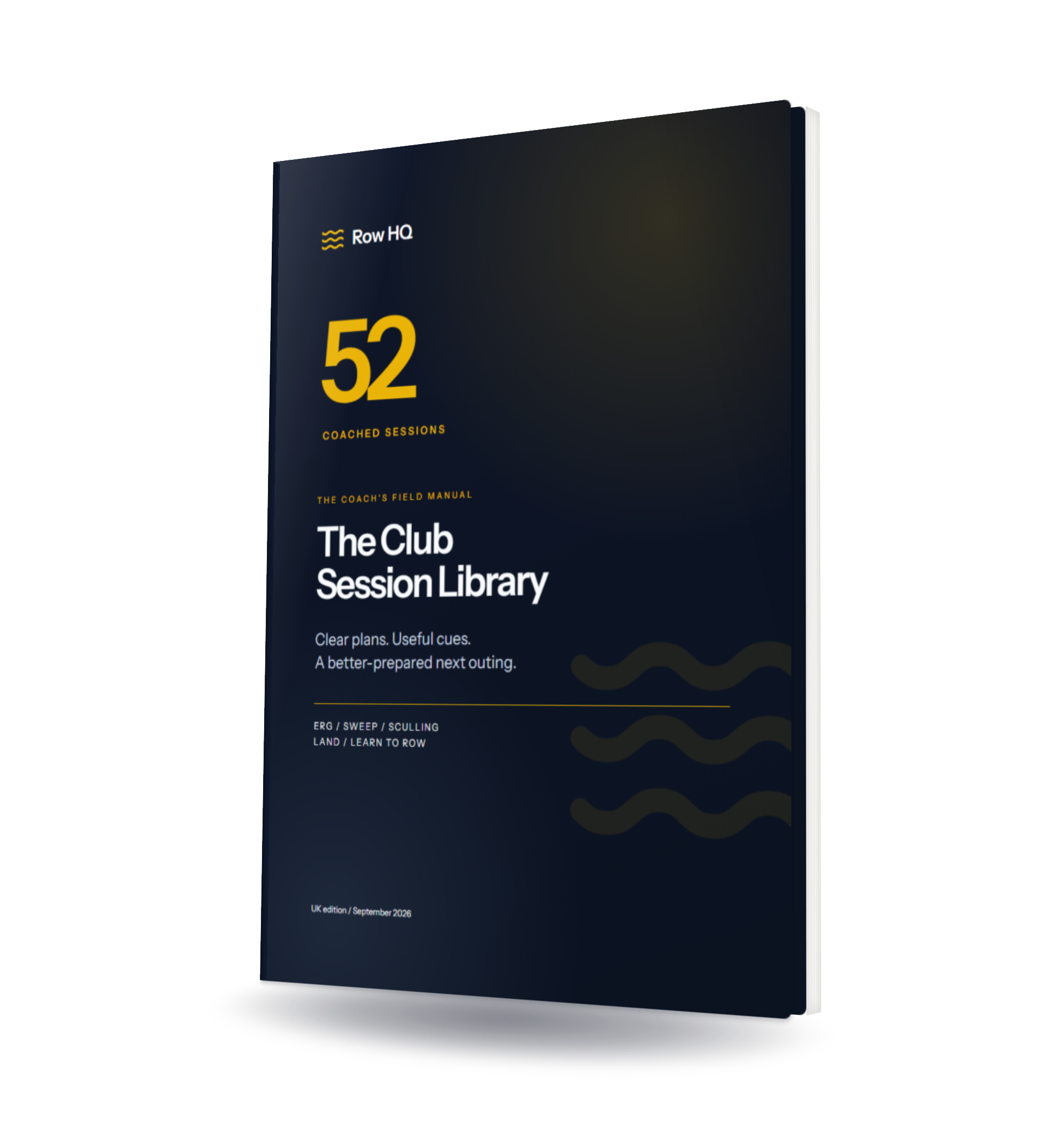
The Club Session Library
52 rowing sessions for club coaches, with an illustrated coaching PDF, editable CSV plans, two seasonal blocks and a printable coaching cheat sheet.
Sources & references
- Rowing Australia - Governance and member associations — Rowing Australia
- Rowing Australia - Coach Education pathway — Rowing Australia
- Rowing Australia - Hot Weather Policy and safety guidance — Rowing Australia
- Australian Schools Championships overview — Rowing Australia
- OAIC - Australian Privacy Principles — Office of the Australian Information Commissioner
- Row HQ - Coach tools feature page — Row HQ
- Row HQ - Training sessions feature page — Row HQ
- Row HQ - Member portal feature page — Row HQ
- Row HQ - Crew selection guide — Row HQ
- Row HQ - Streamlining training sessions — Row HQ