Coxswain
The coxswain is the person in the stern of a rowing boat steering the line, calling the race plan and managing the crew through every stroke. Coxes do not row. They hold the rudder, run the tactics, time the calls and direct the boat through a microphone wired to speakers along the spine. The role is essential in the eight and the coxed four; pairs, singles and quads race coxless.
The Coxswain: Steering, Race Plan and Crew Direction
A coxswain (cox) is the person who sits in the stern of a rowing boat steering, calling the race plan and managing the crew through the session. Coxes do not row. They hold the rudder lines, watch the line and the field, time the calls and run the race tactically through a microphone connected to speakers along the boat. The role is essential in the eight and the coxed four; pairs, doubles, singles and quads race coxless.
Also called: Cox, Cox'n
What the cox does on the water
In any session or race the cox runs three jobs simultaneously: steering the line, executing the race or session plan, and directing the crew.
Steering is the permanent background task. Rudder lines run from the cox's hands to the rudder beneath the stern. A small hand movement turns the boat. Good coxes hold a line with featherweight rudder use because dragging the rudder slows the crew - on a winding river course at a head race or down the Yarra in chop, steering is the difference between a winning time and a losing time.
Race plan execution is what separates a seasoned cox from a beginner. The cox knows the race plan cold - when to push, when to settle, when to call the third 500 move, when to call the sprint - and executes it on time under physical pressure no rower can deliver from inside the boat. In a 6-minute 2km race the cox is the only crew member not gasping for air, the only one with a clear view of the field, and the only one able to make split-second tactical calls based on what is actually happening rather than what was rehearsed.
Crew direction happens stroke to stroke. The cox calls rhythm, technical reminders (catch, finish, drive), pressure changes and morale through every minute of the piece. They know the personality of every rower in the boat and adjust the tone to the individual - the call that fires up the stroke seat will not work on bow seven. The best coxes balance the technical and the emotional inside a single sentence delivered in time with the catch.
Cox weight: check your Australian event rules
Cox weight matters because every extra kilogram is weight the rowers push through the water for the full duration of the race. The minimums exist to keep racing fair across crews from junior club through to the King's Cup eight.
British Rowing requires 55 kg for all crews except J15 and younger crews, where the minimum is 45 kg. Its 2025 rules remain unchanged for 2026. See rule 7-2-7. These figures do not establish local rules in other countries.
USRowing sets 120 lb for men's and mixed crews and 110 lb for women's crews. Required deadweight stays close to the cox's torso in the boat throughout the race. See the current Rules of Rowing. The youth weigh-in exemption concerns USRowing-hosted youth regattas; check your event packet.
Check the governing rules for your actual event. British Rowing and USRowing figures are examples, not local rules for this country. Ask your coach to confirm the minimum, any exemption and the accepted ballast arrangement before racing.
The cox box: dashboard, microphone, timer
The cox box is the cox's electronic dashboard - voice amplifier, stroke rate counter and piece timer in a single unit, with GPS speed, 500m split and distance added on the newer models. See the dedicated cox box glossary entry for the full breakdown of the unit itself.
The units Aussie sheds run most often are the NK CoxBox family (Mini, Pro and GPS variants - long the international standard) and the Coxmate GPS (Australian-made and -designed, popular at sheds across NSW, Victoria and South Australia). Both connect to a headset microphone the cox wears and to small speakers placed along the boat spine, typically one near each pair of rowers in an eight.
During training the readouts let the cox call rate changes precisely ("up two for the next twenty"), report split per 500m mid-piece, and timestamp drills against the squad session plan. During a race the cox uses the rate display to verify the crew is at race pace, the boat speed display to call the third-500 move at the right moment, and the timer to anchor the rest of the race plan.
Coxed and coxless Aussie boats
Different boat classes use different steering arrangements:
- Eight (8+): always coxed. There is no coxless eight in standard Australian competition - the boat is too long for foot-steering to work safely.
- Coxed four (4+): carries a cox, usually in the stern but sometimes in the bow on smaller training fours where a bow cox gets a clearer view of the line.
- Coxless four (4-): the 'straight four' - one rower's shoe pivots to a rudder cable, so a small heel movement steers. Standard at senior club and elite level in Australia.
- Pair (2-): coxless. Foot-steering by one of the two rowers, usually bow.
- Quad (4x), double (2x), single (1x): all coxless sculling boats. Quads and doubles use foot-steering; in the single the rower steers entirely by varying pressure between the two blades.
For the boats that do carry a cox, the difference in race quality between a great cox and a poor one is dramatic. Crew planning often turns on which crews get the strongest cox available, which is part of why most Aussie boatsheds are permanently in the market for more.
Starting as a cox at an Aussie boatshed
Most coxes start by accident. Someone smaller and confident turns up to a school programme or learn-to-row intake, an experienced coach asks if they want to try the cox seat, and the rest follows from there. The path then is time on the water, watching how experienced coxes run sessions, and absorbing the rhythms of how a boat moves through different conditions.
Formal pathways into coxing in Australia:
- Rowing Australia and state associations: progressive cox accreditation through safety, induction and on-water modules delivered locally.
- School and university routes: most AGSV, CAS, GPS and Sydney University-aligned programmes run their own cox induction alongside the state pathway, with St Ignatius' College Riverview, Scotch College, Shore School and Melbourne Grammar among the strongest coxing-development schools.
- State and regional bodies: Rowing Victoria, Rowing NSW, Rowing SA, Rowing WA and Rowing Tasmania deliver supplementary safety, steering and regatta-day courses that most senior club coxes pass through at some point.
The fastest path to becoming a useful cox is repetition - 50 outings deliver hundreds of drills called, dozens of starts sat through, and the rhythm of how a boat moves absorbed into reflex. Most Aussie boatsheds are short on coxes year-round, so a willing learner gets water time fast. The crew selection guide covers the context on how coaches build crews around the available cox pool.
If your first session in the seat is coming up, our first-time coxswain guide runs through the calls, steering and kit worth knowing before you push off.
pages/glossary/coxswain.body.college.heading
pages/glossary/coxswain.body.college.intro_html
pages/glossary/coxswain.body.college.ira_html
pages/glossary/coxswain.body.college.high_school_html
pages/glossary/coxswain.body.college.roles_html
pages/glossary/coxswain.body.certifications.heading
pages/glossary/coxswain.body.certifications.intro_html
- pages/glossary/coxswain.body.certifications.safety_html
- pages/glossary/coxswain.body.certifications.coxswain_series_html
- pages/glossary/coxswain.body.certifications.safe_sport_html
pages/glossary/coxswain.body.certifications.reality
Aussie and international coxes worth knowing
Australia has a long history of producing strong coxes at Olympic and international level. Toni Cochrane coxed Australian eights through the early 2010s and is still active in the King's Cup pathway. Internationally, Mary Whipple coxed the United States women's eight to back-to-back Olympic gold medals in 2008 and 2012 and is widely regarded as one of the great racing coxes of any era. Pete Cipollone coxed the US men's eight to Olympic gold at Athens 2004. At Henley Royal Regatta, the Diamond Jubilee Challenge Cup for women's eights regularly produces standout cox performances that get studied closely by ambitious Aussie coxes.
pages/glossary/coxswain.body.rowhq.heading
pages/glossary/coxswain.body.rowhq.intro_html
pages/glossary/coxswain.body.rowhq.training_html
pages/glossary/coxswain.body.rowhq.portal_html
Get the free Cox Calls Sheet
Coxswain FAQs
What does a coxswain actually do during a session?
The cox has three permanent jobs: steer the line, manage the race plan or session plan, and direct the crew through every stroke. Sitting in the stern (or sometimes the bow) facing the rowers, they hold a rudder line in each hand, watch the line and the field, and call rate changes, pressure shifts and technical corrections through a microphone wired to speakers along the boat. In training they run the warm-up, call drills, give technique feedback to individual rowers, manage rate-ladder pieces against the cox box, and report back to the coach after the row.
What are the minimum weights for a coxswain in Aussie rowing?
Your event's published rules set the minimum, including any junior exemptions. Confirm them with the organiser and coach. Do not assume World Rowing, British Rowing or USRowing rules apply automatically. A lighter cox carries accepted deadweight only where the governing rules require it. Check weighing, certification and ballast placement before race day.
Do coxes row?
No, coxes do not row. They direct the boat: steering, race tactics, calls and timing. The rowers move the boat with the oars; the cox provides the steering, the strategy and the voice. Some coxes train in singles or pairs to understand the stroke from the rower's perspective, but inside a coxed boat the cox holds the rudder lines, the microphone and the race plan - not an oar. That distinction defines the difference between coxed events (eights, coxed fours) and coxless events (coxless fours, pairs, doubles, quads and singles), where one rower steers via a foot-steering mechanism instead.
What does a cox box do for the cox?
The cox box is the cox's electronic dashboard. It amplifies their voice through speakers along the boat spine so every rower hears every call clearly even into a Penrith headwind, displays stroke rate live from a magnetic sensor on the stroke seat slide, and times pieces. GPS-enabled units (NK CoxBox GPS, Coxmate GPS, NK Speedcoach GPS) add boat speed, 500m split and distance covered, plus session logging that can be reviewed on a computer after the row. See the cox box glossary entry for the full breakdown of the unit itself.
Which Aussie boats need a coxswain and which steer themselves?
The eight (8+) is always coxed - there is no coxless eight in standard Aussie competition. The four splits into two variants: the coxed four (4+) carries a cox in the stern or bow, while the coxless four (4-, often called a 'straight four') uses a foot-steering mechanism where one rower's shoe is pivoted to the rudder. Pairs (2-), singles (1x), doubles (2x) and quads (4x) are all coxless. Some lower-grade school and learn-to-row eights and fours are coxed for safety regardless of the formal event type. Adaptive rowing categories sometimes use coxed boats with the cox handling steering for the crew.
How does someone start coxing at an Aussie boatshed?
Most coxes start at a school rowing programme or a senior club's learn-to-row intake. The first step is a cox induction covering steering, basic boat commands, on-water safety, capsize and emergency procedures. After that comes time on the water learning to feel the line, manage the rudder lightly so as not to drag the boat, and call drills under a coach's watch. Rowing Australia and state associations run progressive cox accreditation courses, and most school programmes run their own induction streams alongside. Aussie boatsheds are almost always short on coxes, so a willing learner gets water time fast.
Related
What Is a Regatta in Australian Rowing?
In Australian rowing, a regatta is a sprint side-by-side meet on a flat-water buoyed course, every crew starting on the...
What is an Ergometer?
An ergometer, or "ergo" as every Aussie shed actually calls it, is the indoor rowing machine that turns each pull on the...
What is a Rowing Shell?
A rowing shell is the racing hull a crew sits inside - long, knife-thin, and laminated from carbon fibre over a foam or...
Rowing Boat Types
Aussie rowing runs on eight standard racing shells: the single (1x), double (2x), pair (2-), quad (4x), straight four (4...
What is a Scull?
A scull is one of the two short oars a sculler grips, one in each hand. Sweep rowing puts a single longer oar across the...
What is Catching a Crab?
A crab is the moment a blade gets pinned under the surface while the hull keeps tracking forward. Forty kilos of moving...
The Cox Box: Amplifier, Stroke Rate Counter and GPS Unit
A cox box is the electronic unit the coxswain plugs into during every session. It amplifies the cox's voice through spea...
Stroke Rate: Cadence in Strokes per Minute
Stroke rate is the cadence of the rowing stroke in strokes per minute (spm). Aussie training bands run 18 to 22 for stea...
From the RowHQ shop
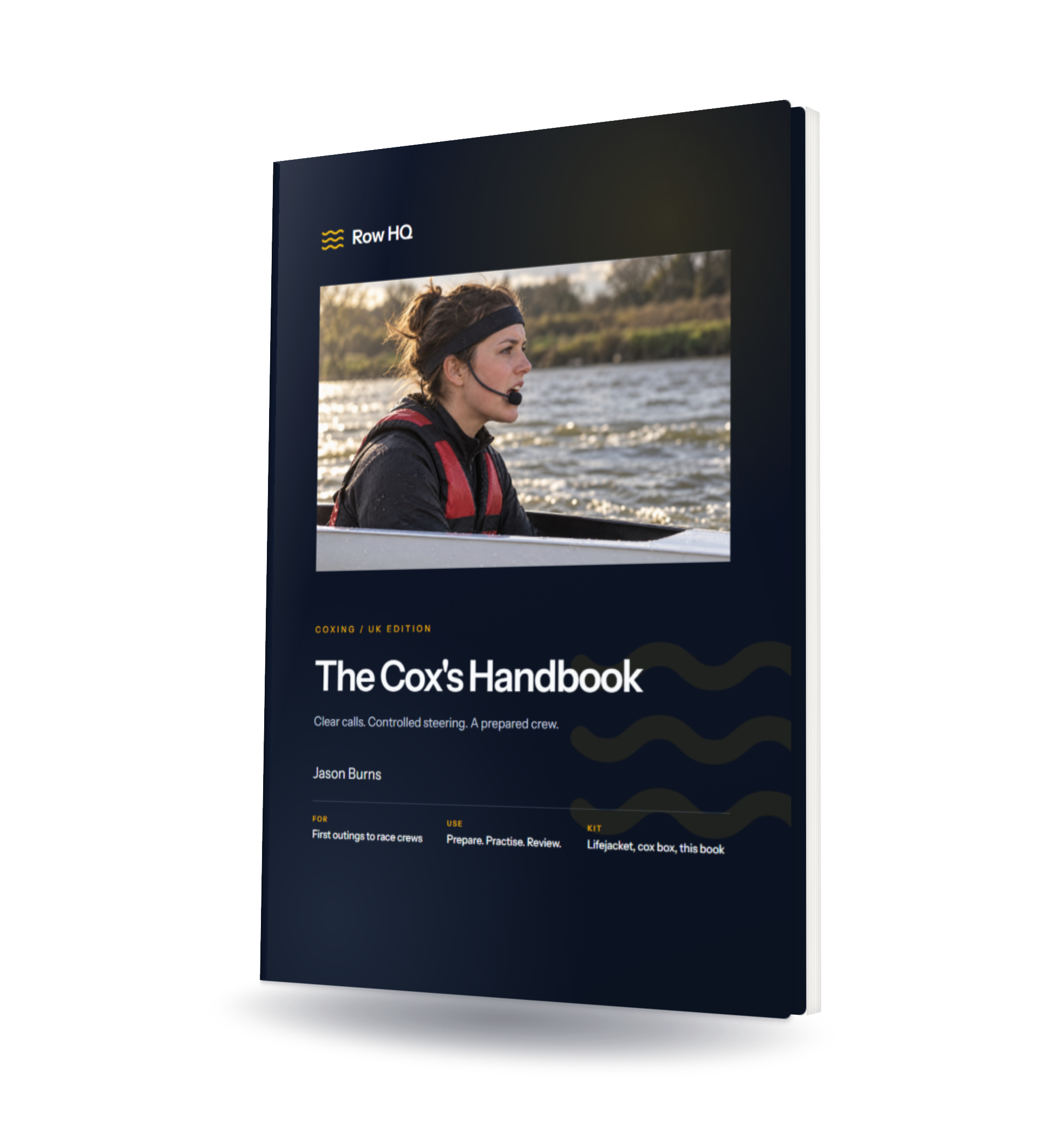
Printable PDFs written for club rowers. Buy once, keep forever.
Keep learning
Good coxing starts before push-off, with the crew and session plan settled. club software for Australian rowing clubs keeps those details ready at the boatshed. The rowing glossary explains the calls and equipment around the cox seat.
Coxes deserve better than a coaches' WhatsApp group.
Row HQ tells each cox which crew they are with, what session it is, and where to be - automatically, before they leave home. Built by rowers.