Ergometer
An ergometer, or "ergo" as every Aussie shed actually calls it, is the indoor rowing machine that turns each pull on the handle into a number on a screen. Concept2 has owned this space since the mid-1980s, and its RowErg is the box you will find lined up under the rafters at Sydney Rowing Club, Mercantile, Mosman and pretty much every GPS, AGSV and CAS boatshed in the country. Rowers sit on it when Penrith is closed, when the Yarra is brown after rain, or when a coach wants a clean read on fitness that has nowhere to hide.
What is an Ergometer?
An ergometer (ergo) is the indoor machine Aussie rowers train and test on between sessions at Penrith, on the Yarra or wherever the home shed sits. The Concept2 RowErg dominates Australian club, schools and Rowing Australia testing because its calibration has held steady for decades. The monitor reads out split, watts, calories, distance, time and stroke rate, and those numbers anchor squad selection at AGSV, CAS and GPS schools right through to the King's Cup pool.
Also called: Erg, Rowing Ergometer, Indoor Rower, Rowing Machine
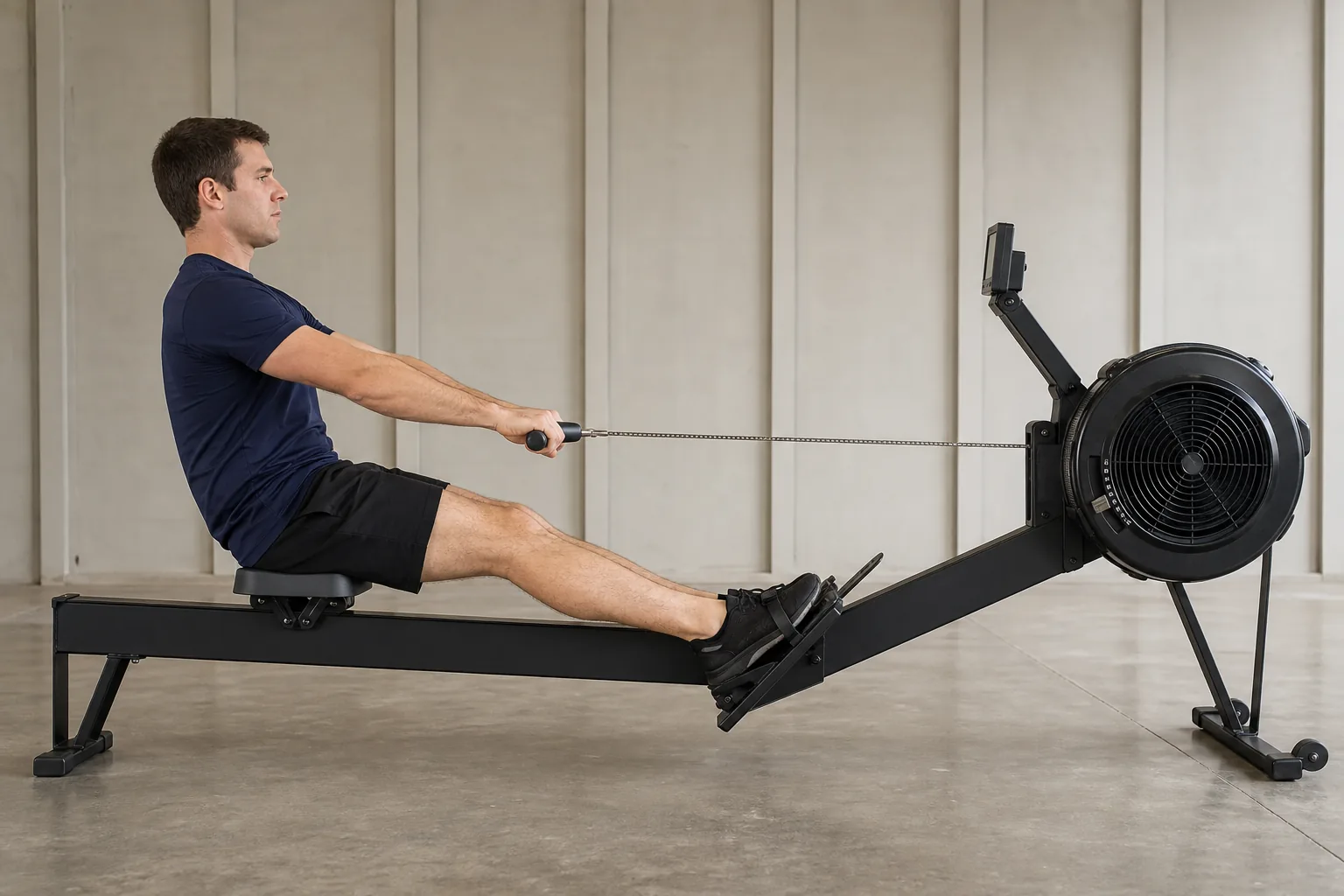
Ergometer, ergo, indoor rower: one and the same
Three names, one machine. "Ergometer" is the formal label (from the Greek ergon, work) and turns up in Rowing Australia testing paperwork, AIS sport science write-ups and the kind of coach reports that get filed at season end. "Ergo" is the word a Year 9 Toowong rower and a King's Cup squad member both use without thinking. "Rowing machine" or "indoor rower" is what the F45 down the road puts on the sign. All three describe the same bit of kit: sliding seat, footplate, handle on a chain, and a flywheel that fights you back.
How an ergometer works
Pull the handle and the chain spins a flywheel. On a Concept2 that flywheel is braked by air, on a WaterRower by water in a tank, on a Hydrow by magnets. The clever bit is what happens between strokes: a sensor watches how fast the flywheel slows down, calculates the work that went into the last stroke, and converts that figure into a notional metre rowed. The monitor stitches the numbers together in real time and serves them up as split, watts, distance and calories per hour.
On a RowErg, the lever sitting on the side of the flywheel cage (the damper) opens or closes vents to change how much air gets in. Set it on 1 and the flywheel spins up easily, like a light single. Wind it to 10 and it feels heavy, more like dragging an eight. The setting changes the feel of the catch, but the score depends on the drag factor, which the monitor reports in the More Options menu and corrects for damper position and the air temperature in the shed. Pop a split into the ergo pace calculator to convert it across to watts, kilojoules and projected splits over every standard test distance.
The Concept2 standard down under
The RowErg (the line previously sold as Model D and Model E) sits at the centre of Australian rowing testing because of one simple thing: Concept2 Australia ships the same box to every shed, the calibration has barely shifted in forty years, and a score pulled at Banks BBC in Brisbane can be lined up directly against a score pulled at Mercantile in Melbourne with no asterisk. That is why Rowing Australia uses it for talent identification, why the Australian Rowing Team trains on it at the Australian Institute of Sport (AIS), and why NSWIS, VIS and QAS scholar testing protocols are all written around the C2 monitor file.
WaterRower, Hydrow, NordicTrack, Echelon and the rest of the home-fitness brands build perfectly decent machines, but none of them publish to the Concept2 scale. A 2k personal best set on a magnetic rower at the gym does not convert. State selectors will not look at it, schools coaches will not enter it on the trial sheet, and the AIS will quietly ask you to come back when you have a Concept2 read. The ergo also strips out the synchronisation demand of a crew boat: the PM5 measures one rower in isolation, while race-day boat speed at Penrith depends on eight Aussies catching, driving and recovering in tight synchronisation with each other.
What the readouts mean
- 500m split: the projected time to cover the next 500 metres at your current effort. A reading of 1:45 means half a kilometre would take one minute forty-five at that pace. Every Aussie squad talks in splits before anything else.
- Watts: the power your pull is putting into the flywheel right now. Concept2 publishes the relationship as watts = 2.80 / (split_seconds / 500)^3. A 1:45 split sits around 268 W, a 1:30 split jumps to about 425 W.
- Calories per hour: roughly watts x 4 + 300, where the 300 covers basal metabolism. Handy for a session-load read, not a precision burn figure.
- Stroke rate: strokes per minute. UT2 in an Aussie programme is 18-20, UT1 sits at 20-24, AT lands at 26-28, race pace climbs into the 32-38 band.
- Distance: a metres-equivalent figure derived from flywheel deceleration. The shed floor stays where it is.
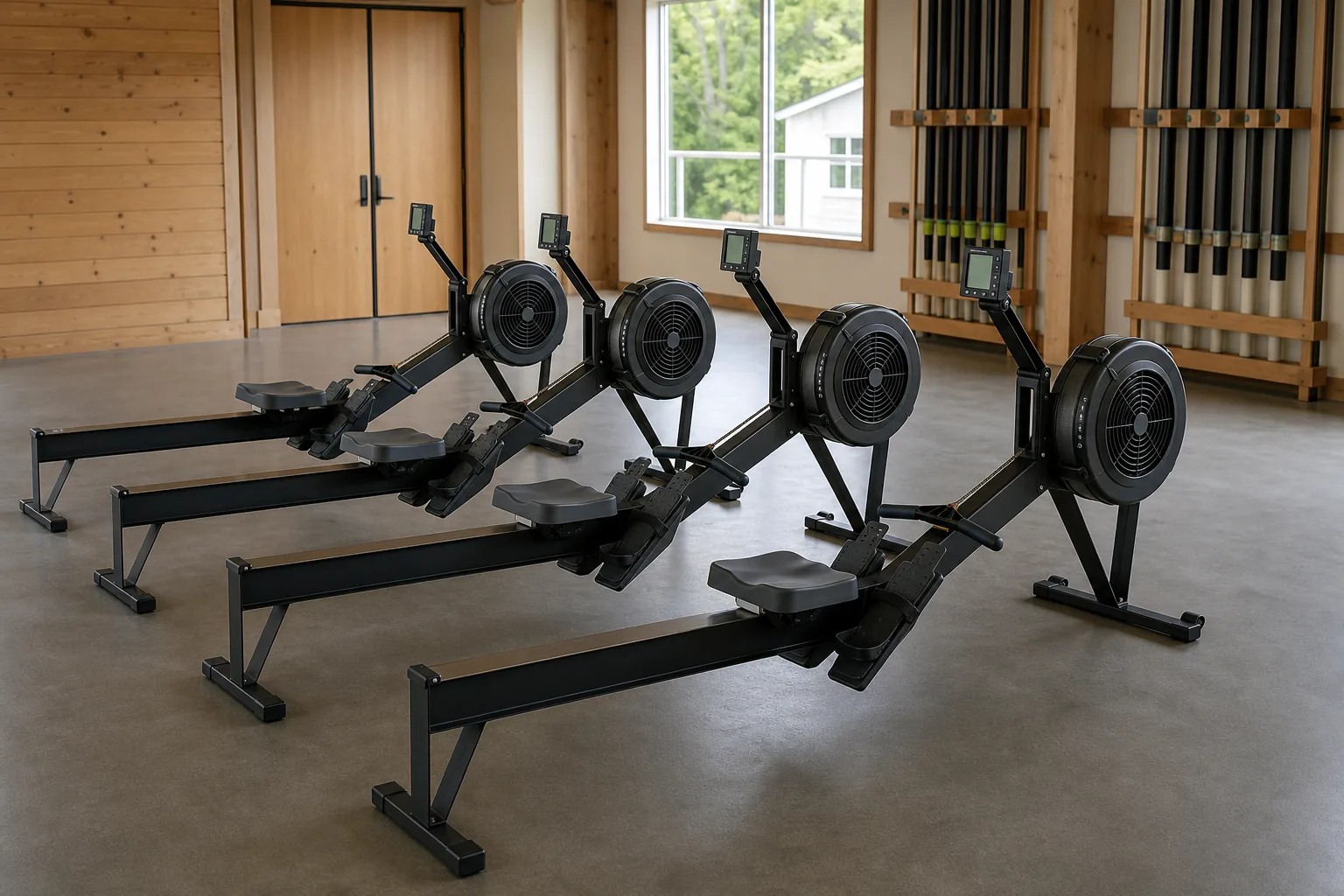
Where the ergo sits in Aussie clubs and schools
In an Australian programme the ergo earns its space three ways. First, it keeps the squad training when the conditions take the water out of play, whether that is a wild westerly on Sydney Harbour, a brown Yarra after a downpour, or a closed Penrith course for a regatta build. Second, it gives coaches a clean test bench: the 2k, the 5k, the 30-minute and the 6k winter benchmark are the pieces that get logged. Third, and this is the one parents see, the December and February ergometers at GPS, AGSV and CAS schools are the numbers coaches lean on when they start drafting seat-race orders for 1st VIII trials.
That data only earns its keep when it lives somewhere the coach can actually find it later. Recording every ergometer test, watching the trend over a Penrith camp or a pre-Head of the Yarra block, and ranking athletes against age and weight standards is the work that holds up when a parent rings asking why their daughter is in the 2nd VIII. Row HQ's coach tools file every ergo score against the rower it belongs to so the season trajectory is one click away.
The ergo test sheet in Aussie programmes
The standard ergometer pieces that turn up on Australian squad sheets:
- 2,000m (2k): the Olympic distance and the headline number in Aussie selection. Six to eight minutes for elite men, seven to nine for elite women. The 2k ergo is what AGSV, CAS and GPS coaches put at the top of the trial sheet.
- 5,000m (5k): aerobic test, 17-22 minutes for most senior squad rowers.
- 30 minutes: metres covered in half an hour at a sustainable threshold. The yardstick for endurance going into a winter block.
- 60 minutes: the long aerobic piece, sat at UT1 or UT2 and used to read who is built for the bigger boats.
- 4 x 2,000m or 8 x 500m intervals: race-specific power-and-recovery work, the kind of session that turns up six weeks out from Champs.
Each piece gets logged with the rower's bodyweight on the day (lighter athletes carry a power-to-weight handicap that the World Rowing weight-adjusted formula cleans up) and the drag factor the monitor reported during the test.
Indoor rowing as its own sport
The ergo has grown beyond the boatshed. The Australian Indoor Rowing Championships is the national 2k event and pulls entries from clubs, schools, masters and the Rowing Australia talent pathway every year. The World Rowing Indoor Championships sits above that on the global ladder, and Concept2's online challenges (the Holiday Challenge, the Million Metre Club, the team relays) run year-round. CrossFit boxes from Bondi to Fremantle now run their own ergo leagues, and plenty of Aussies who have never sat in a single have a respectable 2k to their name from a Saturday-morning class.
Ergometer FAQs
Is an ergometer the same as a rowing machine?
Yes. In Aussie rowing, "ergometer" or "ergo" is the term coaches and rowers use for what every commercial gym calls a rowing machine. Same box, different vocabulary. Competitive squads say "ergo" almost without exception, while the wider fitness market reaches for "rowing machine". The dominant make across Australian clubs, schools and the Rowing Australia testing programme is the Concept2 RowErg, distributed locally by Concept2 Australia and used at the Australian Indoor Rowing Championships, the AIS, NSWIS, VIS, and basically every GPS, AGSV and CAS shed in the country.
What does an ergometer measure?
It measures the work going into each stroke and translates that into a stack of live readouts: 500m split (projected pace for the next half kilometre), watts (the power your pull is putting into the flywheel), calories per hour, metres covered, elapsed time and stroke rate. The pace-to-power maths is Concept2's published equation, watts = 2.80 / (split_seconds / 500)^3, and the calorie figure runs at roughly watts x 4 + 300 to cover basal metabolism. The PM5 monitor shows the lot in real time and parks the file on a USB stick or in the Concept2 Logbook for the coach to pull later.
What is a good 2k ergo time in Australia?
Senior openweight men in an Aussie squad chase under 7:00 (a 1:45 split), with sub-6:30 (1:37) the elite line that opens the King's Cup conversation. Senior openweight women aim under 8:00 (2:00 split), with sub-7:15 (1:48) sitting in the national selection bracket. U19 boys at strong GPS, AGSV or CAS schools turn up trial day in the 6:30 to 7:00 band; U19 girls 7:30 to 8:00. These are also the entry standards that state pathway squads (NSWIS, VIS, QAS, WAIS) and the Rowing Australia national talent identification programme work from. Masters rowers should always run their raw time through the Concept2 age-graded percentile tables before lining it up against open figures. The ergo pace calculator converts any 2k into its equivalent split, watt output and projected longer-distance times.
How does an ergo measure distance when nothing is moving?
It measures distance the only way it can: through the flywheel. Each pull yanks the chain, the chain spins the flywheel against air resistance, and an internal sensor times how fast the wheel slows down between strokes. That deceleration gets converted into a per-stroke work figure, which the monitor then turns into a notional "metre rowed" as if a boat were being moved through water. The drag factor (Concept2's measurement of how aggressively the flywheel decays) lets the maths self-correct for damper position and how cold or warm the shed happens to be. The metres on the screen are a work-equivalent, not literal distance on the floor.
What damper setting should I use on an ergo?
The honest answer for almost every Aussie rower is somewhere between 3 and 5, not the 10 that gym lifters reach for. The damper changes how the catch feels (5 sits closer to an eight, 1 closer to a racing single) but it does not change your score. The number that matters is the drag factor in the More Options menu. Openweight men typically test at 130 to 150, openweight women 120 to 135, lightweight men 110 to 130, lightweight women 105 to 120. The Australian Indoor Rowing Championships and the World Rowing Indoor Championships are usually rowed at drag factors under 130. Pull the damper down before each piece, take the drag factor reading, then leave it alone.
Do ergo scores predict on-water speed?
Loosely, and with caveats every Aussie coach knows by heart. The ergo isolates power output in a fixed environment; boat speed at Penrith or on the Yarra depends on power, technique, balance, crew rhythm, water conditions and the wind reading on the morning. A faster ergo score normally means a faster rower in the boat, but the relationship is not one-to-one. State and schools selection panels treat the ergo score as one input alongside seat-racing, on-water timed pieces and coach assessment. Every Aussie programme has a story about the rower who pulls a stunning ergo and cannot seem to find the catch in the boat, and the one who is two seconds off the squad number on the machine but turns crews into rockets.
Related
What Is a Regatta in Australian Rowing?
In Australian rowing, a regatta is a sprint side-by-side meet on a flat-water buoyed course, every crew starting on the...
The Coxswain: Steering, Race Plan and Crew Direction
The coxswain is the person in the stern of a rowing boat steering the line, calling the race plan and managing the crew...
What is a Scull?
A scull is one of the two short oars a sculler grips, one in each hand. Sweep rowing puts a single longer oar across the...
Stroke Rate: Cadence in Strokes per Minute
Stroke rate is the cadence of the rowing stroke in strokes per minute (spm). Aussie training bands run 18 to 22 for stea...
From the RowHQ shop
Printable PDFs written for club rowers. Buy once, keep forever.
Learn-to-Row Starter Plan
A free 6-week introduction plan for brand-new rowers - on the water and on the erg.
Winter Base Builder
Build the biggest engine of your life over the off-season - 12 weeks of mostly-easy volume plus a strength routine, so you arrive at spring fast.
Keep learning
Erg testing gives coaches a repeatable fitness measure, but only if the results stay attached to the rower. rowing club management software keeps that history ready for selection discussions. Read the rowing glossary for more terms used by Australian crews.
Every ergo score against the right rower, automatically.
Row HQ files every ergometer test next to the rower it belongs to, plots the season trajectory across Penrith camps and the build to Schools Champs, and pipes the read straight into selection. Built by rowers and live at Oundle Town Rowing Club.