Stack workflow in 30 seconds
Setting V1, V2, V3, frosh 8+ and the 4+ options should take roughly 15 minutes per practice. Most NCAA staffs and scholastic programs leak hours because they reassemble lineups from a blank sheet each week. The fix is a repeatable six-step pattern: pull availability before the stack opens, sort athletes by selection bucket (varsity vs JV, port vs starboard, weight class, ergometer band), match boats to crews rather than the other way, recall last week's saved cards, publish to the team channel at a fixed time the night before, log what worked, archive the card. Set the stack privately - never in the bay with athletes watching. Software that holds saved boat cards compresses the routine. Pen and paper still works if the program is small.
Lineup management eats hours every week at most US rowing programs. It does not have to. The job is messy on its face: practice attendance, 2k testing under fatigue, weight class, port/starboard balance, and personal chemistry all need fitting into a finite fleet across V1, V2, V3, freshman 8+, plus the 4+ options the staff runs alongside the eights. The process around the job can be reduced to a six-step pattern that takes roughly 15 minutes per practice once the workflow is in place and the boat cards from last week are queued up.
The six-step lineup stack method
The pattern below works across the typical US program. Principles hold whether the roster is 18 athletes or 80. Time saved scales with program size.
Step 1 - Pull availability before you stack
The single biggest delay in lineup setting is not knowing who is actually showing up. Begin by chasing replies and you have already burned half an hour on text messages. Treat availability as something athletes own and the program collects.
Push practice calls at least a week ahead. Require an active confirmation - a tap, a click, a one-word reply that says yes. Treat anyone who has not confirmed by 24 hours before the practice as unavailable. The rule sounds harsh; in practice it cleans up confirmation behavior inside two weeks because rowers learn that ambiguity costs them their seat in the varsity boat.
The reverse pattern, where every athlete is assumed in unless they say otherwise, puts the work back on the coaching staff to chase. It does not scale once a program crosses 30 rowers. Active confirmation scales naturally because every athlete owns their own status on the team app.
Step 2 - Sort athletes by selection bucket
Once the confirmed list is in hand, sort it. The buckets that matter for most US programs are:
- Weight class - lightweight or heavyweight (women\'s lightweight is a key category for the handful of NCAA programs still carrying it).
- Side preference - port, starboard, or bilateral. Bilateral athletes are gold dust across the stack.
- Experience level - novice (typically freshman), JV, varsity. Maps directly to your fleet access rules.
- Ergometer band - if you select on PM5 performance for any boat in the fleet.
- Sweep or sculling - relevant for the small minority of US programs that train both alongside their sweep program.
Most US programs land on five or six buckets that combine in predictable ways. A varsity heavyweight bilateral sweep athlete fits almost any boat across the stack. A novice lightweight port-side rower has fewer destinations. Knowing the matrix in advance turns selection from a creative problem into a constraint-matching one - which is exactly the kind of problem software is better at than a tired coach at 11 p.m. on a Sunday.
Step 3 - Match boats to crews, not the reverse
Every shell has constraints. Rigger configuration, weight rating, novice access rules, maintenance status. List your available boats first with constraints attached, then start fitting crews. Pick the crew first and the boat second and you end up with the fleet-shuffle problem - three coaches realizing simultaneously that they all want the same Resolute eight on Saturday morning.
Leave one fewer boat in play than the math says. A last-minute scratch, an injury, a Filippi coming back late from the boatman - one of those will hit every week. A spare shell is a buffer. An overcommitted fleet is a problem nobody wants to solve at 5:30 a.m. with launches ready to go off the dock.
Step 4 - Seat boats deliberately
Inside a boat, who sits where matters more than most coaches admit on the record. The bow-stroke partnership in a four sets the rhythm for the whole shell. The middle pair in a V8+ is the engine room. Two athletes who row well together in a pair will usually row well together in larger boats. Two who clash in a pair will keep clashing across the rest of the season.
Use what is already on the record. If you have rowed a successful four with a specific set of pairings, start the next four from that lineup and only change the seats that have to change because of availability. This is the saved-card principle and it is what makes lineup setting compounding rather than starting from zero every Monday. Coach tools that hold saved boat cards make this trivial; working from memory or from notes works but takes considerably longer.
Step 5 - Publish once, lock down
Pick a time the night before. 6 p.m., 8 p.m., whatever fits the program. Push the final cards at that time and not before. Multiple updates as you negotiate the last two seats erode trust and double the messaging load on GroupMe. The squad learns to ignore early updates because they will change.
Lock the stack the moment it goes out. The exception is a genuine emergency - an athlete reports an injury that morning, a shell goes down to damage on the boathouse floor. For everything else, the lineup is the lineup. The discipline saves hours of last-minute swaps that cascade across the fleet.
Step 6 - Debrief and archive the card
After practice, take five minutes to log what happened. Which pairings clicked. Which boat ran clean. Anything that broke on the water or at the dock. Save the card so it seeds next week. Most US programs skip this step and pay for it every week by rebuilding the stack from a blank sheet.
The compound effect across a season is significant. By week eight the program has a library of working lineup cards covering every weather condition, every roster combination, and every boat in the fleet. Lineup setting becomes a matter of selecting from known-good pairings rather than building them from first principles every Sunday night.
Failure modes
Three patterns will break the method if left unchecked. Watch for them:
Setting boats in front of an audience. If lineup decisions happen in the boathouse with athletes watching the call land, you will be interrupted with questions you should not be answering live. Set the stack the night before, alone, with last week's saved cards open. Push the result; take questions in office hours.
Letting one athlete veto pairings. Most rowers have someone they would prefer not to row with. Sometimes the reason is real and sometimes it is preference dressed up as one. Accommodate every preference and you run out of options inside two practices. Be willing to seat awkward pairings for at least one full practice before deciding the partnership is wrong.
Coach-by-committee. If three assistants all want input on every boat card, decisions stretch ten times as long. One coach owns the stack. Other coaches advise. Decisions are made by the owner. Most NCAA programs run this through the head coach with V and JV staff feeding inputs.
Fall versus spring lineup logic
The method above runs for regular weekly practice through any phase of the season. Fall is largely about development: rotating freshmen through 2V seats, testing pair combinations, building toward HOCR with a wider lineup pool. Spring is consolidation: lineups settle by mid-March, V1 stops rotating except for injury cover, and the priority becomes refining the few combinations that will race IRA, Eastern Sprints, or Stotesbury. The six-step method holds across both phases; the saved-card library you build in the fall is what makes spring stack management efficient.
Championship selection sits outside the weekly cycle - IRA, NCAA, USRowing Youth Nationals all warrant their own longer-arc selection process with formal seat racing rounds, weight management for lightweights, and final boat sign-off. Different process, different timeline, deserves its own treatment. For weekly practice management through the regular season, the six-step pattern is the workflow.
Software that handles the stack
The method runs on a clipboard and a notebook. It runs better with software that holds the data persistence across the fleet. The specific jobs worth automating are availability collection (so confirmations roll up automatically), saved boat-card storage (so the program reuses rather than rebuilds), and notification (so the cards land with athletes reliably the night before, in the app or by email).
Row HQ's coach tools handle the three jobs together so the six-step method becomes a 15-minute weekly routine instead of a Sunday afternoon.
For a deeper look at the selection methodology specifically, read the seat racing and varsity selection playbook. For the practice-planning side of the same problem, see streamlining practice schedules.
Cut lineup setting to 15 minutes per practice
See how Row HQ's coach tools turn the six-step stack method into a routine the whole US coaching staff can run.
Request a DemoFrom the RowHQ shop
Printable PDFs written for club rowers. Buy once, keep forever.
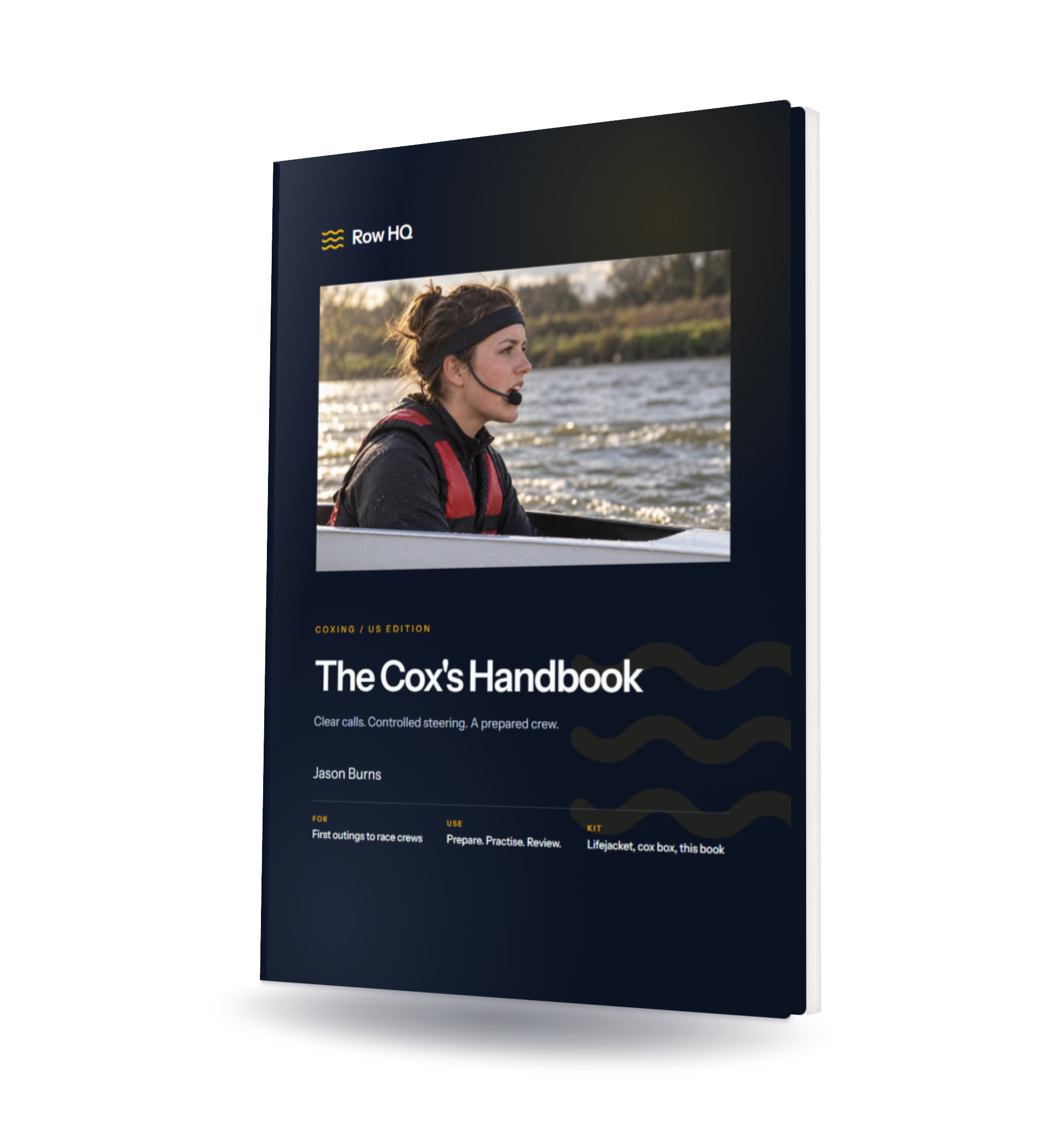
The Cox's Handbook
Practical calls, steering, session drills and race plans for new and improving coxes. Includes five printable worksheets.

The Club Session Library
52 rowing sessions for club coaches, with an illustrated coaching PDF, editable CSV plans, two seasonal blocks and a printable coaching cheat sheet.
Sources & references
- USRowing - Coach Education and SafeSport — USRowing
- USRowing - Membership and club governance — USRowing
- NCAA Rowing - Sponsorship and championship structure — NCAA
- IRA National Championship Regatta — IRA
- EARC - Eastern Association of Rowing Colleges — EARC
- Head Of The Charles Regatta - Event guidance — Head Of The Charles Regatta
- Stotesbury Cup Regatta — Stotesbury Cup
- Row HQ - Coach tools feature page — Row HQ
- Row HQ - Training sessions feature page — Row HQ
- Row HQ - Member portal feature page — Row HQ
- Row HQ - Seat racing and varsity selection guide — Row HQ
- Row HQ - Streamlining practice schedules — Row HQ