2k Prediction Calculator
Estimate a 2k from a completed 5k, 6k, 10k or 30-minute test. Compare three Riegel model scenarios and a 500m race plan. These are planning estimates, not confidence intervals.
Last updated:
How do you predict a 2k erg score?
The Riegel model predicts time at a new distance using T2 = T1 x (D2 / D1)^c. Enter a longer test result and compare exponents of 1.05, 1.06 and 1.07. When predicting a shorter distance, the larger exponent gives the faster time. These scenarios show model sensitivity; they do not prove your next 2k result.
Your test result
Typical 30-minute distances: 7,000m (recreational), 8,000m (club), 8,800m (OUA / university), 9,500m+ (national).
Test summary
Predicted 2k (likely)
Best case
Cautious
500m race plan for each prediction
Even-split target (recommended for most rowers). Negative-split alternative below.
| Prediction | Target time | 500m | 1000m | 1500m | 2000m |
|---|---|---|---|---|---|
Each quarter uses the same average split time. The target is an even-paced model, so no start or sprint allowance is added.
Negative-split alternative
Open 1.5 seconds slower than your target average and close 1.5 seconds faster. For your "likely" prediction of , that means:
Negative splits suit rowers who close strongly on hard pieces. If your third 500m is historically your worst segment, an even split is the more conservative and reliable choice.
Which test gives a useful 2k prediction?
Use a recent continuous test at a hard, sustainable effort. Enter the full rowing time and distance. Check the source split time against the monitor average. The output gives a predicted 2k time, split time and average watts. It estimates performance at another distance, rather than promising a future result.
| Source result | Useful information | Main limitation |
|---|---|---|
| 5,000m test | Sustained pace over a longer effort | Sprint ability may change the 2k result |
| 6,000m test | A familiar endurance benchmark | Test conditions and fatigue still matter |
| 30-minute distance | Longer-duration rowing endurance | A larger extrapolation to 2,000 metres |
| Recent 2,000m test | Your actual current performance | Not a prediction |
The Riegel equation uses a distance ratio and an exponent. For a longer source test, a larger exponent predicts a faster 2k. The best, likely and cautious outputs are model scenarios, not a statistical confidence interval or guaranteed race result.
Check your source result with the erg pace calculator before entering it here.
Set provisional session paces with the training pace calculator and replace the estimate after your next real 2k test.
Use the rowing pace chart to translate a target time into four equal 500m segments.
Method and further reading: Concept2 pace calculator and formulas
Frequently asked questions
How accurate are 2k erg predictions from longer tests?
There is no guaranteed error margin. The model extrapolates from one test distance to another. Pacing, fatigue, technique and your balance of endurance and sprint power affect the result. Keep the predicted erg score beside a real 2k result to see whether the model suits you.
Why does the calculator give three different times?
For a longer source test, exponent 1.07 gives the fastest predicted 2k, 1.06 the middle and 1.05 the slowest. The distance ratio is below one, so a larger exponent reduces predicted time. These are illustrative model scenarios, not confidence intervals.
How do I use the predicted split time?
Divide the predicted 2k time by four to find the average 500m split time. An even-paced plan holds that split time across all four quarters. Treat it as a planning target. A prediction does not establish that you can sustain the required average watts on test day.
Should I use a 5k, 6k, 10k or 30-minute test?
Use a recent continuous test with a known distance and finish time. A closer distance requires less extrapolation, but the effort must still be representative. If two tests produce different predictions, compare test conditions and average watts before choosing a target. Replace estimates with your next completed 2k erg score.
How the prediction works
The Riegel formula with three exponents
The equation is T2 = T1 x (D2 / D1)^c. It relates a completed time and distance to a target distance. This tool uses 1.07 for the fastest scenario, 1.06 for the middle scenario and 1.05 for the slowest. That order follows from a target distance smaller than the source distance. The exponents are assumptions, not measured confidence levels.
Why predictions are not perfect
A longer test and a 2k place different demands on endurance and sprint power. The Riegel exponent represents an assumed change in sustainable pace. It does not measure your physiology. A bigger difference between source and target distances means more extrapolation.
Pacing strategy decoded
An even-paced plan holds the same split time across all four quarters. A negative split starts slower and finishes faster. The displayed alternative changes each quarter by a fixed amount while preserving the total target time. Choose a plan with your coach and adjust it using completed test results.
Use this with the training pace calculator
Use the training pace calculator for provisional session targets and the rowing pace chart for split conversions. The erg score calculator explains weight and illustrative age adjustments. Replace predictions with a real 2k result when one becomes available.
From the RowHQ shop
Printable PDFs written for club rowers. Buy once, keep forever.
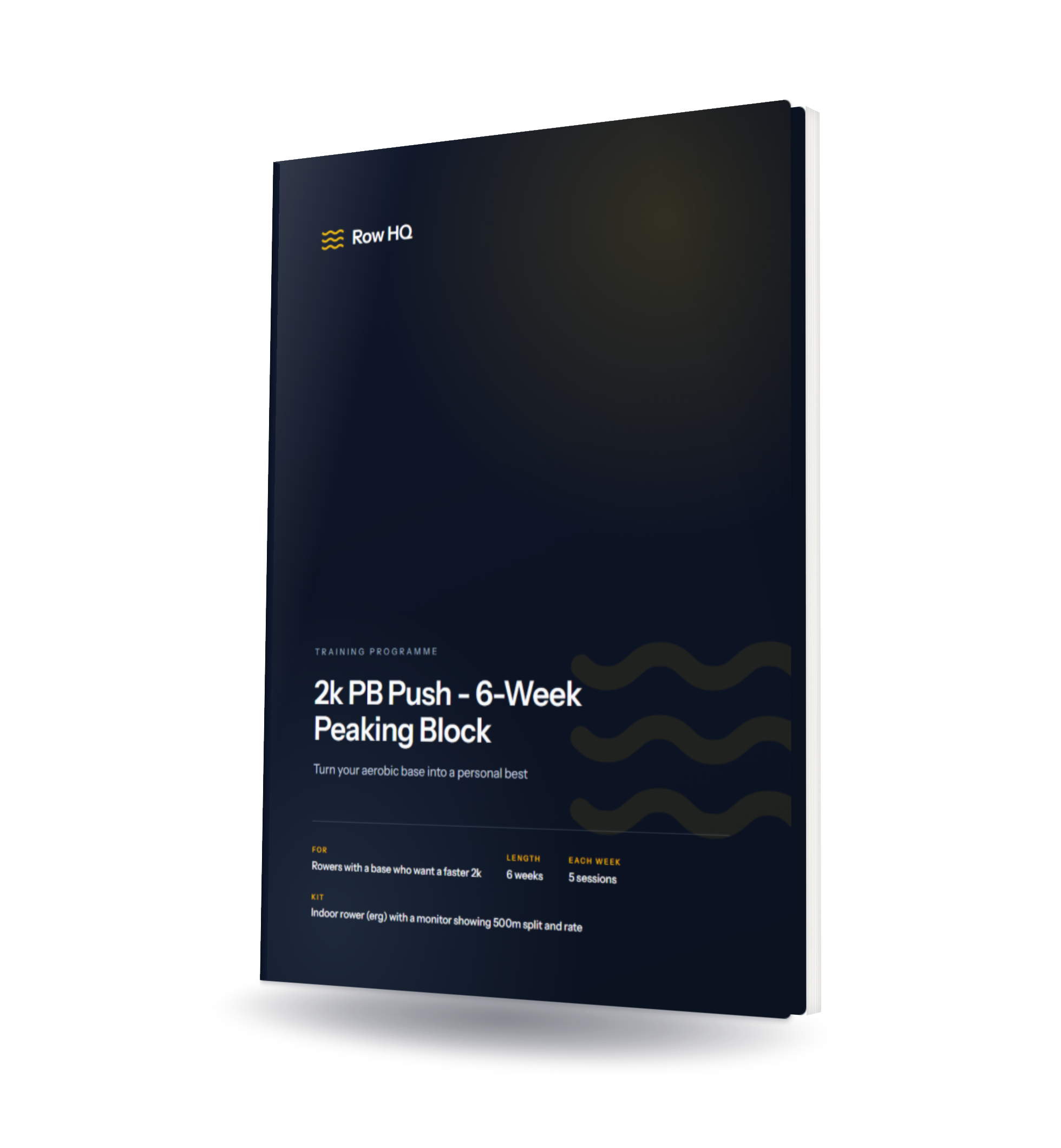
2k PB Push - 6-Week Peaking Block
Six weeks that turn an existing aerobic base into a 2k personal best - race-specific work, a proper taper, every pace scaled to your own time.

Summer Race Sharpener
Turn your winter base into race speed - 12 weeks that sharpen a big aerobic engine and peak you for a target regatta or 2k, every pace set from your own 2k.
Predicting your 2k is one calculation. Selecting a crew from squad predictions is twenty.
A coach at Argonaut RC or St Catharines RC building a senior eight wants 2k predictions for every crew member from their last 5k and 6k tests, weighted by recency, grouped by confidence band. That is what Row HQ does inside coach tools, pulling lineups from live data through training session tracking. See it in action or read the crew selection guide.
The step after predicting a 2k is tracking whether it happened. That is the job Row HQ's rowing club management software does for the whole membership, test after test.
More rowing tools
Erg Pace Calculator
Convert split to watts, calories and any distance.
Erg Score Calculator
Compare raw, weight-adjusted and illustrative age-adjusted scores.
Training Pace Calculator
UT2/UT1/AT/TR/AN paces and stroke rates.
Rowing Pace Chart
Visual pace chart with zone bands.
Bodyweight-Adjusted Erg Score
Compare lightweight and heavyweight 2k times on a fair scale using the Concept2 weight-adjustment formula.
Watts to Split Converter
Convert any wattage to a 500m split, or split to watts. Bidirectional Concept2 power calculator.