RCA Zone Pace Calculator
Type your 2k erg split into the box below and the calculator hands back target splits, stroke rate windows and watt outputs across all five training bands the NCCP coach pathway runs on (UT2, UT1, AT, TR, AN), plus an interval menu a coach at Argonaut RC, Hanlan, Don Rowing or Brentwood College can copy straight onto the boathouse whiteboard.
Last updated:
Why Canadian programs anchor every prescription to the 2k split
A rowing training pace calculator turns your current 2k 500m split into suggested session paces. It shows split time, stroke rate and approximate watts for UT2, UT1, AT, TR and AN. These ranges help plan indoor rowing sessions, but they do not replace an individual training assessment.
Your current 2k 500m split
Target 500m split
Stroke rate
Watts (approx)
RPE
Sample interval sets at
Print this for your coach
Use your browser's print dialog (Ctrl+P / Cmd+P) to export this page as a PDF. Or write the splits straight onto the boathouse whiteboard. The numbers behind the table are the same arithmetic Row HQ runs when a head coach programs the week\'s erg work for a CSSRA or OUA squad.
How should you use rowing training zones?
Start with a recent, representative 2k 500m split. Training zones suggest a 500m split for each session, but heart rate, breathing and perceived effort still matter. Heat, fatigue and recovery can change the pace you can sustain. If steady state work feels hard, slow down rather than chasing a calculated split.
| Session type | What to check | When to adjust |
|---|---|---|
| UT2 steady state | Comfortable breathing and controlled technique | Slow down if the effort keeps rising |
| UT1 aerobic work | Sustainable work across every interval | Reduce pace if later repetitions collapse |
| AT threshold work | A repeatable hard effort | Use the prescribed recovery |
| TR / AN intervals | Quality at the planned stroke rate | Stop chasing pace when technique breaks down |
The offsets shown here are a coaching rule of thumb, not a lactate test or a universal training plan. Two rowers with the same 2k time can have different aerobic endurance. Use an agreed club programme to decide volume and recovery.
If your latest result is over 5k or 6k, the 2k prediction calculator can provide a provisional starting point.
Use the stroke rate calculator to compare strokes per minute and distance per stroke during steady state work.
For a quick conversion from pace to power, use the watts to split converter and keep the same average watts throughout the interval.
Method and further reading: Concept2 pace calculator and formulas
Frequently asked questions
What are UT2, UT1, AT, TR and AN training zones?
Five intensity bands the NCCP coach education program and Rowing Canada Aviron pathway run on. UT2 (utilisation 2) is the easy aerobic band at 18 to 20 spm, paced to let you finish a sentence between strokes. UT1 (utilisation 1) sits one gear up at 22 to 24 spm where breathing turns deliberate. AT (anaerobic threshold) lands at 26 to 28 spm right at the lactate clearance ceiling, the band where most Royal Canadian Henley builds spend the back half of January. TR (transport) is your 2k race pace at 30 to 34 spm. AN (anaerobic) climbs above 36 spm and runs faster than 2k for short pieces, the sharpening currency used inside the final fortnight before CSSRA Championship or OUA Championship racing. Across a winter erg block at Western, Brock or McGill, the lion's share of metres lives in UT2 and UT1 with AT salted through twice a week and AN reserved for the taper.
How is training pace calculated from 2k split?
This calculator applies fixed offsets to your 2k 500m split. UT2 is 12-16 seconds slower, UT1 6-10 slower, AT 3-5 slower, TR around 2k pace and AN 3-5 faster. These are illustrative starting ranges, not measured physiological thresholds. Check each target against breathing, perceived effort and advice from your coach.
What is a sample UT2 erg session?
The session menu includes continuous rowing and longer intervals with brief recoveries. Choose a duration that suits your current training. UT2 should feel controlled and conversational. If the effort keeps rising, reduce the pace or shorten the session rather than forcing the calculated split time.
Can lightweight and masters rowers use the same zone offsets?
The calculator starts from your own 2k 500m split, but fixed offsets do not suit every rower equally. For a 7:00 2k, its UT2 range is 1:57-2:01. For 6:30, it is 1:49.5-1:53.5. For 7:30, it is 2:04.5-2:08.5. Use these as starting points and adjust for endurance, recovery and effort.
Five zones, mapped to what a Canadian week actually looks like
UT2: steady aerobic
UT2 is steady aerobic work. This calculator adds 12-16 seconds to your 2k 500m split and suggests 18-20 strokes per minute. Use comfortable breathing and controlled technique to judge the effort. The offset is a starting point; some rowers need a slower split time for genuinely easy work.
UT1: firm aerobic
UT1 is firmer aerobic work. This tool adds 6-10 seconds to your 2k 500m split and suggests 22-24 strokes per minute. Choose an interval length you can repeat without a large drop in pace. Reduce the target if fatigue turns the session into a harder workout than intended.
AT: anaerobic threshold
AT refers to anaerobic threshold training. The suggested range here is 3-5 seconds slower than your 2k 500m split at 26-28 strokes per minute. Your actual threshold cannot be established from a fixed pace offset. Use repeatable efforts and the recovery prescribed by your coach.
TR: transport (race pace)
TR is transport or race-pace work. The calculator uses your 2k 500m split and suggests 30-34 strokes per minute. The sample intervals include substantial recovery. Match the session to your experience and stop forcing the target when technique or pace deteriorates.
AN: anaerobic
AN is short anaerobic work. The illustrative target is 3-5 seconds faster than your 2k 500m split. The suggested stroke rate is 36 or more strokes per minute, but stroke quality matters. Short, hard intervals need suitable recovery and should fit within your wider programme.
Building the weekly structure
Decide the balance of easy work, harder intervals and recovery with your coach. Training history, upcoming events and fatigue all change that balance. Keep the drag factor consistent when comparing erg sessions. The data-driven training guide explains how to record the work you actually completed.
A stale 2k gives you stale zones. The 2k prediction calculator will estimate a current one from a longer piece, the 2k test pacing guide explains how to split the test evenly, and splits convert to watts in the erg pace calculator.
From the RowHQ shop
Printable PDFs written for club rowers. Buy once, keep forever.
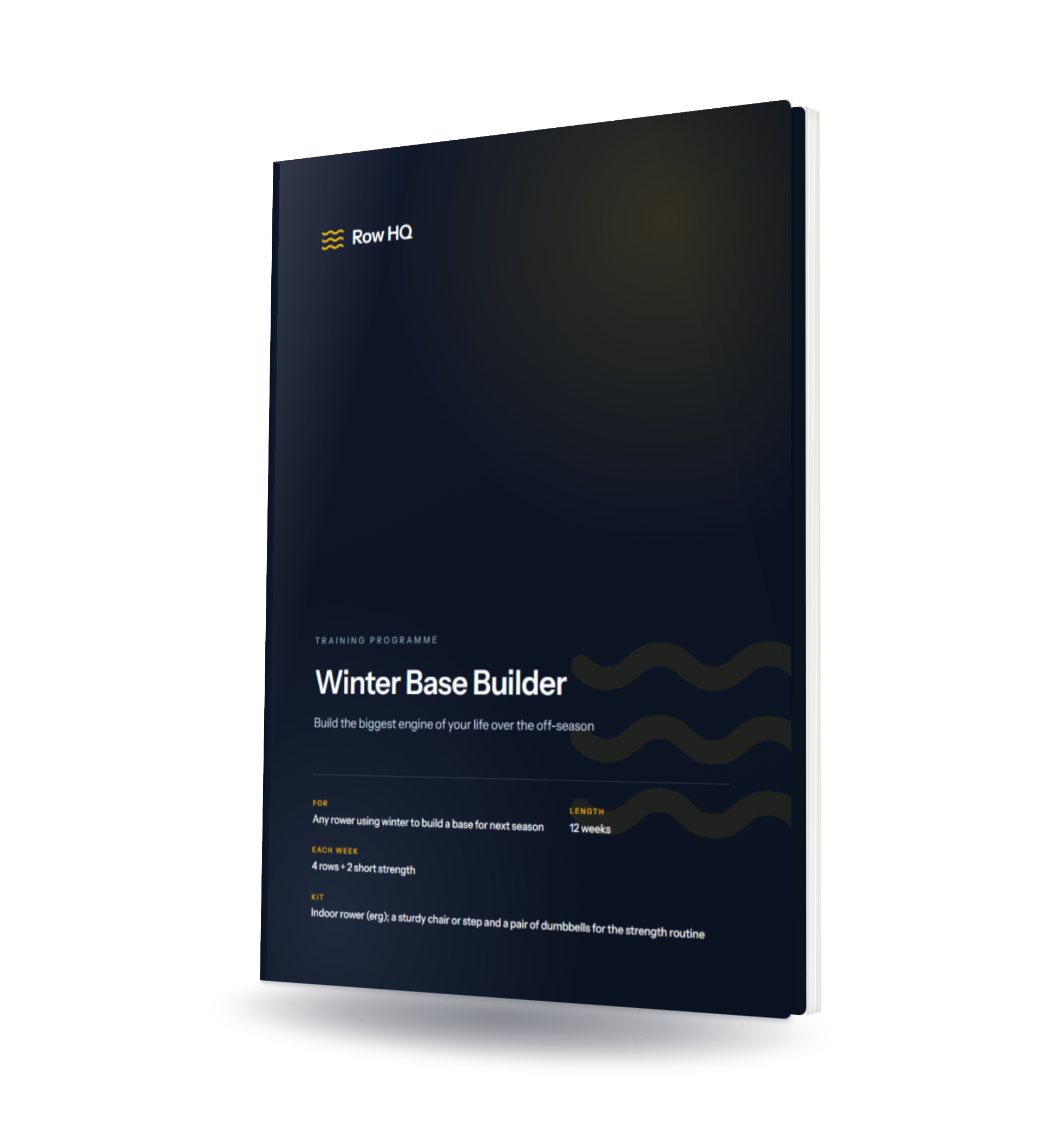
Winter Base Builder
Build the biggest engine of your life over the off-season - 12 weeks of mostly-easy volume plus a strength routine, so you arrive at spring fast.
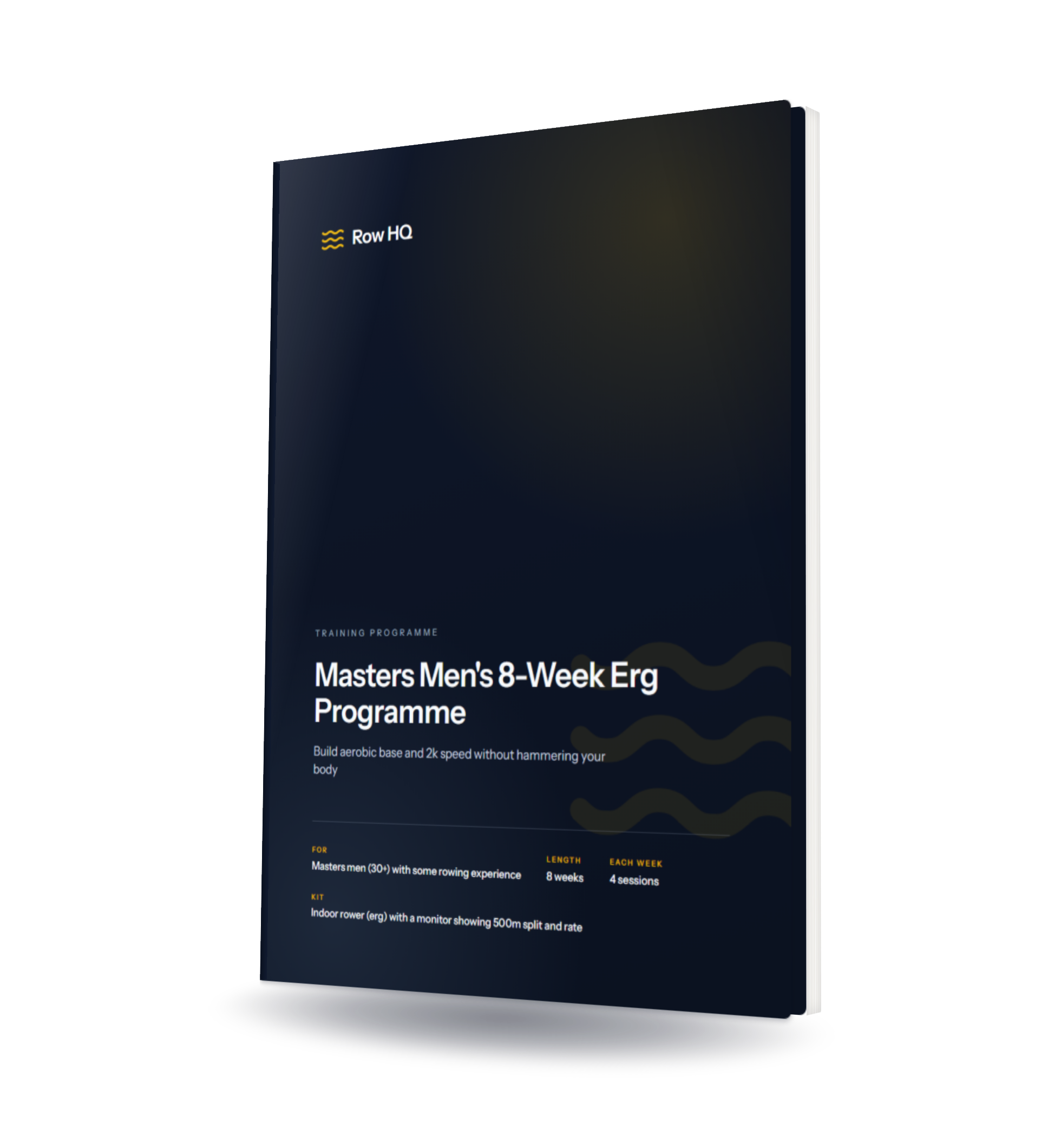
Masters Men's 8-Week Erg Programme
Eight weeks of structured erg training built around a masters body - science-backed, joint-friendly, and designed to protect your engine as you age.

The Club Session Library
52 rowing sessions for club coaches, with an illustrated coaching PDF, editable CSV plans, two seasonal blocks and a printable coaching cheat sheet.
A whiteboard scrawl works for tonight's session. A 36-week NCCP plan needs a database.
Knowing the zones is one piece. Seeing which zones a thirty-athlete squad actually trained in across the last twelve weeks is the harder piece. Row HQ logs each athlete's session pace against the RCA zone framework so a coach can spot the sculler grinding away in UT1 every Tuesday when the plan called for AT, or catch the crew running short on AN volume two weeks out from the Royal Canadian Henley. See it inside coach tools, the training session features, and inside the Oundle Town RC case study that shows how zone distribution gets tracked across a competitive senior squad.
More rowing tools
Concept2 Ergo Pace Tool
Convert 500m split into watts, kcal/hr and projected finish times across every Canadian test distance.
Ergo Score Percentile Tool
Weight-adjusted, age-graded percentile rank against Canadian benchmarks.
Rowing Pace Chart
Single-screen pace lookup with intensity bands colour-coded for trial week.
2k Prediction Calculator
Back-solve a credible 2k from a recent 5k, 6k or 30-minute test piece.
Stroke Rate Calculator
Calculate distance per stroke from rate and split, with training-zone references for rate discipline.
Drag Factor Calculator
Find the right Concept2 drag factor for your weight, experience and goal.