Coxswain
The coxswain is the non-rowing crew member who sits in a coxed shell to steer, call rate and direct race strategy. The cox does not pull an oar. The role is central in the eight and the coxed four; pairs, singles, doubles and quads race coxless across every Canadian regatta.
The Coxswain
A coxswain (cox) is the non-rowing crew member who sits in the stern (or in some shells the bow) of a coxed rowing boat to steer, call rate, manage the race plan and keep the rowers focused. Coxes do not pull an oar. They hold the rudder lines, speak into a microphone connected to hull speakers, and read live stroke rate and 500m split from the cox box. The role is essential in the eight (8+) and the coxed four (4+); pairs, singles, doubles and quads race coxless across all Canadian competitions.
Also called: Cox, Cox'n
What the coxswain does on the water
The cox carries three responsibilities through every Canadian outing and race: steer the shell, execute the race plan, and hold the crew together under load.
Steering is constant background work. Rudder lines connect the cox's hands to the rudder beneath the stern. A skilled Canadian cox steers with tiny, almost invisible adjustments because burying the rudder costs hull speed and the cox knows it. On a winding river course at a head race in the Welland Canal or the Trent-Severn system, a clean line can mean the difference between winning a category and being a few seconds off the podium.
Race strategy separates experienced coxes from new ones. The cox translates the pre-race plan into live decisions: when to push the rate, when to settle, when to call the sprint through the final 500m at the Royal Canadian Henley. In a 2,000m race that lasts about six minutes, the cox is the only person in the shell who is not gasping for air and the only one with a clear view of the whole field.
Motivation and feedback run between every stroke. The cox calls rhythm, technical reminders (catch timing, finishing cleanly, the leg-back-arm sequence) and morale when the crew starts to fracture in the third 500. The best Canadian coxes know each rower personally and know whose focus needs lifting at which point in the race.
Coxswain weight: confirm the rules for your Canadian event
Cox weight is a real performance variable. A heavier cox is additional mass the crew has to accelerate through the water for the full duration of the race. Weight minimums exist to stop programs from fielding very light coxes purely as a hull-speed advantage.
British Rowing requires 55 kg for all crews except J15 and younger crews, where the minimum is 45 kg. Its 2025 rules remain unchanged for 2026. See rule 7-2-7. These figures do not establish local rules in other countries.
USRowing sets 120 lb for men's and mixed crews and 110 lb for women's crews. Required deadweight stays close to the cox's torso in the boat throughout the race. See the current Rules of Rowing. The youth weigh-in exemption concerns USRowing-hosted youth regattas; check your event packet.
Check the governing rules for your actual event. British Rowing and USRowing figures are examples, not local rules for this country. Ask your coach to confirm the minimum, any exemption and the accepted ballast arrangement before racing.
What the cox box does for the coxswain
The cox box is the cox's on-water electronics package. It runs three jobs in parallel: amplifies the cox's voice through speakers fitted along the hull, tracks stroke rate from a sensor on the stroke seat's slide, and times the session or race. Modern GPS units add boat speed, 500m split and distance covered.
The NK CoxBox is the long-established standard on Canadian club, university and Royal Canadian Henley shells. The NK Speedcoach GPS 2 is a smaller GPS-only unit used in sculling and as a backup display in eights. The Coxmate GPS is a lighter alternative stocked at smaller Canadian clubs. All connect to a headset microphone the cox wears and to compact speakers spaced along the hull.
In training, the rate display lets the cox call precise adjustments ("up two for the next twenty") and report 500m split mid-piece. In racing, the timer anchors the pace plan and the rate sensor confirms the crew is holding the target number through each segment of the 2,000m course. At a Royal Canadian Henley final, the cox box readout is the difference between calling a rate push correctly and guessing.
Which Canadian shells carry a coxswain?
Coxing arrangements vary by shell class:
- Eight (8+): always coxed. There is no coxless eight in competitive rowing anywhere in Canada.
- Coxed four (4+): carries a cox in the stern or bow. Bow-loader fours give the cox a clearer sightline down the course and a lower aerodynamic profile.
- Coxless four (4-): foot-steered by one of the rowers, with their heel connected to the rudder via a small pivot. A sideways heel movement directs the shell.
- Pair (2-): coxless. One of the two rowers steers via the foot mechanism.
- Quad (4x), double (2x), single (1x): all coxless. Sculling shells use foot steering or, in the single, differential blade pressure alone.
For the shells that do carry a cox, the performance gap between a sharp cox and a poor one is dramatic. Crew planning at Canadian clubs regularly comes down to which lineups can be built around the strongest available cox in the squad.
How to become a coxswain in Canada
Most Canadian coxes arrive in the role without planning it. A coach notices someone with sharp spatial awareness at a learn-to-row session, asks them to try the cox seat, and the career begins. After that first outing, the path forward is time on the water, watching how experienced coxes run sessions, and absorbing feedback from coaches.
Formal training routes in Canada:
- Rowing Canada Aviron: cox safety and steering competencies sit within the RCA coaching and officiating framework, delivered through provincial bodies.
- Rowing Ontario, Rowing BC, Rowing Quebec, Rowing Nova Scotia: run cox development clinics and on-water certification sessions, often alongside junior and club regattas.
- Club, school and university programs: Canadian clubs, CSSRA-affiliated high-school squads and OUA / U Sports university programs run their own cox induction sessions covering local waterway rules, emergency procedures and standard drill calls.
The fastest way to become a reliable Canadian cox is repetition - calling a hundred drills, sitting through dozens of race starts, and building a feel for how a shell responds to different rudder inputs. Canadian clubs are almost always short of coxes, so anyone willing to commit to the seat will get water time. Read our crew selection guide for context on how coaches fit the available coxes into their lineup planning.
Heading out for your first row in the seat? Read the coxing guide for first-time coxswains for the calls, steering habits and kit to bring.
pages/glossary/coxswain.body.college.heading
pages/glossary/coxswain.body.college.intro_html
pages/glossary/coxswain.body.college.ira_html
pages/glossary/coxswain.body.college.high_school_html
pages/glossary/coxswain.body.college.roles_html
pages/glossary/coxswain.body.certifications.heading
pages/glossary/coxswain.body.certifications.intro_html
- pages/glossary/coxswain.body.certifications.safety_html
- pages/glossary/coxswain.body.certifications.coxswain_series_html
- pages/glossary/coxswain.body.certifications.safe_sport_html
pages/glossary/coxswain.body.certifications.reality
Notable coxswains in rowing history
The most decorated Olympic cox is Garry Herbert (Great Britain), who called the famously dramatic comeback victory in the coxed pair at Barcelona 1992 for Greg and Jonny Searle. Mary Whipple coxed the United States women's eight to consecutive Olympic gold medals at Beijing 2008 and London 2012 and is widely regarded as one of the best racing coxes of the modern era. Pete Cipollone coxed the US men's eight to gold at Athens 2004. Canada has produced strong club and university coxes through the Rowing Ontario, Rowing BC and Rowing Quebec development pipelines, and the Royal Canadian Henley eight final routinely turns on sharp cox calls in close finishes.
pages/glossary/coxswain.body.rowhq.heading
pages/glossary/coxswain.body.rowhq.intro_html
pages/glossary/coxswain.body.rowhq.training_html
pages/glossary/coxswain.body.rowhq.portal_html
Get the free Cox Calls Sheet
Coxswain FAQs
What does a coxswain actually do?
The cox carries three responsibilities through every Canadian outing and race. Steer the shell, run the race plan, and keep the crew working as one unit. Sitting in the stern facing the rowers, the cox holds a rudder line in each hand, watches the racing line and the competing shells, and feeds rate and pressure calls through a microphone wired to speakers along the hull. In training the cox runs the warm-up, calls drills, observes individual technique faults and passes those notes back to the head coach after the outing.
What are the coxswain weight minimums in Canada?
Your event's published rules set the minimum, including any junior exemptions. Confirm them with the organiser and coach. Do not assume World Rowing, British Rowing or USRowing rules apply automatically. A lighter cox carries accepted deadweight only where the governing rules require it. Check weighing, certification and ballast placement before race day.
Do coxswains row?
No. The cox steers, calls rate and runs race tactics while the rowers move the shell with the oars. Some Canadian coxes train in singles or pairs in the off-season to build a feel for technique from the rower's seat, but in a coxed shell the cox holds the rudder lines, the microphone and the race plan, never an oar. This is the line that separates coxed events (8+, 4+) from coxless events (4-, 2-, quads and singles) where one rower steers via a foot-operated rudder.
What does the cox box do for a coxswain?
The cox box is the cox's on-water electronics. It amplifies the cox's voice through speakers fitted along the hull so every rower can hear, reads live stroke rate from a sensor on the stroke seat's slide, and times the session or race. Modern units (NK CoxBox, NK Speedcoach, Coxmate GPS) add GPS-derived boat speed, 500m split and distance covered. Canadian coxes use the readouts to call precise rate adjustments, manage the pace plan through each 500m segment, and confirm the crew is hitting target rate during race rehearsals.
Which boats carry a coxswain?
The eight (8+) is always coxed - there is no competitive coxless eight. The four splits two ways: the coxed four (4+) carries a cox in the bow or stern, while the coxless four (4-, often called the straight four) is foot-steered by one of the rowers. Pairs (2-), single sculls (1x), double sculls (2x) and quads (4x) all race coxless. Some Canadian learn-to-row eights and fours are coxed for safety reasons regardless of event format. Certain adaptive rowing categories at Canadian regattas also use coxed boats.
How do you become a coxswain in Canada?
Most Canadian coxes come into the seat through a club learn-to-row program, a high-school squad feeding CSSRA, or a university program in OUA, RSEQ, U Sports or AUS. The starting point is a cox induction covering steering, standard commands, on-water safety and emergency procedures. From there it is time on the water - learning to hold a line with minimal rudder use, call drills cleanly and read how the shell responds. Rowing Canada Aviron and provincial bodies like Rowing Ontario, Rowing BC, Rowing Quebec and Rowing Nova Scotia run cox development resources and safety certification. Canadian clubs are almost always short of coxes, so anyone interested will get water time fast.
Related
What is a Regatta?
A regatta is the sprint format of competitive rowing. Six lanes, a buoyed 2,000m course, all crews launched off the line...
What is an Ergometer?
Every boathouse in Canada has a row of them along one wall. Concept2 RowErgs - the indoor rowing machines that translate...
What is a Rowing Shell?
A rowing shell is the racing hull at the heart of the sport. Strip away the riggers, the seat and the oars and what is l...
Rowing Boat Types
Eight racing shell classes are contested at Canadian regattas: the single (1x), double (2x), pair (2-), quad (4x), coxle...
What is a Scull?
A scull is one of a matched pair of short rowing oars. A sculler holds two of them - one in each hand. That one fact sep...
What is Catching a Crab?
The blade goes in, the boat keeps moving, and suddenly the oar will not come out. That is a crab. The water flowing past...
The Cox Box
A cox box is the compact electronic unit a coxswain runs to amplify their voice through hull speakers, read live stroke...
Stroke Rate Explained
Stroke rate is the rating a crew holds, measured in strokes per minute. Canadian rating bands run from 18 spm on a UT2 w...
From the RowHQ shop
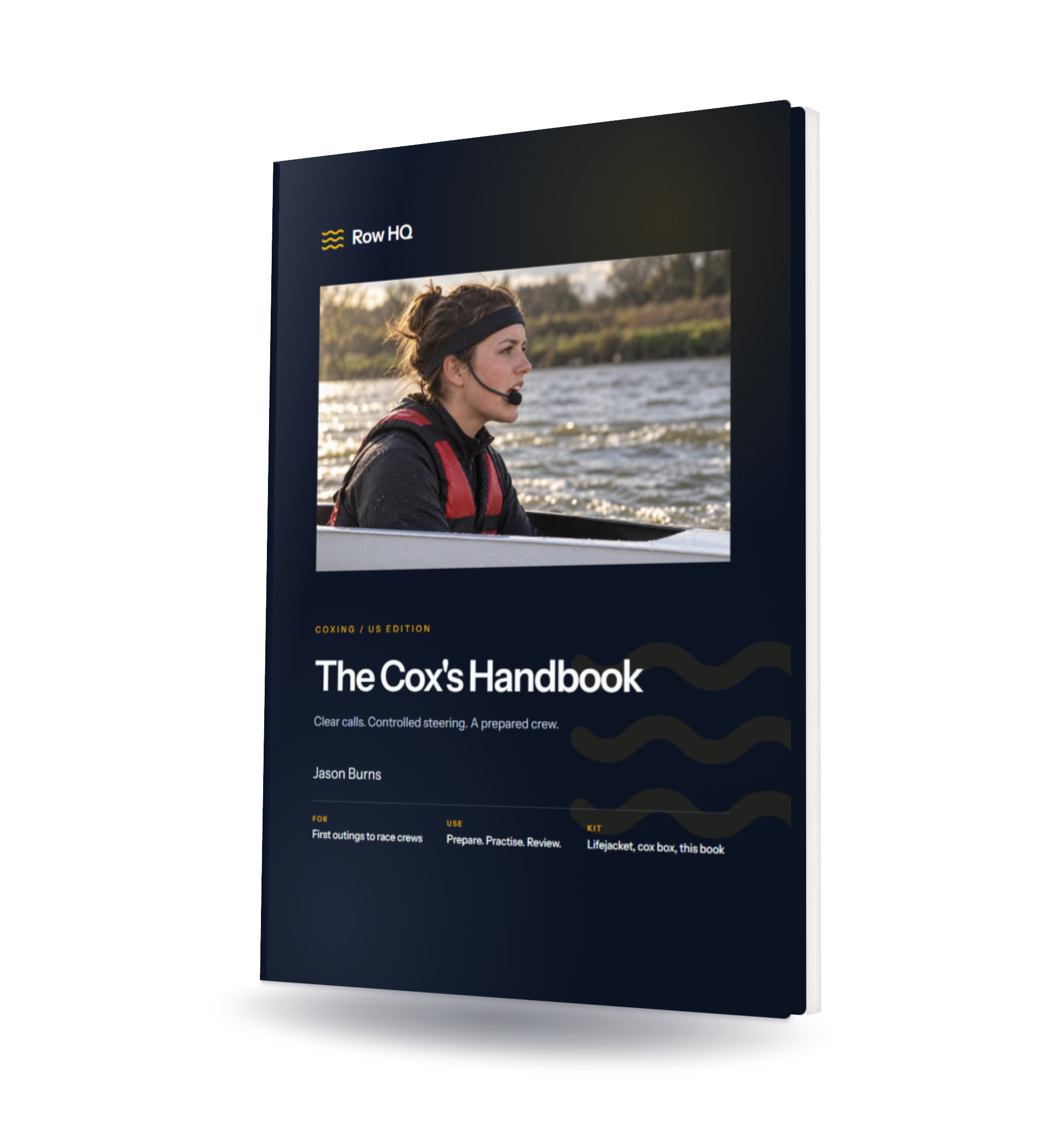
Printable PDFs written for club rowers. Buy once, keep forever.
Keep learning
Clear crew assignments let a coxswain prepare the right calls before an outing. Keep the lineup and training plan together in rowing software for Canadian clubs. Continue through the rowing glossary for the language used from bow to stern.
Coxes deserve better than a group chat at 9pm the night before.
Row HQ tells coxes which crew they're with, what session it is and where to be - automatically. Built by rowers, used at Oundle Town Rowing Club.