Scull
A scull is one of a matched pair of short rowing oars. A sculler holds two of them - one in each hand. That one fact separates sculling from sweep rowing, where every rower grips a single longer oar in both hands. Canada has produced sculling royalty for over a century, from Ned Hanlan winning the world professional championship on Toronto Bay in the 1880s to Silken Laumann's comeback bronze at Barcelona 1992. Today, the sculling discipline runs through Rowing Canada Aviron from the first learn-to-row session at any club boathouse all the way to Olympic A finals.
What is a Scull?
A scull is one of a matched pair of short rowing oars. A sculling rower holds two of them, one in each hand. Sculling stands as one of the two disciplines of rowing - the other being sweep, where each rower holds a single longer oar in both hands. Canada has a long sculling pedigree dating back to Ned Hanlan, the world professional champion of the 1880s, and continuing through modern Olympians such as Silken Laumann.
Also called: Sculling, Sculling Oar, Scull Boat
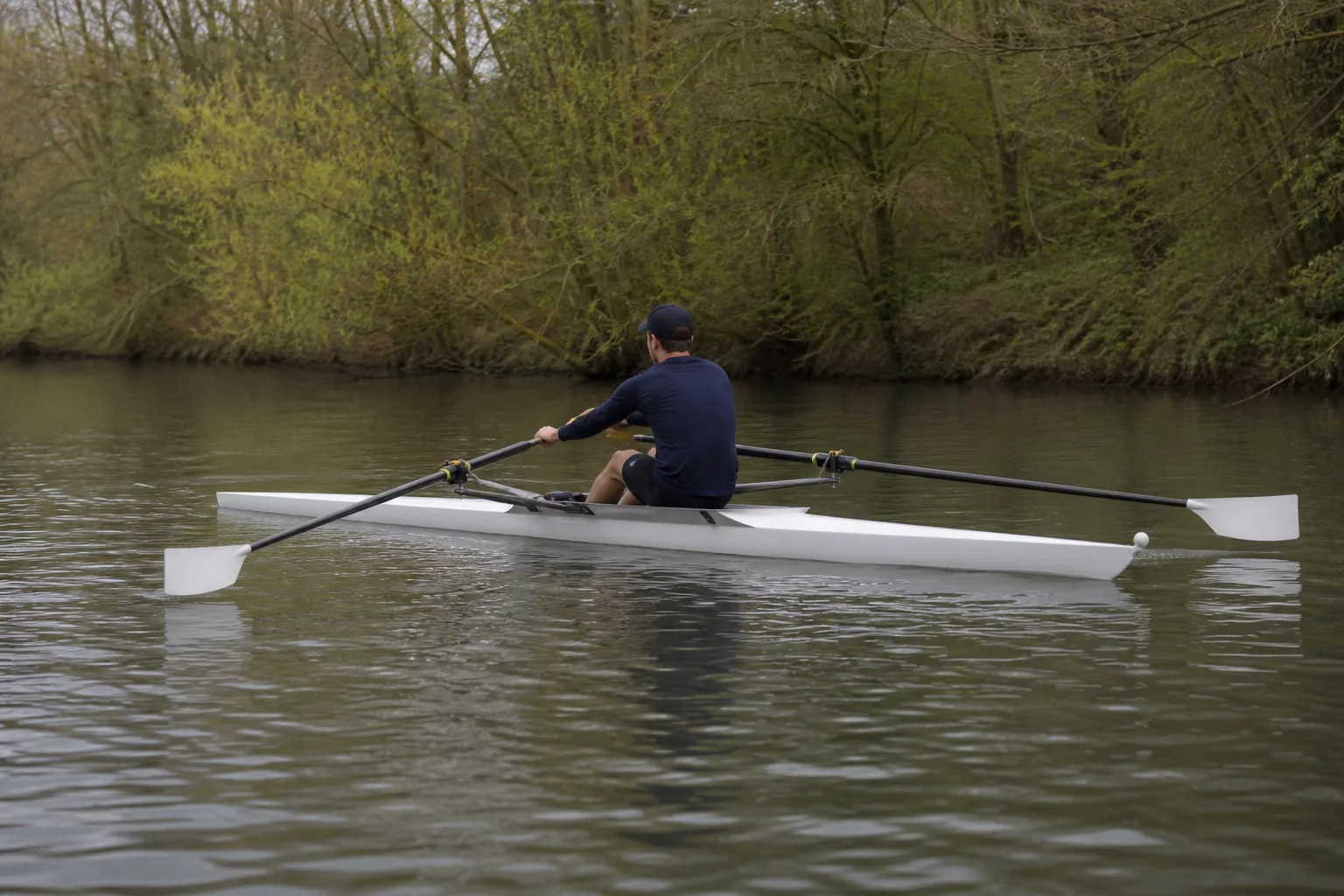
Sculling vs sweep: the two disciplines of rowing
Every rower belongs to one of two camps. Scullers pull two short oars, one per hand, with the body loading equally on both sides through every stroke. Sweep rowers pull a single longer oar held in both hands, and the rower commits to one side - bow side or stroke side - for the duration of that crew's existence. Both fall under the umbrella term 'rowing'. Both are contested at the Olympics, the World Rowing Championships, and across the Canadian calendar from the Royal Canadian Henley at Henley Island to the CSSRA Championships at Brentwood. At a typical Saturday at Hanlan, you'll see singles, doubles and quads training alongside pairs, fours and eights from the same boathouse.
The mechanical contrast goes deep. A sculling stroke is symmetric: shoulders square to the boat, both arms drawing in time, both blades catching and releasing together. A sweep stroke is asymmetric: the trunk rotates toward the rigger, one shoulder leads the catch, and the rower commits to driving against only one oarlock for every stroke they will ever take in that boat. Rigging follows from this - a sculling shell carries one rigger on each side at every seat, while a sweep boat alternates riggers down the length of the hull. See the rowing shell entry for how the hulls themselves differ.
The four sculling boats
- Single scull (1x): 8.2 m hull, one rower, two oars. The most exposed boat in rowing - balance, timing and power output all on one person, with nowhere to hide. The Wingfield Sculls and the Diamond Sculls at Henley are the historic single-scull titles; in Canada, the equivalent is the senior single at the Royal Canadian Henley. Edward "Ned" Hanlan, world professional sculling champion in the 1880s, gave his name to Hanlan Boat Club and to Hanlan's Point on Toronto Island.
- Double scull (2x): 9.8 m hull, two rowers, two oars each. The natural progression for a sculler moving up from the single, and a major Olympic class in its own right.
- Quadruple scull (4x): 12.5 m hull, four rowers, two oars each. Often called simply "the quad". One of the quickest crew boats on the water - faster than a coxless four at almost every level of the sport.
- Octuple scull (8x): 17 m hull, eight rowers, two oars each, plus a coxswain. Raced mostly at junior and masters level in Canada and not contested at the Olympics, but it shows up regularly at CSSRA and junior development regattas.
For the full breakdown of every boat class, including the sweep side of the family, see the <a href=":rowing_boat_types_url">rowing boat types entry</a>. The headline point: a sculling boat is faster than the equivalent sweep boat with the same crew size because each rower puts twice as many blades in the water per stroke.
Sculling oars (sculls): anatomy and dimensions
A sculling oar measures 285 to 290 cm overall - about 80 cm shorter than a sweep oar. Each oar has the same five components: handle (the grip end, usually a moulded rubber sleeve over the carbon shaft), shaft (the hollow tapered carbon tube running the length), sleeve and collar (the wear surface that sits inside the oarlock), and blade (the wide flat end that catches the water). Concept2 oars from Vermont are the most common across Canadian club sheds, with Croker out of Sydney and Braca from Lithuania filling out the racing market. Blade shape sets how the catch feels: the Macon is a tulip profile that suits long, drawn-out strokes; the Big Blade is a hatchet shape that has dominated competitive sculling since the early 1990s; the Vortex carries ridges across the blade face that bite into the water more aggressively at the catch.
A complete pair of sculls weighs roughly 1.6 kg, or 3.2 kg total per rower. The inboard length - the distance from the handle end to the collar - is adjustable by sliding the button along the sleeve. This is what lets a club rig the same pair of sculls for rowers of different heights without having to buy separate kit for every athlete.
Why most rowers learn to scull first
Almost every learn-to-row program in Canada - school programs, club novice intakes, university freshers - begins in sculling boats. Three things drive this choice.
Balance comes first. With one oar in each hand, the boat gives constant corrective feedback. Lean too far to starboard and the port blade drops, prompting the rower to push back. The shell teaches you to stay upright. In a sweep boat, by contrast, a beginner can sit lopsided for an entire row without realising it because the crew around them masks the imbalance.
Symmetric loading is the second factor. Both sides of the body do the same work in a sculling stroke, which means technique problems show up clearly and respond predictably to correction. A sweep rower can build a side-specific compensation that takes seasons to unwind once it has set in.
Self-sufficiency is the third. A single scull launches with one rower, a clear stretch of water and a launched safety boat. A sweep eight needs eight rowers and a cox to all be available at the same time. Through a Canadian winter or a wet spring, the rower who can row in a single whenever the dock is clear of ice is the one who builds the most water time.
How clubs structure sculling pathways
A typical Canadian club sculling pathway runs novices through wide stable tubs first, graduating to club-grade training singles and then to a competitive 1x as the stroke develops. Doubles and quads come in as crew rowing takes shape. The strongest scullers move toward Rowing Ontario, Rowing BC or RSEQ provincial squads, then onto Rowing Canada Aviron under-23 and senior trials at Elk Lake. Session scheduling matters more in sculling than in sweep because singles and doubles training is self-directed - the rower books the shell, the time slot and the safety boat coverage themselves rather than turning up for a fixed crew outing.
For coaches, tracking which scullers are ready to graduate up a boat class, who has completed their Rowing Canada Aviron capsize requirement, and who has clocked the necessary supervised hours in a 1x sits inside Row HQ's coach tools. Connecting that to boat booking means the right rower is in the right shell every time the boathouse doors open.
Sculling FAQs
What is the difference between sculling and rowing?
Rowing is the umbrella sport. It splits into two disciplines: sculling and sweep. A sculler uses two short oars, one held in each hand, and the boat is rigged symmetrically. A sweep rower uses a single longer oar held in both hands, and crew members alternate which side they pull on. Most Canadian programs start beginners in sculling boats because the two-oar setup makes balance click much faster. Rowing Canada Aviron runs national team selection in both disciplines, and the Royal Canadian Henley Regatta contests every sculling and sweep class on the international slate.
How is sculling different from sweep rowing?
Body mechanics are the real difference. A sculler loads both sides of the body identically through every stroke - shoulders open square to the boat, both arms drawing in unison, both hands feathering and squaring independently. A sweep rower loads one side at a time, with the trunk rotating toward the rigger as the oar is drawn in. Sculling rewards bilateral coordination and quick wrists. Sweep rewards committed power on the rigger side and the ability to row exactly with the rower in front of you. Most Canadians start in sculling because the symmetric load gives instant feedback when something is off.
What boats use sculls?
Four boat classes are sculling boats. The single (1x) carries one rower. The double (2x) carries two. The quad (4x) carries four. The octuple (8x) carries eight plus a coxswain and is raced primarily at junior and masters level. All four classes appear regularly on the Canadian regatta calendar - the single at every level from Brentwood club racing through to the national team trials at Elk Lake, the quad at the Royal Canadian Henley, the octuple at junior development events.
How long is a sculling oar?
Sculling oars run roughly 285 to 290 cm overall - around 80 cm shorter than a sweep oar (typically 370 to 376 cm). The shorter length matches the smaller arc the blade travels through and reduces the load on the wrists and forearms. Concept2 sculls (made in Vermont) are the default in most Canadian boathouses, alongside Croker and Braca. Blade profiles - Macon (the original tulip shape), Big Blade (the dominant racing shape since the early 1990s), Vortex (with surface ridges to bite the water) - each change how the catch loads and how the blade releases.
Is sculling easier to learn than sweep rowing?
Yes - and this is why most Canadian learn-to-row programs from Hanlan in Toronto to Burnaby Lake in BC start beginners in sculling boats. With two oars, the boat self-corrects: tip one way and the opposite oar drops into the water, prompting an automatic recovery push. Sweep rowing commits a beginner to one side from the first stroke, and side-specific technique faults can take years to undo. The standard pathway in Canada runs novices through tubs and stable singles for the first several weeks, into doubles and quads as the stroke develops, and only then into sweep boats once balance and blade control are reliable.
What is a 'feathered scull'?
Feathering is the wrist rotation that turns the blade flat to the water during the recovery phase of the stroke - the part where the blade is out of the water and the hands are travelling away from the body. Flat blades cut through the air, clear chop on the surface and reduce wind drag. The hand rolls the handle with the fingers as the blade leaves the water, then squares the blade back to vertical just before the catch. In sculling, both hands feather independently, which is one of the technical demands that makes sculling fascinating to coach. New rowers usually learn square-blade rowing first so they can focus on the catch and drive without juggling feathering at the same time.
Related
What is a Rowing Shell?
A rowing shell is the racing hull at the heart of the sport. Strip away the riggers, the seat and the oars and what is l...
Rowing Boat Types
Eight racing shell classes are contested at Canadian regattas: the single (1x), double (2x), pair (2-), quad (4x), coxle...
The Coxswain
The coxswain is the non-rowing crew member who sits in a coxed shell to steer, call rate and direct race strategy. The c...
What is a Regatta?
A regatta is the sprint format of competitive rowing. Six lanes, a buoyed 2,000m course, all crews launched off the line...
What is Catching a Crab?
The blade goes in, the boat keeps moving, and suddenly the oar will not come out. That is a crab. The water flowing past...
Feathering in Rowing
Feathering is the 90-degree wrist roll that turns the blade parallel to the water during the recovery, then back to perp...
From the RowHQ shop
Printable PDFs written for club rowers. Buy once, keep forever.

Steady in the Single
Why you cannot balance a single, diagnosed properly - find out when in the stroke the boat goes down, check whether the rigging is doing it, then drill the actual cause.
The Club Session Library
52 rowing sessions for club coaches, with an illustrated coaching PDF, editable CSV plans, two seasonal blocks and a printable coaching cheat sheet.
Keep learning
Cold-water rules and boat clearances matter before a sculler pushes off. Keeping those records in rowing club management software gives coaches one place to check who can use each shell. Continue with the rowing glossary for the terms used through training and racing.
Run sculling sessions without the spreadsheet.
Row HQ handles boat bookings, sculling sign-out, safety boat coverage and rower qualifications in one place. Built by rowers, used at Oundle Town Rowing Club.