The honest answer in 30 seconds
Pick four numbers off the PM5 and stop chasing the rest: 2k time, 500m split, watts and stroke rate. A monthly 2k on a Concept2 RowErg, drag locked at 110 to 130 for most senior athletes, body weight noted alongside, one line on how it felt, that is the working dataset. Plot the trend across the winter erg block at Inniscarra and the picture writes itself. Rowing Ireland HP shortlisting and IURC selection run on Concept2 scores, so the same four numbers stack cleanly against national, university and club benchmarks. The rest of the monitor screen is decoration.
There is a story Irish rowing tells about itself that goes "we just row hard". Skibbereen RC and the O'Donovan brothers carry most of the weight of that story. The reality behind the line, the part Dominic Casey built quietly across two decades on the Ilen, is that the Skibbereen LM2x programme runs on disciplined erg data, not folklore. The same is true of the Rowing Ireland HP group at the National Rowing Centre at Inniscarra, the IURC squads at Trinity, UCD, UCC, NUIG and UL, and any open-club programme producing genuine results across an Irish season. Every serious boathouse uses the ergometer to benchmark fitness, track progress and identify potential, and the same approach scales the whole way down to a winter Junior 16 group at Commercial RC. With one Concept2, a consistent test protocol and somewhere clean to log the numbers, your club can turn raw splits into better training calls.
Why erg testing earns its place in an Irish programme
On-water times in Ireland are noisy by their nature. A westerly running down Lough Ree, a flat calm at Inniscarra, two centimetres of head on the Lagan, the seat you happen to be drawn in at the Trinity vs UCD Colours race - every one of those factors moves the boat. Strip them all away on the Concept2 and what is left is a clean read on individual fitness and power output. Three jobs the test does well:
-
Benchmarking: A baseline that lets the coach line athletes up objectively for crew selection and training group placement, with no debate about who is fitter on the morning.
-
Progress tracking: Week-to-week, month-to-month, across the full season, the trend tells you whether the training programme is working or quietly drifting, in time to adjust before the Castleconnell trial.
-
Goal setting: Vague intent like "get fitter" becomes a concrete target: "break 7:30 on the 2k by March, ready for the Castleconnell head race." Athletes train differently when the number is on the wall.
Worth knowing how big a pond your athletes are swimming in. The Concept2 Logbook closed out 2025 with these numbers on the board:
The four metrics that matter
The PM5 screen shows you a dozen numbers. Most are decoration. Knowing which ones actually move selection and which are noise is the gap between data-driven training and chart porn. Four numbers carry the load, all of them live on the Concept2 PM5 that every Rowing Ireland-affiliated boathouse runs, and all of them appear in the ergometer glossary entry if a term is new:
Key erg metrics explained
2k time
The benchmark every Irish selector falls back on. Two thousand metres flat out measures peak aerobic capacity and a particular kind of mental toughness. Record to the second. Rowing Ireland HP shortlisting and IURC trial day both open with this number.
500m split
Average pace projected per 500m. The split exposes pacing strategy, late-piece fade, and exactly which 500 segment cost an athlete the trial.
Watts
Raw flywheel power. Watts cut through bodyweight assumptions and give the coach an objective measure of strength across the squad and across the season.
Stroke rate
Strokes per minute. Read alongside split, the rate exposes efficiency: which athlete moves the boat fast for fewer strokes, the trait Dominic Casey selects on at Skibbereen.
The Concept2 is the leveller. From a Junior 16 sculler at NUIG or a masters single sculler at Garda RC up to a Skibbereen Olympic gold medallist, everyone gets measured on the same machine against the same standard. That is enormously valuable.
How Row HQ makes erg tracking easy across a Rowing Ireland squad
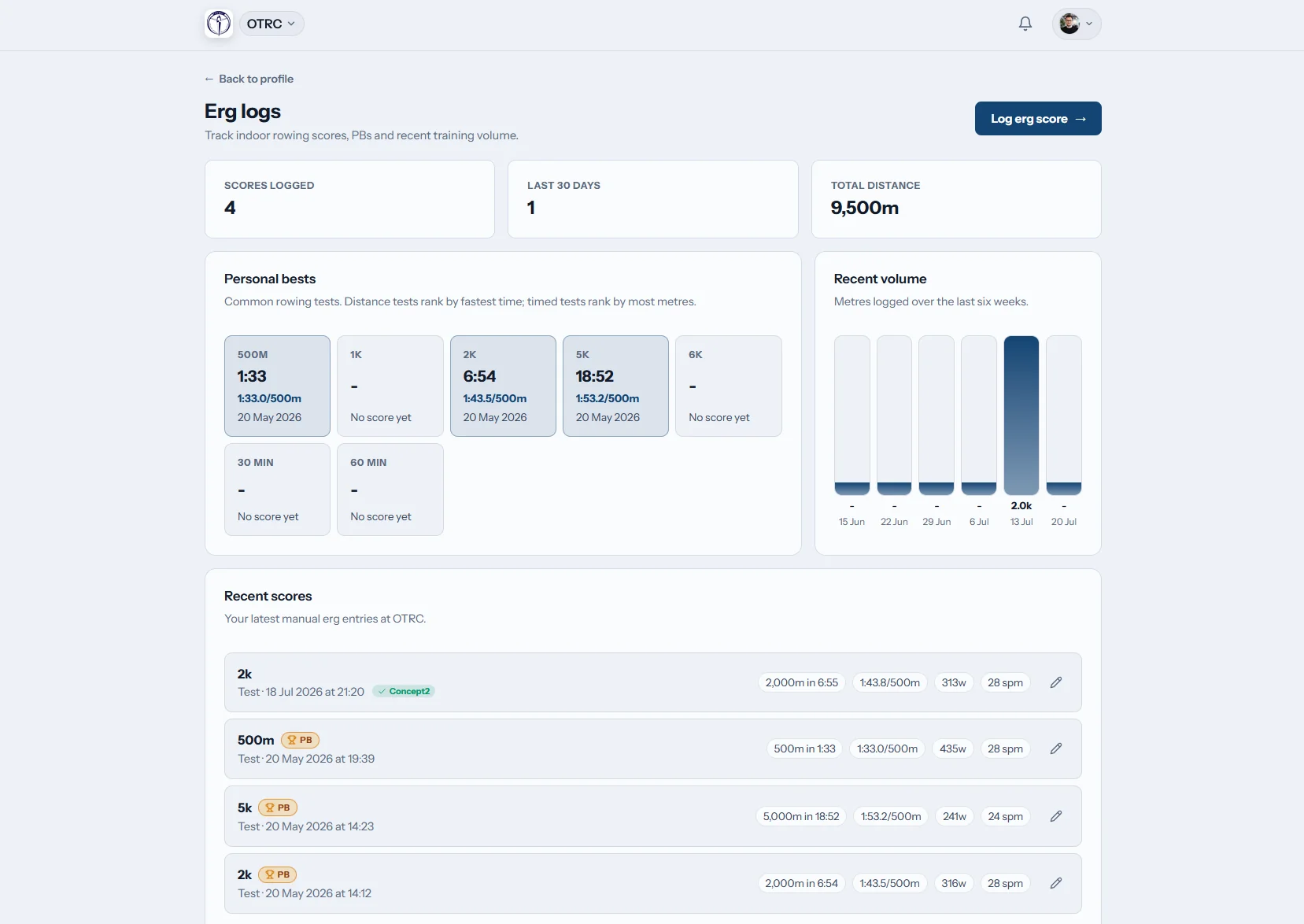
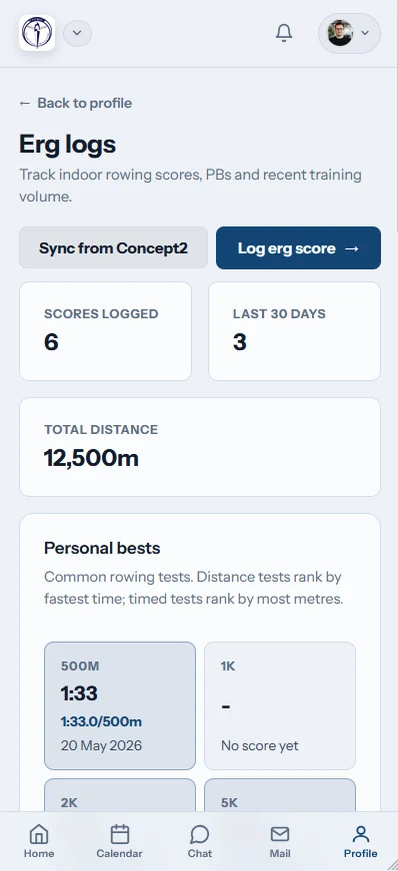
The data collection part is straightforward. Where most Irish clubs lose the value is in the organising, comparing across athletes, and actually feeding the numbers back into Tuesday's session plan. Row HQ's built-in erg log, baked into the coach tools, takes raw test scores and turns them into something a coach can read mid-week and an athlete can read mid-winter. Concept2 scores upload today through the member portal or CSV import; direct Concept2 Logbook API sync is on the short-term roadmap so scores flow in with no manual step at all.
-
Easy logging: Phone or laptop, scores into the member portal in seconds. No more handwritten erg sheets curling off the Inniscarra wall or shared spreadsheet headaches at 11pm on selection night.
-
Historical data: Stored, indexed and instantly accessible. Pull a trend across the winter erg block, the Castleconnell taper, the Irish Champs build, even an entire Olympiad if you keep the records going.
-
Coach review: Every athlete on one screen via the admin dashboard. Crew selection conversations become data-backed instead of memory-backed, which is exactly how the Skibbereen and Commercial coaches already work.
-
Personal bests: PBs surface automatically. Athletes get a clear target to chase in the member portal, and the coach gets a clean signal that something has shifted.
Putting the numbers to work for the athlete and the squad
Data on its own does nothing. What the coach does with it on Wednesday morning is what changes outcomes. Patterns that have worked in Irish boathouses from Bann RC up north down to Cork BC in the south:
- Celebrate progress: Two seconds off a 2k for a Junior 16 sculler at UCC or NUIG is real work. Recognise the climb, not just the peak. The kid grinding from 8:10 to 7:45 across a winter deserves the same nod as the squad rower under 6:30.
- Create healthy competition: Internal leaderboards and squad rankings sharpen the room. The training session tools link the leaderboard back to on-water work so the competition spills into seat racing on the Lee or the Liffey.
- Identify weaknesses: A consistent fade through the third 500. Low watts despite clean catch timing. The data points the coach at the specific gap to attack in training sessions, instead of guessing.
- Track training load: Layer erg performance on top of weekly training volume and you can see the overtraining cliff a fortnight before an athlete falls off it. That single move alone would save the early-March collapse that wipes out so many Irish Junior squads heading into Schools Champs.
What real progress looks like through an Irish season
2k baseline, return to training
14 seconds gained
New PB, on track for Castleconnell
5.7% faster
Five tips for running erg testing properly across an Irish squad
The whole edifice falls down without consistency. Drift on test conditions and the numbers stop comparing cleanly across the season. Five practices that keep the data trustworthy:
- Standardise test conditions: Same time of day, same warm-up protocol, same drag factor on the day. Anything else is noise pretending to be signal. Our drag factor calculator gives a per-session number for the athlete to dial in.
- Test regularly without over-testing: A monthly 2k pulls the trend out cleanly. Drop in the occasional 500m flying piece or a 6k long-piece anchor to round out the picture. More than that and you are just doing races as training.
- Record everything: Time alone is not enough. Splits, stroke rate, body weight, a one-line note on how the piece felt. That context is what turns the score into a defensible selection conversation in March.
- Build a culture, not a meatgrinder: The erg is brutal. Squads that survive long-term recognise the effort the test took, not just the fastest time on the sheet. That difference is partly why Skibbereen keeps producing senior athletes year after year while churn-and-burn programmes break their own pipeline.
- Sit down and discuss: One-to-ones with each athlete to walk through their data, set the next goal, build a personalised plan. Our 2k prediction calculator is useful here for back-solving a credible Olympic-distance target from a recent long piece.
Watching the trend line move month by month, in black and white rather than just in the way a piece felt, changes the athlete's relationship with the work. The numbers give them something concrete to push against. Coaches at Oundle Town Rowing Club across the Irish Sea saw this play out, and the same dynamic shows up the moment any Rowing Ireland-affiliated boathouse pulls its erg results out of WhatsApp groups and into a structured log.
The bottom line
Erg data does not replace coaching instinct. It backstops it. Numbers give Irish coaches a defensible basis for selection through the coach tools, hand athletes a clear picture of their own development, and make progress (or stagnation) visible across the whole squad before it shows up in seat racing.
Row HQ takes care of the recording and the organising. Spreadsheets stop going missing. Manual reconciliation stops eating Tuesday nights. Just the numbers your coaches need, in one place. To convert a single split on the fly, the free erg pace calculator handles splits to watts, calories and projected times across the test distances Irish squads actually run. Step through the screenshot gallery to see the erg log live, look at pricing, or just get started. Questions live in the FAQ.
The erg log ships as one piece of Row HQ, in the same platform as the sessions the scores come from.
- The Row HQ Team
Sources & references
- Rowing Ireland - performance pathway and selection standards — Rowing Ireland
- British Rowing Plus - crew selection in rowing (coach perspective on erg-test weighting, included for cross-channel methodology) — British Rowing Plus
- Concept2 PM5 monitor service and reference — Concept2
- Concept2 Online Logbook — Concept2
- Concept2 2025 Year in Review (141,735 new athletes, 79.7B m logged, 210+ countries) — Concept2 (accessed May 17, 2026)
- New 2k world record 5:35.8 (Josh Dunkley-Smith) — Concept2
- Trends in indoor rowing records — World Rowing
- Why Sir Steve Redgrave uses the Concept2 rower — Fitness Etc
- Row HQ erg pace calculator (split to watts, calories, predicted times) — Row HQ
- Row HQ 2k prediction calculator (extrapolate from shorter pieces) — Row HQ
- Row HQ drag factor calculator (set athletes per-session) — Row HQ
Related articles
From the RowHQ shop
Printable PDFs written for club rowers. Buy once, keep forever.
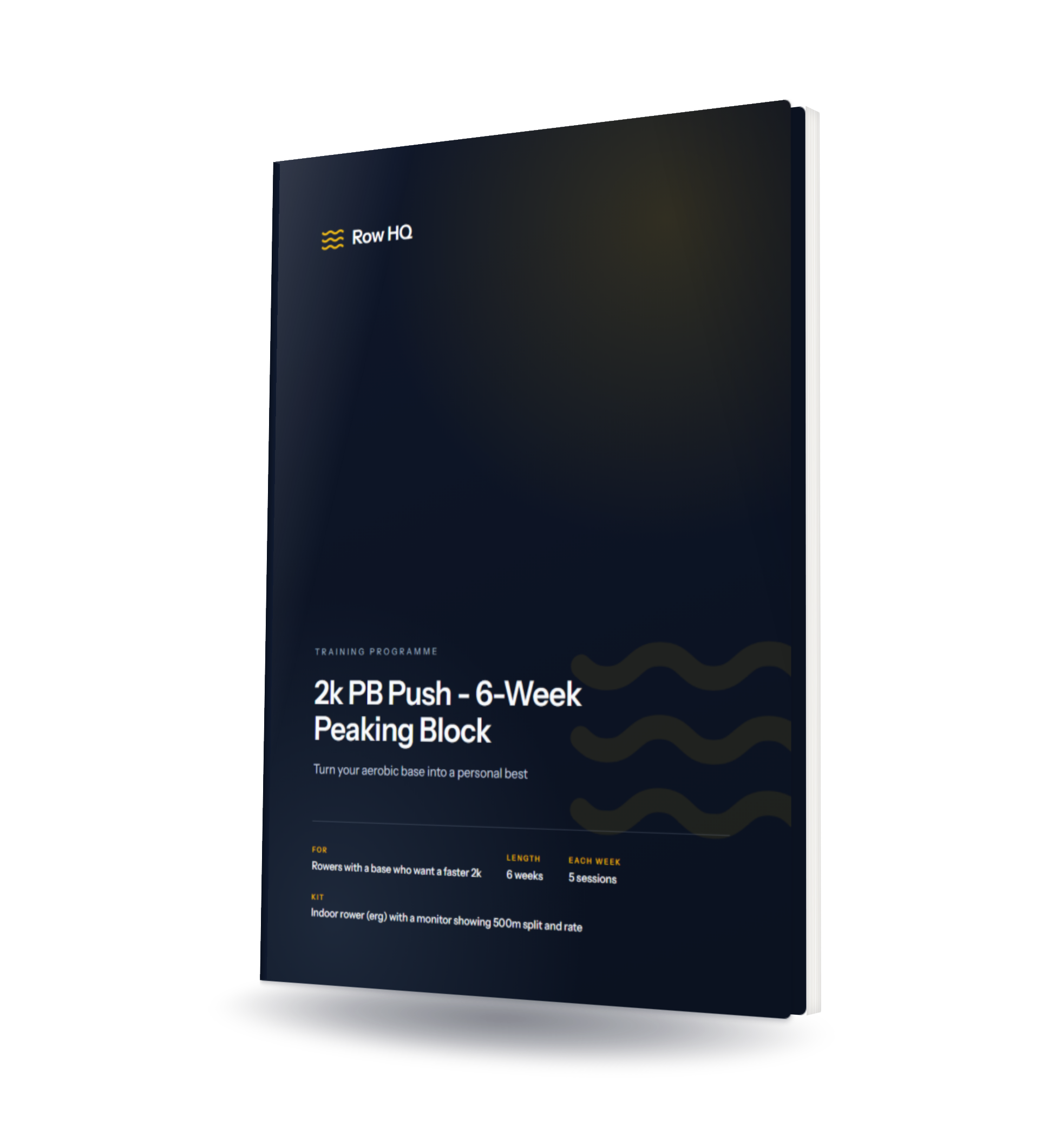
2k PB Push - 6-Week Peaking Block
Six weeks that turn an existing aerobic base into a 2k personal best - race-specific work, a proper taper, every pace scaled to your own time.
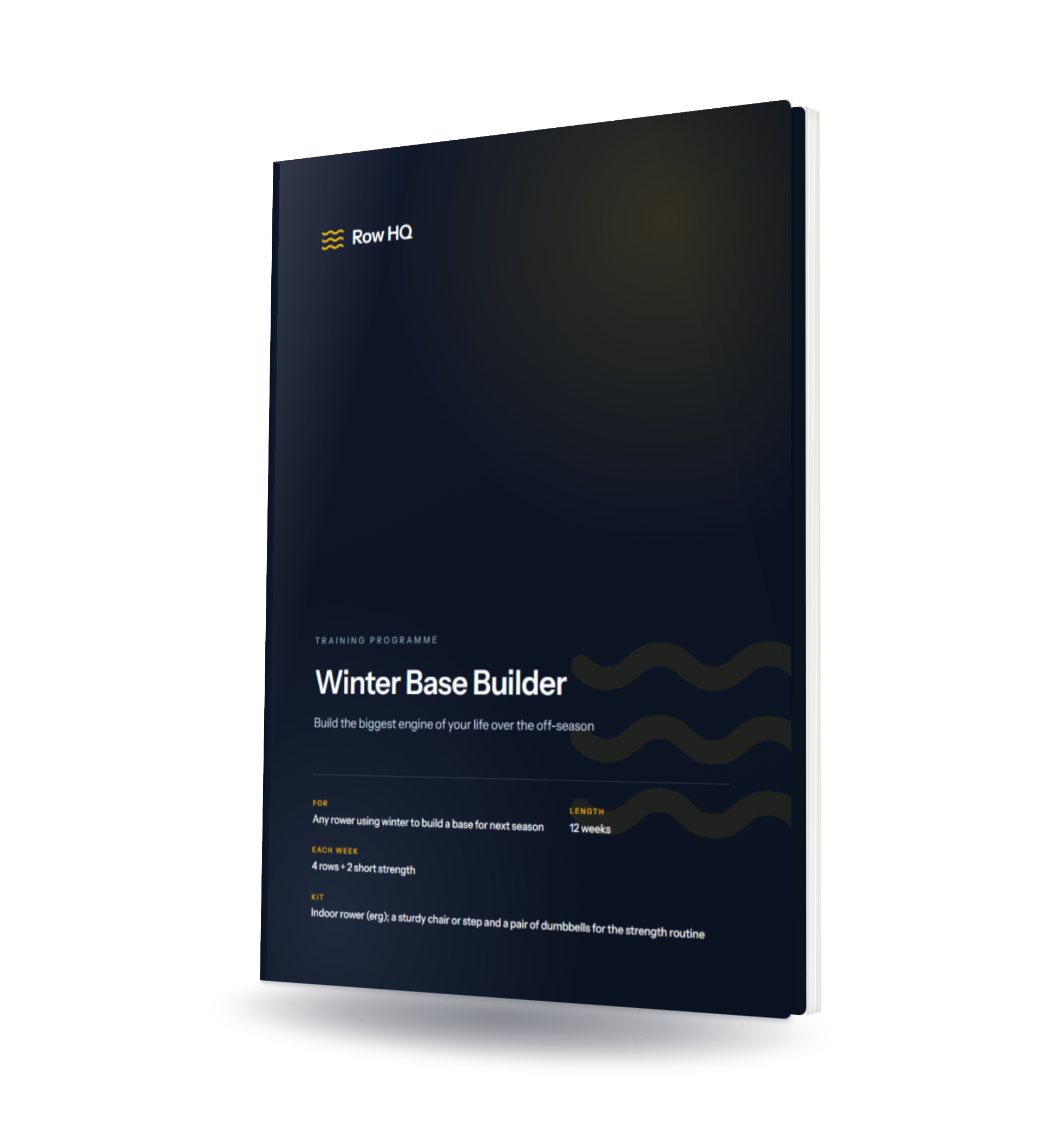
Winter Base Builder
Build the biggest engine of your life over the off-season - 12 weeks of mostly-easy volume plus a strength routine, so you arrive at spring fast.
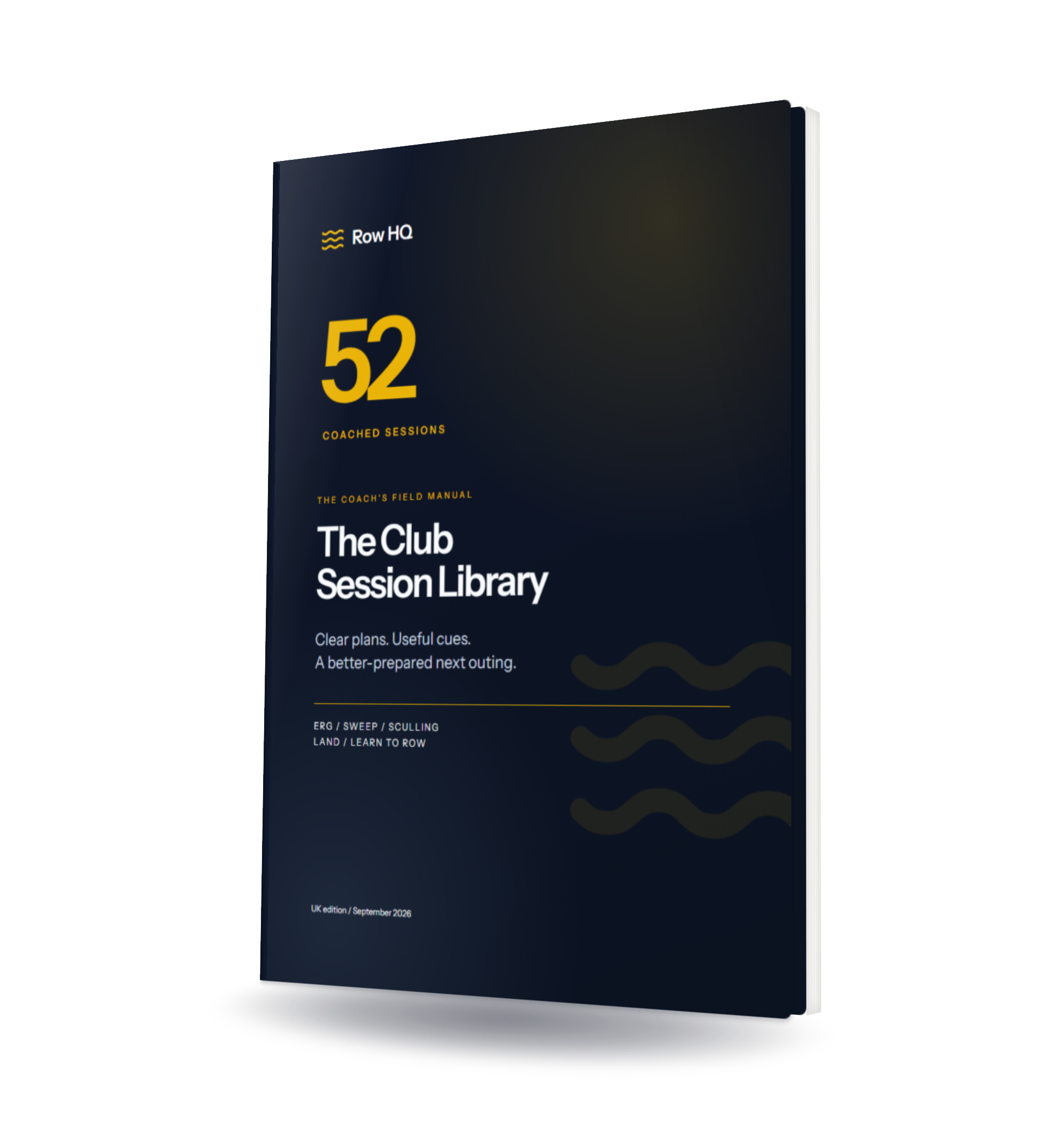
The Club Session Library
52 rowing sessions for club coaches, with an illustrated coaching PDF, editable CSV plans, two seasonal blocks and a printable coaching cheat sheet.