Selection plan in 30 seconds
Confirm attendance through the team app first. Layer 2k splits, port/starboard preference, and seat-race deltas onto a ranked depth chart. 2k erg time correlates with on-water finishing position at r ~ 0.72-0.78 in international sculling (Mikulic et al., 2009, Journal of Sports Sciences) - strong, never the whole story. Back the erg up with three to five rounds of seat racing through the fall, archive every result, then publish the 1V, 2V, 3V and freshman 8+ cards in one notification before the next launch goes off the dock. Set lineups privately the night before. Never in the bay with the squad watching.
Building 1Vs That Win at IRA
Seat racing on the river, 2k splits on the PM5, a coach's eye for swing - the question every NCAA staff answers from October through May is how to fuse all three into a defensible 1V by Monday morning launch.
Selection week wears coaching staffs down to the bone. Concept2 splits roll in piecemeal across two weeks of testing. Port/starboard preferences shift as freshmen settle into the program. Depth charts live on clipboards that nobody syncs across the office. I have been on both sides of selection - waiting for the call as an athlete, now watching coaches at my own club work through the same political grind every Sunday evening - and the pattern is universal whether the boat is a club V8+ or a Division I 1V at an EARC program. The Row HQ coaching toolkit closes that gap so varsity, club and scholastic staff can compress the 1V through novice 4+ selection cycle while keeping every call defensible to athletes, parents, and the AD office.
Condensing selection week into 15 minutes
Confirm attendance through the team app. Layer 2k split, port/starboard preference, and seat-race ladders onto a ranked shortlist. Varsity programs running this workflow typically compress Sunday planning into roughly 15 minutes once last week's published boat card seeds the new one. The compounding effect of saved lineups is where the time savings actually live.
What slows down varsity selection
Varsity boat decisions juggle five inputs at once: practice attendance under heavy class load, 2k testing under accumulated fatigue, port/starboard rigging across the boat, demonstrated swing partnerships, plus injuries and midterm crunch. Across a 40-athlete roster split between varsity, JV and novice squads, the admin alone fills an evening. Three patterns repeat at almost every program.
Data Stranded Across Five Tools
Concept2 Logbook holds the 2k results. A roster spreadsheet tracks side preferences. A Google Doc captures seat-race notes. GroupMe carries the absences. Paper boat cards live taped inside the launch. Reconstructing a defensible 1V from that jigsaw takes longer than picking the boat itself. There is a cleaner option than spreadsheets built for the same data flow.
Roster Churn Through Midterms and Finals
Division I athletes juggling premed labs and 18-credit semesters miss occasional 5:30 a.m. sessions; the compliance office pulls scholarship rowers for paperwork meetings without much notice. Last-minute substitutions in the bay force a 2V reshuffle on the dock. A self-service athlete portal handles the availability piece without flooding the head coach's phone at midnight.
Carrying Three Squads in Your Head
Tracking novices ready for 2V promotion, seniors protected for IRA selection, athletes returning from stress reactions, plus clean six-seven pairings - several seasons of memory layered on top of this week's testing data. Even experienced staff drop threads once a program scales past 30 athletes across V, JV and novice.
Hours lost to spreadsheets are hours stolen from launch time, technique work, video review, recruiting calls and captain meetings. Our companion piece on streamlining practice schedules addresses the planning side of the same problem.
The Row HQ workflow for US lineup selection
Open the lineup builder. Last week's confirmed roster, current 2k splits, port/starboard preferences, plus the prior 1V, 2V and 4V cards all load automatically into a ranked shortlist. Drag athletes into seats. Hit publish; every rower gets a notification with the boat assignment before the next practice block - no waiting on the team channel, no confusion at the boathouse door.
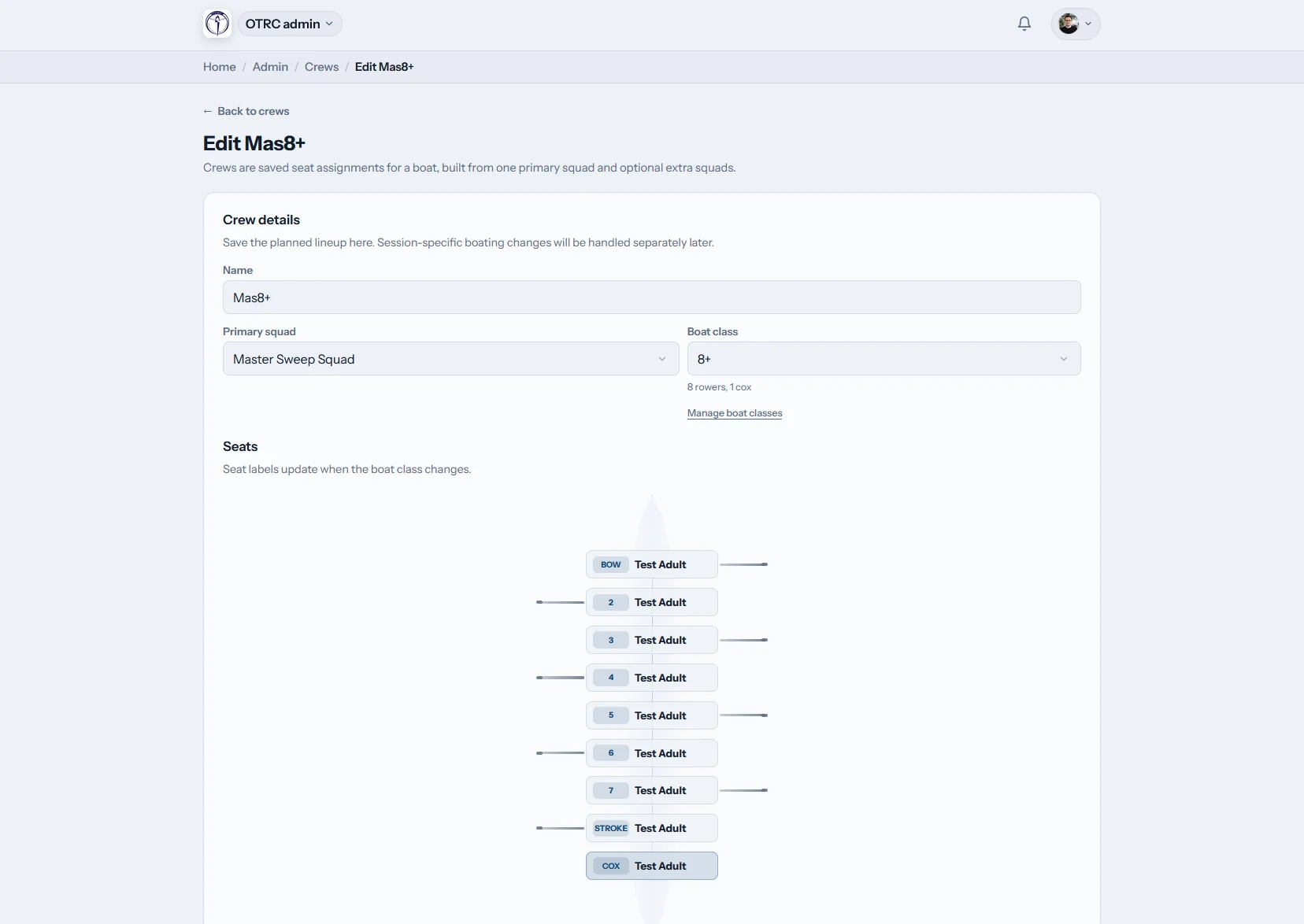
Drag-and-Drop Lineup Building
Drop athletes into the boat card by seat. The availability indicator on each name (green confirmed, amber tentative, red unavailable) means coaches stop firing off "are you in?" texts at 9 p.m. The screenshot gallery shows the full workflow.
Saved Boat Cards by Event
A boat that swings is a boat you save. Row HQ archives every published lineup card and recalls it in a single tap - your HOCR varsity 8, your Eastern Sprints lightweight 8, your developmental novice 4+ for the Saturday dual. Build forward off what worked instead of starting from scratch every Monday.
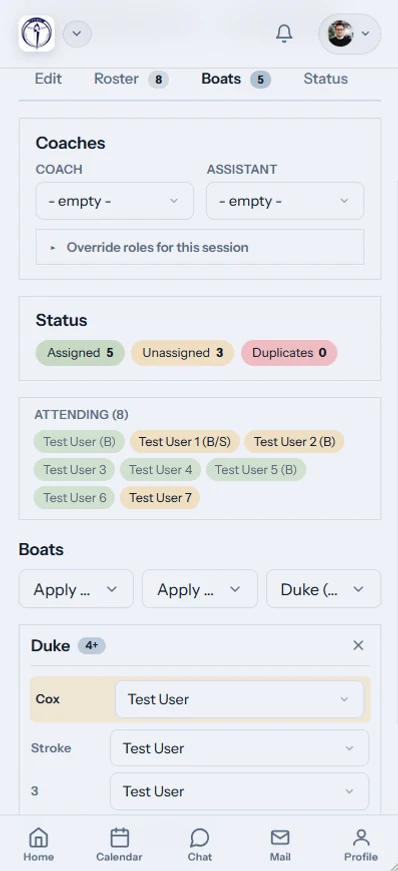
Seat-by-Seat Position Control
Bow, stroke, engine four - assign each with visibility on athlete preferences, port/starboard coverage, coxswain certifications, and prior boat assignments. The five-seat who flipped to port last spring is flagged so the rigging stays correct on race morning at Cooper or the Schuylkill.
Selection principles that hold up
Software handles the admin. The judgment call is still yours. Five principles that consistently produce 1V, 2V and 4V lineups capable of beating their seed at IRA, Eastern Sprints, Pac-12 Heads or Stotesbury:
-
Build Vertically Through the Squad: Healthy programs feed novices into JV slots and JV athletes into varsity gaps every season. Mixing developmental athletes into deeper boats during fall is how the novice-to-varsity pipeline actually moves. The staff at Brown and Penn AC have run this approach for decades.
-
Read the Academic Calendar: Midterm week and finals reshape availability across the program. Lineups protected through November rarely fall apart in March. Attendance tracking turns those patterns into something you can plan against.
-
Anchor Selections in Seat-Race History: A single 2k test is one data point. Eight rounds of seat racing give you eight more. Row HQ stores lineup history alongside ergometer progressions, making IRA-prep decisions defensible when an athlete pushes back. Combine with erg metrics for the full picture.
-
Respect the Physics of the Boat: A varsity 8 needs comparable heights through the engine room, a stroke who can hold a 32 spm base rate under boat pressure, a bow seat who reads the water. The rower with the best 2k does not always make the boat go faster - that is still the call you have to make as the head coach.
-
Publish in Writing, Then Take Questions Later: Row HQ automatically notifies every athlete the moment the lineup card goes live. No more "I never saw the GroupMe" the next morning, no ambiguity about who is racing in the four versus the eight. Pushback happens in office hours.
Some rowers will never ever get how hard it is for coaches to make that selection, how much stress it causes you. You really are trying to do the right thing, you're not trying to do someone over.
What programs gain from going digital
What changes when the workflow goes digital
Reclaimed across the 1V, 2V and 4V selection cycle each week
Confirmed availability arrives before the lineup is built, not after it
Every published boat card archived alongside the 2k testing data behind it
Time is the obvious win. The bigger win is decision quality once the right inputs sit in front of the head coach at the right moment:
- Coaching Time Returned: Less time piecing the lineup together, more time on the launch giving feedback before the next regatta block at Mercer or Lake Carnegie.
- One Channel for Boat Calls: Notifications land with the athlete directly - no chasing GroupMe, no missed messages from the rower who muted the channel during finals.
- Season-Over-Season Memory: Last year's HOCR boat card is a tap away. The novice 8 from spring becomes the 2V in the fall with the lineup history to support it.
- Substitution in Seconds: When an athlete pulls out the morning of a piece, swap them in the builder and republish - the boat knows before they hit the water.
NCAA coaching staffs running Row HQ report Sunday lineup planning collapsing from an hour-plus to roughly 15 minutes. When a stroke seat calls in sick on a Wednesday before river practice, the depth chart instantly surfaces the next available athlete on that port or starboard side - including swaps triggered by a midweek 2k retest on the ergometer. Run target paces through our free 2k pace calculator while athletes prep selection-week pieces.
The coach's job, distilled
Filling seats is admin. Building a 1V that gets faster across the spring is coaching. What I have seen actually work, on both sides of the lineup card, is the same playbook every time: pull the data the night before, set the boat privately, post in writing before the next launch leaves the dock, take the conversations in office hours - never in the bay with the squad watching. Pulling admin off your plate frees judgment for what it deserves: which combinations swing, which athletes are ready to step up, which freshman has the technique to develop into a varsity bow seat next year.
A 25-athlete club roster and a 60-athlete Division I program share the same fundamentals: know each athlete, archive what works, communicate calls without ambiguity, audit selections after every regatta. Our pricing page lists program tiers; the FAQ answers procurement questions ADs typically ask before signing.
See the lineup builder in action
We built the Row HQ lineup builder around this exact problem - the Sunday-night admin grind I kept watching coaches burn an hour on before posting a boat card. Schedule a 30-minute walkthrough and I will run your sample varsity roster through it live: drag, save, publish, iterate.
What to take into selection week
- Patchwork tooling across Concept2, GroupMe, and spreadsheets is where varsity selection time actually leaks each week
- A drag-and-drop lineup builder with saved boat cards compresses Sunday planning into roughly 15 minutes
- Protect varsity attendance through the academic calendar - midterms and finals reshape every roster on the program
- Pair lineup history with 2k erg progressions to defend HOCR, Eastern Sprints and IRA selection calls under scrutiny
- Publish boat cards so every athlete is notified and the assignment is in writing before the next launch leaves the dock
- Want to test the workflow against your own depth chart? Spin up a Row HQ trial for the program
From the RowHQ shop
Printable PDFs written for club rowers. Buy once, keep forever.

The Club Session Library
52 rowing sessions for club coaches, with an illustrated coaching PDF, editable CSV plans, two seasonal blocks and a printable coaching cheat sheet.

The Cox's Handbook
Practical calls, steering, session drills and race plans for new and improving coxes. Includes five printable worksheets.
Sources & references
- Crew selection in rowing (coach interviews: Jamie Leighton, Rob Dauncey, Tom Mapp, Beth Rodford) — British Rowing Plus (accessed May 17, 2026)
- Relationship between 2000-m rowing ergometer performance times and World Rowing Championships rankings in elite-standard rowers (Mikulic et al., 2009) — Journal of Sports Sciences
- Physiological responses to ergometer and on-water incremental rowing tests (Vogler, Rice and Gore, 2010) — International Journal of Sports Physiology and Performance
- The Evaluation of Physical Performance in Rowing Ergometer: A Systematic Review (2025) — Journal of Functional Morphology and Kinesiology (MDPI)
- USRowing - Coach Education program — USRowing
- NCAA Rowing Championships records and selection guidance — NCAA
- IRA - Intercollegiate Rowing Association regatta information — IRA
- EARC - Eastern Association of Rowing Colleges — EARC
- British Rowing PT Testing Protocols (the Concept2 erg testing standard) — British Rowing
- Row HQ coach tools (lineup builder, ergo tracking, saved boat cards) — Row HQ
- Row HQ training sessions feature (attendance, availability, scheduling) — Row HQ
- Row HQ athlete portal (self-service availability and preferences) — Row HQ
Have a strong selection week.
- Jason and the Row HQ team