Coxswain
A coxswain is the human in the stern of a coxed rowing shell who steers, runs the race plan, motivates the lineup and stays calm while everyone else is gasping for air. Essential in the 8+ and 4+; pairs, singles, doubles, quads and the straight 4- all race coxless.
What is a Coxswain?
A coxswain is the person who sits in the stern (or bow) of a coxed rowing shell steering, running race tactics, calling the rate and pressure, and motivating the lineup. The cox does not row. The role is essential in the 8+ and the coxed 4+ at NCAA, IRA, ICSA and prep school levels; pairs, singles, doubles, quads and the straight 4- all race coxless.
Also called: Cox, Cox'n
What does a coxswain do?
Three jobs, run simultaneously in every practice and every race: steer the shell, run the race plan, motivate the lineup.
Steering is the constant background task. Rudder lines run from the cox's hands to a rudder beneath the stern. A small movement turns the shell; a heavy hand on the rudder slows the lineup measurably. Good coxes hold a line with almost invisible rudder use, only catching a correction when the boat starts to drift off the line. On a winding head-race course like the Head of the Charles, the Head of the Hooch or the Head of the Schuylkill, steering is the difference between a winning time and a slow time. The same crew can post a 30-second range across a 19-minute HOCR run depending purely on how clean the line was through the turns.
Race strategy is what separates an experienced cox from a beginner. The cox holds the race plan: when to settle, when to push, when to call the move on the rival lineup, when to call the sprint. They watch the rate on the cox box, watch the field, watch the wind line on the water, and make split-second decisions about timing. In a 6-minute 2k at the IRA Championships, the cox is the only person in the lineup not blacking out from lactate and the only one with a complete view of the field. The decisions they make in the third 500 routinely separate medal lineups from fourth place.
Motivation and feedback happen between every stroke. The cox calls rhythm, technical corrections (catches, finish, drive), and morale, reminding the lineup of practices they have already survived together and keeping the boat moving together when it starts to come apart in the third 500 of an Eastern Sprints final. The best coxes know each athlete's personality and adjust tone accordingly. A call that fires up one rower will shut down another, and a varsity cox who has been with the lineup all year knows the difference cold.
Coxswain weight: USRowing rules and a UK comparison
Cox weight matters. A heavier cox is weight the lineup pushes for the duration of the race. Weight rules exist to keep racing fair across lineups, with dead weight added to make light coxes legal.
British Rowing requires 55 kg for all crews except J15 and younger crews, where the minimum is 45 kg. Its 2025 rules remain unchanged for 2026. See rule 7-2-7. This is not a World Rowing rule or a universal rule for other countries.
USRowing sets 120 lb for men's and mixed crews and 110 lb for women's crews. Required deadweight stays close to the cox's torso in the boat throughout the race. See the current Rules of Rowing. The youth weigh-in exemption concerns USRowing-hosted youth regattas; check your event packet.
Confirm the governing rules, event category and weighing process with your coach before racing. Carry approved ballast without blocking your exit. A race minimum is not advice to change your body weight.
What does a cox box do?
The cox box is the cox's amplification and metrics unit. Three jobs: voice amplification through speakers wired down the spine of the shell, live stroke rate from a magnet on the stroke seat's slide, and timing. Modern units add GPS for boat speed, 500m split and distance.
Standard units in US college rowing include the NK CoxBox Pro (the default at most NCAA programs), the NK CoxBox GPS (Pro features plus GPS data and session logging), the Coxmate GPS (the main alternative, gaining ground in US boathouses), and the Active Tools EmPower Oarlock (which pairs with a cox box to add per-oar force data). All connect to a headset microphone the cox wears and to speakers wired along the shell. See the cox box glossary entry for the full breakdown, US pricing, and fleet maintenance.
In practice the cox uses the readouts to call rate changes precisely ("up two for the next twenty"), report split per 500m mid-piece, and timestamp drills. In racing the cox uses the rate display to verify the lineup is at race pace and the timer to anchor the race plan against the stroke count.
Which boats are coxed?
Different shell types use different steering arrangements:
- Eight (8+): always coxed. There is no coxless 8 in NCAA, IRA, ICSA, ACRA or USRowing youth competition.
- Coxed four (4+): carries a cox in the stern or the bow. Bow-loaders give the cox a clearer view of the course but a less commanding voice position.
- Straight four (4-): coxless, with foot-steering by one of the rowers. Common in NCAA men's lightweight programs.
- Pair (2-): coxless. Foot-steering by one of the two rowers.
- Quad (4x), double (2x), single (1x): all coxless. Sculling shells use foot-steering or, in the single, no rudder at all (the rower steers by varying pressure between the two blades).
For the shells that do carry a cox, the gap between a great cox and a poor one is dramatic. Lineup planning across a US college program often hinges on which crews get the strongest cox in the pool.
How to become a coxswain in the US
Most coxes start by accident. A high school crew coach or college novice coach notices a smaller, confident athlete at a learn-to-row session and asks if they want to try the cox seat. From there it is time on the water, watching how experienced coxes call practices, and absorbing the rhythms of how a shell moves under different rate and pressure calls.
Formal US pathways into the cox seat:
- USRowing Coxswain Education Series: the standard curriculum covering safety, communication, steering mechanics, race strategy and race-day procedures.
- USRowing Safety Education Course: mandatory online certification for any cox racing at a USRowing-sanctioned regatta.
- Prep school cox programs: NEIRA, MARA, MPSRA and Stotesbury feeder schools typically run a cox clinic at the start of the fall season covering school-specific procedures, course knowledge and cox box handling.
- College novice cox programs: NCAA varsity, ACRA and ICSA programs accept walk-on coxes and run structured fall-season cox training, usually with a dedicated assistant coach.
The fastest path to becoming a useful cox is repetition. 50 practices in, a motivated novice has called hundreds of drills, sat through dozens of starts, and absorbed enough rhythm to handle a JV 8+. Most US programs are short on coxes, so a willing learner gets water time fast. Read the lineup selection guide for context on how head coaches build crews around the available cox pool.
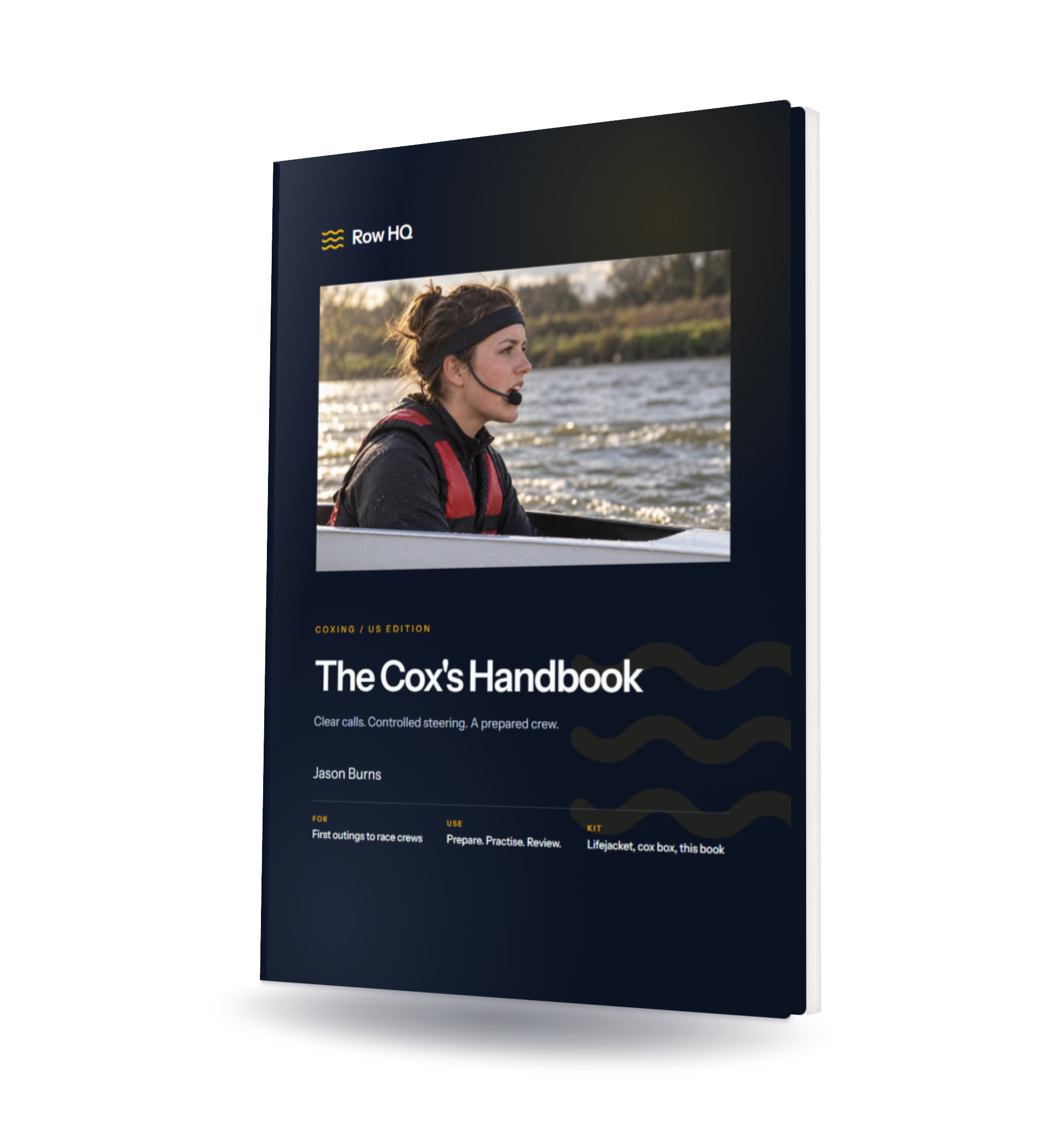
New to the seat? Our coxing guide for first-time coxswains walks through the standard calls, steering and gear you need for your first practice.
Coxswains in US college and high school rowing
The cox role is central to American collegiate rowing. At NCAA varsity programs, the V8+ (varsity 8), 2V8+ (second varsity 8) and V4+ (varsity coxed 4) all require a cox. So do the JV (junior varsity) and freshman/novice eights that form the pipeline below varsity. A strong program will have three to five coxes on the roster, one for each boat on a typical water day, with a sixth on the launch shadowing the coaching staff for the day.
The IRA National Championship Regatta (founded in 1895 and historically run at Mercer Lake in NJ after years at Camden) is the marquee men's collegiate event, and the quality of coxing in the eight is a documented factor in close finishes. Programs at Yale, Harvard, Cal, Washington, Princeton, Brown and Navy invest heavily in recruiting and developing strong coxes because a race-sharp cox in a close 2k routinely pulls a length out of a leaderboard-quality eight. The NCAA Rowing Championship on the women's side carries equivalent weight, with Stanford, Texas, Brown, Cal and Princeton all known for cox development.
At the high school level, NEIRA (New England Interscholastic Rowing Association), the Stotesbury Cup in Philadelphia, USRowing Youth Nationals and the SRAA National Championships all require coxes in 8+ and 4+ events. Most prep school and high school club programs run a cox-specific clinic at the start of fall season. Demand for capable coxes almost always outstrips supply, so a motivated J16 or J17 athlete who wants to cox will get water time fast.
The cox's responsibilities shift by squad level. In a novice program, the cox manages safety, basic steering, the rate call, and relays the coach's feedback from the launch. In a JV or varsity 8+, the cox runs the full race plan autonomously, calling rate changes at precise stroke counts, reading the field in real time, and making tactical decisions mid-race with no input from the launch. At the IRA or NCAA Championship level, the cox holds a mental model of every rival lineup's tendencies from video study, knows the water's quirks from warm-up laps, and calls the sprint at the exact stroke count the lineup can sustain to the line.
USRowing cox certifications and training
USRowing runs the standard certification pathway for coxes competing at sanctioned events in the United States.
- USRowing Safety Education Course - the mandatory online certification for any cox racing at a USRowing-sanctioned regatta. Covers capsize procedures, water safety rules, right-of-way, cold-water response and basic cox responsibilities. Takes roughly 2 to 3 hours to complete. Programs are required to keep copies of cox certifications on file for every athlete on the roster.
- USRowing Coxswain Education Series - a deeper curriculum covering race strategy, communication, steering mechanics and race-day procedures. Not mandatory for all events, but strongly recommended for any cox moving from a high school 4+ into a college novice 8+ or from a JV 8+ into a V8+.
- SafeSport Certification - required for any cox or rower over 18 working in programs that include minors. Administered through the US Center for SafeSport. NCAA-affiliated programs require it for all athletes and staff each season.
The USRowing Safety Education Course is the floor, not the ceiling. Programs that run a structured cox development pipeline (assigned mentor cox, weekly video review of cox calls, timed steering drills on flat water and on chop) produce coxes who step into a varsity 8+ faster and make fewer race-losing tactical errors. World Rowing publishes supplementary cox development resources for programs sending athletes to international events.
Famous US and Olympic coxswains
Mary Whipple coxed the United States women's 8+ to Olympic gold at Beijing 2008 and London 2012, and is widely regarded as the standard-setter for modern US racing coxes. Her work rate, race intelligence and communication style under pressure became the benchmark for cox development at NCAA programs. Pete Cipollone coxed the US men's 8+ to gold at Athens 2004 and held the IRA course record for years; his preparation method (detailed race plans tailored to each rival lineup, constant video study of rival starts and sprints) is still cited in USRowing coaching resources. Marcus McElhenney coxed the US men's 8+ to bronze at Beijing 2008. At Olympic level outside the US, Garry Herbert (Great Britain) coxed the gold-medal coxed pair of Greg and Jonny Searle at Barcelona 1992 in one of the most memorable comebacks in Olympic rowing. The Head of the Charles Regatta routinely produces standout cox performances across collegiate, club and masters divisions, with the Club and Championship Eight events drawing the most competitive cox fields in US domestic rowing.
How Row HQ helps coxswains and US programs
Running a US college program with multiple coxed shells (V8+, 2V8+, V4+, novice 8+) means every cox needs to know their assignment before they leave the dock. Row HQ's coach tools let the coaching staff build the full lineup (including which cox is in which shell) and push the assignment directly to every athlete and cox via app notification. No cox arrives at the boathouse uncertain which shell they are in. No head coach fields a GroupMe thread of "which boat am I in?" messages the night before practice.
The practice scheduling module lets the cox see what is on the program for the week (water, erg, lift, land workouts) with time and location, so they can prepare their practice plan ahead of launch. Coaches add practice notes visible to the cox as well as the athletes, covering drills, rate targets and the day's technical focus.
Through the athlete portal, the cox manages their own profile, USRowing certification status, and availability for each practice. If a cox is out for Tuesday's practice, the head coach sees it in the lineup builder before building the boats. No surprise gaps at launch on a winter Tuesday with a 27 degree wind on the Charles.
Get the free Cox Calls Sheet
Coxswain FAQs
What does a coxswain do?
A coxswain holds three jobs at once during every race and every practice: steer the shell, run the race plan, and motivate the lineup. They sit in the stern (sometimes the bow on a 4+) facing the rowers, hold a rudder line in each hand, watch the course and the rival lineups, and call the rate, the pressure and the tactical moves through the cox box. In practice the cox runs warm-ups, calls drills, gives technical feedback to individual rowers, and reports back to the head coach on the launch.
How heavy should a coxswain be?
Cox weight rules depend on the event. British Rowing uses 55 kg, except for J15 and younger crews at 45 kg. USRowing uses 120 lb for men's and mixed crews, and 110 lb for women's crews. Lighter coxes carry accepted deadweight where required. Check the current event rules for exemptions, weighing and ballast arrangements. These figures are not universal national or international rules.
Do coxswains row?
No. The cox does not pull an oar. They steer the shell, manage race tactics, hold the race plan in their head, and call the rate and pressure. The athletes move the shell with the oars; the cox provides the steering, the strategy and the voice. Some coxes train in singles or pairs in the off-season to feel the technique they coach all year, but in any coxed shell during practice or racing the cox is on the rudder and the microphone, not the handle. This is what distinguishes coxed events (8+, 4+) from coxless events (4-, 2-, 4x, 2x, 1x), where rowers steer with a foot-steering mechanism.
What does a cox box do?
A cox box is the cox's amplification and metrics unit. It amplifies the cox's voice through speakers wired down the spine of the shell so every athlete hears the call. It displays live stroke rate from a magnet on the stroke seat's slide. It times the piece. GPS-enabled units from Nielsen-Kellerman (NK CoxBox GPS) and Coxmate (Coxmate GPS) also display boat speed, 500m split and distance covered, and log every stroke to internal storage for review after practice.
Which boats need a coxswain?
The 8+ (eight) is always coxed. There is no coxless 8 in any US college, prep school or club competition. The 4+ (coxed four) carries a cox in the stern or the bow. The 4- (straight four) is coxless and uses foot-steering, common in NCAA men's lightweight programs. Pairs (2-), single sculls (1x), double sculls (2x) and quad sculls (4x) all race coxless. Some smaller club shells and learn-to-row 4+ and 8+ boats carry a cox for safety regardless of event format. Adaptive rowing events sometimes use coxed shells with the cox handling steering for the lineup.
How do you become a coxswain?
Most US coxes start at a high school crew, a college novice program, or a club's learn-to-row program. The first step is usually a cox induction covering steering basics, boat commands, water safety and emergency procedures. USRowing requires the Safety Education Course before racing at any sanctioned regatta. The USRowing Coxswain Education Series builds the deeper skill set. After that the only thing that matters is time on the water: 50 practices in, a motivated novice cox is usually competent in a JV 8+. Most programs are short on coxes, so a willing learner gets practice time fast.
Related
What is a Regatta?
A regatta, in US rowing, is the spring and early summer sprint format. Six lanes, a buoyed straight, a 2,000m course for...
What is an Ergometer?
An ergometer is the indoor rowing machine that every US boathouse owns in volume. Walk into the erg room at Princeton, Y...
What is a Rowing Shell?
A rowing shell is the racing hull itself, the boat as an object, and in US boathouses it is almost never called anything...
Rowing Boat Types
Eight racing shells make up the entire roster of US rowing. The single (1x), double (2x), pair (2-), quad (4x), straight...
What is a Scull?
A scull is the short rowing oar a sculler holds one in each hand. That two-oar grip is what separates sculling from swee...
What is Catching a Crab?
Catching a crab is the moment an oar fails to release while the shell is still under power. The hull keeps moving, the l...
What is a Cox Box?
A cox box is the amplification and metrics unit the cox runs during every practice and race: speakers wired down the spi...
What is Stroke Rate?
Stroke rate is the per-minute cadence the cox box, NK SpeedCoach and Concept2 PM5 monitor display, in strokes per minute...
From the RowHQ shop
Printable PDFs written for club rowers. Buy once, keep forever.
Keep learning
A coxswain cannot call a sharp practice from an outdated lineup. Put shell assignments and practice details in rowing team management software, then use the rowing glossary to check the terms behind the calls.
Coxes deserve better than a GroupMe thread.
Row HQ tells coxes which lineup they're in, what practice it is and where to be, automatically. Built by rowers, in use at Oundle Town Rowing Club.