Scull
A scull is the short rowing oar a sculler holds one in each hand. That two-oar grip is what separates sculling from sweep rowing, where every athlete holds one longer oar with both hands and is assigned a side. Four shells use sculls: the single (1x), the double (2x), the quad (4x) and the octuple (8x). The US sculling calendar peaks at the Head of the Charles Regatta in October, where the championship single sculls fields draw Olympic and World Championship medalists from across the country and around the world.
What is a Scull?
A scull is a rowing oar built to be used as one of a matching pair, with each athlete holding one scull per hand. Sculling is the discipline where every seat pulls two oars; sweep is the discipline where every seat pulls one. US sculling pathways run from learn-to-row programs at Craftsbury Sculling Center in Vermont up to the USRowing National Selection Regatta on Mercer Lake, the Head of the Charles championship singles and the US Olympic single and double scull.
Also called: Sculling, Sculling Oar, Scull Boat
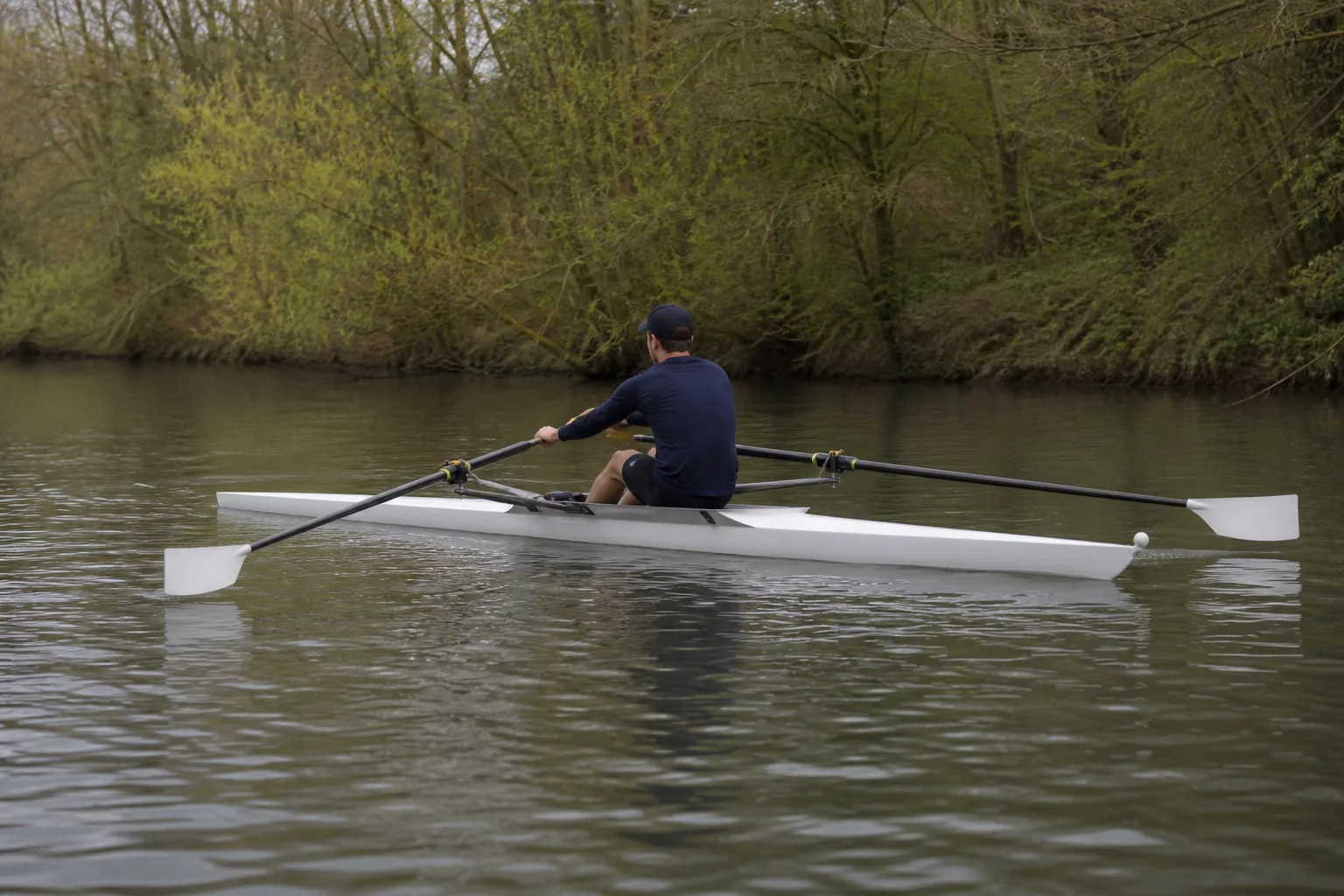
Sculling vs sweep: the two disciplines of rowing
Rowing splits into two disciplines at every level. Sculling means two oars per seat, one in each hand. Sweep means one oar per seat, gripped with both hands, with the athlete locked to either port or starboard. Both compete at the Olympics, World Rowing Championships and across the US racing calendar. The Head of the Charles fields championship singles, doubles, quads and the recreational sculling events all on the same weekend as its dominant eights program. USRowing Senior Nationals runs the full Olympic-distance program in both disciplines. Para sculling adds the PR1, PR2 and PR3 single sculls classifications, with US athletes competing at every World Championship cycle.
The rigging follows the oar count. A sculling shell carries a rigger on each side of every seat so the load stays symmetric. A sweep shell alternates riggers down the hull so port and starboard athletes balance each other through opposite stroke arcs. Spread (the distance from the centerline of the boat to the oarlock pin) runs lower on a sculling shell because two oars together fall in a tighter geometry than one. See the rowing shell entry for the wider picture on hull design and rigging across boat classes.
The four sculling shells
- Single scull (1x): 27 ft, one athlete, two oars. The cleanest test of individual rowing skill in the sport. Hardest to balance, fastest to surface a technique fault. Gevvie Stone of Boston won Olympic silver in the 1x at Rio 2016, the most decorated US single sculling performance of the Concept2 era. Kara Kohler followed with bronze at the 2019 World Championships.
- Double scull (2x): 32 ft, two scullers each pulling a pair of oars. Faster across a 2k than any sweep pair because four oars beat two for power transfer. The 2x is contested at every Olympics and at the Head of the Charles. US programs at Riverside Boat Club in Cambridge MA, Penn AC in Philadelphia and Craftsbury in Vermont turn out 2x crews for senior trials each spring.
- Quadruple scull (4x): 41 ft, four scullers each pulling two oars. Eight oars in the water at once. No coxswain at senior level; one athlete steers with a foot mechanism wired into the rudder. The 4x has been an Olympic class for both men and women since the 1980s, and the World Championship gold medal usually goes to a European federation with a deep sculling base (Germany, the Netherlands, Italy).
- Octuple scull (8x): 56 ft, eight scullers plus a coxswain. Sixteen oars on the water. The 8x lives in US junior, masters and developmental racing. Not an Olympic class. The Head of the Charles runs a youth and recreational 8x event, and USRowing Masters Nationals typically fields a strong octuple program from clubs across the Northeast and West Coast.
Sculling shells run narrower at the waterline than equivalent sweep shells because the symmetric oar load needs less hull width to stay upright. A double moves faster than a sweep pair over a 2k. A quad beats a coxless four. Eight oars on a quad produce more thrust per stroke than the four oars on a sweep four, even with the same number of athletes pulling. The geometry of two oars per athlete simply transfers more cleanly to boat speed.
Sculling oars: anatomy and sizing
A sculling oar runs 285cm to 290cm and breaks into four parts: a handle for the single hand grip, a hollow carbon shaft, a sleeve and collar that sits inside the oarlock, and a blade. Concept2 builds the oars used in most US boathouses, with manufacturing in Morrisville Vermont and a service network that gets a damaged shaft repaired and back on the rack inside two weeks. Croker out of Australia and Dreissigacker fill out the rest of the US market. Blade choices include the Macon (the original tulip shape, still common in masters fleets), the Big Blade (wider and shorter, the dominant collegiate shape since the 1990s), the Vortex (a Big Blade variant with surface edges that grip the water at the catch) and the Comp (Croker's modern racing shape with a slight asymmetric profile).
A pair of sculls weighs about 1.6 kg, so 3.2 kg of oar load total per athlete. Inboard length runs adjustable through a sliding collar, which lets a club rig the same fleet of oars for athletes spanning a 30cm range in height. Sculling spread (the pin-to-pin distance across the boat) typically lands around 160cm on a club single, tightening to 158cm for elite scullers chasing a more direct catch angle. Sweep spread sits closer to 86cm measured from centerline.
Why most sculling programs start athletes in singles
Learn-to-row weeks, high school novice clinics and masters entry programs almost all start beginners in sculling shells. Three reasons drive the pattern across US programs.
Balance comes first. Two sculls create a self-correcting feedback loop. If an athlete leans port, pressure builds on the port handle and lightens on starboard, and the instinctive response is to even the pressure back out. That correction happens automatically in a single. In a sweep boat, only the rower next to the leaning athlete feels the shift, and the correction has to be coordinated across the lineup.
Symmetric work patterns come second. Both hands do the same job, so any technique fault shows up identically on both sides. There is no port-side bad habit because there is no port side. Just a left hand and a right hand, always doing the same thing at the same time. Sweep rowing locks athletes into side-specific patterns from the first stroke, and unwinding those patterns takes months once they set.
Independence is the third reason and the one that determines whether a novice stays with the sport. A single goes on the water with one athlete and a launch driver. No crew to schedule. No coxswain to recruit. A new sculler can show up at the boathouse on a Tuesday evening, sign out a stable single, and be on the water in fifteen minutes. That access pattern is what gets US novices through their first season, even at programs where the racing lineup is overwhelmingly sweep.
How US sculling programs structure athlete development
A typical US sculling progression runs through stable recreational shells (Maas Aero, Hudson Recreational, Edon) for the first month of balance work, then graduates athletes into club-grade singles and doubles as technique develops, then into quads for athletes ready to race together. Scullers chasing USRowing Senior Trials, the Independence Day Regatta open singles or the Head of the Charles championship 1x specialize in single training across the racing season. Practice scheduling software matters at this stage because sculling work is largely self-directed - athletes book the shell, the time slot and the launch coverage themselves rather than getting slotted into a fixed lineup.
Coaches running a mixed sculling and sweep program need to track which athletes have completed USRowing capsize and water safety certification, which shells each rower is cleared to take out unaccompanied, and who is progressing toward which boat class. Row HQ coach tools hold those records against each athlete's profile alongside ergometer scores, on-water splits and seat-racing notes. Wire that record into online boat booking and the right athlete is always in the right shell, with the launch coverage automatically scheduled around it.
Sculling FAQs
What is the difference between sculling and rowing?
Rowing is the umbrella sport. Underneath sit two disciplines: sculling and sweep. A sculler grips one oar per hand and the boat is symmetric. A sweep rower grips a single oar in both hands and is locked to port or starboard for the duration of the row. Sculling shells are the 1x, 2x, 4x and 8x. Sweep shells are the 2-, 4-, 4+ and 8+. US collegiate racing leans heavily sweep because IRA, Eastern Sprints and NCAA Women's all crown eights and fours. The sculling calendar lives outside collegiate competition: USRowing Senior Trials, the Head of the Charles championship singles, Independence Day Regatta in Philadelphia, and the masters singles fields that fill Cambridge MA in October.
How is sculling different from sweep rowing?
A sculler's hands cross each other at the catch (left over right in most US programs, by convention) because the two oars share a single point of stroke arc directly in front of the athlete. A sweep rower's hands stay on the same side. Sculling shells are rigged with both oarlocks at matching height and pitch; sweep shells alternate riggers down the hull so port and starboard balance against each other. Sculling rewards wrist mobility, hand independence and clean blade work on both sides at once. Sweep rewards committing power into a single oar with the larger muscles of the back and legs. Coaches usually say sculling is faster to start and slower to master.
What shells use sculls?
Four shell classes use sculls. The single (1x) carries one athlete with two oars. The double (2x) carries two scullers paired in a longer hull. The quad (4x) carries four scullers across four seats. The octuple (8x) carries eight scullers plus a coxswain and shows up at junior nationals, masters nationals and developmental regattas, though it is not an Olympic class. Sculling shells run narrower at the waterline than equivalent sweep shells because the symmetric oar load distributes balance evenly without the need for extra hull width.
How long is a sculling oar?
A sculling oar measures roughly 285cm to 290cm, around 30cm shorter than a sweep oar at 370cm to 376cm. The shorter shaft matches the smaller arc each scull travels and the lower outboard load on one side of the body. Concept2 oars built in Morrisville Vermont dominate US programs because of the manufacturer's service network and parts availability. Croker and Dreissigacker are common alternatives, both running their own blade geometry. Macon blades still appear in masters fleets; Big Blades own the collegiate market; Vortex edges show up where coaches want extra grip at the catch on choppy water.
Is sculling easier to learn than sweep rowing?
Most US learn-to-row programs put novices in a stable single or wide-beam recreational shell first. The two-oar grip gives instant balance feedback - if the boat tips, the pressure between hands shifts and the athlete corrects without thinking. Sweep rowing requires assigning a side from day one, and athletes ingrain side-specific patterns that take months to undo. Once basic balance is in place, scholastic and collegiate programs typically move athletes into pairs, fours and eights because that is where the racing lives. Sculling-first remains the norm at masters clubs, at sculling-specialist programs like Craftsbury, and at Vesper Boat Club in Philadelphia where the singles tradition runs back over a century.
What is a 'feathered scull'?
Feathering rotates the scull blade flat to the water during the recovery so the face does not catch chop. As the hand pushes away from the body after the finish, the fingers roll the handle and the blade lays parallel to the surface. Just before the catch, the same fingers square the blade back vertical for the entry. Each hand feathers independently in sculling, which is why wrist mobility and coordinated hand swing show up so often in sculling drill work. New scullers usually train on square blades first to build a clean catch before adding the rotation. Square-blade rowing also sits at the top of the fix list for over-feathering crabs.
Related
What is a Rowing Shell?
A rowing shell is the racing hull itself, the boat as an object, and in US boathouses it is almost never called anything...
Rowing Boat Types
Eight racing shells make up the entire roster of US rowing. The single (1x), double (2x), pair (2-), quad (4x), straight...
What is a Coxswain?
A coxswain is the human in the stern of a coxed rowing shell who steers, runs the race plan, motivates the lineup and st...
What is a Regatta?
A regatta, in US rowing, is the spring and early summer sprint format. Six lanes, a buoyed straight, a 2,000m course for...
What is Catching a Crab?
Catching a crab is the moment an oar fails to release while the shell is still under power. The hull keeps moving, the l...
What is Feathering in Rowing?
Feathering is the wrist rotation that turns the blade flat to the water between strokes. Square during the drive (so the...
Keep learning
A sculler needs the right shell, current safety clearance and water time that fits the program schedule. Coaches can coordinate that through rowing software for US programs while athletes focus on handling two oars cleanly. The rowing glossary explains the terms they will hear at practice and racing.
Less spreadsheet. More time on the water.
Row HQ handles shell sign-out, safety launch coverage, athlete qualifications and practice scheduling for sculling programs. Built by rowers, used at Oundle Town Rowing Club.