Ergometer
An ergometer is the indoor rowing machine that every US boathouse owns in volume. Walk into the erg room at Princeton, Yale, Washington, Cal or any IRA program and the same product is lined up against the back wall: a Concept2 RowErg fitted with a PM5 monitor, built in Morrisville, Vermont. It is the standard machine of competitive US rowing. C.R.A.S.H.-B Sprints, USRowing winter trials, NCAA recruiting tests and every varsity 1V seat-racing card all run on it.
What is an Ergometer?
The ergometer is the indoor rowing machine that measures the work a rower puts into each stroke and converts it into a /500m pace, watt output, calorie rate and stroke rate. In US rowing the word points to one specific product: the Concept2 RowErg with a PM5 monitor, built in Morrisville, Vermont. It is the machine on which every C.R.A.S.H.-B Sprints heat is rowed, every USRowing winter trial result is logged, and every college recruiting profile is built.
Also called: Erg, Rowing Ergometer, Indoor Rower, Rowing Machine
Ergometer, erg, indoor rower: same machine, three labels
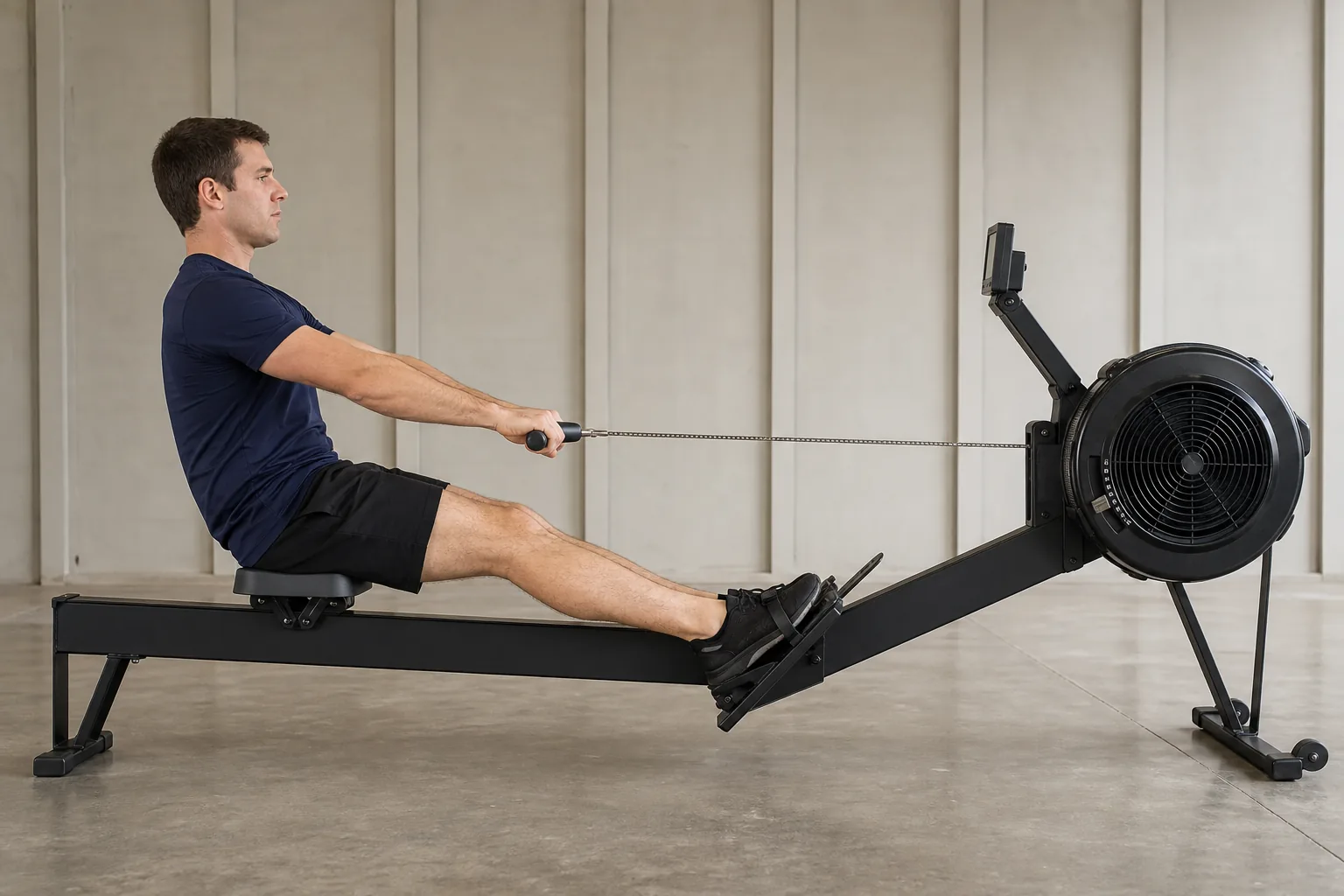
Three words point at the same piece of equipment, and the word a person picks signals where they came up in the sport. Coaches writing season plans and exercise physiology textbooks say "ergometer" because it is the technically correct term (Greek ergon, meaning work, plus metron, meaning measure). Inside any boathouse no one bothers with the full word. A varsity captain shouting from the front rack says "erg" every time: "set up the ergs for 5K trials." Commercial gyms call the same thing a "rowing machine" or, lately, just a "rower." All three labels mean the same hardware: a sliding seat on a steel monorail, a foot stretcher with adjustable heel cups, a chain handle, an enclosed flywheel, and a monitor reading work in pace units.
How an ergometer converts a pull into a number
Each stroke pulls the chain, which spins a flywheel inside the cage. The flywheel meets resistance from air entering through vents in the housing. Between strokes the wheel slows. A magnetic sensor on the housing reads precisely how quickly the wheel decelerates, the PM5 firmware solves for the work the rower put into the chain on the previous stroke, and the answer appears on screen as a /500m split. Watts, calories per hour and cumulative meters are secondary readouts from the same underlying calculation. The machine itself never moves. There are no motion sensors, no GPS, no boat speed. Everything on the display is computed work expressed in rowing-equivalent pace units.
The damper lever on the side of the flywheel cage adjusts how much air enters per stroke. Set to 10 the wheel grabs more air and decelerates harder, so the catch feels heavy and the back end of the stroke loads up fast. Set to 1 the wheel spins freely and the stroke feels like a quick, light single. The damper position alone does not change the score on the PM5. What does change the score is drag factor, the number found under More Options on the PM5, which combines damper position with the air density of the room. US heavyweight men typically race C.R.A.S.H.-B at drag factors of 125 to 135. Lightweight women usually train at 110 to 120. Drop any /500m split into the erg pace calculator for the matching watt, calorie and predicted distance values.
Why the Concept2 is the standard machine of US rowing
Concept2 is a family-owned company in Morrisville, Vermont that has been shipping a fundamentally consistent ergometer design since 1981. The current model is the RowErg, badged simply as the Concept2 RowErg since around 2021. Before the rename, the same machine carried the Model D (standard 14-inch seat height) and Model E (taller 20-inch seat height, easier on the knees during get-on and get-off) names. The internals across all three are essentially identical. The reason this product dominates US college rowing is calibration. A 2k score pulled on a Concept2 in the Brown boathouse in November reads against a score pulled on a Concept2 at Stanford in March within stroke-for-stroke precision. That single property is what makes the machine the recruiting currency of the sport. IRA programs publish 2k roster cutoffs against it. Eastern Sprints qualifiers are gated on it. C.R.A.S.H.-B Sprints in Boston has required Concept2 calibration on every machine on the floor since the first event in 1982.
How does the ergometer differ from rowing on the water? The geometry is similar but the physics is not. The chain pulls in a straight line, while an oar arcs through an angled gate. The flywheel resistance is constant and predictable, while water resistance shifts with hull speed, wind, set, swell and crew rhythm. There is no balance to maintain, no shell to keep flat, no coxswain to listen to, no lane to hold. A strong erg score is the floor for a good rower, not the ceiling. The athletes who turn watts on the flywheel into boat speed are the ones who can take that engine and apply it cleanly to a stroke that has to thread eight other rowers, a hull, and a moving environment together. Erg pieces also remove the synchronization demand of an eight: the PM5 monitor measures one athlete in isolation, while race-day boat speed depends on eight athletes catching, driving and recovering in tight synchronization with each other.
Reading the PM5 monitor
- /500m split: the projected finishing time the PM5 calculates for the next 500 meters at the current rate of work. A reading of 1:42 means the rower is on pace for a 1 minute 42 second half kilometer. Every US race plan, training zone and athlete comparison anchors on the split because it is unambiguous and converts directly to boat speed.
- Watts: instantaneous power output into the flywheel. Concept2 publishes the relationship as watts equal to 2.80 divided by the cube of pace seconds per 500 meters. A 1:45 split is roughly 268 watts. A 1:30 split is roughly 425 watts. The cube makes the climb brutal: halve the pace number and watt output multiplies by eight.
- Calories per hour: the PM5 estimate calculated as four times watts plus 300 for resting metabolism. Repeatable across sessions and useful as a relative training-load proxy, but not a nutritionist-grade number.
- Stroke rate (spm): strokes per minute. Steady-state aerobic work sits at 18 to 20. Threshold pieces run 26 to 28. Race rates in a varsity 1V eight open the start at 38 to 42 and settle through the body of the race at 32 to 36.
- Distance: meters of computed work, not meters traveled. The machine is bolted to the floor. The display converts flywheel work into rowing-equivalent meters using the Concept2 calibration constant.
How US programs actually use the erg
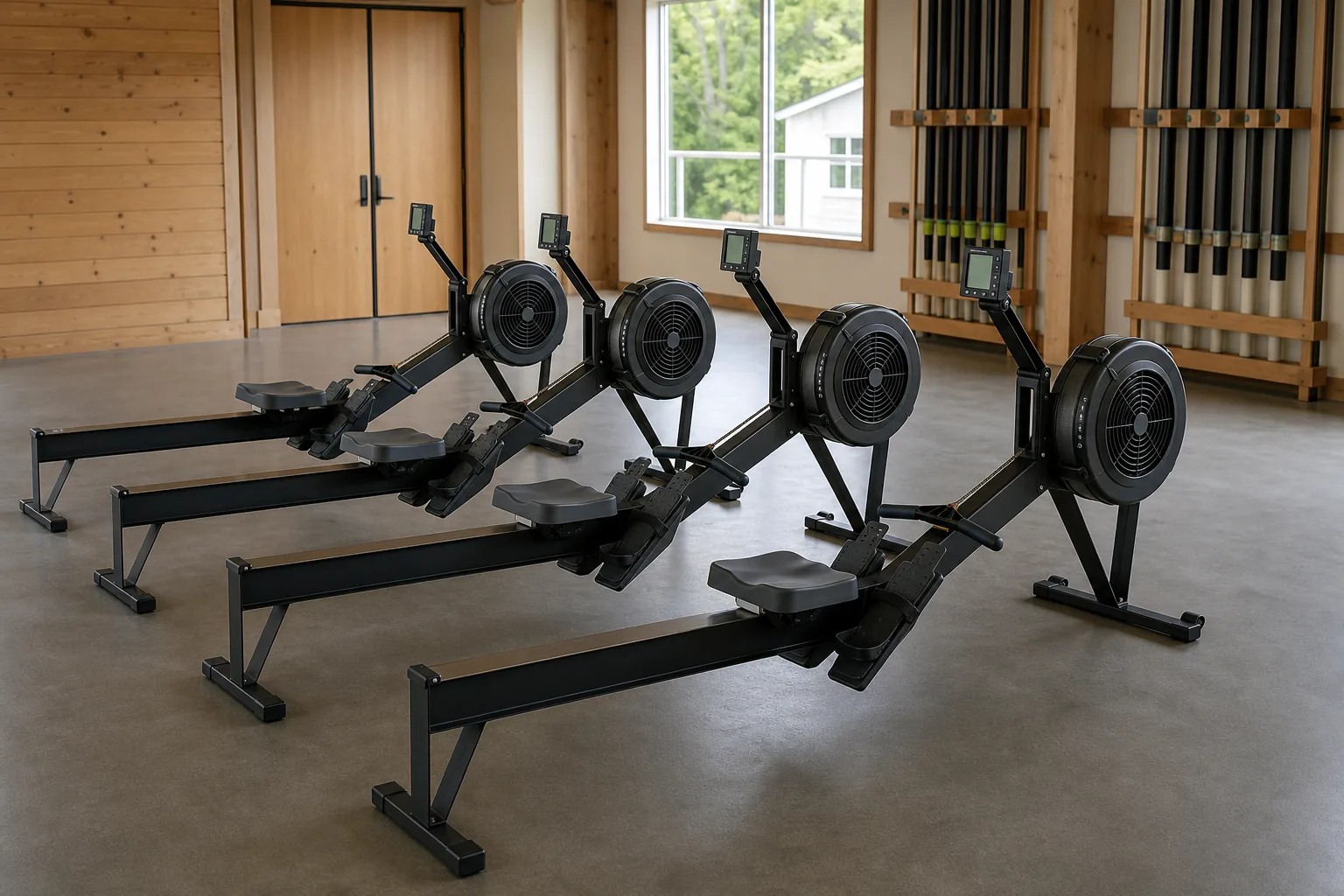
The ergometer carries three loads inside a US program. Load one is the winter. From mid-November through February most boathouses on the East Coast, in the Midwest and across parts of the Pacific Northwest cannot put hulls on the water safely, so the entire fitness build for the spring sprint season happens indoors on the ergs. Load two is fitness testing. The 2k erg score is the single most scrutinized data point in US collegiate rowing recruiting. Coaches at IRA, EARC, Pac-12, Big Ten and ACC programs publish target 2k times by class year and weight category, and high school athletes who cannot hit those numbers do not get roster offers. The 5k, the 6k and the 30-minute test fill out the aerobic battery. Load three is lineup selection: erg scores sit alongside on-water seat-racing and timed pieces as the primary inputs when a coach builds the varsity 1V, the 2V and the freshman boats.
Recording one number is easy. Tracking a 35-athlete roster across a fall head-racing block, a winter erg build, a spring sprint season and a summer USRowing trials campaign is a database problem dressed up as a spreadsheet. Row HQ coach tools attach every test to the right athlete the moment the PM5 stops, plot fitness trajectory across the season, and surface a quietly fading novice or a freshman about to overtake the JV stroke before the next seat-racing night begins.
The standard US erg test pieces
These are the ergometer protocols on the trial sheet at most US college and prep school boathouses:
- 2,000 meters (the 2k): the Olympic race distance and the recruiting benchmark. Most varsity-grade openweight men finish between 6:00 and 6:50. Varsity women between 6:45 and 7:30. The 2k is the entry requirement for every C.R.A.S.H.-B Sprints category and every NCAA roster slot.
- 5,000 meters (the 5k): aerobic endurance test, rowed at threshold or just below. Most varsity squads finish in 17 to 22 minutes. Flags athletes who run out of aerobic engine partway through and need a winter base block.
- 30-minute piece: total meters covered in half an hour at sustained threshold pace. Pacing discipline test as much as fitness test.
- 60-minute piece: long aerobic build at UT1 or UT2 intensity, used by some programs as the February baseline before the season-opening 2k retest.
- 4 x 2,000 meters or 8 x 500 meters intervals: race-pace specificity work. The 8 x 500 with two minutes rest is a particular favorite at US scholastic programs because it teaches freshman novices how to suffer at race rate without yet asking for a full 2k.
Every result on the trial sheet needs the athlete's bodyweight that morning logged next to the time, plus the drag factor used. Bodyweight matters because lighter rowers face a real power-to-weight disadvantage on the erg that the World Rowing weight-adjusted formula corrects for. Drag factor matters because a 6:30 at 130 drag and a 6:30 at 100 drag are different efforts. Without both numbers the sheet is only half a result.
C.R.A.S.H.-B Sprints and the indoor circuit
Indoor erg racing grew into its own sport behind one event. The Charles River Association of Sculling Has-Beens, better known as C.R.A.S.H.-B Sprints, has run every February in Boston since 1982. It draws over two thousand entries across open, collegiate, masters and lightweight categories on a single weekend, and a strong showing on the C.R.A.S.H.-B leaderboard is a recruiting signal college coaches read directly. The World Rowing Indoor Championships moved onto Concept2 calibration as soon as the international federation took the event on. The Concept2 online ranking system runs year-round and lets a Princeton junior compare a 2k against a Yale senior or a New Zealand U23 in the same minute the screen flashes the time.
Ergometer FAQs
Is an ergometer the same as a rowing machine?
Practically yes. In US rowing the word "ergometer" (or just "erg") points to one specific product: the Concept2 RowErg with a PM5 monitor, manufactured in Morrisville, Vermont. "Rowing machine" is what a commercial gym calls the same equipment, and "rower" is what most home fitness brands have settled on. What sets the Concept2 apart from the rest is calibration: C.R.A.S.H.-B Sprints, the World Rowing Indoor Championships and every US college recruiting protocol use this machine because a score on one Concept2 matches a score on every other Concept2 anywhere in the world.
What does an ergometer actually measure?
Work, not movement. A magnetic sensor on the flywheel housing reads how quickly the wheel decelerates between strokes. The PM5 firmware solves for the joules the athlete put into the chain on the previous stroke and converts that into a /500m split, watts, calories per hour and cumulative meters of work. The watt formula is published openly by Concept2: 2.80 divided by the cube of pace seconds per 500m. Calories per hour come out as four times watts plus 300 for resting metabolism. Nothing on the display comes from GPS or motion sensing because the machine is bolted to the floor of the erg room.
What 2k erg time gets a US high school athlete recruited?
Heavyweight men chasing NCAA Division I openweight programs need a sub-6:30 (1:37 split) on video to get a return email from a coach. Lightweight men typically need sub-6:50. NCAA women openweight programs look for sub-7:15 (1:48 split) at the top end and sub-7:35 for lightweight. Junior under-19 athletes target 6:30 to 7:00 for boys and 7:30 to 8:00 for girls. Ivy League, Big Ten, Pac-12 and ACC programs all publish internal roster bands. Run any 2k time through the erg pace calculator to back out the split, watts and predicted longer-distance pieces.
How does the erg measure meters if the machine never moves?
It does not measure literal meters traveled. The meters on the PM5 are computed work. The flywheel slows between strokes at a rate the sensor reads exactly, the PM5 turns that deceleration into joules of work, and the Concept2 calibration constant maps joules into meters of rowing equivalent. The drag factor reading under More Options is the variable that makes the conversion accurate: it tells the monitor how fast the wheel is decelerating given today's damper position and the air density in the room. That is why drag factor is the number to check before a test piece, not the damper number on the cage.
What damper setting should I use?
Train at damper 3 to 5, not 10. The damper opens or closes the vents on the cage. Higher numbers admit more air, the flywheel decelerates harder, and the catch feels heavy in a way that approximates a slow boat. Lower numbers feel like a quick single. Neither setting changes the score on the PM5 because the firmware adjusts for drag. What matters is drag factor. Heavyweight men at IRA programs typically test at 130 to 135 drag. Lightweight men at 120 to 130. Openweight women at 115 to 125. Lightweight women at 110 to 120. C.R.A.S.H.-B Sprints categories are typically raced below 130 drag. Check it on the PM5 before every test piece and write it on the trial sheet.
Do erg scores translate to boat speed?
They translate to potential boat speed. The erg holds the environment fixed, so the score is a clean measure of the watts an athlete can produce. On the water those watts have to survive technique, lineup chemistry, hull set, steering, wind, water state and coxswain calls. A 6:20 2k who cannot move a shell is worth less in the boat than a 6:45 2k with a clean stroke and good run between strokes. US college coaches use erg scores as a floor: anyone below the program standard gets screened out at the recruiting stage. After that, seat-racing and on-water timed pieces decide who actually ends up in the varsity 1V.
Related
What is a Regatta?
A regatta, in US rowing, is the spring and early summer sprint format. Six lanes, a buoyed straight, a 2,000m course for...
What is a Coxswain?
A coxswain is the human in the stern of a coxed rowing shell who steers, runs the race plan, motivates the lineup and st...
What is a Scull?
A scull is the short rowing oar a sculler holds one in each hand. That two-oar grip is what separates sculling from swee...
What is Stroke Rate?
Stroke rate is the per-minute cadence the cox box, NK SpeedCoach and Concept2 PM5 monitor display, in strokes per minute...
From the RowHQ shop
Printable PDFs written for club rowers. Buy once, keep forever.

Learn-to-Row Starter Plan
A free 6-week introduction plan for brand-new rowers - on the water and on the erg.
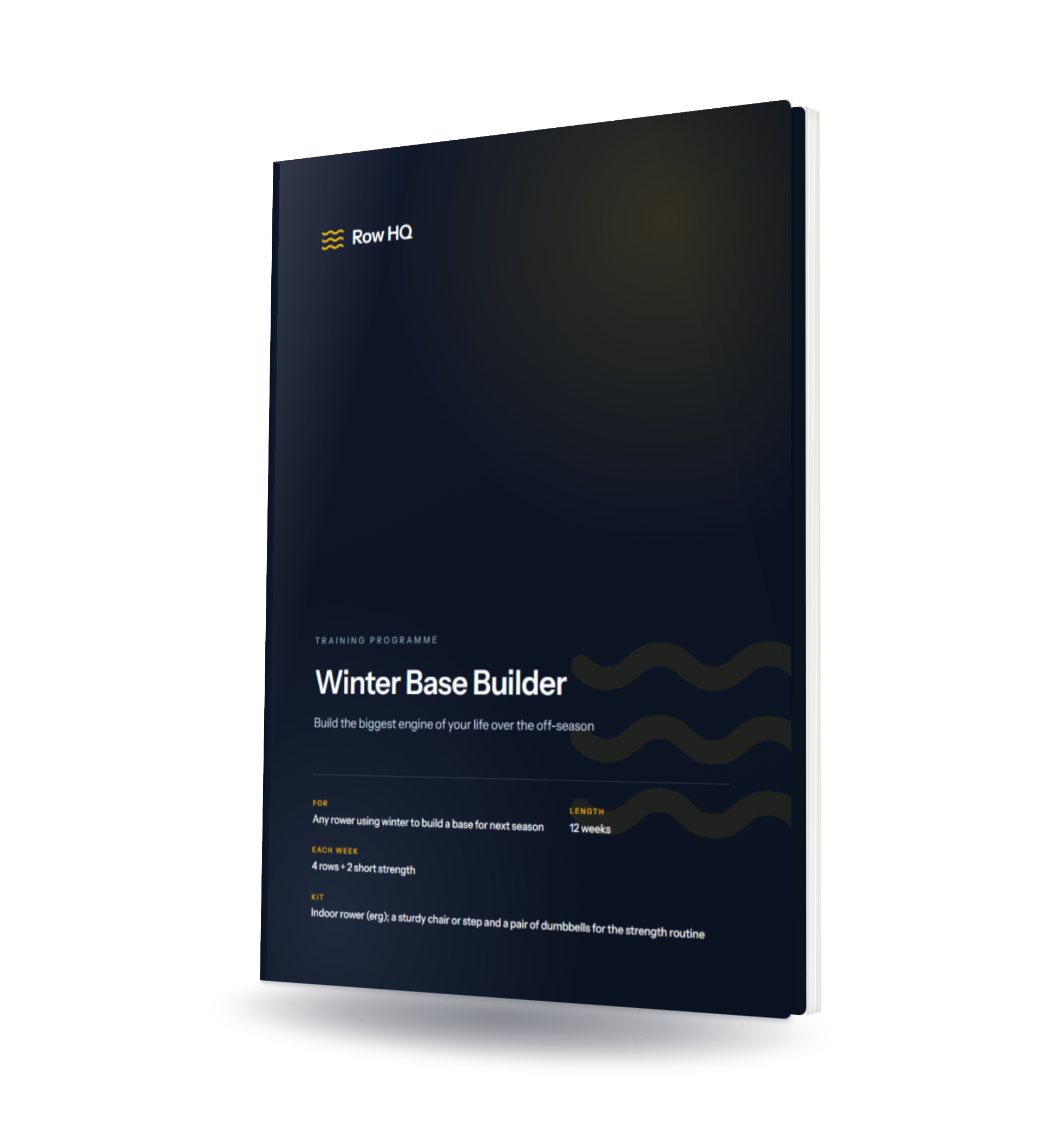
Winter Base Builder
Build the biggest engine of your life over the off-season - 12 weeks of mostly-easy volume plus a strength routine, so you arrive at spring fast.
Keep learning
A 2k score matters most when a coach can compare it with earlier tests and the rest of the athlete's season. rowing software for US programs puts that record in one place for coaches and athletes. The rowing glossary explains the other terms used in the boathouse and on the water.
Every PM5 split, attached to the right athlete, automatically.
Row HQ stores every Concept2 test against the right athlete's profile, plots fitness trajectory across the fall, winter and spring blocks, and pipes the data straight into lineup selection nights. Built by rowers, deployed at Oundle Town Rowing Club.