Stroke Rate
Stroke rate is the cadence of the rowing stroke in strokes per minute (spm). Aussie training bands run 18 to 22 for steady state through to 40 to 44 in the start sequence. Rate is independent of boat speed - the two are linked through distance per stroke. And above an optimal rate the hull slows down, not up.
Stroke Rate: Cadence in Strokes per Minute
Stroke rate is the cadence at which a rowing crew or sculler rows, measured in strokes per minute (spm). It is shown live on the cox box, ergometer monitor or GPS unit. Stroke rate is independent of hull speed - the same crew can row faster at a lower rate with longer, more powerful strokes (high distance per stroke) or at a higher rate with shorter strokes. Aussie training bands run from 18 spm steady state through to 44 spm in the start sequence. Above an optimal rate, more rate makes the boat slower, not faster.
Also called: Rate, SPM, Stroke Rating, Cadence
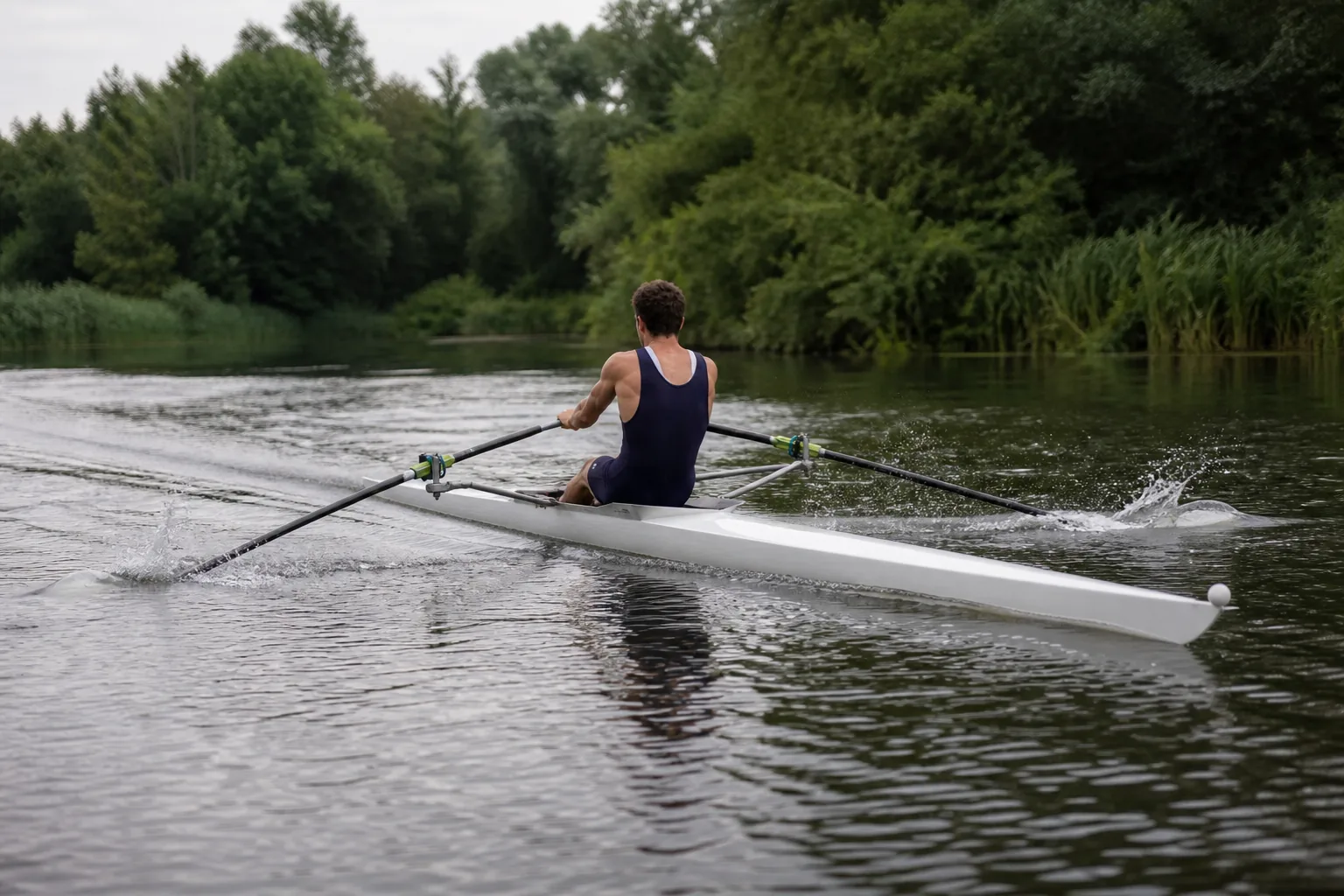
What stroke rate is and how it is reported
Stroke rate is the cadence at which a rowing crew or sculler rows, reported in strokes per minute (spm). One stroke is one complete cycle through catch, drive, finish and recovery. A crew rating 32 takes 32 complete stroke cycles every 60 seconds.
Rate is shown live on the cox box display, the Concept2 PM5 monitor on the shed ergometer, and on GPS units like the Coxmate GPS and the NK Speedcoach. Most units report to one decimal place (so a typical display reads 32.4 spm) and update the figure every few strokes rather than instantaneously.
How stroke rate is measured in a boat and on the shed ergometer
In a coxed boat the source of truth is a magnetic sensor on the slide rail at the stroke seat. The sensor triggers each time the seat passes a fixed point near the catch. The cox box counts the triggers and converts to strokes per minute, with the figure shown on the cox box display for the cox to call against.
On the Concept2 RowErg (the dominant ergometer in Aussie sheds) the PM5 monitor derives stroke rate directly from the timing of the chain pull. Same number, different mechanism. The PM5 reports rate alongside split, watt output and the kcal/hour estimate live during every piece.
GPS units without a slide sensor - Coxmate GPS, NK Speedcoach GPS - pull rate from the boat's velocity trace. The hull accelerates each drive and decelerates slightly through each recovery, so individual strokes are visible in the GPS data and the unit can derive rate from the motion alone. Useful in sculling boats and singles where a wired sensor is awkward.
Aussie training and racing rate bands
Standard rate bands across senior club, schools and King's Cup-level Aussie rowing:
- UT2 steady aerobic: 18 to 22 spm. Long-distance aerobic kilometres on the Yarra or West Lakes, the bulk of winter volume.
- UT1 firm aerobic: 22 to 26 spm. Higher quality aerobic work, lifting lactate threshold.
- AT threshold: 26 to 30 spm. Sustained threshold pieces, race-pace minus a little.
- Head race pace: 28 to 32 spm. The rate crews settle to across 4 to 7 km of head racing - Head of the Yarra, Head of the Schuylkill protocols when adapted locally, head-of-the-river school events.
- Regatta race pace: 36 to 40 spm. The settled middle 1000 of a 2km at the Australian Rowing Championships, King's Cup, or the Penrith course.
- Start sequence and sprint finish: 40 to 44 spm. The first 20 strokes from a standing start and the final 250m kick toward the line.
Schoolboy 1st VIII crews at AGSV, CAS and GPS competitions and the Australian Schools Championships typically race one or two spm lower than the open senior bands. The free training pace tool and ergometer pace tool convert target pace into the split, watt and rate combination each band requires.
How rate links to the drive-recovery ratio
Each stroke has a drive (loaded, spoon in the water, see the drive glossary entry) and a recovery (unloaded, spoon above the water, see the recovery entry). Rate determines how much time the full cycle has - a 60 / spm seconds-per-stroke window. The drive-recovery ratio determines how that window is divided between the work half and the reset half.
At low rates of 18 to 22 the recovery is two to three times longer than the drive (1:2 or 1:3 ratio). Lots of glide time, lots of reset time. At regatta race rate of 36 to 40 the recovery compresses dramatically and the ratio drifts toward 1:1 - drive and recovery take roughly the same time. The crews who hold seats in the third 500 of a 2km are the ones who hold the longest possible recovery as the rate climbs. Rushed slides under race pressure are the textbook way to lose hull speed at exactly the wrong moment.
Rate, distance per stroke and the optimal race rate
Stroke rate and boat speed are linked through distance per stroke (DPS): DPS equals boat speed divided by stroke rate. The same crew can produce the same boat speed at a lower rate with longer, more powerful strokes (high DPS) or at a higher rate with shorter strokes (lower DPS but more frequent power application). Aussie coaches often track DPS as the single number that summarises crew efficiency, because rate alone hides the strength of each individual stroke.
Above a crew-specific optimal rate, more strokes per minute slow the boat down rather than speed it up. The recovery compresses too far for the rower to apply full force on the next drive, distance per stroke drops faster than rate rises, and net hull speed falls. Optimal rate is discovered through rate ladders and race rehearsals - typically 38 to 40 for King's Cup-grade eights, 34 to 36 for senior club fours, 32 to 34 for school 1st VIIIs. Going above optimal also burns the crew before the line, which is a separate way to lose a race.
Rate ladders and rate-locked pieces
Rate ladders are the standard Aussie shed exercise for building rate awareness. A typical session: 5 minutes at 18, 5 at 20, 5 at 22, 5 at 24. The same drive shape and the same recovery sequence carried through each rate, so the squad becomes equally comfortable across the whole training spectrum. Rate-locked pieces (4 x 1km at 32 spm, 3 x 2km at 28 spm) train the crew to hold a specific target rate under pressure rather than drifting up or down.
The stroke seat and the cox use the cox box readout to verify the rate is correct through each piece. Crew lineup and session planning let coaches set rate targets per piece in advance, so the cox arrives at the boat already knowing the rate ladder rather than working it out on the dock.
Stroke rate FAQs
What stroke rates do Aussie crews typically rate?
Standard Aussie training and racing bands: UT2 steady state at 18 to 22 spm, UT1 firm aerobic at 22 to 26, AT threshold at 26 to 30, head race pace at 28 to 32 (think Head of the Yarra), regatta race pace at 36 to 40 (Australian Rowing Championships, King's Cup heats), and the start sequence and sprint finish at 40 to 44. King's Cup eights and Australian Boat Race crews settle around 38 to 40 in the middle 1000. Schoolboy 1st VIII crews at the Australian Schools Championships typically race one or two spm lower than the open senior bands.
Is stroke rate the same as boat speed?
No. Stroke rate is cadence - how often the crew takes a stroke. Boat speed is hull velocity - how fast the boat moves through the water, usually reported as a 500m split or in metres per second. The two are linked but not identical. The same crew can row faster at a lower rate by taking longer, more powerful strokes (high distance per stroke), or at a higher rate by taking shorter strokes. Distance per stroke (boat speed divided by stroke rate) is often a better single number for crew efficiency than rate alone.
How does the rate fit inside the drive-recovery ratio?
Each stroke is made of a drive (the work half, see the drive glossary entry) and a recovery (the reset, see the recovery entry). Stroke rate determines how much time the full cycle has, and the drive-recovery ratio determines how that time is split between work and reset. At UT2 18 spm the recovery is two to three times the drive (1:2 or 1:3). At race rate 38 the recovery compresses hard and the ratio approaches 1:1. Fast crews are the ones who keep the recovery long as long as possible even when the rate climbs.
How does a cox box or ergometer monitor measure stroke rate?
In a coxed boat a small magnetic sensor sits on the slide at the stroke seat and triggers every time the seat reaches the catch. The cox box counts triggers and converts to strokes per minute, usually shown to one decimal place. On the ergometer the Concept2 PM5 derives rate from the timing of the chain pull. Coxmate GPS and NK Speedcoach units without a slide sensor pull rate from the boat's motion trace - the hull surges each drive, so individual strokes are visible in the velocity data.
If the rate goes up, does the boat always go faster?
No. There is an optimal rate above which extra strokes per minute cost power. The recovery becomes too short to apply full force on each drive, distance per stroke drops faster than rate increases, and the hull actually slows down. The optimal rate is crew-specific and gets discovered empirically through rate ladders and race rehearsals. King's Cup-level eights typically settle 38 to 40 and lose speed above 41 or 42; club fours often settle 34 to 36 and lose speed above 38. Going above optimal rate also burns the crew before the finish line of a 2km, which is a separate way to lose.
Related
Stroke Seat Explained
The stroke seat owns the boat's clock. Sitting at the stern of the shell, this athlete sets the cadence every other rowe...
The Coxswain: Steering, Race Plan and Crew Direction
The coxswain is the person in the stern of a rowing boat steering the line, calling the race plan and managing the crew...
The Cox Box: Amplifier, Stroke Rate Counter and GPS Unit
A cox box is the electronic unit the coxswain plugs into during every session. It amplifies the cox's voice through spea...
What is an Ergometer?
An ergometer, or "ergo" as every Aussie shed actually calls it, is the indoor rowing machine that turns each pull on the...
What is a Head Race?
A head race is the autumn time-trial format of Australian rowing. Crews leave the start in single file at 10 to 15 secon...
What Is a Regatta in Australian Rowing?
In Australian rowing, a regatta is a sprint side-by-side meet on a flat-water buoyed course, every crew starting on the...
From the RowHQ shop
Printable PDFs written for club rowers. Buy once, keep forever.
2k PB Push - 6-Week Peaking Block
Six weeks that turn an existing aerobic base into a 2k personal best - race-specific work, a proper taper, every pace scaled to your own time.

The Club Session Library
52 rowing sessions for club coaches, with an illustrated coaching PDF, editable CSV plans, two seasonal blocks and a printable coaching cheat sheet.
Keep learning
A rate ladder works best when the cox and crew have the same targets before push-off. club software for Australian rowing clubs keeps those numbers with the session plan. The rowing glossary covers the stroke phases behind each change in cadence.
Rate targets that live in the session plan, not on a whiteboard.
Row HQ's session planning lets coaches set rate targets per piece in advance, and rowers see the plan in their portal before they leave home for the boatshed.