The honest answer in 30 seconds
Weight the criteria before the block opens, not after. A defensible Kiwi selection process for a Maadi 1st VIII or an NZURA Bond Cup boat layers four inputs: a recent 2k erg with bodyweight handicap (correlates with on-water finishing at r ~ 0.72-0.78 in international sculling, Mikulic et al. 2009), side-by-side rigged pairs over a measured stretch at Karapiro or your home water, a seat-racing series in fours where the same athletes swap across at least three rounds in matched conditions, and coach-rated technical scoring through the block. The shortlist falls out of the erg and the pairs work. Seat racing settles the swing seats. The call is announced privately after the block closes, never in the boatshed with the squad watching. The rest of this article walks through how to organise that block, how to communicate the result without losing the room, and how to stop drowning in WhatsApp messages while you do it.
Selection is the call that defines a season
Get the criteria, the seat-racing protocol and the communication right and the rest of the season runs. Get any one of them wrong and the boatshed knows by Wednesday.
Selection is the call that decides whether a season comes together or comes apart. I have been on the receiving end as a university and masters rower waiting for the lineup to go up, and now I watch coaches at NZ schools and clubs from Auckland down to Otago run the same gauntlet every pre-Maadi block. The bit that nobody warns a new coach about is that the selection itself is not the hard part. The hard part is the surrounding work: organising the seat-racing schedule across three weeks of variable Ruataniwha weather, holding three months of erg scores in your head, briefing parents on why a Year 13 has been dropped, and keeping the squad believing the process was fair. Row HQ's coach tools were built to take the admin off the table so the coaching judgement can do its job. Here is how a workable selection process looks in a Kiwi programme.
Weighting the criteria before the seat race
Before a single pair goes out at Karapiro for the first round of selection trials, write down what each criterion is worth. A typical Maadi 1st VIII rubric across a serious NZ school programme weights the 2k erg around 25 percent (bodyweight-handicapped for lightweights), side-by-side pairs work around 30 percent, the seat-racing block in fours around 30 percent, and coach-rated technical scoring across the camp around 15 percent. The exact split is the coach\'s call. The discipline is locking it in before the testing starts, sharing it with the athletes at the start of the block, and refusing to retrofit the weights to the lineup you wanted. Selection that is defensible against an angry parent has the rubric on paper before the first test.
What makes selection hard in a Kiwi programme
The selection process itself is straightforward. Everything around it is where coaches lose hours, sleep, and occasionally the trust of the squad. Three recurring patterns show up in every programme I work with.
Selection data scattered across four places
The erg history is in a Google Sheet a parent volunteer maintains. The seat-race times are in a notebook in the coach's gear bag. Availability for the Friday-night pairs session is in a WhatsApp thread. The previous lineup is a photo on the coach's phone. The moment three of those four are out of date you are reconstructing the picture from memory at ten o'clock the night before selection. There is a better approach than the spreadsheet workflow.
Holding the pre-Maadi block together
A three-week selection block needs every athlete on the water for every key session. Miss the Wednesday pairs session and the seat-race seeding falls apart. A late dropout for the Saturday morning at Lake Karapiro means reshuffling the matched-pair pairings on the jetty with twenty minutes on the clock. A member portal where rowers update their own availability turns that scramble into a screen refresh.
Carrying the selection picture in your head
Who beat whom in last week's pair, by how much, in what conditions. Whose 2k is from October and whose is from last Tuesday. Which Year 12 has come through a growth spurt and now matches the Year 13s for length. Which two athletes had a falling-out at the school's rowing camp last winter and cannot sit in the same boat. The mental load is real, and it grows across the block until it starts costing you sleep and selection accuracy.
Every hour spent reconstructing the picture from messages and notes is an hour not spent watching the actual rowing. The companion guide on running training sessions efficiently covers the scheduling side of the same problem.
How Row HQ holds the selection workflow
Row HQ\'s crew assignment tool brings the confirmed availability for the next selection session, the erg history for every athlete in the squad, the previous round\'s seat-race times, and the saved lineups from last week into a single drag-and-drop view. Instead of stitching the picture together from four sources at ten on a Sunday night, the coach builds the next round\'s pairings from a shortlist that already has the relevant numbers attached, sees which seat-race matchups have not been run yet, and publishes the call to the squad in one tap. The rower gets a notification the moment the lineup lands.
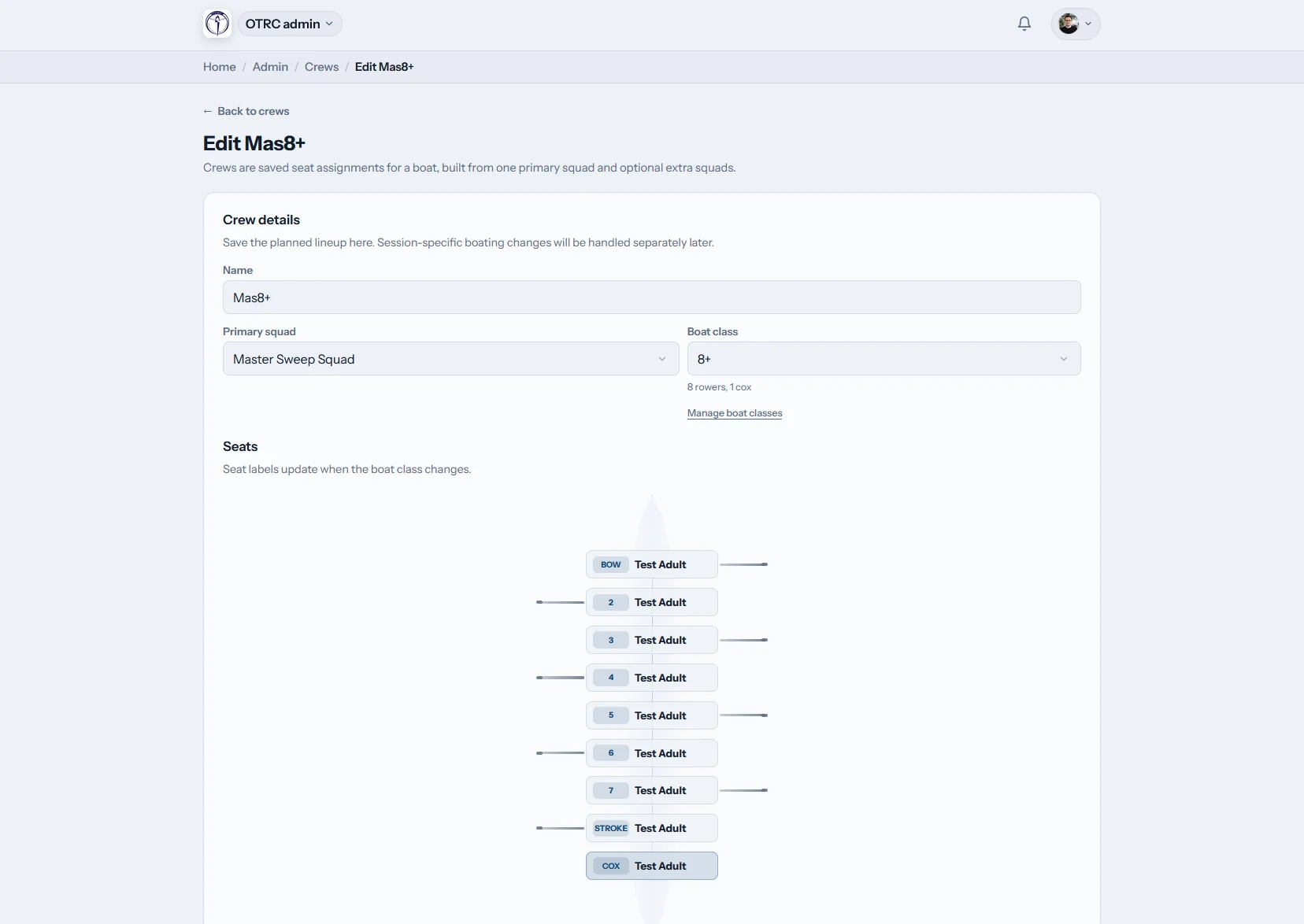
Drag-and-drop pairings for a seat-racing round
Seat a rower by dragging the name into a position. Availability status sits on each name in colour (green confirmed, amber tentative, greyed out unavailable) so the cross-referencing stops and the "are you on the water Saturday?" messages stop with it. See the interface in the screenshot gallery.
Saved seat-race matchups and trial lineups
When a seat-racing round produces clear results, save the matchup so the same pairings can be loaded again later in the block under different conditions. Row HQ stores crew configurations and loads them back in a single click, so a Friday-morning matched-pairs session at Karapiro reproduces the previous week's pairings without anyone reconstructing them on the jetty. Useful for any pre-Maadi or NZURA regatta block, equally useful for a club development quad you are slowly building toward a Trans-Tasman trial.
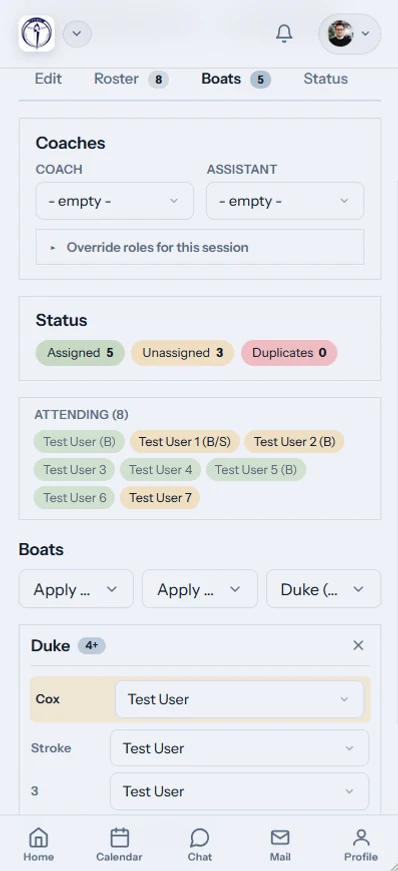
Side, seat and capability tracking
Seats are not interchangeable. Row HQ lets you assign each athlete to a specific position with member preferences and capabilities visible as you build: who is rated to cox, who rows stroke side only, who has been working on bow-side technique for the last six weeks. The bit that matters in selection is being able to filter the squad by capability before the seat-racing round starts, so a stroke-side-only athlete is not accidentally seeded into a matchup that needs bow-side cover.
Selection principles that survive Maadi week
Software clears the admin. Coaching judgement still fills the seats. A handful of principles that consistently hold up across NZ school, club and university programmes:
-
Lock the rubric before the first test: Write down what the 2k erg is worth, what side-by-side pairs is worth, what the seat-racing series is worth, and what coach-rated technique is worth. Share the rubric with the squad. Refuse to change it after a result lands. The rubric is what makes the selection defensible.
-
Run the seat race like a controlled experiment: Matched conditions, matched rates, side-by-side over a fixed stretch, at least three swap rounds. One race is a data point. Three rounds with the same two athletes swapping across different combinations is a verdict. Capture every time. Attendance and session tracking over the full block makes the data hard to argue with.
-
Treat erg scores as one input, never the whole story: A bodyweight-adjusted 2k is a useful filter for the initial shortlist. It is a poor proxy for boat-moving. Hamish Bond was not the fastest erg in the Rowing NZ squad through the mid-2010s and he won eight world titles in the pair. The erg metrics guide walks through how to weigh the test against on-water evidence.
-
Honour the side and rig: A stroke-side-only athlete cannot be a swing seat. A heavyweight in the front pair throws the run. Height matched through the middle, the calmest rhythm in the squad at stroke, the steadiest hands at bow. The structural principles are not negotiable, even when they cost you a strong erg score.
-
Announce in writing, never live: Row HQ pushes lineup notifications to every member in the crew the moment you publish. Send the call the evening after the block closes, brief any athlete affected by a change in person the next morning, and field the parent calls in a one-on-one rather than on the jetty.
Some rowers will never ever get how hard it is for coaches to make that selection, how much stress it causes you. You really are trying to do the right thing, you're not trying to do someone over.
What changes when the admin is automated
What changes when you go digital
Less time spent piecing together selection rounds each week
Availability is visible upfront, reducing pre-session reshuffles
Every seat-race time and selection round is recorded and searchable
The time saving is the first thing every coach notices. The second is that the selection itself gets better, because the call is being made from data rather than from memory of the last good piece:
- Time reclaimed: Selection planning moves from a Sunday-night slog through four data sources to a focused review in front of one screen. The time recovered goes back to the coaching that actually moves boats.
- Better communication: Lineups go out as automatic notifications the moment they are published. No misread message, no rower who missed the group chat, no Year 13 finding out about their drop to the 2nd VIII at the same time as the squad.
- A defensible audit trail: Every seat-race time, every erg score, every lineup tried across the block is recorded. When a parent challenges the call, the rubric and the data are in one place. The call defends itself.
- Faster adaptations: A late withdrawal reshuffles in seconds. The coach adjusts the boat in the app, notifications go out immediately, and the seat-racing round still runs on time.
What Kiwi coaches report back is that Sunday-evening selection planning, which used to take an hour or more of cross-referencing the Google Sheet against the WhatsApp thread against the seat-race notebook, now wraps in around fifteen minutes. A late dropout shows who is available to fill the seat without sending a single message. See what coaches at Oundle Town Rowing Club found after making the switch, and use our free Concept2 erg tool when working through bodyweight-adjusted 2k splits in the selection rubric.
The Bond and Murray reference
Hamish Bond and Eric Murray are still the cleanest case study a Kiwi coach can point at when explaining what a real seat-racing process produces. Rowing NZ ran them against every plausible combination in the men's pair through the early 2010s, in matched-pair trials at Karapiro under controlled conditions, with the times recorded and the swaps documented. The pairing held under every test the system threw at it. Eight unbeaten seasons followed. The lesson for a school or club coach picking a Maadi 1st VIII or an NZURA Bond Cup boat is that the selection only earns the squad's trust when the process is visible, the conditions are controlled, and the rubric is locked before the testing starts. Do that work and the call you announce on the Friday evening before Maadi defends itself. Skip it and you are negotiating with parents on the jetty for the rest of the season.
The principles hold across every level of New Zealand rowing, from a small Otago club picking a senior four through to a competitive Saint Kentigern or Hamilton Boys 1st VIII heading into Ruataniwha for Maadi week: weight the criteria before the test, run the seat race like a controlled experiment, record the data, announce the call privately and in writing, and field the response in a one-on-one. See our pricing page for a plan that suits a Kiwi club or school, or check the FAQ for anything else.
See the selection tools in action
The selection workflow in Row HQ was built around the exact problem this article describes: a defensible rubric, a seat-racing block that holds together across three weeks of variable weather, a lineup builder that sits on top of the erg history and the seat-race times, and a one-tap publish to the squad. Book a walkthrough and I will run through it with a worked Maadi-style example.
Key Takeaways
- Lock the rubric before the first test of the selection block; refuse to retrofit the weights to the lineup you wanted
- Run the seat race like a controlled experiment: matched conditions, matched rates, side-by-side rigged pairs, at least three swap rounds
- Hamish Bond and Eric Murray are the reference point - a controlled pairs process produced eight unbeaten seasons
- Announce the call in writing after the block closes, never in the boatshed with the squad watching
- When a Year 13 is dropped from the 1st VIII, front-foot the conversation and find a real role in the 2nd VIII
- Ready to organise the selection block in one place? Get started with Row HQ today
From the RowHQ shop
Printable PDFs written for club rowers. Buy once, keep forever.
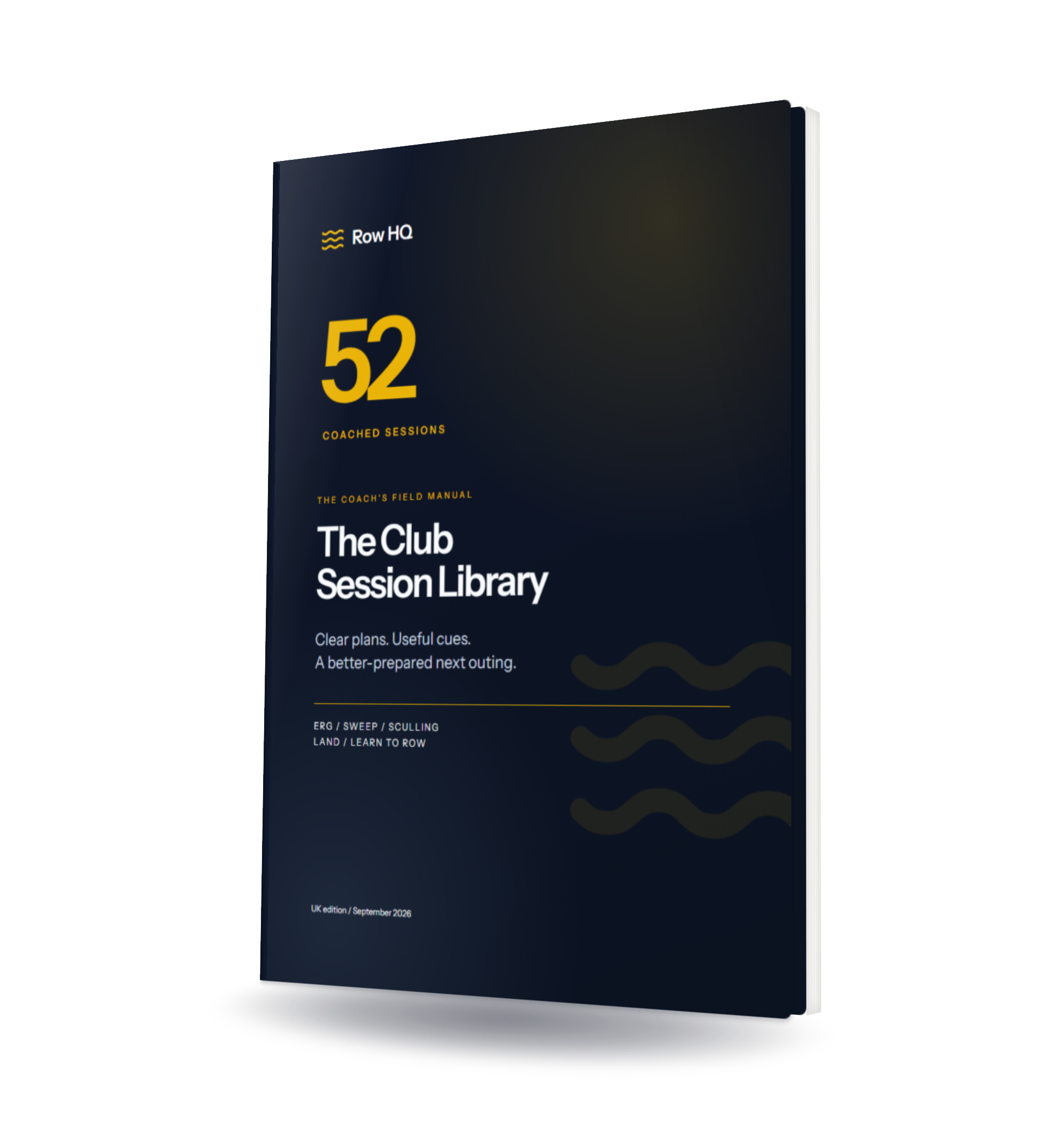
The Club Session Library
52 rowing sessions for club coaches, with an illustrated coaching PDF, editable CSV plans, two seasonal blocks and a printable coaching cheat sheet.

The Cox's Handbook
Practical calls, steering, session drills and race plans for new and improving coxes. Includes five printable worksheets.
Sources & references
- Crew selection in rowing (coach interviews: Jamie Leighton, Rob Dauncey, Tom Mapp, Beth Rodford) — British Rowing Plus (accessed May 17, 2026)
- Rowing New Zealand coach education and resources — Rowing NZ
- New Zealand Secondary Schools Rowing Association (Maadi Cup) — NZSSRA
- New Zealand Universities Rowing Association — NZURA
- Relationship between 2000-m rowing ergometer performance times and World Rowing Championships rankings in elite-standard rowers (Mikulic et al., 2009) — Journal of Sports Sciences
- Physiological responses to ergometer and on-water incremental rowing tests (Vogler, Rice and Gore, 2010) — International Journal of Sports Physiology and Performance
- The Evaluation of Physical Performance in Rowing Ergometer: A Systematic Review (2025) — Journal of Functional Morphology and Kinesiology (MDPI)
- Row HQ coach tools (lineup builder, ergo tracking, saved crew cards) — Row HQ
- Row HQ training sessions feature (attendance, availability, scheduling) — Row HQ
- Row HQ member portal (athlete self-service availability and preferences) — Row HQ
Kia kaha on the water.
- The Row HQ Team