The honest answer in 30 seconds
A new Sykes eight out of Geelong, a Hudson Canadian, an Empacher German or a Filippi Italian lands somewhere between AUD 60,000 and 90,000 by the time it touches the rigger trolley. Looked after, it gives a shed fifteen to twenty years. The cheapest insurance the programme owns is a phone-based damage register every athlete can write to. The clipboard in the bay does not survive a wet morning on the Yarra, the Brisbane River or Sydney Harbour, and a hairline crack left unlogged turns into a write-off the AGM has to fund out of capital reserves. Salt-water sheds carry an extra burden (corrosion on rigger bolts and gates after every outing on the Harbour). Yarra sheds carry the silt-and-debris burden every flood event. Put the register on the same app that handles bookings, photograph everything, and follow Rowing Australia safety expectations on routine inspection.
Look After the Hulls, Stretch the Capital
Whether the shed houses ten hulls or eighty, condition tracking is the cheapest insurance policy a director of rowing can take out. Shift from reactive panic-fixes to a planned schedule and the next capital ask gets pushed years down the track.
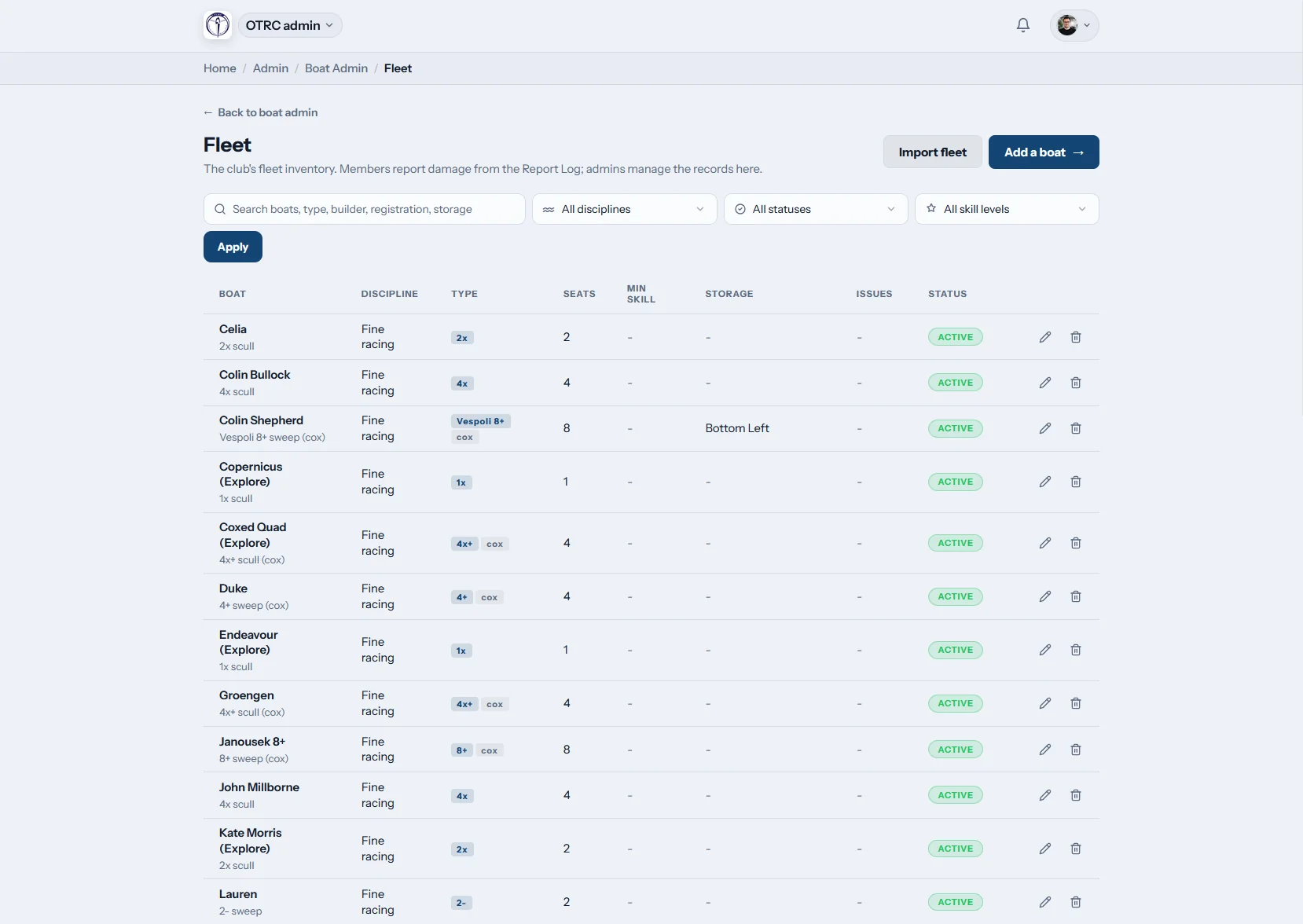
Sykes Racing built the eight that won the King's Cup. They build most of the rest of the Aussie senior fleet too - Sykes is the dominant boatbuilder in this country and the first name on every state-team purchase order. Hudson out of Canada and Empacher out of Germany fill out the international side of most Aussie racks, with Filippi covering the high-end racing shells at uni and elite clubs. A new racing eight from Sykes or a Hudson out of the Brisbane dealer lands at AUD $60,000 to $90,000 by the time it touches the rigger trolley. Even an entry-level training single is several thousand. Yet most clubs and even some well-resourced GPS school sheds still run a tatty A4 notebook tied to a clipboard near the slings, or no record at all. Row HQ's fleet management module swaps that for a damage register that lives in everyone's pocket.
What does shed-level fleet tracking actually look like for an Aussie programme?
Capture every hit at the rack on the same app that handles the booking, tag the hull by sail number, attach a phone photo, and tick whether she is rowable for the next session. The boatie, or the director of rowing if it is a GPS school cycling fifty hulls across V8+/2V8+/3V8+ crews, sees a single ranked queue. Squads see live status before they leave Mosman, Hawthorn, Toowong or West Lakes for the shed. Damage history and the last full service stay against the hull record rather than rotting in a binder above the workbench.
What is at stake if the programme keeps winging it?
Three things at once: protecting the six-figure capital outlay sitting in the racks, keeping athletes (especially Year 9 novices) safe on the water, and pushing out the next AGM capital request. Where each piece of value comes from:
What Reactive Repairs Actually Cost a Programme
Panic repairs typically run several times the price of the same fix done early (industry estimate)
Hulls last significantly longer when somebody is actually watching them
Realistic working life of a properly looked-after racing shell
-
Athlete safety: Hairline cracks in a Sykes hull, a worn rigger pin, a seat track that has eaten itself can let go mid-piece. Systematic shed checks catch the issue before a Year 10 novice ends up swimming in the Brisbane River. See our notes on data security and Australian Privacy Principles handling for member equipment-allocation records.
-
Capital protection: A pinhole in a carbon hull spotted at the morning row costs a few hundred dollars to patch at the local Sykes service agent. The same hull sitting in a tin shed through a 40 degree summer up in Brisbane or Perth, with the resin softening in the heat, becomes a write-off the AGM has to fund out of capital reserves. Sydney Harbour sheds layer salt corrosion on top - rigger bolts seize, alloy fittings pit, gates need lubing twice as often, and the bill compounds. Yarra sheds carry the opposite burden after a flood - silt embedded in the slides, river debris scoring the hull below the waterline, a forensic post-flood walk-around with photos against the previous week.
-
Longer fleet life: A well-cared-for Sykes or Hudson eight serves a club shed for fifteen to twenty years. Neglected, the same hull might give the programme eight before the layup is shot and the school council is asked to find another $80K mid-budget cycle.
-
Auditable trail: Digital records create the paper trail the school council, club committee, or auditor will ask for at year-end. Who inspected the W8+ before the AGSV head, what they found, what got actioned. The admin console stores the full history against the hull, exportable for insurance or warranty conversations with the dealer.
Why does the phone-based register beat the paper logbook?
A paper logbook lives bolted to a clipboard in one corner of one shed, turns into mush after a wet morning on the Yarra, and only the boatie has the biro. A digital register sits on every athlete's phone, time-stamps the entry the moment somebody clocks a fresh chip, and pins the photo against the correct sail number automatically. The boatie opens a single ranked queue rather than wading through scribbled notes from the past six weeks of school crews. Background context lives in our spreadsheets vs purpose-built software piece.
| What you get | Clipboard in the shed | Row HQ register |
|---|---|---|
| Where you can read it | Bolted to the shed wall | Open on every athlete's phone |
| Photographic evidence | Realistically, never happens | Unlimited photos pinned to the hull |
| Looking up history | Flicking back through pages | Type a sail number, see everything |
| Reminders for the next service | Whoever remembers | Automatic, scheduled, recurring |
| How damage is recorded | Couple of biro lines | Photos plus condition rating per part |
| Risk of losing the lot | Soaked, lost, or written over | Backed up to the cloud automatically |
What Row HQ ships for fleet management
The toolset is built around how Aussie sheds actually work, including the shared-fleet reality where a club squad and a partner school cycle through the same hulls week to week. The pieces that earn their keep day in, day out:
-
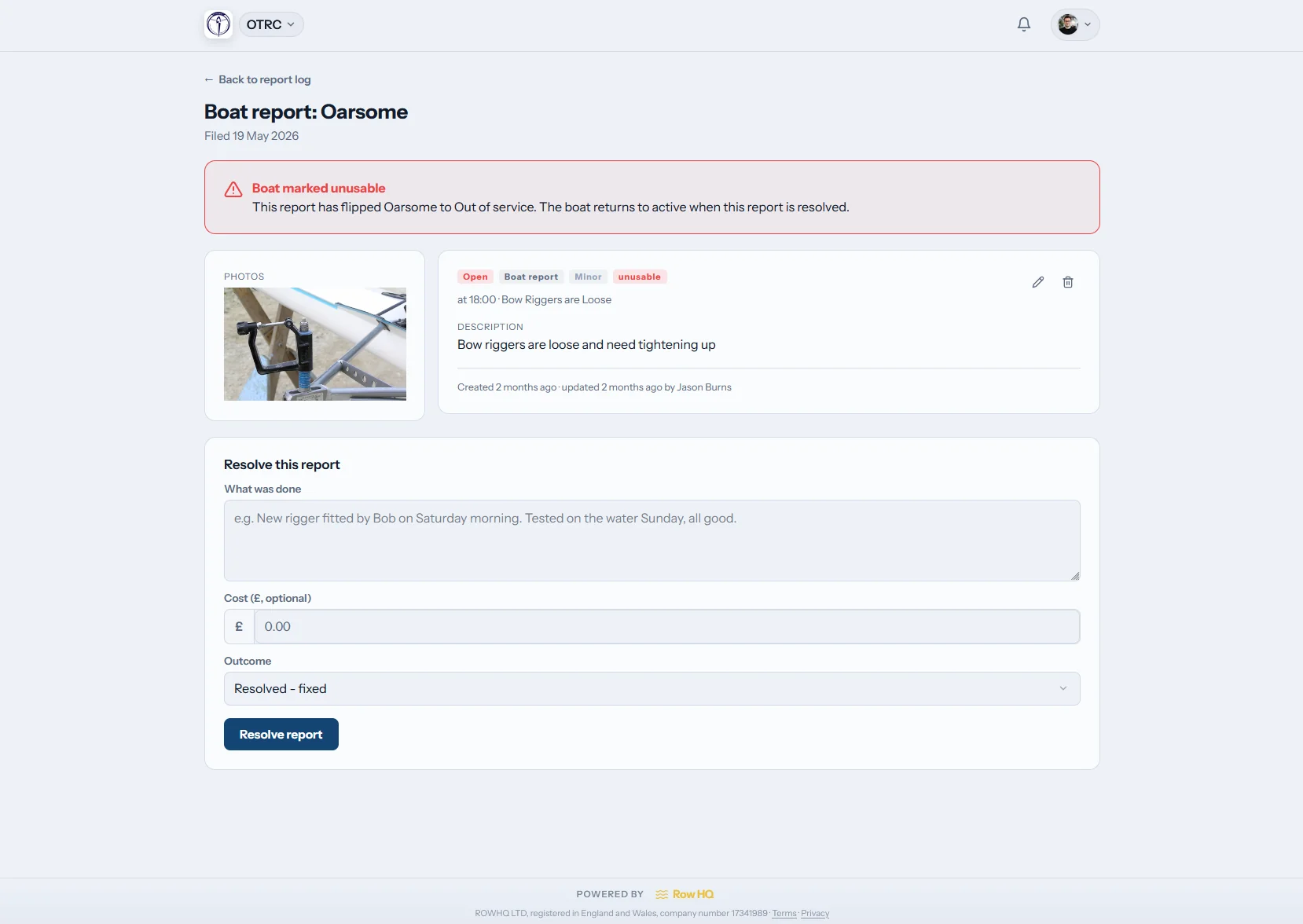
Photo-led assessments: Document hull condition with as many phone photos as needed. Capture the chip from three angles, track the patch through to cured resin, and build a visual record that takes the argument out of who was in the boat when it picked up the gouge. Useful when the same shell rotates between a club M8+ on Saturday and a school 2nd VIII on Wednesday.
-
Component-level ratings: Score each part of the hull (shell, rigger arms, seats, footplates, slides, gates) on a standardised scale. Flagging a hull as not-rowable removes it from the available list inside the booking workflow straight away, so nobody can grab it for a 5am paddle.
-
Recurring service jobs: Set up scheduled work - annual hull service with the dealer, monthly rigger torque check, post-regatta sweep, the post-flood Yarra silt rinse for Mercantile, Hawthorn and Banks sheds. The platform pings the right person at the right time, so the post-Head-of-the-Yarra fleet inspection actually happens before the next training cycle starts.
-
Spares and consumables: Track what is in the parts bin, set re-order points, and generate order lists for the next dealer run. Nobody has to tear the shed apart at 5:30am on King's Cup trial morning hunting for the right size 8mm rigger bolt.
Building a habit that survives the season
The right system is the one athletes actually open. A handful of habits that hold across a club, a 70-boat GPS or AGSV school setup, or a university programme like Sydney University Boat Club, MUBC at Mercantile, UTS or Adelaide Uni:
Equipment Captain's Working Routine
Every Outing
- Hose hulls down with fresh water (non-negotiable at salt-water sheds on Sydney Harbour or the Swan)
- Eyeball for fresh chips, gouges, or stress marks - especially after a Yarra session post-rain when debris is up
- File any damage in Row HQ before walking out of the shed
- Rack hulls right way up, slings and straps tensioned
Every Week
- Torque-check each rigger bolt across the active fleet (twice as often on salt-water racks)
- Run the seat across the slides, listen for grit - Yarra silt loves a slide
- Look over foot stretchers, heel restraints, quick-release knots
- Lube slides, gates and pivots
Every Month
- Full hull walk-around with photos against the previous month
- Refresh component ratings inside Row HQ
- Audit the parts bin, raise an order with the Sykes, Hudson or Empacher dealer if low
- Look over sculls and sweeps - blade tips, sleeves, collars
Off-Season / Year-End
- Professional hull service with the local Sykes, Hudson, Empacher or Filippi service agent
- Strip, deep clean, polish every shell on the racks
- Retire anything past its working life
- Pull the annual fleet report for the school council, board or AGM
What separates programmes that stick with it
- Name owners: Hand a coach, captain of boats, or senior rower clear ownership of each hull or each squad of shells. Hawthorn and Mercantile both run this pattern with named captains for each squad. The coach panel assigns and tracks that ownership in one place.
- Push the alerts where the crew already chats: Pipe Row HQ alerts into the equipment captain's WhatsApp group so a flagged hull surfaces in the same place the squad already lives. The athlete portal lets any rower file a damage report from the pontoon while it is still fresh.
- Photograph everything, not just the bad bits: Photos win arguments. Capture before-and-after on every repair so a trustee, an auditor, or a warranty assessor can see exactly what the issue was and what got done. Worth its weight when transporting a hull interstate to a regatta and it picks up a knock on the trailer between Melbourne and Sydney.
- Read the patterns: Use the reporting view to spot the hull that keeps coming back to the bench. If the same Hudson keeps cracking near the bow ball, the conversation moves from another patch to a warranty call with the dealer.
- Drill the rowers: Walk every athlete (including Year 9 novices on their first term in school programmes) through how to spot and log a problem. The more eyes on the fleet, the cheaper the maintenance year. Reference: how our flagship UK club embedded this in their crew sign-on - the principles drop straight into an Aussie club shed or GPS school setup.
Where the gains land
Programmes running a real register (not just a clipboard) hit far fewer surprises and stretch their hulls' working lives further. Dependable equipment also means uninterrupted squad sessions and clean rigging through King's Cup, the Australian Boat Race, Head of the Yarra, the AGSV head, and the school regatta calendar:
Smaller emergency-repair line
Catch issues early and the panic-fix line on the budget shrinks. Plenty of programmes report a 30 to 50 percent drop in their fleet care spend after a single season on a real register.
Fewer near-misses
Systematic checks find problems before they become a swim. Critical when half the rowers in the boat are minors in a school programme.
Defensible records
A clear log of which person inspected which hull on which date. Digital records shut down disputes and hold up if the programme needs to lodge an insurance claim after a shell takes damage on a trailer between states.
More years per hull
Looked-after boats last longer. Stretch the fleet's working life and the next capital ask gets pushed out a few seasons.
Photo evidence is the single most useful piece, day to day. Scrolling back six months to see exactly how a Sykes hull has aged makes the repair-or-replace call defensible at the school council, board, or club AGM. Skim the screenshot tour to see the fleet view inside the platform.
How to get the first season on the rails
Switching from clipboard to phone takes less weekend than expected. Walk the racks, photograph every hull as it stands today, set baseline component ratings, then bed in the new habits one routine per fortnight. Row HQ captures assessments straight from a phone in the shed - no laptop required, no carting paperwork home. The interface holds up fine on dodgy 4G at a regional shed two hours from the nearest town.
Hulls are too expensive, and athletes (especially school students) too important, to leave fleet care to memory. A digital register gives the programme structure, the audit trail, and the data the next budget conversation needs. Skim our plans page for the right fit for a club, school, or combined setup, or the FAQ for the questions Aussie boaties tend to ask first. Ready to roll? Get started here.
Fleet care does not need its own app. The maintenance register is built into Row HQ alongside boat bookings and the rest of the day-to-day admin.
- The Row HQ team
Sources & references
- Rowing Australia - safety and risk-management resources — Rowing Australia
- RowSafe 2026 (British Rowing safety guidance - the most detailed equipment inspection regime published anywhere, widely referenced by Aussie clubs) — British Rowing (accessed 17 May 2026)
- Sykes Racing - Aussie boat builder, Geelong — Sykes Racing
- Ask the Boatmakers: prolonging the life of your fleet (Hudson, Filippi, Pocock interview) — row2k
- Rowing in salt water (corrosion and rinse routine notes - directly relevant to Sydney Harbour clubs) — row2k
- Rowing shell maintenance: a plan for success — MaxRigging
- Empacher racing eight specification (construction, layup, weight) — Empacher Bootswerft
- Filippi competition boats price list — Filippi
- Hudson Boat Works - Canadian racing shell manufacturer — Hudson Boat Works