The honest answer in 30 seconds
The Sykes Gold racing eight that turns up on most Kiwi school racks lands at around NZ$60,000 to NZ$80,000 before riggers and freight from Geelong, a Hudson sits closer to NZ$80,000 to NZ$100,000, and a Filippi for the top of the senior fleet runs higher again. None of those numbers leave room for a hull chip nobody bothered to write down. The cheapest bit of equipment insurance any club has is a damage register that lives on a phone in the pocket of whichever Year 12 walked the boat down the ramp this morning. A clipboard pinned to the boatshed wall does not survive a Canterbury sou'wester rolling through the doors, and a thumbnail crack left unlogged for a fortnight becomes a gelcoat job that costs four figures to fix. Run the register on the same app the crews use to book the boat, photograph everything, and pin it to your Rowing NZ club safety obligations and the equipment-inspection paper trail HSWA 2015 expects from a PCBU.
Your Fleet Deserves Better Care
A well-kept fleet is what keeps a Kiwi club racing on a Sunday and clear of an incident report on a Monday. Move from reactive panic to a planned routine and the same Sykes eight sees out twenty Maadi cycles instead of ten.
Walk past the racks at Karapiro the week after Maadi and the fleet tells its own story. A Sykes Gold eight back from the start line. A Hudson quad with a fresh gelcoat scuff from a coxless landing. A couple of singles that took rack rash on the trailer back from Twizel. For a Kiwi club the boats are the biggest single line item in the asset register - a Sykes eight runs NZ$60,000 to NZ$80,000 by the time freight from Australia is on the invoice, a Hudson closer to NZ$80,000 to NZ$100,000, and even an old-stock training single is several thousand. Plenty of clubs still track all of this with a damp exercise book in the office and a coach who can sort of remember which boat made the funny noise on Saturday. Row HQ's boat management features give the boatman a working alternative.
How should rowing clubs track boat maintenance?
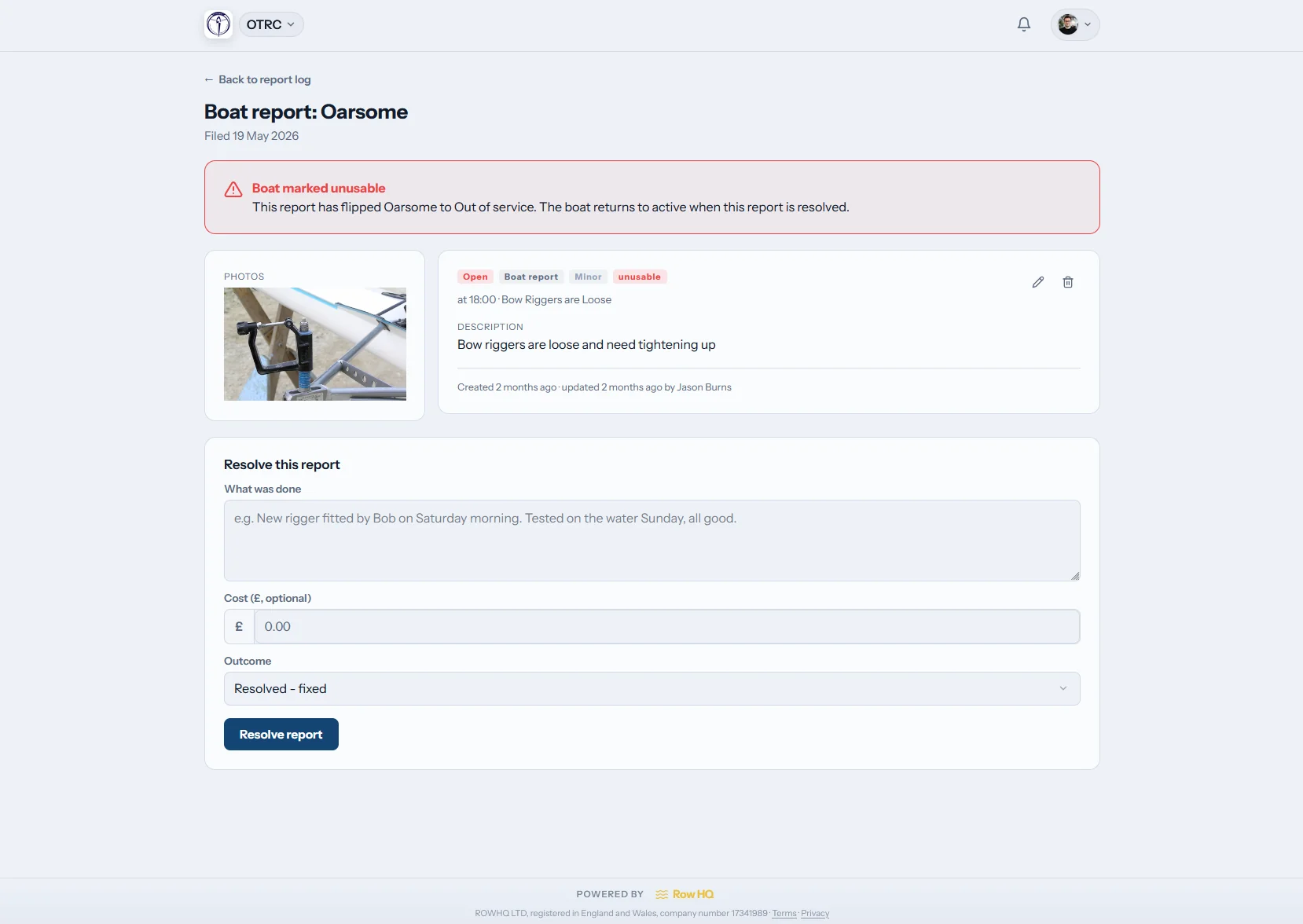
Capture every issue at the boatshed on the same device the crew used to book the boat. Tag the hull, mark whether it is rowable or off the water, and let the entry sit against the boat record for good. The boatman opens one ranked list on a Monday morning instead of sifting through a clipboard. A cox or a stroke seat sees the boat status before driving out to Lake Hood or down to the Waitemata, so a 5am trip is not wasted on a boat already on the off list. History stays with the hull rather than walking out the door the day the volunteer boatman moves on.
Why Boat Maintenance Tracking Matters
Tracking the fleet properly protects an expensive asset, keeps crews on the water safely, and gives a club committee something concrete to wave at an insurer. The detail of what that buys you:
The Cost of Poor Maintenance
A panicked repair the Wednesday before a regatta tends to cost a multiple of the same fix scheduled in advance
A documented care routine routinely doubles the useful life of a hull
What a Sykes or Hudson should give a club if it is rinsed, covered and tracked
-
Safety First: A cracked rigger, a worn footstretcher cable or a hairline hull split that nobody flagged is exactly the failure that turns a club training session into a Maritime NZ phone call. Systematic tracking catches the small stuff before it becomes the big stuff. Under HSWA 2015 a rowing club operating as a PCBU has a non-negotiable duty to manage equipment-related hazards, and a maintained digital log is the cleanest piece of evidence you can put in front of WorkSafe that the duty was being met. Read more on our approach to data security and safety.
-
Cost Protection: A small split caught the morning it happened is a few hundred dollars of gelcoat work at a local repairer. The same split ignored for a season is a hull replacement on a Sykes that came in by freight from Australia, with the parts lead time alone running into months.
-
Extended Lifespan: A boat that is rinsed, covered and inspected on a schedule serves a Kiwi club for fifteen to twenty seasons. The same boat ignored on an outdoor rack at Lake Hood through three summers of high UV days needs a gelcoat strip-back and recoat at year seven. The price gap between those two outcomes is the whole point of writing this down.
-
Accountability: Digital records make it obvious who checked what, when, and what they saw. The admin dashboard hands the club captain a full audit trail. When the insurer asks who inspected the boat the week before the incident, the answer is in the system rather than in someone's memory.
Why is digital boat maintenance tracking better than paper?
A paper logbook lives in one room. It gets soggy when a wet Auckland morning blows in through the boatshed doors at North Shore, it gets pulped when a Canterbury nor'wester sheets rain across the Avon, and it only takes one entry at a time from whoever is holding the biro. A digital log sits on every member's phone, time-stamps each entry, and pins the photo of the damage to the right hull rather than to a vague description that might mean any of three Sykes eights. The boatman opens the queue and sees one prioritised list instead of decoding fortnight-old handwriting. Read the longer spreadsheets comparison for the rest of the case.
| Aspect | Paper Logs | Row HQ Digital |
|---|---|---|
| Accessibility | On the boatshed wall only | In every member's pocket |
| Photo Documentation | Impractical | Built-in, unlimited |
| History Search | Flick back through six months of pages | Instant search by hull |
| Maintenance Reminders | Whoever remembers | Automated alerts to the boatman |
| Damage Tracking | Text descriptions only | Photos + condition ratings |
| Loss Risk | High (one nor'wester, gone) | Secure cloud backup |
Row HQ's Maintenance Tracking Features
Row HQ ships maintenance tooling built around how a rowing club actually moves boats in and out of the shed. The pieces that earn their keep day to day:
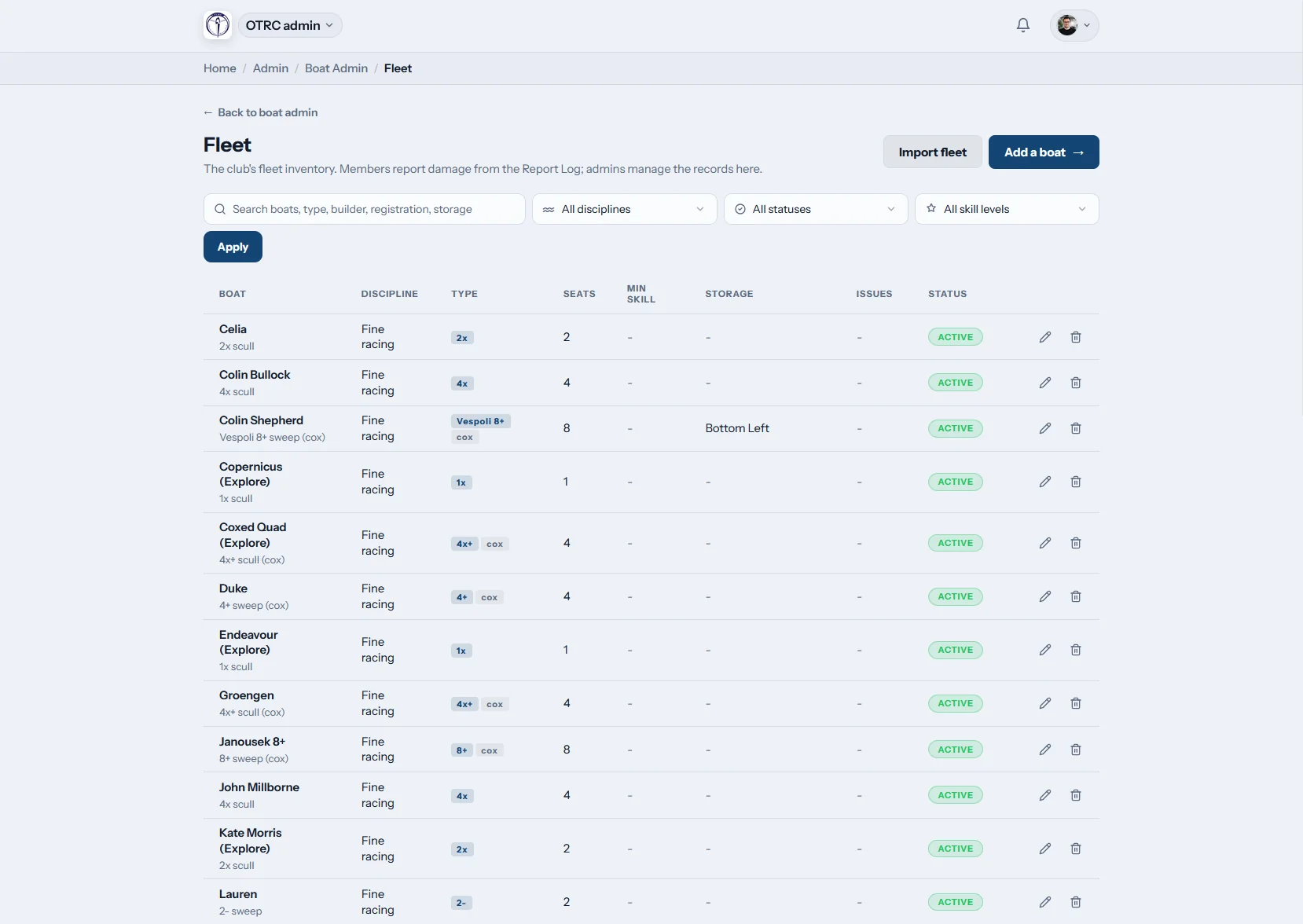
-
Photo-Based Assessment Reports: Document every hull with as many photos as you want. UV creep on a Sykes deck does not show up overnight, it shows up across two summers of side-by-side images, and that is exactly the comparison the photo log makes effortless. Capture damage from multiple angles, watch repair progress over a season, and stop relying on anyone's memory of what the bow looked like in April.
-
Condition Ratings: Rate the hull, riggers, seats, footplates and rudder on a standard scale. The dashboard sorts the fleet by condition so the boatman starts the week with the right boat, not the loudest complaint. Ratings feed straight into the boat booking system, so a crew physically cannot book a boat that has been marked off-water.
-
Maintenance Schedules: Schedule recurring jobs - annual hull inspection, monthly rigger check, post-regatta trailer-rash sweep after a Maadi or North Island Champs trip, an end-of-summer gelcoat audit for the outdoor racks. Row HQ pings the right person at the right time rather than leaning on the boatman to hold the whole calendar in their head.
-
Parts and Inventory: Track spare parts and consumables on the shelf, including the bits that take real time to land. Sykes spares come from Geelong on the same shipping schedule as a new hull. Filippi and Concept2 components ship from Europe. A bow ball or a footstretcher cable ordered today is not on the racks for weeks - knowing the next regatta is on the calendar before the inventory runs out is the whole job.
Establishing a Maintenance Routine
The best maintenance system is the one the Year 11 squad will actually use at 6:15am on a Tuesday. A handful of routines that stick across a Kiwi club:
Equipment Manager's Maintenance Checklist
Daily (After Each Session)
- Salt rinse for coastal and estuarine clubs - Waitemata, West End at North Shore, anywhere brackish (skip the rinse and the rigger bolts pit within a season)
- Freshwater wipe-down for lake clubs - Karapiro, Ruataniwha, Hood, the Avon - less critical but never a wasted minute
- Check for new scratches, gelcoat dings or rigger play before the boat goes back on the rack
- Log any issue straight into Row HQ on the phone, before the rower drives away
- Cover the hull on outdoor racks - NZ UV is among the highest in the world and degrades gelcoat faster than UK clubs ever have to think about
Weekly
- Torque-check rigger bolts and pin nuts
- Inspect seat wheels, tracks and the wheel housings
- Walk the footstretchers and heel restraints for fray, especially after a week of trial-piece sessions
- Light lube on slides and pin threads
Monthly
- Full hull inspection with photos against the existing record
- Refresh condition ratings in Row HQ for every boat in the shed
- Place the parts order with allowance for international freight lead times
- Inspect every set of blades, sleeves and collars in the rack
Annually / End of Season
- Professional hull inspection - the local repairer who knows your fleet
- Deep clean, light polish and UV reseal on any hull that lives on an outdoor rack
- Replace consumables and worn rigger hardware ahead of the next season
- Pull the annual fleet report for the committee, the insurer and the AGM
Tips for Success
- Assign ownership: Hand each boat or boat class to a named person. A senior squad member, a parent volunteer, a coach - someone whose name is on the record. Accountability is what moves a job from the wishlist to the bench. The coach tools make assignment and follow-up straightforward.
- Enable notifications: Set the reminder system so the weekly rigger check actually happens on Wednesdays, not the morning of the regatta. The member portal gives any rower a fast path to log damage the moment they see it, without waiting for the captain.
- Document everything: A photo of a small dent today is the proof the insurer asks for in eighteen months. Capture damage before and after repair, time-stamped against the boat record.
- Review trends: Use Row HQ's reporting to see which hull keeps coming back to the bench. If the same Sykes single is on the off-water list every other month, the answer might be retirement rather than another patch.
- Train your members: Make damage-reporting part of how new members are inducted. The more eyes on the fleet the earlier the small stuff surfaces. The Oundle Town Rowing Club case study shows how a working club embeds this into their routine - the principle travels straight across the Tasman and out to Karapiro.
The Benefits Add Up
Clubs that track the fleet properly hit fewer surprises and get more seasons out of every boat. A well-kept fleet also means a reliable hull under the crew on training sessions and on race day at Karapiro or Ruataniwha:
Cost Savings
Catching the small stuff early routinely cuts annual maintenance spend by a third to a half. That is real money when the alternative is a freight invoice from Geelong for a replacement bow section.
Improved Safety
Systematic checks find the failures before the failures find the rower. The same log doubles as evidence of your PCBU duty under HSWA 2015 if WorkSafe ever asks.
Clear Accountability
Know exactly who inspected what and when. Digital records settle the awkward conversations and back up the insurance claim if it comes to that.
Extended Lifespan
A documented care routine is what gets a Sykes eight from year seven to year fifteen. Given the cost of freighting a replacement into Tauranga, that is the most useful return on a five-minute habit a club can buy.
The photo log is the part that quietly earns its keep. Being able to compare a hull's condition across two summers makes the repair-or-replace call obvious rather than guesswork. Walk through the screenshot gallery for what the maintenance view looks like in real use.
Getting Started
Moving the fleet record off paper is much smaller a job than it looks. Photograph every boat in current condition on a Saturday afternoon, set the condition rating, and the baseline is done. From there the routine builds one checklist at a time. Row HQ takes assessments straight off a phone on the boatshed floor - no laptop, no spreadsheet, no extra step.
The fleet is too valuable, and the crew on board too important, to keep tracking on a soggy clipboard. A digital register gives the boatman structure, the club captain accountability, and the insurer the audit trail they ask for. Check the pricing for the plan sized to your membership, or the FAQ for the common questions. Ready to roll? Start here.
All of this lives inside Row HQ. Damage reports, the fix-it list and the fleet register share one home with the club's other records.
- The Row HQ Team
Sources & references
- Rowing NZ club resources and safety guidance — Rowing NZ (accessed May 17, 2026)
- Health and Safety at Work Act 2015 - PCBU duties for equipment management — WorkSafe New Zealand
- Water Safety New Zealand - club and venue safety resources — Water Safety NZ
- NIWA UV Atlas - New Zealand UV index relative to the rest of the world — NIWA
- Sykes Racing - hull range, construction and care — Sykes Racing
- Hudson Boat Works - racing shell manufacturer, construction and care references — Hudson Boat Works
- Filippi Lido - competition boat range and specifications — Filippi
- Ask the Boatmakers: prolonging the life of your fleet (Filippi, Hudson, Pocock interview) — row2k
- Rowing shell maintenance: a plan for success — MaxRigging