Quick answer for an equipment manager
A Hudson V8+, a Vespoli scholastic eight, a Resolute four and a pair of Pocock singles each represent five-figure capital sitting in a bay door that opens to weather. A new carbon eight from Hudson, Empacher or Filippi lands north of USD 55,000 before rigging, and a strong fleet is built to give a program close to two decades of racing if every athlete logs every hit, every booster reads the photos at the next meeting, and every winter boat-down checklist gets signed off in writing. The fastest fix is a damage register that lives on the same phone an athlete already uses to sign in for practice. A wet clipboard on the bay wall hides the small chips that turn into Hudson factory repair invoices in March. Track everything in one place, photograph it on the dock, and tie the record to USRowing safety guidance so the paper trail is ready for the AD, the insurer and the Title IX audit before any of them ask.
Built for boathouses that race a real schedule
IRAs in May, HOCR in October, Eastern Sprints, Stotesbury, NCAAs - the fleet has to be ready and the records have to be straight. Move off the clipboard and the next AD budget meeting writes itself.
Capital tied up in shells is the second biggest line in most college rowing budgets behind staffing. A Hudson, Vespoli, Pocock or Resolute V8+ now lists north of $55,000, and even a single from WinTech or Swift runs five figures once rigged. Plenty of US programs still capture damage on a curling spreadsheet that nobody opens after Labor Day, or on a clipboard pinned to the bay door that turns to mush by November. Row HQ's shell management workflow replaces all of that with a phone-first log every athlete can write to from the dock.
Logging shells, launches, trailers and blades in one place
Every entry starts on a phone. The athlete picks the hull from a live list, snaps a photo of the hit, and flags whether the shell is rowable. The equipment manager opens one ranked feed of jobs the next morning. Hudson factory rep emails, Vespoli service quotes and rigger photos sit against the right hull instead of buried in someone's text thread. Launch outboards (Mercury, Yamaha, Tohatsu) carry their own service interval log. Trailer brake checks, light tests and DOT inspection dates live in the same record, so the spring trip to Cooper River or Lake Carnegie does not roll out with a paperwork gap.
What proper tracking actually protects
A live record protects four things at once: the capital plan, the kids on the water, the insurance position when a shell takes damage in transit, and the Title IX equipment equity case for the women's program. Each one is worth looking at on its own.
What neglected fleet care actually costs
Reactive repair bills routinely come in at multiples of the planned-work quote (industry estimate from US shell repair shops)
Shells that get washed, photographed and serviced on schedule keep racing well past the depreciation curve
Typical service life of a Hudson, Vespoli, Pocock or Empacher eight under documented care
-
Athlete safety: An unseen rigger crack, a softening footboard or a stress line along a Pocock cedar deck can fail at exactly the wrong moment on a windy day at Mercer or the Schuylkill. A live log means the next person to take that hull out sees the open issue before they sign it out. The data security overview covers how the record is stored and who can see it.
-
Capital and operating budget: A small hull chip patched in early November is a couple hundred dollars at the local rigger. Left unsealed through a freeze on the Quinsigamond or the Charles, it splits the layup and turns into a four-figure invoice from the Hudson factory by March. The cheapest repair is the one logged the day the hit happened.
-
Service life out of every shell: Cared-for hulls keep racing for fifteen to twenty years. Older Pocock cedar boats still in masters fleets at Lake Union and the Cooper are proof that documented maintenance buys decades, not seasons. Neglected carbon shells routinely retire inside eight years with the booster board left holding the replacement bill.
-
AD reporting and Title IX equity: Every photograph and condition rating is dated, signed and exportable. When the AD asks why the women's V8+ needs replacing, the timeline shows the hits, the repairs and the trailer transit damage that got it there. The same record answers the harder question of whether the women's program fleet is truly equivalent in spec, age and condition to the men's. The admin dashboard gives you the full audit trail.
Phone-first log vs the boathouse clipboard
Clipboards live in one place, get rained on, and accept entries from one writer at a time. A digital log sits on every athlete's phone, time-stamps the entry, geo-tags it to the boathouse, and binds the photos of the damage to the right hull. The equipment manager opens a single ranked queue rather than flipping through twenty pages of wet pencil. The spreadsheets comparison walks through the same trade-off in detail.
| Aspect | Clipboard Logs | Row HQ Digital |
|---|---|---|
| Where you can read it | Boathouse only | Any phone, any laptop, any time |
| Photo evidence | Stapled in if you remember | Bound to the hull, unlimited |
| History lookup | Flip through pages | Instant search by hull or athlete |
| Service reminders | Whoever remembers | Automatic alerts to the right inbox |
| Damage record | Free-text description | Photos plus condition rating per component |
| Loss risk | High (water, missing pages, lost binder) | Encrypted cloud copy, US-hosted backups |
Row HQ's fleet maintenance toolkit
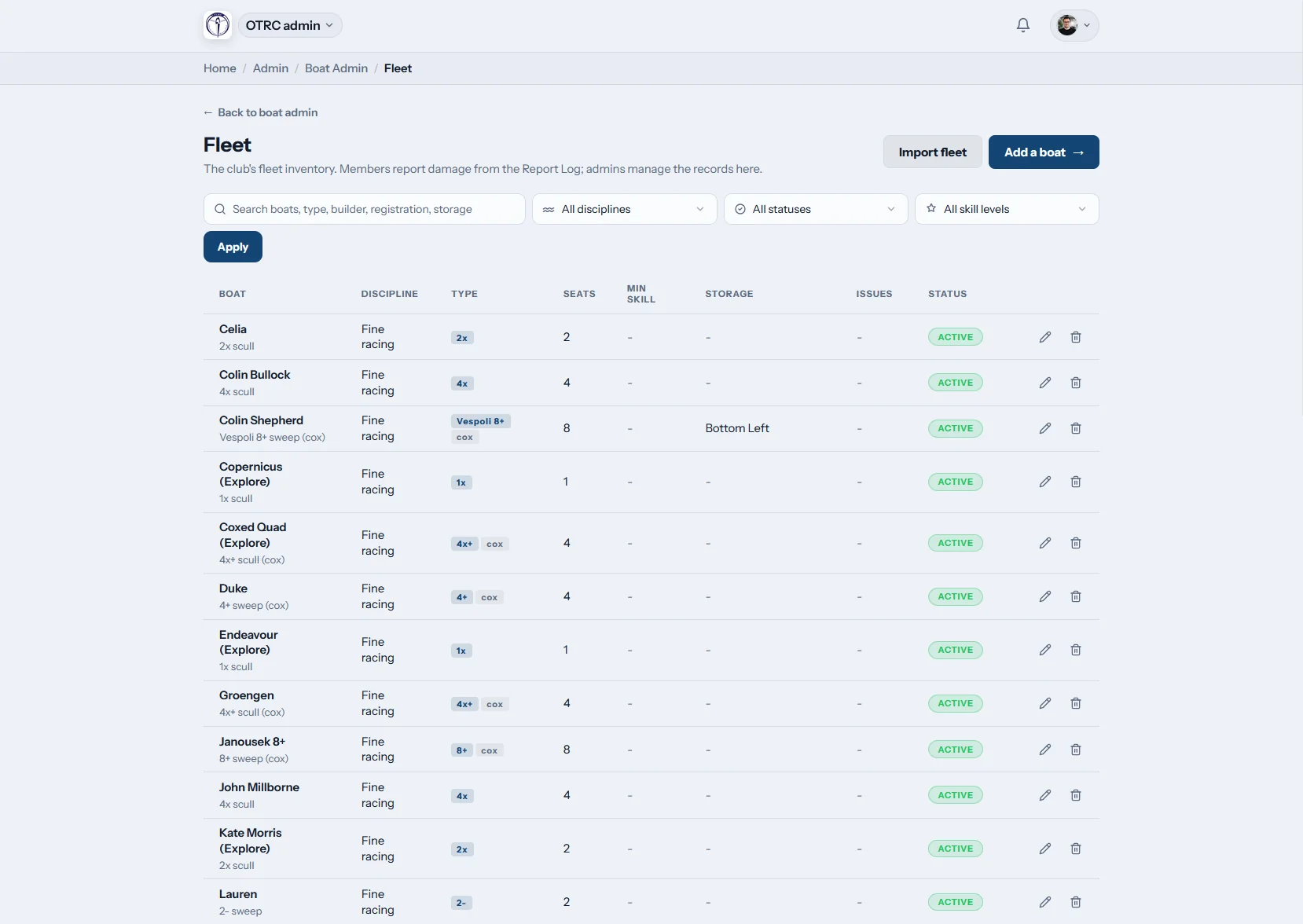
Row HQ ships with maintenance tooling built for the way a US rowing program actually runs. The features the equipment manager touches every week:
-
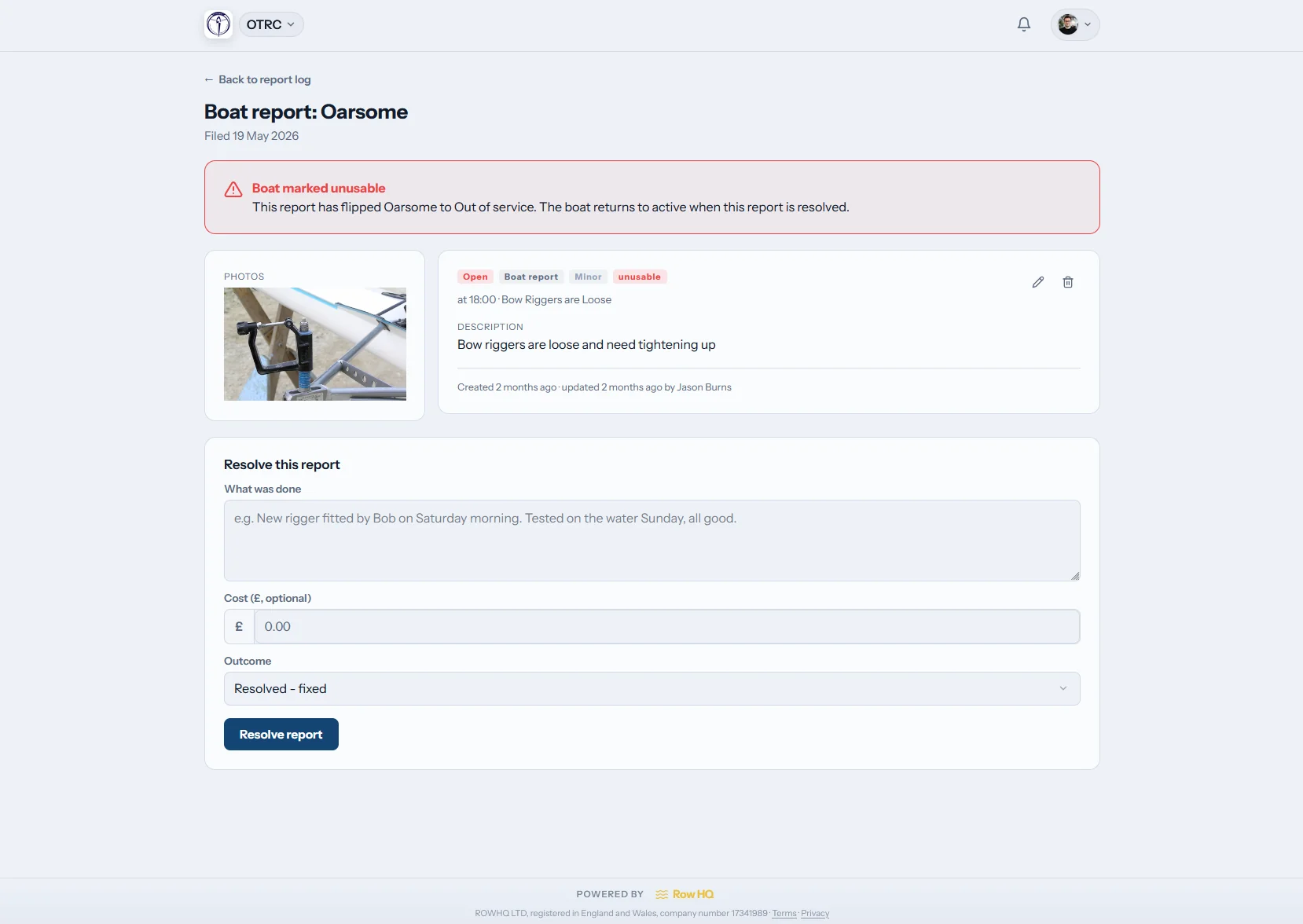
Photo-based damage reports: Document hull condition with unlimited photos. Catch chips from three angles, track the repair progression frame by frame, and lock down a record that holds up if the shell takes a hit on the trailer between Cambridge and West Windsor.
-
Condition ratings tied to reservations: Rate each component (hull, riggers, seat top wheels, footboards, fin, blades) on a consistent scale. See which hulls need attention and prioritize repair work accordingly. The rating feeds the shell reservation system, so the V8+ stays off the sign-up board until the equipment manager clears it.
-
Service schedules that actually fire: Set up the recurring jobs - annual Hudson factory service, monthly rigger torque checks, post-regatta trailer audit, Mercury outboard 100-hour service. Row HQ pings the right person at the right time so the post-HOCR fleet sweep happens before winter storage closes the boathouse.
-
Parts and inventory: Track Concept2 Smoothie blades, Croker handles, Dreissigacker spares, seat top wheels and rigger bolts. Know what is on the shelf, what is on order from Hudson or Vespoli, and what to grab off the rack before the trailer leaves for IRAs.
Building a routine that survives a US college season
A maintenance system only works if the routine fits the rhythm of the school year. Habits that hold across varsity, JV and novice squads:
Equipment manager's seasonal checklist
After each practice
- Rinse hulls and riggers with fresh water (Charles, Schuylkill and Cooper salt-spray exposure matters more than crews realize)
- Walk each hull and flag any new chips or stress marks
- File any damage report immediately in Row HQ from the dock
- Rack shells in the assigned bay with covers as conditions require
Weekly
- Torque all rigger bolts to the builder spec sheet
- Inspect seat top wheels, slides and tracks for grit
- Check footboards, heel cups and quick-release tie-downs
- Lubricate moving parts and clean blade collars
Monthly
- Full hull inspection with fresh photos
- Update condition ratings against every shell in Row HQ
- Order replacement parts before stock runs out
- Inspect launches (Mercury, Yamaha) and run the prescribed service interval
Spring boat-up and fall boat-down
- Pull every hull off the rack for a professional inspection (Hudson factory rep, Vespoli service, Pocock cedar restoration shop or a regional rigger in Boston, Philly or Seattle)
- Deep clean and wax all carbon shells; oil the cedar boats still in the masters fleet
- Replace worn seat top wheels, footboards and rigger bushings
- Trailer DOT inspection (lights, brakes, bearings, tires) before the first away regatta
- Generate the annual fleet condition report for the athletic department and the booster board
- Run the Title IX equipment equity audit and file the export
Habits that make the system stick
- Assign hull ownership: Give each hull or hull class to a named assistant coach or rising senior. Ownership cuts the "someone else will log it" problem. The coach tools make it straightforward to assign and track responsibilities across the roster.
- Turn on notifications: Use Row HQ reminders so the post-HOCR rigger check, the pre-IRAs trailer inspection and the spring boat-up walkdown all fire on schedule. The athlete portal makes reporting a hit a five-tap job on the way back up the ramp.
- Photograph everything: Before and after shots prove what changed. The same record backs up an insurance claim when a hull takes transit damage on I-95 or under a careless launch hoist at an away venue.
- Read the pattern, not the single hit: If the same Vespoli four keeps logging issues at the bow seat, the report view exposes the trend and the conversation shifts from individual repair to warranty claim or replacement planning.
- Train the athletes who row the boat: Every rower on the roster needs to know what a soft hull spot, a slipping seat, a frayed heel tie and a loose rigger bolt look like. More eyes catch more damage earlier. The Oundle Town RC case study walks through how a working club builds reporting into onboarding (the playbook transfers directly to a US varsity boathouse).
What the program gets back
Programs that run a real maintenance log report fewer surprise outages, cleaner trailers, longer hull life, and a better booster pitch when the next capital ask lands. Reliable equipment also lifts practice quality through the build to IRAs and NCAAs:
Operating cost savings
Catch damage early and the emergency repair line in the budget shrinks. Programs running a structured log routinely report 30-50% lower annual maintenance spend.
Stronger safety record
Documented checks find problems before athletes do. Protect the kids and the program reputation with evidence the inspections actually happened.
Audit-ready records
Know exactly who inspected what, when, with what photos. Digital records cut disputes and back up insurance claims when a shell takes damage in transit (also the kind of paper trail Title IX equipment equity reviews ask for).
Longer fleet life
Documented care pushes the next big capital cycle out by years. Protect the booster investment and stretch every shell across more racing seasons.
The photo timeline is the part US equipment managers tend to value most. Being able to compare a Vespoli hull or a Pocock cedar deck at three points across two seasons makes the repair-versus-replace decision defensible at booster meetings and athletic department budget reviews. Browse the screenshot gallery to see the fleet dashboard in context.
Getting started without rebuilding the boathouse
Moving off the clipboard is lighter work than most equipment managers expect. Spend one afternoon photographing every hull as it stands today, then layer one checklist at a time onto the existing routine. The phone-first interface lets the captain log an assessment from the dock without opening a laptop, so the system loads even while the JV launch is still untying.
Shells are too expensive, athletes are too valuable, and an audit trail is too useful to leave fleet care to memory. Digital tracking gives the program structure, accountability and a record that holds up at the AD's desk. Check our pricing for the plan that fits the program, or read the FAQ for the questions equipment managers usually ask first. Ready to roll? Start here.
The maintenance log described here is part of Row HQ, which means the fleet record lives in the same system as the roster and the schedule.
- The Row HQ Team
Sources & references
- USRowing safety resources for programs and coaches — USRowing
- Hudson Boat Works (Canada-built, dominant shell in US college fleets, factory service and rep network) — Hudson Boat Works
- Vespoli USA (New Haven CT, scholastic and collegiate fleet specialist with factory service) — Vespoli USA
- Pocock Racing Shells (Seattle, cedar restoration and modern composite production) — Pocock Racing Shells
- Resolute Racing (US-built carbon shells, in service across IRA-program fleets) — Resolute Racing
- Ask the Boatmakers: prolonging the life of your fleet (Hudson, Pocock and Filippi interview) — row2k
- Shell Repair USA (full-service shell repair shop, US East Coast) — Shell Repair USA
- Rowing shell maintenance: a plan for success — MaxRigging
- Title IX athletic equipment and supplies (NCAA compliance framework for equipment equity reviews) — NCAA