The honest answer in 30 seconds
A racing eight imported into an Irish club from Empacher, Filippi, Hudson or Sykes lands at north of EUR 35,000 once VAT, shipping and rigging are in. It is built for fifteen to twenty years if washed after every outing, photographed regularly and tracked properly. The cheapest insurance the club holds is a phone-based damage register every member can write to. A paper logbook bolted to the bay does not survive a wet morning at Skibbereen, a salt-spray weekend at Bantry, or a zebra-mussel scrape at Lough Ree. Put the register on the same app that handles bookings, photograph everything, and run the inspection rhythm off the Rowing Ireland safety code rather than memory.
Your fleet deserves better care
A well-kept fleet is the foundation of any rowing club. Move from reactive repair to planned upkeep and the club saves money, keeps members safe on the water, and pulls more racing years out of every shell.
Boats are the single largest line on an Irish club's balance sheet. An imported racing eight from Empacher, Filippi, Hudson or Sykes runs north of €35,000 by the time it lands in the bay at Skibbereen, Commercial RC or NUIG, and even a training single from a second-hand fleet auction costs several thousand euro. Most clubs still track upkeep with a damp paper logbook, a Post-it note on the rigger, or no record at all. Row HQ's boat management features offer a different way to run it.
How should rowing clubs track boat maintenance?
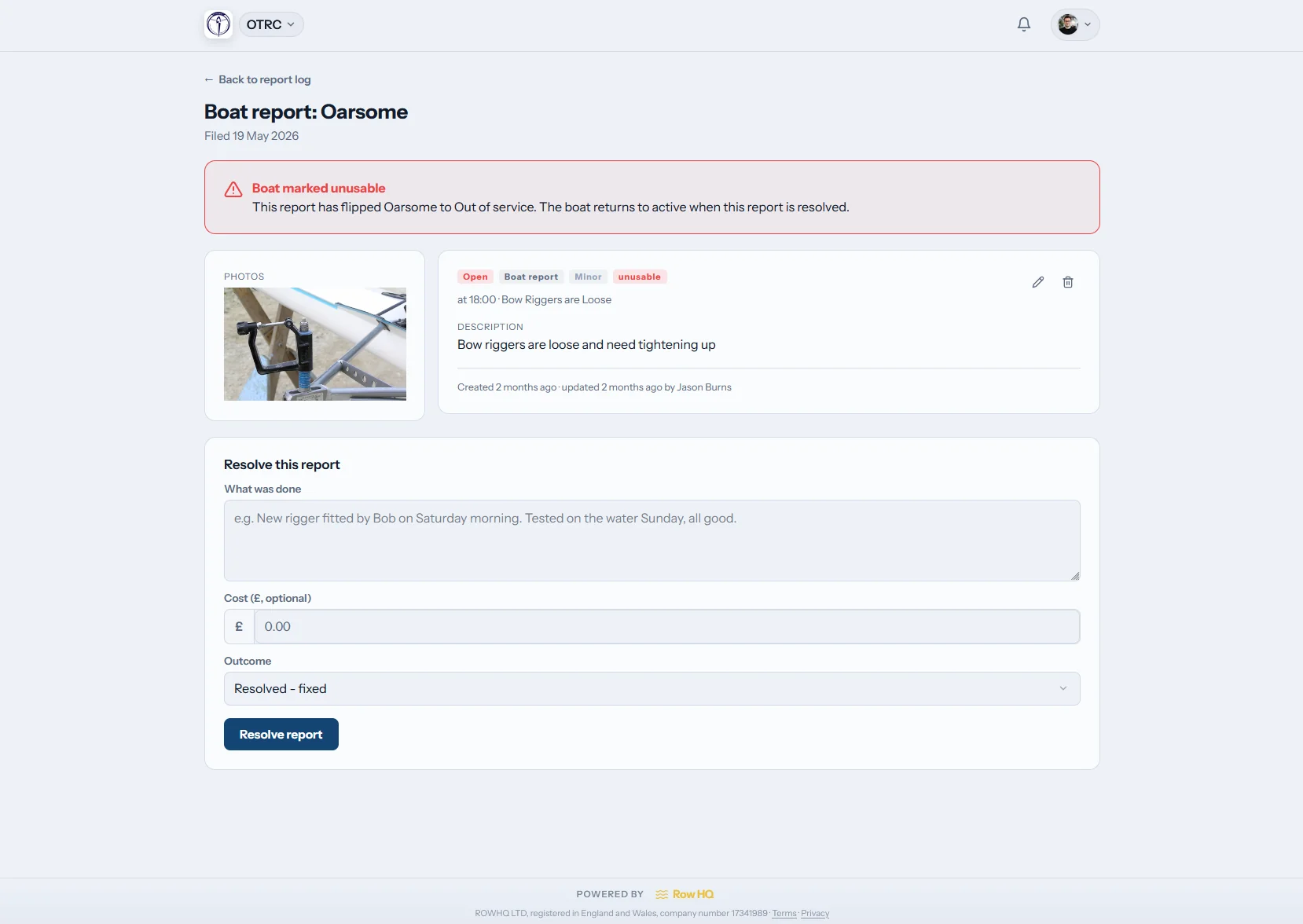
Every issue gets logged at the boathouse on the same phone the booking lives on. Tag the boat. Flag whether the hull is rowable or grounded. The boatman gets a single ranked feed of jobs, sorted by priority. Members see the boat status before they leave home. Damage history and last service date sit against the boat in the database, not in a notebook nobody can find at AGM season.
Why boat maintenance tracking matters
Tracking properly protects the asset and keeps members on the water. The detail behind that:
The cost of poor maintenance
Emergency repairs typically cost several times what the planned fix would have (industry estimate)
Boats last significantly longer with consistent documented care
Expected lifespan of a well-maintained imported racing shell
-
Safety first: Undetected damage to hulls, riggers or seats turns into equipment failure on the water. The Rowing Ireland safety code requires affiliated clubs to keep boats in seaworthy condition, and a systematic check log is the only practical way to evidence that the club did so. Read more on our data security and safety approach.
-
Cost protection: Small problems caught early stay small. A minor crack patched for a couple of hundred euro can become a full hull replacement at thousands of euro if it is left to spread through a winter at Lough Ree.
-
Extended lifespan: Boats that get consistent documented care routinely serve clubs for fifteen to twenty years. Boats that get the wash-and-hope routine often need replacing in half that time.
-
Accountability: Digital records establish who inspected what, when, and what they found. The admin dashboard gives a full audit trail, which matters at insurance renewal time and at the AGM when somebody asks why the four-plus is grounded.
Why is digital boat maintenance tracking better than paper?
A paper logbook lives in one place. It gets soggy on a wet morning in the bay. Only one person can write in it at a time. A digital log sits in every member's pocket, time-stamps every entry, and pins photos of damage to the right boat. The boatman opens the app to a single ranked list of jobs rather than thumbing through twenty pages of half-legible biro from the previous boatman. Read the full spreadsheets comparison for the broader context.
| Aspect | Paper Logs | Row HQ Digital |
|---|---|---|
| Accessibility | Boathouse only | Anywhere, any device |
| Photo documentation | Impractical | Built-in, unlimited |
| History search | Manual page flipping | Instant search |
| Maintenance reminders | Memory-based | Automated alerts |
| Damage tracking | Text descriptions | Photos + condition ratings |
| Loss risk | High (water, misplacement) | Secure cloud backup |
Row HQ's maintenance tracking features
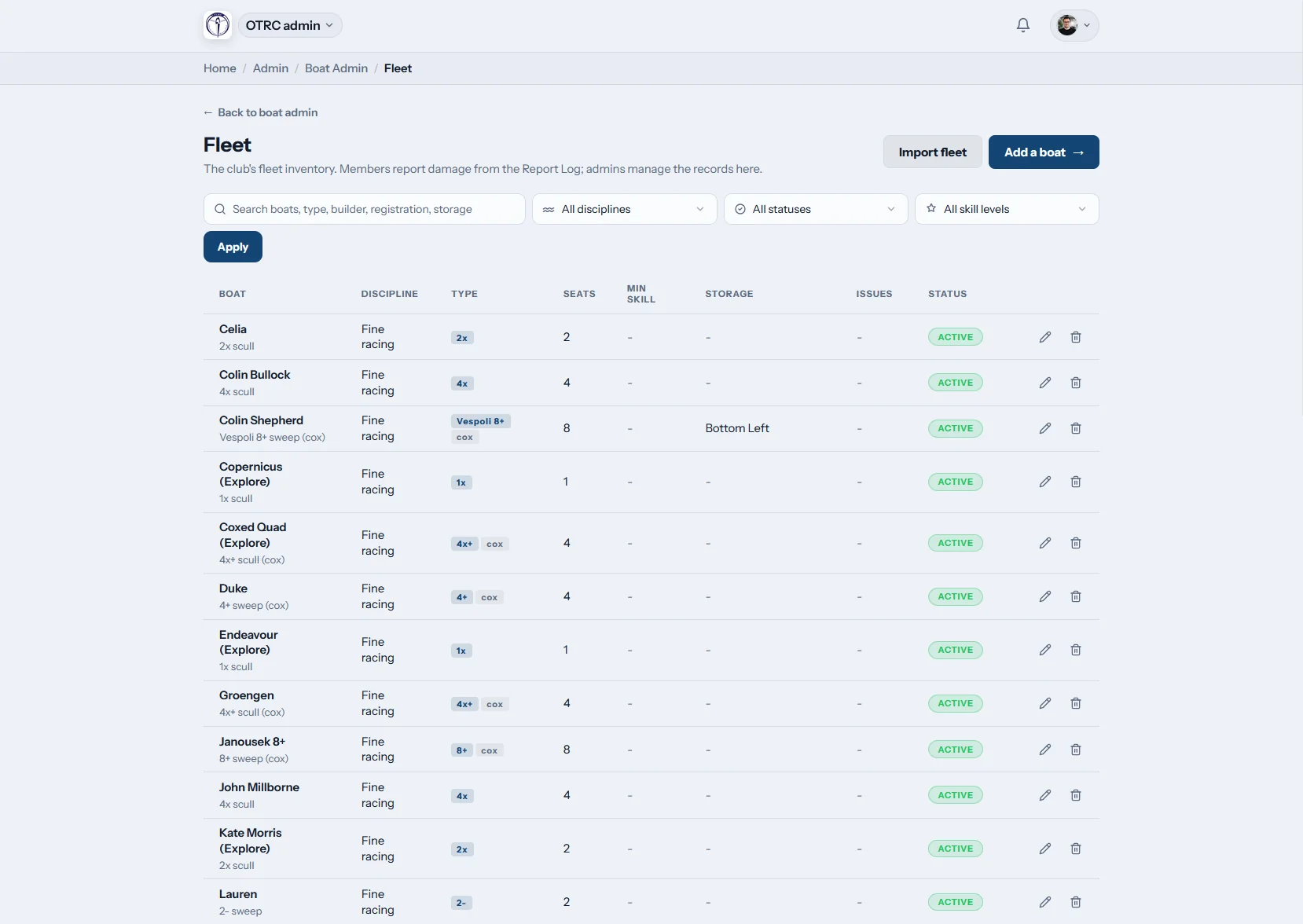
Row HQ ships maintenance tracking built specifically for rowing fleets. The day-to-day pieces:
-
Photo-based assessment reports: Document boat condition with unlimited photos. Capture damage from multiple angles, track repair progress across weeks, and remove the ambiguity that creeps into text-only logs.
-
Condition ratings: Rate each component (hull, riggers, seats, footplates, slides) on a standardised scale. The status feeds directly into the boat booking system, so members only book hulls that are actually fit for the water.
-
Maintenance schedules: Set recurring tasks - annual services, monthly checks, post-regatta inspections after Castleconnell, Erne Head or Skibbereen Regatta. Row HQ pings the right people on the right week.
-
Parts and inventory: Track spare parts on the shelf, see what is in stock, and generate a clean parts list for the next Sykes or Empacher order. Never scramble for the right bolt size on the Friday before a Cork Regatta.
Establishing a maintenance routine
The best maintenance system is the one that actually gets used. A few habits that stick at Irish clubs:
Equipment manager's maintenance checklist
Daily (after each outing)
- Rinse hulls with fresh water - non-negotiable at Skibbereen, Bantry or any coastal club where Atlantic salt builds fast
- Check for new scratches, fresh chips, or zebra-mussel scrape damage from Lough Ree or Lough Allen
- Report any issue immediately in Row HQ before the boat goes back on the rack
- Store boats correctly with the slings spaced for the hull
Weekly
- Tighten every rigger bolt
- Check seat wheels and slide tracks
- Inspect foot stretchers and heel ties
- Lubricate the moving parts as needed
Monthly
- Full hull inspection with fresh photos
- Update condition ratings in Row HQ
- Review and order replacement parts from Sykes, Empacher or Filippi distributors
- Clean and inspect oars and blades
Annually / end of season
- Professional hull inspection by an experienced repairer
- Deep clean and polish across the fleet
- Replace worn components ahead of the next Irish Champs build
- Generate the annual fleet report for the AGM and insurance renewal
Tips for success
- Assign ownership: Pin specific people to specific boats or boat classes. Accountability drives action. The coach tools make assignment and tracking straightforward.
- Turn on notifications: Use the reminder system so checks happen on the calendar, not when somebody happens to remember. The member portal lets any rower flag damage from the slip without messaging the boatman first.
- Document everything: A photo carries a thousand words at AGM time. Capture damage before and after repair. The trend across a season is what reveals whether a hull is genuinely failing or just collecting cosmetic wear.
- Read the trend: Use the reporting view to spot patterns. If the same Filippi quad keeps failing weekly checks, it has probably moved past intervention and into the replacement conversation.
- Train your members: Make sure every rower knows how to spot and log an issue. The more eyes on the fleet, the cleaner the data. See how Oundle Town Rowing Club built this into their weekly rhythm.
The benefits add up
Clubs that track upkeep properly see fewer surprises mid-season and longer-lived boats. Good fleet care also means more reliable hulls on the rack for training sessions and on race day at Inniscarra:
Cost savings
Cut emergency repair spend by catching issues early. Irish clubs that have moved to the system commonly report 30-50% lower annual maintenance bills.
Improved safety
Systematic checks find problems before they become hazards on the water. Protect members. Protect the club's standing under the Rowing Ireland safety code.
Clear accountability
Know exactly who checked what and when. Digital records resolve disputes and support insurance claims if a hull is damaged in transit or storage.
Extended lifespan
Well-kept boats run for two decades. Protect the asset and pull more racing years out of the existing fleet before the next capital appeal lands.
The photo documentation is the single most useful piece in practice. Watching a hull\'s condition across a season makes the repair-or-replace call straightforward instead of a guess. Browse the screenshot gallery to see the maintenance dashboard in context.
Getting started
Moving to a digital register is lighter work than it looks. Start by photographing every boat in its current condition, then build the routine one checklist at a time. Row HQ\'s interface is designed for logging from the phone in the bay - no laptop, no setup ceremony.
An Irish fleet is too valuable, and the members\' safety too important, to leave upkeep to memory and goodwill. Digital tracking gives the club structure, accountability and an audit trail the insurer and the AGM both expect. Check the pricing for the right plan, browse the FAQ, or get started here.
The maintenance log is a standard part of Row HQ, so the fleet history sits in the same account as the memberships and the bookings.
- The Row HQ Team
Sources & references
- Rowing Ireland Safety Code — Rowing Ireland (accessed May 17, 2026)
- Rowing Ireland - Club Responsibilities — Rowing Ireland
- Rowing Ireland - Insurance and club governance — Rowing Ireland
- Ask the Boatmakers: prolonging the life of your fleet (Filippi, Hudson, Pocock interview) — row2k
- Rowing shell maintenance: a plan for success — MaxRigging
- Empacher racing eight specification and construction — Empacher Bootswerft
- Filippi competition boats price list (carbon wing-rigger range) — Filippi
- Hudson Boat Works (racing shell manufacturer, construction and care references) — Hudson Boat Works
- Sport Ireland - club governance and equipment standards — Sport Ireland