The honest answer in 30 seconds
A new Hudson Boatworks club eight from the Picton factory lands at CAD 65,000 to 80,000 by the time it sits on the slings, and is built to last fifteen to twenty years if it is rinsed after every outing, photographed every fortnight, and tracked properly across the freeze-thaw cycle. The cheapest insurance a Canadian club has is a dock-side phone register every member can write to. A paper binder bolted to the boathouse wall does not survive a wet morning on the Welland Canal, a fall haul-out, or the freeze-thaw cycle through a Canadian winter, and a hairline crack left unlogged becomes a CAD 4,000 hull repair by the time it is found in spring rigging. Put the register on the same app that handles bookings, photograph every issue at the dock, and follow Rowing Canada Aviron's safety guidance for member-protection records.
A Reactive Fleet Is an Expensive Fleet
Most Canadian clubs discover the actual value of a shell when it is already on the repair bench at Hudson Boatworks. Move to scheduled, documented maintenance and the next capital ask gets pushed years down the road.
For a Canadian rowing club, the fleet is one of the biggest financial commitments the board will ever sign off on. A new Hudson Boatworks club eight from the Picton factory runs CAD 65,000 to 80,000 delivered. Empacher and Filippi imports clear CAD 90,000 by the time they reach the boathouse. Even an entry-level training single from Hudson, Maas, or Pocock runs several thousand dollars. Yet plenty of Canadian clubs still log maintenance in a paper binder, on sticky notes, or not at all. Row HQ's fleet management features give the boathouse a better option.
How should a Canadian rowing club track shell maintenance?
Log every issue at the dock on the same phone that handles the booking, tag the shell, and flag whether it is rowable. The equipment officer gets a single ranked queue of open jobs. Members see the status of every hull before they leave the house on a minus-fifteen Saturday morning in January. Damage history and the last Hudson Boatworks service date sit against each boat rather than buried in a binder on the boathouse shelf.
What proper tracking unlocks
Proper maintenance tracking protects the club's capital reserves and keeps members safe on cold Canadian water. The specifics:
The Cost of Skipping Maintenance Tracking
Emergency repairs typically run several times the cost of the same fix caught early (industry estimate)
Shells last significantly longer with consistent, documented care through the freeze-thaw cycle
Expected lifespan of a properly maintained Hudson, Empacher, or Filippi racing shell
-
On-water safety: A cracked hull, a worn rigger pin, or a seized seat track can fail mid-piece on a cold Canadian river - and the water on Burnaby Lake, the Ottawa River, or Lake Banook in May is cold enough to make that a serious incident. Systematic checks catch those problems at the dock, not halfway across Martindale Pond. See our notes on data security and member safety records.
-
Capital Protection: Small problems caught early stay small. A hairline crack that could be repaired for a few hundred dollars at Hudson Boatworks turns into a hull replacement costing thousands if left through a winter of freeze-thaw cycles inside an unheated boathouse.
-
Extended Lifespan: Shells that get consistent, documented care routinely serve Canadian clubs for 15 to 20 years - some Hudson eights from the 1990s are still racing at masters regattas. Neglected equipment may need replacement in half that time, a significant blow to any club's capital reserves.
-
Accountability: Digital records establish who inspected what, when, and what they found. The records also matter under PIPEDA - having a clear paper trail for equipment decisions protects the club if a member files a complaint after an incident. The admin dashboard gives the board a full audit trail at AGM time.
Dock-side phone register vs paper boathouse binder
A paper binder lives in one spot, gets wet, and only one member can update it at a time. A digital register sits on every member's phone, time-stamps every entry, and attaches damage photos to the correct shell automatically. The equipment officer gets a single ranked queue of open jobs instead of flicking through twenty pages of handwriting from three different captains. Read the full spreadsheets comparison for context on why purpose-built tools beat general-purpose ones.
| Aspect | Paper Binder | Row HQ Phone Register |
|---|---|---|
| Where it lives | Boathouse shelf only | Every member's phone |
| Photo evidence | Impractical | Built-in, unlimited |
| Searching history | Flick through pages | Instant search |
| Reminders | Memory-based | Automated alerts |
| Damage records | Text scrawl | Photos + condition ratings |
| Loss risk | High (water, dropped, mislaid) | Secure cloud backup |
Row HQ's Maintenance Features
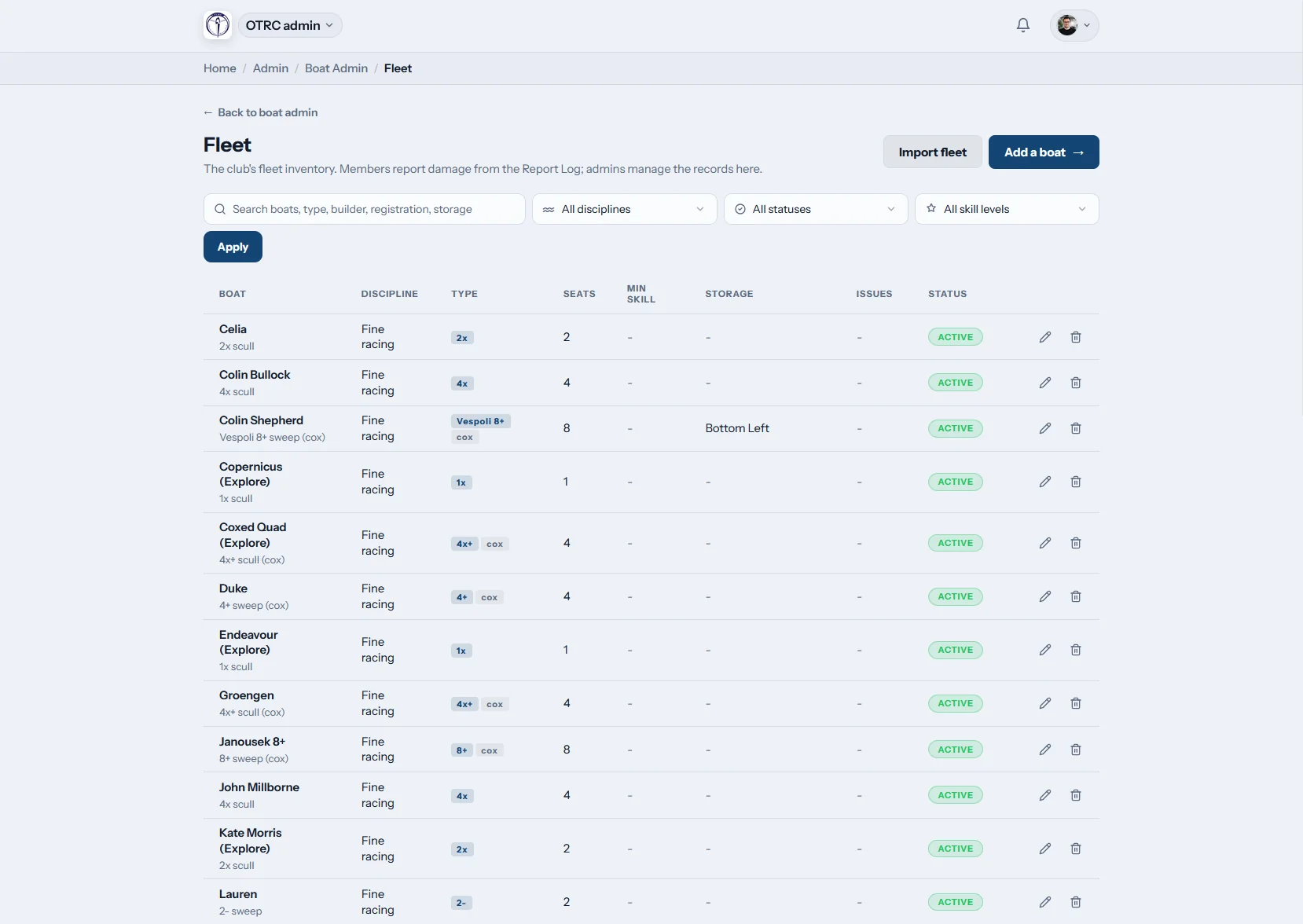
Row HQ ships maintenance tools built for the realities of a Canadian boathouse - fall haul-out, freeze-thaw storage, spring rigging, Henley build. The pieces that earn their place day to day:
-
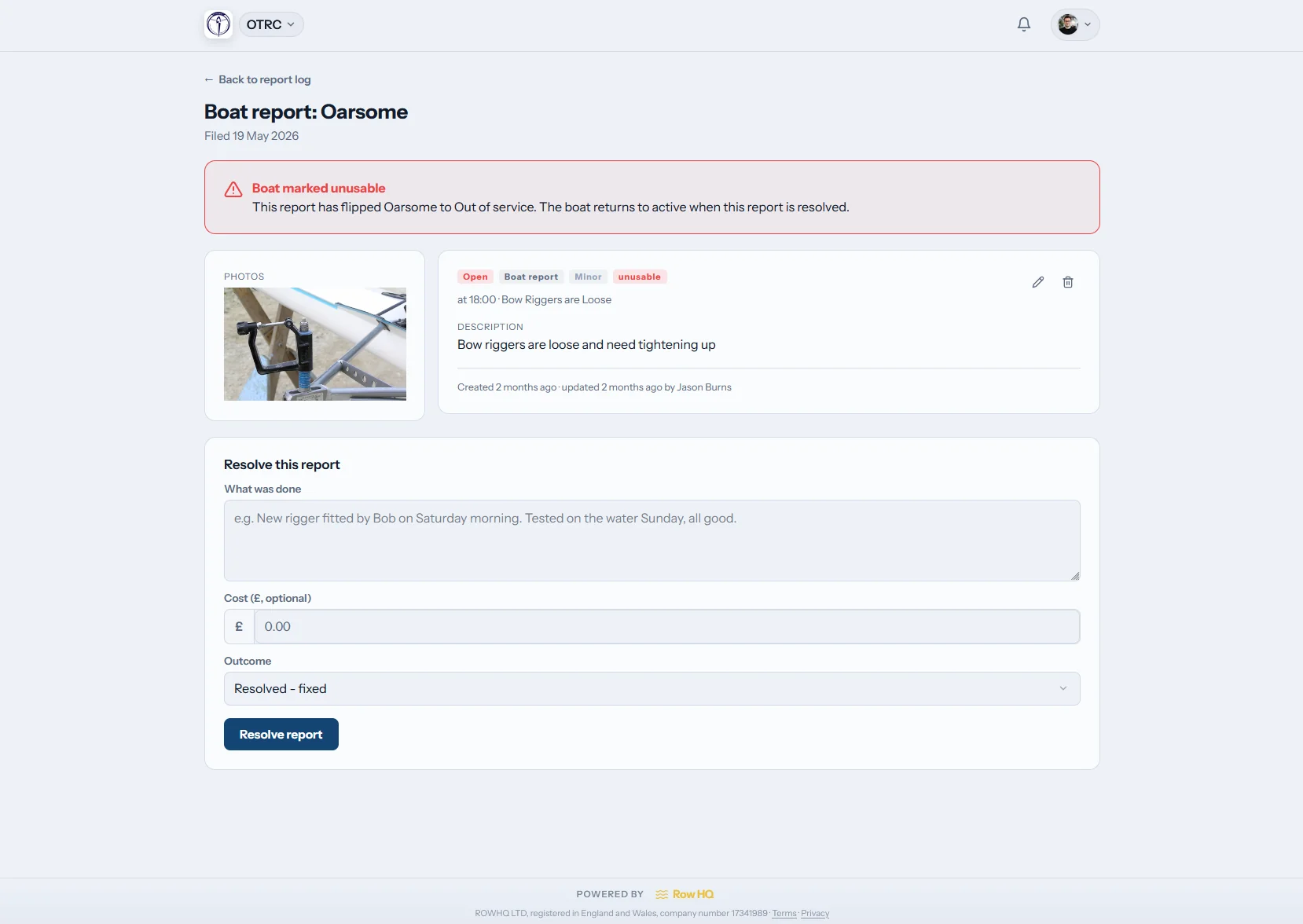
Photo-Based Damage Records: Document shell condition with unlimited photos from the dock. Capture damage from multiple angles, follow a Hudson Boatworks repair from intake through completion, and create visual records that settle disputes about who was in the boat when the gouge appeared.
-
Condition Ratings: Rate each component (hull, riggers, seats, footplates, fin, stern bung) on a standardised scale. Instantly see which shells need attention and prioritise accordingly. The rating feeds the shell booking system directly, so members can only reserve hulls that are cleared for use.
-
Maintenance Schedules: Configure recurring jobs - the fall haul-out checklist, the freeze-thaw winter checks, the spring rigging round, the annual Hudson Boatworks service, post-regatta inspections after the Royal Canadian Henley or the CSSRA Championship. Row HQ alerts the right people at the right time, so the post-regatta sweep actually happens.
-
Parts and Inventory: Track spare parts and consumables - rigger bolts, seat wheels, slide ends, stern bungs - know what is in the parts cupboard, and generate an order list to Hudson Boatworks or Maas before the next regatta weekend. Never scramble for the right bolt size on a Friday night before a Saturday race day again.
A Canadian-season maintenance routine
The best maintenance system is the one people actually use. Habits that hold across a full Canadian rowing season from May spring camp through to November fall haul-out:
Equipment Officer's Seasonal Checklist
Every Outing
- Rinse hulls with fresh water at the dock
- Visual check for new scratches, gouges, or rigger flex
- Report any issue immediately in Row HQ before leaving the dock
- Store shells correctly on slings or wall racks
Weekly
- Torque-check all rigger bolts
- Inspect seat wheels and slide tracks for grit
- Inspect foot stretchers, heel ties, and clogs
- Lubricate slides, gates, and rigger pivots as needed
Monthly
- Full shell inspection with photos against the rating scale
- Update condition ratings in Row HQ
- Review parts stock and place a Hudson Boatworks order if needed
- Clean and inspect every oar set, including collars and sleeves
Fall Haul-Out and Spring Rigging
- Professional hull inspection at Hudson Boatworks or comparable
- Deep clean, polish, and full damage audit before winter storage
- Replace worn components - slides, sleeves, footplate fabric
- Generate annual fleet condition report for the AGM and the insurance renewal
Tips for Success
- Assign shell ownership: Name specific members as responsible for each shell or shell class. Clubs like Argonaut RC on Sunnyside, Don RC, and Hanlan run this pattern effectively with named equipment captains per crew. The coach tools make it straightforward to assign and track responsibility through the season.
- Switch notifications on: Use Row HQ's reminder system so the checks actually happen on schedule, not just when someone happens to remember. The member portal lets any rower log damage from the dock while the detail is fresh in their head.
- Photograph everything: Photos resolve disputes. Capture damage before and after every repair to establish exactly what work was done and by whom. Two minutes at the dock saves a forty-minute argument at the next committee meeting.
- Watch the patterns: Use Row HQ's reporting to spot trends. If the same Hudson four keeps returning to the bench, it may be time for a deeper conversation with the dealer or the boathouse layout.
- Train every member: Make sure every rower knows how to spot and log a problem on the phone register. More eyes on the equipment means fewer surprises at spring rigging. See how Oundle Town Rowing Club embedded this habit into their routine - the same principles transfer cleanly to any Canadian boathouse.
The Benefits Add Up
Canadian clubs that track maintenance properly see fewer surprises and longer-lasting shells. Good fleet care also means more reliable boats for training sessions and race day on Martindale Pond:
Capital Savings
Catch issues early and emergency repair costs drop. Canadian clubs that switch to structured tracking commonly report a 30 to 50 percent reduction in annual maintenance spend.
Improved Safety
Systematic checks find problems at the dock rather than on cold water. A cracked hull caught before a 5am outing on the Welland Canal is a five-minute fix rather than a swim that ruins someone's day.
Clear Accountability
Know exactly who inspected what and when. Digital records remove ambiguity and hold up if an insurance claim is needed after damage in transit to the Royal Canadian Henley.
Extended Lifespan
Properly maintained shells last longer. Protect the club's capital and get more seasons of racing out of every hull in the racks.
Photo records are the most valuable piece in day-to-day practice. Scrolling back through a hull's condition over the past three seasons makes the repair-or-replace decision defensible at the AGM, in front of the board, and to the insurance assessor. Browse the screenshot gallery to see the maintenance dashboard in context.
Getting Started
Moving to a dock-side phone register is less work than it looks. Photograph every shell in current condition over a single Saturday morning, then introduce the habits one checklist at a time. Row HQ's interface lets any member log an assessment from their phone at the dock - no laptop, no clipboard, no walking back to the office.
A CAD 70,000 shell with no maintenance record is an insurance claim waiting to happen. Digital tracking gives the board the structure, accountability, and audit trail the next AGM and insurance renewal will ask for. Check our pricing for the plan that fits your Canadian club, or the FAQ for common questions. Ready to go? Get started here.
In Row HQ the maintenance record is connected to the boats themselves: report damage, track the fix and see the history on one screen.
- The Row HQ Team
Sources & references
- Rowing Canada Aviron safety and equipment guidance for clubs — Rowing Canada Aviron (accessed May 17, 2026)
- Hudson Boat Works - racing shell construction and care — Hudson Boat Works (Picton, ON)
- RowSafe 2026 (British Rowing safety guidance, comparative reference) — British Rowing
- Ask the Boatmakers: prolonging the life of your fleet (Filippi, Hudson, Pocock) — row2k
- Rowing shell maintenance: a plan for success — MaxRigging
- Empacher racing eight specification and construction — Empacher Bootswerft
- Filippi competition boats price list (carbon wing-rigger range) — Filippi
- CSSRA - Canadian Secondary Schools Rowing Association rules and equipment standards — CSSRA
- PIPEDA overview - privacy obligations for Canadian organisations — Office of the Privacy Commissioner of Canada