Pick a piece in 30 seconds
Need a session right now? Building base: pick from UT2 base aerobic (60-90 minute steady, conversational, the backbone of any Penrith camp and Head of the Yarra build). Sharpening for a 2k: drop into TR race-pace tolerance (6x500m or 4x1k, 5-8 seconds off 2k). Testing day: head to benchmark tests (2k, 5k, 30-min). Squad piece in 45 minutes: pick a mixed-zone ladder. Lock drag factor first (110-130 for most senior athletes), warm up 10 minutes, log the result before walking out of the shed.
The session library I wish I had the year I started writing ergo programmes. Thirty pieces, sorted by AIS intensity band, with target paces drawn from Rowing Australia high-performance practice and Concept2 training guidance. Each piece carries a brief, a target split formula off your 2k, and notes on running it through a squad of twelve. Bookmark it. Captains hand it to a new coach on day one; rowers pick a session at 5am when fog has shut Penrith or smoke has closed the Yarra and the boatshed ergos are the only option. The skeleton is the same one MUBC, Sydney Uni, Banks BBC, Mosman, Toowong and most of the GPS schools work off. Names of pieces change shed to shed. The bones do not.
AIS intensity bands
Five-band intensity is the shared language across Aussie coaching. Rowing Australia's high-performance pathway maps onto the same UT2 to AN structure published in the AIS coaching manuals, and most institutes (NSWIS, VIS, QAS, WAIS, SASI) lean on it for weekly squad prescription. Bands anchor to a current 2k pace, or to maximum heart rate if a proper ramp test has been done. Find your zone splits with the training pace tool - paste a 2k, every band drops out, zero whiteboard maths.
| Band | Purpose | Split (vs 2k) | % HRmax | RPE | Rate |
|---|---|---|---|---|---|
| UT2 | Base aerobic, fat oxidation | +18 to +25 sec | 60-70% | 3-4/10 | 18-22 spm |
| UT1 | Aerobic capacity build | +12 to +17 sec | 70-80% | 5-6/10 | 20-24 spm |
| AT | Aerobic threshold | +8 to +12 sec | 80-85% | 7/10 | 22-26 spm |
| TR | Lactate threshold / transport | +4 to +8 sec | 85-92% | 8-9/10 | 26-32 spm |
| AN | Top-end anaerobic | -2 to +2 sec | 92-100% | 9-10/10 | 30-38 spm |
Worked example: a rower carrying a 7:00 2k (1:45 average) trains UT2 at 2:03-2:10, AT at 1:53-1:57, TR at 1:49-1:53. Convert wattage to split with the watts-to-split utility if the PM5 is set to power mode.
UT2 base aerobic: 5 pieces
Where 60-70 percent of weekly volume belongs. Unglamorous, slow, and the foundation everything else stacks on. I have done 4x20 minutes more times than I want to count. Never gets exciting. Always works.
1. 60-minute base steady
Target: Continuous 60 minutes at UT2 split
Purpose: Pure base aerobic. The single most useful piece in an autumn-winter Aussie programme.
Notes: Hold a chat throughout. Cannot? Going too hard. Cap rate at 22. Split drifting up 2-3 sec by the end is fine.
2. 4x20 minutes (UT2)
Target: 4 x 20 minutes, 3 min rest, UT2 split
Purpose: Same volume as a 90-minute steady, but the breaks protect cleaner posture.
Notes: Handy for less-fit rowers who cannot hold tidy form for 60 continuous minutes. Rate 18-20.
3. 3x30 minutes (UT2)
Target: 3 x 30 minutes, 5 min rest, UT2 split
Purpose: Bridge between the 4x20 and the 90-minute continuous. Pre-season backbone.
Notes: Common squad piece: everyone starts together, splits are personal. Coach circles the shed.
4. 90-minute base steady
Target: Continuous 90 minutes at UT2 split
Purpose: Long aerobic block. Once a week max in base phase, usually a Saturday morning slot.
Notes: Audiobook session. Bring water. Watch for posture drift past the hour mark. Reset every 10 minutes.
5. UT2 fartlek (60 minutes)
Target: 60 minutes alternating 8 min UT2 + 2 min UT1
Purpose: Adds variety to long aerobic work without leaving the aerobic system.
Notes: Keeps a squad engaged through a long piece. Lift rate two beats in the UT1 segments.
AT aerobic threshold: 5 pieces
Threshold work sits just below the point where lactate starts to accumulate. Where the engine that holds a King's Cup eight together past the 1k buoy gets built. Sessions should feel "uncomfortably steady" - short phrases possible, full sentences not.
6. 4x10 minutes (AT)
Target: 4 x 10 minutes, 3 min rest, AT split
Purpose: Classic threshold block. Lifts aerobic capacity and tolerance for sustained effort.
Notes: Rate 22-24. Rep three is the test. Cannot hold split on rep three? Started too hot on rep one.
7. 5x8 minutes (AT)
Target: 5 x 8 minutes, 2 min rest, AT split
Purpose: Shorter intervals, lower total volume, quicker recovery.
Notes: Good Tuesday after a heavy Sunday water session. Rate 22-26.
8. 2x20 minutes (AT)
Target: 2 x 20 minutes, 5 min rest, AT split
Purpose: The benchmark threshold piece. Holding AT for 2x20 proves the base is solid.
Notes: Pace the first 10 minutes of rep one cautiously. This piece punishes a hot start.
9. Pyramid 8-6-4-6-8 (AT)
Target: 8min, 6min, 4min, 6min, 8min at AT split, 2 min rest
Purpose: Builds mental focus through pace changes while sitting in one band.
Notes: Lift rate by 1-2 spm on the 4-minute middle piece. Descending sets build confidence.
10. Ladder 5-10-15 (AT)
Target: 5min, 10min, 15min at AT split, 3 min rest
Purpose: Progressive volume across one session. Tests pacing discipline hard.
Notes: Most rowers blow the 15-min piece. Open it 2 sec slower than reps one and two and let it settle.
TR race-pace tolerance: 5 pieces
TR is where 2k speed gets put on. Working at or just over lactate threshold. The burn is real, posture discipline is the hardest part. These are the pieces that hurt to plan and hurt more to do. The ones that put crews on the podium at the Australian Boat Race, the Queen's Cup and the King's Cup.
11. 6x500m (TR)
Target: 6 x 500m at 2k pace + 4-6 sec, 1:30 rest
Purpose: Bread-and-butter race-pace tolerance. In every serious 2k build.
Notes: Rate 28-32. Split target is firm. Open rep one 2 sec under target and rep four punishes hard.
12. 8x500m (TR)
Target: 8 x 500m at 2k pace + 6-8 sec, 1:30 rest
Purpose: Higher volume than 6x500. Builds the back end of a 2k race profile.
Notes: Use 3-4 weeks out from a 2k test, never in the final week.
13. 4x1k (TR)
Target: 4 x 1000m at 2k pace + 5-7 sec, 3 min rest
Purpose: Longer intervals test sustained 2k tolerance. Each rep is half-race length.
Notes: Sit at rate 28-30. The transition from rep two to rep three is where most athletes crack.
14. 3x1500m (TR)
Target: 3 x 1500m at 2k pace + 7-9 sec, 4 min rest
Purpose: Long TR pieces. Brutal mental session. Each rep is more than half a 2k.
Notes: Save for late in a build phase. Most coaches programme once per cycle, not weekly.
15. Race-prep TR set
Target: 2x500m at 2k pace, 2 min rest, then 2x500m at 2k pace -2 sec, 2 min rest
Purpose: Race rehearsal. Second pair simulates pushing past 2k pace.
Notes: Best done 7-10 days out from a 2k test. Project the 2k off this with the 2k projection tool.
AN top-end power: 5 pieces
Anaerobic work is short, sharp, non-negotiable for a clean 2k start. The first 30-45 seconds of every race lives in this system. Pieces are intense, posture-heavy, full recovery between reps.
16. 8x250m (AN)
Target: 8 x 250m at 1k pace, 2 min rest
Purpose: Power and speed without total failure. Builds 2k starts.
Notes: Rate 32-36. Hold the split, do not push past. Goal is repeatability, not heroics.
17. 12x250m (AN)
Target: 12 x 250m at 1k pace, 90 sec rest
Purpose: High-volume anaerobic. Shorter rest makes it brutal by rep six.
Notes: Cut the set early if split drops more than 4 sec. Intensity matters more than volume.
18. 10x500m at 1k pace
Target: 10 x 500m at 1k pace, 2 min rest
Purpose: Mixed AN/TR. First five feel okay. Reps six to ten are character-building.
Notes: Most useful in race-prep weeks. Rate 30-34. Project outcomes via the ergo score percentile tool.
19. 6x500m sub-1k
Target: 6 x 500m at 1k pace -2 sec, 3 min rest
Purpose: Pushes past 1k pace in short bursts. Builds raw watts.
Notes: Long rests are non-negotiable. Do not trim them to make it "harder". Point is full output per rep.
20. 30s on / 30s off
Target: 20 minutes alternating 30 sec max effort + 30 sec light paddle
Purpose: Lactate tolerance, VO2 work. Brief, repeatable, devastating.
Notes: A favourite of CrossFit programmes but originally a rowing classic. Rate 32-38 on the work intervals.
Benchmark tests: 5 pieces
Tests give the numbers everything else gets built off. Run them in standard conditions, log them properly, trust the trend over single results. First time I did a 30-min I went out at 5k pace and exploded at 18 minutes. Tests teach pacing the hard way.
21. 2k test
Target: All-out 2000m
Purpose: The gold-standard ergometer piece. The number every coach wants for King's Cup shortlisting and AGSV / CAS selection.
Notes: Drag 110-130. Rate 30-36. Pace the punch 1-2 sec under target average; settle and grind 500-1500m; lift in the closing 250. Lock the opening split via the ergo score percentile tool.
22. 5k test
Target: All-out 5000m
Purpose: Tests aerobic capacity. Less stressful than a 2k, strong predictor of 2k fitness.
Notes: Run quarterly in the off-season. Most rowers split 5k at 2k pace + 8-12 sec. Rate 26-30.
23. 6k test
Target: All-out 6000m
Purpose: Used hard in junior selection pathways and Rowing Australia pathways. Aerobic-dominant.
Notes: Pace at AT/TR transition. Rate 26-30. Hardest mental section is 2.5k-4k - the bury zone.
24. 30-minute test
Target: Max metres in 30 minutes
Purpose: Standard aerobic benchmark. Bridges 2k and 60-min capability.
Notes: Pace cautiously for the first 10 minutes. Rate 24-28. Total metres is the headline number.
25. 10k test
Target: All-out 10000m
Purpose: Long-form aerobic test. Used as a Head of the Yarra fitness indicator.
Notes: Mental discipline. Hold UT1/AT pace for the first 7k, then lift. Most Aussie clubs run this in April-May ahead of the Yarra.
Mixed-zone work: 5 pieces
Mixed-zone pieces break the monotony and train the body to switch between energy systems. Useful for coaches running shorter sessions, or rowers short on time who still need a quality stimulus.
26. Alternating set 4x(5min AT + 5min UT1)
Target: 40 minutes total, alternating 5 min AT and 5 min UT1, no rest
Purpose: Builds aerobic capacity and threshold tolerance in one block.
Notes: Most efficient piece per minute in the library. Rate steps 26 (AT), 22 (UT1), 26, 22, repeat.
27. Ladder 250-500-750-1k-750-500-250
Target: Pyramid at TR pace, equal rest to work
Purpose: Tests pacing across distances within one session.
Notes: Most rowers crack on the descending 750. Nail the 1k as the anchor rep.
28. Broken 2k (1k + 500 + 500)
Target: 1000m at 2k pace, 1 min rest, 500m at 2k pace -2 sec, 1 min rest, 500m all-out
Purpose: Race rehearsal. Builds confidence at 2k speed without the full 2k cost.
Notes: Add times and rests for an indicative 2k. Usually 5-10 seconds quicker than the actual.
29. Broken 6k (4x1500m with 1min rest)
Target: 4 x 1500m at AT split, 1 min rest only
Purpose: Tolerance work for head-race style efforts. Short rests keep heart rate high throughout.
Notes: Most relevant in autumn ahead of the Yarra. Rate 24-26.
30. Mixed pyramid 1k-2k-1k
Target: 1000m at 2k pace -2 sec, 5 min rest, 2000m at 2k pace, 5 min rest, 1000m at 2k pace -3 sec
Purpose: Tests speed before and after race-pace work. Severe piece.
Notes: Reserve for race prep. The closing 1k tells everything about fitness reserve.
Choosing the right piece
Match goal to session via the table below. Session numbers link back to descriptions. No 2k benchmark on file yet to peg the zones off? Run piece #21 first, then circle back here.
| Goal | Best pieces | Frequency |
|---|---|---|
| General fitness, off-season | #1, #2, #4, #6, #26 | 3-4 per week |
| Race prep (2k focus, King's Cup) | #11, #14, #15, #28 | 2 per week, taper to 1 |
| Race prep (Head of the Yarra) | #3, #4, #24, #25, #29 | 2-3 per week |
| Power and start work | #16, #19, #20 | 1-2 per week |
| Technique piece | #1, #5 (low rate) | Anytime |
| Recovery day | #1 capped at 30 min, UT2 split | After hard session |
| Test week | #21, #22, #24, #25 | One test per week max |
| New to ergo programming | #1, #6, #11, #21 in that order | Build over a month |
Running it across a squad
Writing a 1:1 prescription is one job. Running a squad of twelve through the same piece on twelve different ergos at 5:30am is a different beast. Patterns that hold up in practice:
- Crew grouping: Pair athletes within 5 sec of each other on the 2k. Crews self-pace as a unit, which builds racing discipline. Pull ergo data by potential crew in the coach toolkit ahead of selection.
- Split target by 2k: Each athlete works to their own number, not a shed-wide pace. Session structure stays identical; the splits are personal. Exactly what the Row HQ training pace tool solves. Paste a 2k, every zone target drops out, zero whiteboard maths.
- Squad leaderboards: Run a 6x500 as a session-wide leaderboard. Best aggregated time wins. Works beautifully for #11 and #16. Log the results in the coach toolkit so PBs get tracked.
- Group progression: 12 of 14 athletes hit target on a #8 cleanly? Bump the rep number next cycle (5x20 next week). 3 of 14? Drop the target 2 sec.
- Novice modifications: Halve the volume, keep the shape. A novice 4x500 instead of #11. Time on the ergo matters more than the volume on the prescription.
Pre-piece setup
Pieces only deliver if the machine is set up properly. Most rowers ignore drag factor. Few warm up properly. Both are quality killers.
- Drag factor: 110-130 for most senior athletes. Lighter (90-110) for women and junior rowers. Heavier (130-140) for heavyweight men. Set it before every piece via the PM5 Display menu. Lever position alone does not guarantee drag. Use the drag factor tool if unsure.
- Monitor settings: Display on split (/500m) for steady-state and threshold work. Switch to watts for power work. Pre-load the piece via "Select Workout" so the monitor counts down splits automatically.
- Warm-up (10 min minimum): 3 min easy paddle rate 18-20, 3 min building to UT2 split, then 4 x (30 sec at rate 26 / 30 sec light). Skip this and the first rep on any TR/AN piece is a write-off.
- Log immediately: Time, split, average watts, rate, bodyweight, plus a one-line note ("legs felt fresh", "back from cold"). Two minutes of admin protects months of trend data. The Row HQ member portal handles it on the phone inside 30 seconds.
Quality-killing habits
These are the failure modes that show up most often. Each one is fixable, but each bleeds quality from a session when left to fester.
- Going too hard on steady state. UT2 starting to look like UT1? Not training the aerobic system the piece exists for. Polarised-training research is unambiguous now: 80 percent easy plus 20 percent hard beats spending every session in the grey zone. Cap rate at 22 in UT2 when tempted to push.
- No warm-up. Jumping into 4x10 cold means the first 4 minutes of rep one are wasted warming up at threshold pace, badly. 10 minutes warmed properly beats 15 warmed poorly.
- No split target. "I will see what I can hold" is not a workout. It is a permission slip to coast or blow up. Set the target split before rep one. Derive it off the 2k via the training pace tool.
- Mixing bands inside one session. A "UT2 with sprints" is not UT2. Pick a band and stay in it. Mixed-zone work has its place (see #26-30) but every other session should sit cleanly in one band.
- Not logging. Untracked sessions are training spent without compound interest. No trend means no informed next phase. Free option: paper. Better option: the coach toolkit.
- Testing too often. A 2k a fortnight teaches pacing of 2ks, not how to row quicker. One real 2k per block (every 6-8 weeks), broken 2ks and TR work in between.
FAQ
How many ergo sessions a week should an Aussie club rower do?
Three to five depending on phase. Base build (May to August on the southern-hemisphere calendar) typically runs four to five ergo sessions. Once water training fires back up in spring, two per week is plenty for most senior club rowers. Junior and school programmes may push to six during exam blocks or when conditions sit unrowable.
What is the best ergo piece for a beginner?
Start with piece #1 (60-minute base steady) at conversational pace, twice weekly for the first month. Add piece #6 (4x10 minutes AT) once weekly in month two. Run a first 2k test (piece #21) at the end of month two. That benchmark sets the zone splits for everything that follows.
How long should a club ergo session be?
Most quality sessions land between 45 and 75 minutes including warm-up and warm-down. Below 30 minutes there is not enough quality work once the warm-up is taken into account. Above 90 minutes the returns diminish for anyone not preparing for ultra-distance work.
Do these pieces transfer to a WaterRower or Hydrow?
Yes, but split benchmarks shift. WaterRower and Hydrow use different flywheel mechanics, so a Concept2 1:45 is roughly a WaterRower 1:48 and a Hydrow 1:47 at equivalent power output. Session shape (intervals, zones, rests) transfers cleanly. Most Aussie clubs default to Concept2 because the wider rowing world benchmarks against it.
What separates AT from TR in practice?
AT (aerobic threshold) is the highest sustained pace where lactate stays cleared by the body. TR (lactate threshold or transport) is the pace where lactate begins to accumulate measurably. Practically: AT is "uncomfortably steady, short phrases possible". TR is "hard, single words only". Most club rowers undershoot the AT/TR boundary and train AT sessions too hot.
Should the warm-up include rate work?
Yes. After 6 minutes of easy paddling, drop in 4-6 short rate bursts (15 strokes at rate 26-28, 30 sec rest between). Primes the nervous system without burning glycogen. Most rowers skip the bursts. The first hard interval pays for it.
How do I know my drag factor is right?
For most senior club rowers, 110-130 is right. Heavier rowers (90kg+) can run 130-140. Junior rowers and women typically sit at 100-120. Higher drag does not mean harder work. It means a heavier boat feel with a slower catch. Stroke rate dropping below 22 in a TR session? Drag may be too high. Run our drag factor tool (linked from the Tools hub) for a per-athlete recommendation.
Where can squad ergo scores be tracked?
Row HQ's coach toolkit includes an ergo log sized for Aussie clubs. Athletes log scores from the member portal in 30 seconds, coaches see the squad-wide view with PB highlights, and the data flows straight through to crew selection. Concept2 Logbook entries import automatically.
- Jason
Sources & references
- Concept2 indoor rower training guides and sample workouts — Concept2
- Concept2 PM5 monitor reference — Concept2
- Concept2 Online Logbook (rankings and reference) — Concept2
- Workouts of the Day archive (decades of programmed sessions) — Concept2
- Concept2 drag factor reference — Concept2
- Rowing Australia high performance — Rowing Australia
- Rowing Australia coaching pathways — Rowing Australia
- Interstate Regatta and the King's Cup — Rowing Australia
- Head of the Yarra Regatta — Head of the Yarra
- British Rowing PT Testing Protocols (zone reference) — British Rowing
- Polarised training research (Stoggl & Sperlich, Frontiers in Physiology 2014) — Frontiers in Physiology
- Bompa periodisation of training principles — Human Kinetics
- Row HQ training pace tool — Row HQ
- Row HQ ergo score percentile tool — Row HQ
- Row HQ 2k projection tool — Row HQ
- Row HQ watts-to-split utility — Row HQ
- Row HQ drag factor tool — Row HQ
Related articles & tools
Planning sessions for a whole crew? The Club Session Library includes 52 adaptable session plans, with 16 for the erg.
From the RowHQ shop
Printable PDFs written for club rowers. Buy once, keep forever.
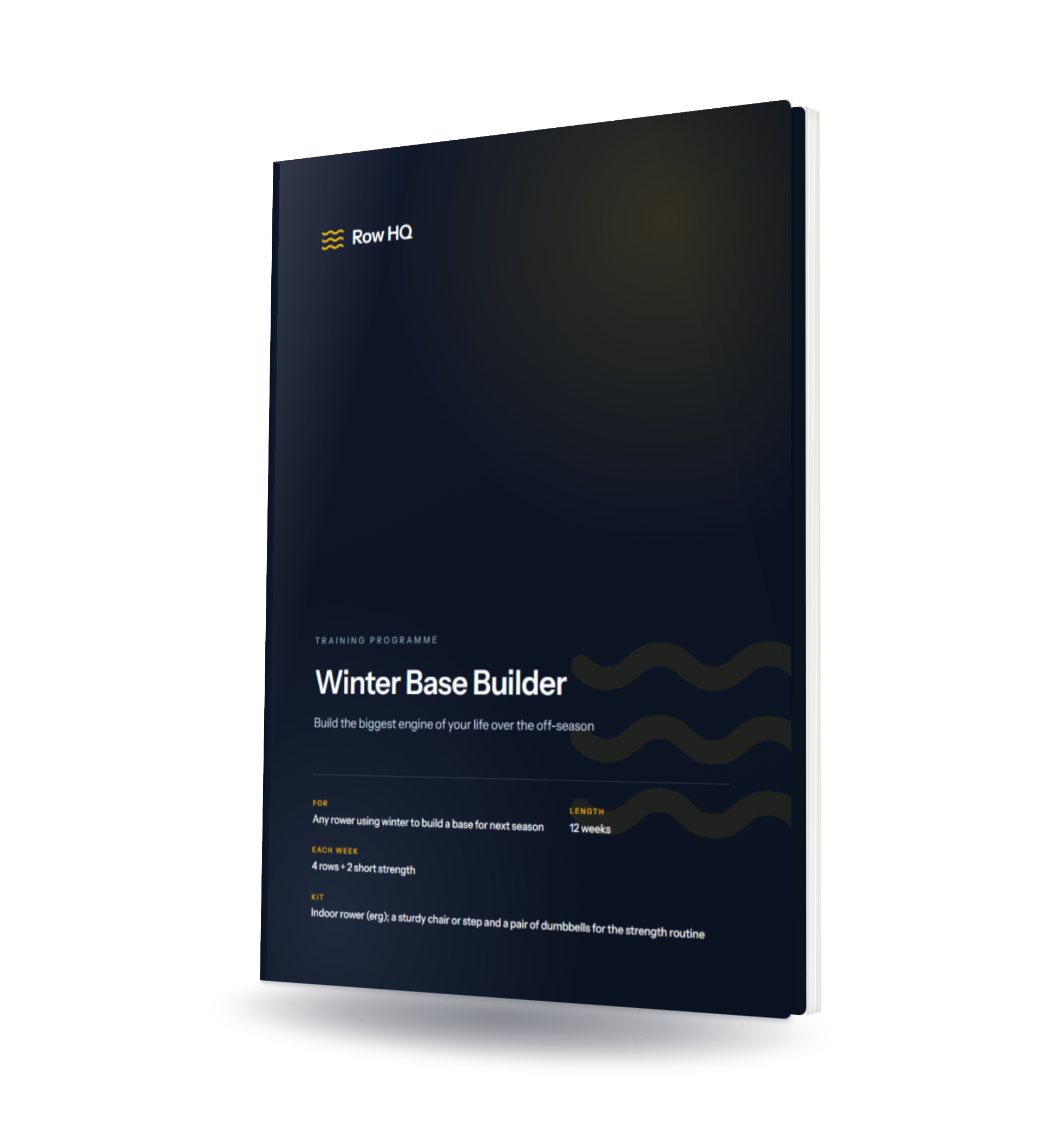
Winter Base Builder
Build the biggest engine of your life over the off-season - 12 weeks of mostly-easy volume plus a strength routine, so you arrive at spring fast.
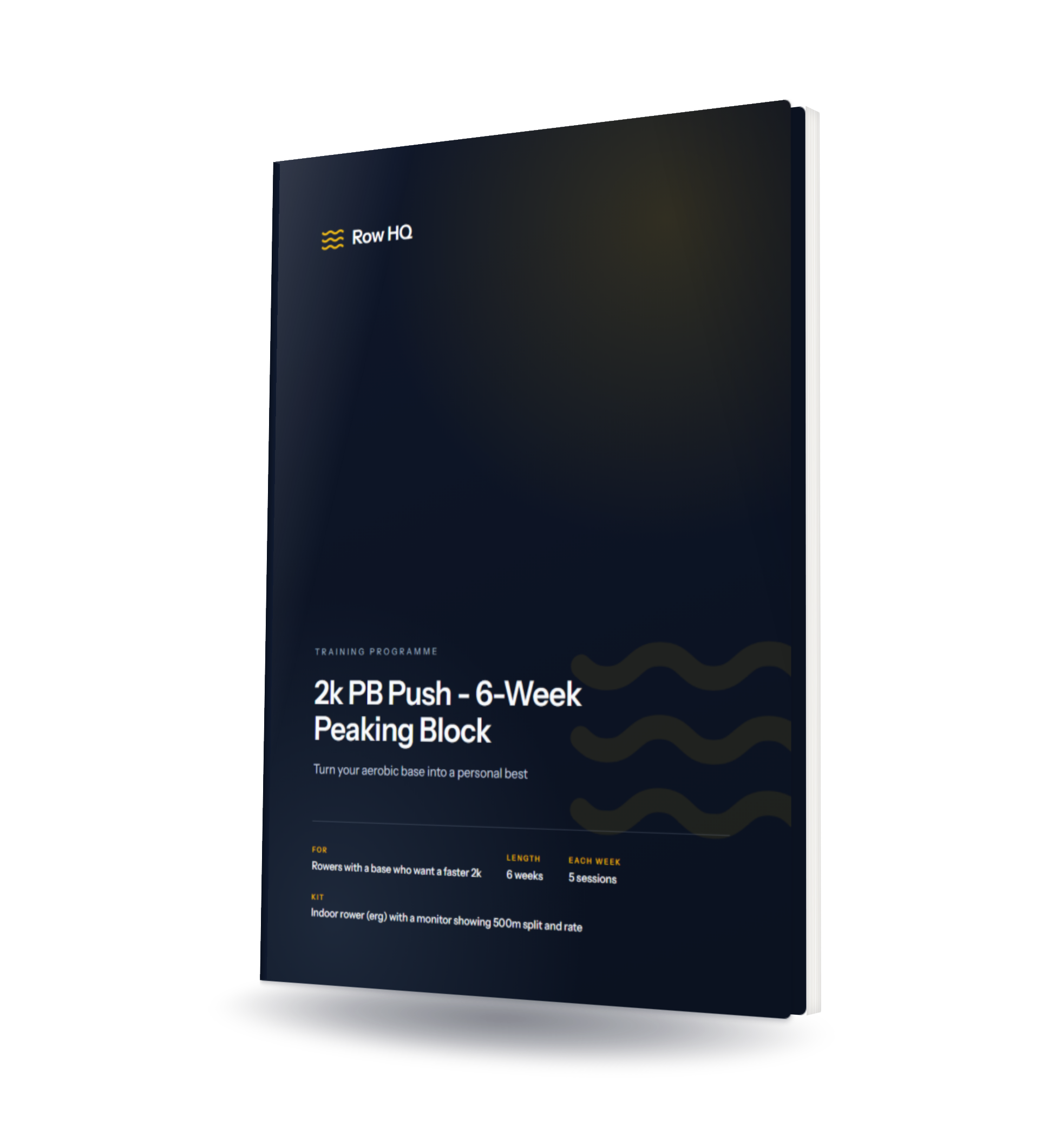
2k PB Push - 6-Week Peaking Block
Six weeks that turn an existing aerobic base into a 2k personal best - race-specific work, a proper taper, every pace scaled to your own time.
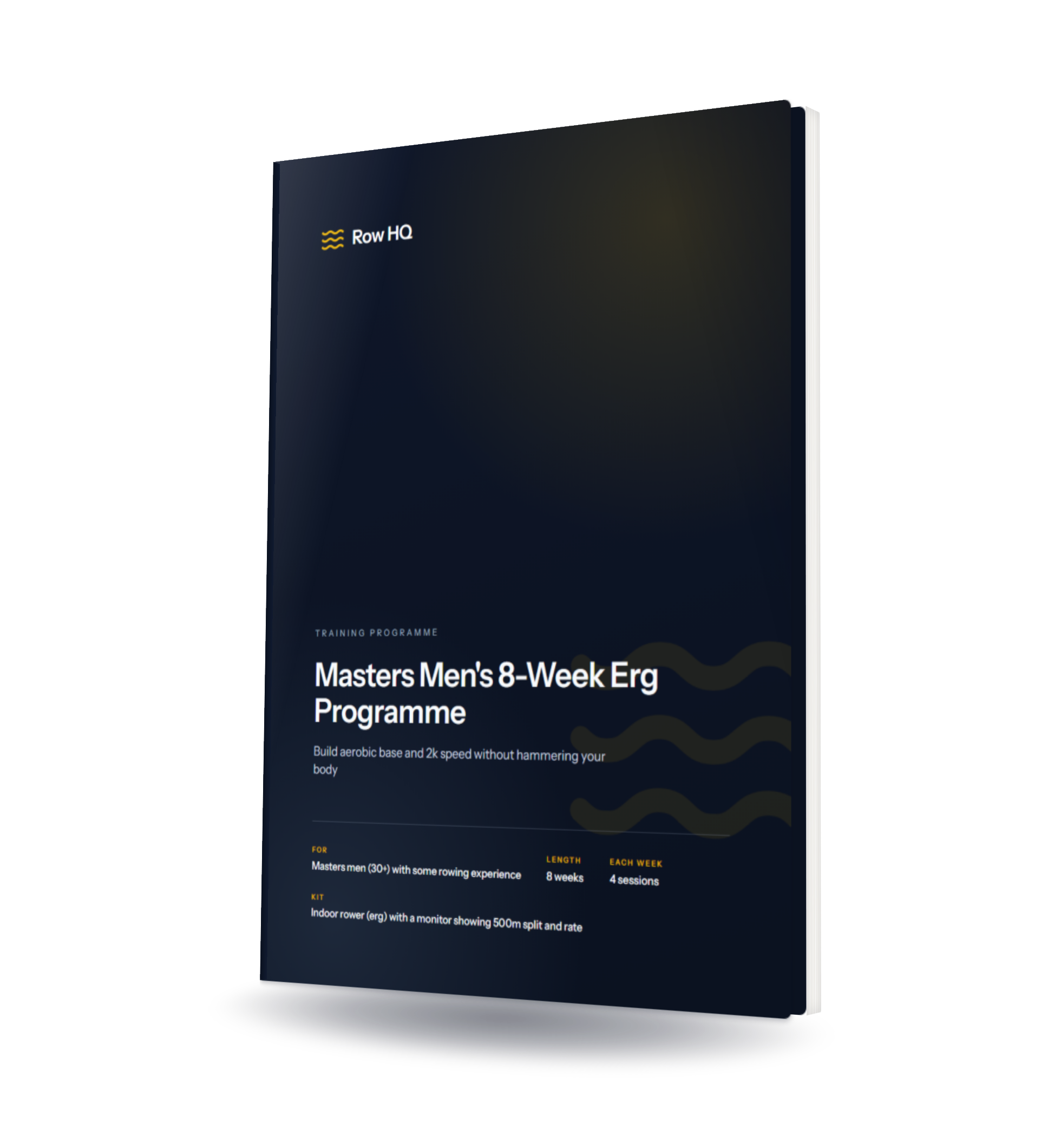
Masters Men's 8-Week Erg Programme
Eight weeks of structured erg training built around a masters body - science-backed, joint-friendly, and designed to protect your engine as you age.