Pick a session in 30 seconds
Need an erg session for the boatshed right now? Building winter base: pull from UT2 steady state (60-90 minute aerobic blocks, the staple of the Karapiro June-to-August grind). Race-ready for spring: drop into TR lactate threshold (6x500m or 4x1k, held a handful of seconds outside 2k pace). Trial day: the test pieces covers the 2k, 5k, 6k anchor and 30-minute. Crew sweat in 45 minutes: a mixed-zone ladder fits the brief. Set drag (110-130 covers most senior athletes), walk through a proper 10-minute warm-up, then log the score before you step off the rail.
This is the session library I wanted on the wall of the boatshed when I started programming ergs for our crew. Thirty sessions, organised by zone, with target paces drawn from Rowing NZ's athlete development pathway and Concept2's training guidance. Every session lists a purpose, a target split tied to your 2k, and notes on running it for a squad. Save the page. Hand it to a new club captain at the start of the Aotearoa winter. Open it at 6:45am when a Wellington southerly has knocked the Hutt off the on-water programme and the only option is the row of ergs against the boatshed wall. The framework here is the same one Hamilton Boys', Saint Kentigern, Christ's College, St Andrew's and St Bede's build their Maadi Cup preparation on. School colours change. The shape of the work does not.
The 5 training zones
Five zones is the shared language of every Kiwi rowing coach from North Shore to Otago. Rowing NZ's high-performance programme runs the same UT2-to-AN structure your club coach chalks on the whiteboard at the boatshed. Zones anchor against your 2k pace, or against maximum heart rate when you have run a proper ramp test. Paste your 2k into the training pace calculator and every zone target falls out without a calculator on the bench.
| Zone | Purpose | Split (vs 2k) | % HRmax | RPE | Stroke rate |
|---|---|---|---|---|---|
| UT2 | Aerobic base, fat oxidation | +18 to +25 sec | 60-70% | 3-4/10 | 18-22 spm |
| UT1 | Aerobic capacity | +12 to +17 sec | 70-80% | 5-6/10 | 20-24 spm |
| AT | Aerobic threshold | +8 to +12 sec | 80-85% | 7/10 | 22-26 spm |
| TR | Lactate threshold | +4 to +8 sec | 85-92% | 8-9/10 | 26-32 spm |
| AN | Anaerobic capacity | -2 to +2 sec | 92-100% | 9-10/10 | 30-38 spm |
Worked example for a 7:00 2k rower (1:45 average split): UT2 sits at 2:03-2:10, AT at 1:53-1:57, TR at 1:49-1:53. PM5 set to watts instead of split? Push the number through the watts-to-split converter and read across.
UT2 steady state: 5 workouts
Sixty to seventy per cent of your weekly volume lives here. It is grey, it is slow, and it is what every spring sharpness sits on top of. Hamish Bond made a generation of Kiwi rowers respect aerobic base for a reason. I have logged more 4x20 sessions than I want to count through Karapiro winters when the lake was glass at 5:30am and the breath fog was thicker than the rate cap. The work never feels heroic. The boat speed in November says it was the right call.
1. 60-minute steady state
Target: Continuous 60 minutes at UT2 pace
Purpose: Pure aerobic base. The most productive single session in any Kiwi club's winter block.
Notes: Should be able to chat the whole way through. Rate cap 22. A 2-3 second split drift toward the end is normal, do not chase it.
2. 4x20 minutes (UT2)
Target: 4 x 20 minutes, 3 min rest, UT2 split
Purpose: Same volume as a 90-minute piece, but the breaks let technique stay clean.
Notes: Suits club rowers who lose posture before the 60-minute mark on a continuous piece. Rate 18-20.
3. 3x30 minutes (UT2)
Target: 3 x 30 minutes, 5 min rest, UT2 split
Purpose: Stepping stone from 4x20 to full 90-minute continuous work. Standard Otago and Waikato winter staple.
Notes: Runs cleanly as a squad session. Everyone starts together, splits stay personal.
4. 90-minute steady state
Target: Continuous 90 minutes at UT2 pace
Purpose: Long aerobic block. Once a week ceiling through base phase, usually a Saturday morning at most Kiwi clubs.
Notes: Podcast session. Water bottle on the slide. Past the 60-minute mark, reset the posture every ten minutes or the back rounds without you noticing.
5. UT2 fartlek (60 minutes)
Target: 60 minutes alternating 8 min UT2 + 2 min UT1
Purpose: Keeps a squad mentally engaged through a long aerobic piece while staying inside the aerobic system.
Notes: Lift the rate 2 spm through the UT1 windows. Useful for July crew sessions when short daylight and weather have cut on-water time.
AT aerobic threshold: 5 workouts
Threshold work sits just below the point lactate starts climbing. This is where the engine gets built across the August-September push. "Comfortably hard" describes the sensation. You can get short phrases out, but a real conversation is gone.
6. 4x10 minutes (AT)
Target: 4 x 10 minutes, 3 min rest, AT split
Purpose: The classic threshold block. Builds aerobic capacity alongside tolerance for sustained effort.
Notes: Rate 22-24. Rep three is the honest test. Drifting split there means rep one was hot.
7. 5x8 minutes (AT)
Target: 5 x 8 minutes, 2 min rest, AT split
Purpose: Slightly shorter intervals, lower total load, easier next-day recovery profile.
Notes: A sensible Tuesday session when Sunday was a hard one on Lake Karapiro. Rate 22-26.
8. 2x20 minutes (AT)
Target: 2 x 20 minutes, 5 min rest, AT split
Purpose: Benchmark threshold session. Hitting AT for 2x20 is the clearest signal your aerobic base is honest.
Notes: Conservative for the first ten of rep one. This session punishes anyone who goes out hot.
9. Pyramid 8-6-4-6-8 (AT)
Target: 8min, 6min, 4min, 6min, 8min at AT split, 2 min rest
Purpose: Demands focus through continuous pace shifts while staying inside one zone.
Notes: Nudge the rate 1-2 spm on the 4-minute centre. The descending half of the pyramid is where confidence gets built.
10. Ladder 5-10-15 (AT)
Target: 5min, 10min, 15min at AT split, 3 min rest
Purpose: Progressive load inside a single session. A direct test of pacing discipline.
Notes: Most athletes blow the 15-min piece by carrying rep-one pace into it. Open the 15 two seconds slower and let it settle.
TR lactate threshold: 5 workouts
TR is where 2k speed is forged. You are at or just over lactate threshold. The burn is constant. Holding technique at that intensity is the hardest part of the session. These are the sessions that get NZURA squads into the Bond Cup A final and Maadi crews onto the Lake Ruataniwha podium. They hurt to write into a programme. They hurt more to execute.
11. 6x500m (TR)
Target: 6 x 500m at 2k pace + 4-6 sec, 1:30 rest
Purpose: Bread-and-butter race-pace tolerance work. Every honest 2k build passes through 6x500.
Notes: Rate 28-32. Respect the target from rep one. Going 2 seconds under on the opener means a price paid by rep four.
12. 8x500m (TR)
Target: 8 x 500m at 2k pace + 6-8 sec, 1:30 rest
Purpose: More volume than 6x500. Develops the back half of a 2k race shape.
Notes: Schedule three to four weeks before a 2k trial, never the final week.
13. 4x1k (TR)
Target: 4 x 1000m at 2k pace + 5-7 sec, 3 min rest
Purpose: Longer intervals that test sustained 2k tolerance. Each rep covers roughly half the race.
Notes: Rate 28-30. The step from rep two to rep three is the moment athletes meet real difficulty. NZURA squads lean on this through the spring sprint regatta build.
14. 3x1500m (TR)
Target: 3 x 1500m at 2k pace + 7-9 sec, 4 min rest
Purpose: Extended TR pieces. Each one passes half the 2k distance. Mentally demanding.
Notes: Keep this for late in a build cycle. Most NZ coaches programme it once per block, not as a weekly fixture.
15. Race-prep TR set (the NZURA 4x2k cousin)
Target: 2x500m at 2k pace, 2 min rest, then 2x500m at 2k pace -2 sec, 2 min rest
Purpose: Race rehearsal. The second pair simulates pushing past 2k pace. The conceptual sibling of the 4x2k race-prep block run at NZURA squads through October.
Notes: Best scheduled 7-10 days out from a 2k test or a school erg trial. Push the score through the 2k prediction calculator to project where the trial will land.
AN anaerobic: 5 workouts
Anaerobic work is short, sharp, and non-negotiable if a competitive 2k start is on the table. The first 30 to 45 seconds of a race lives almost entirely in this system. Sessions are brief, technical, and need full recovery between reps to deliver anything worth logging.
16. 8x250m (AN)
Target: 8 x 250m at 1k pace, 2 min rest
Purpose: Develops power and speed without dragging the athlete into total failure. Targets the 2k start directly.
Notes: Rate 32-36. Consistency is the goal. Hitting the same split eight times beats flying the first three and dying through five.
17. 12x250m (AN)
Target: 12 x 250m at 1k pace, 90 sec rest
Purpose: High-volume anaerobic work. The shorter rest period turns this genuinely nasty from rep six.
Notes: Cut the set early when split degrades by more than 4 seconds. Intensity is the point here, not raw rep count.
18. 10x500m at 1k pace
Target: 10 x 500m at 1k pace, 2 min rest
Purpose: Straddles AN and TR. Reps one to five feel manageable. Six to ten build character.
Notes: Slot it into race-prep weeks. Rate 30-34. Score it via the erg score calculator.
19. 6x500m sub-1k pace
Target: 6 x 500m at 1k pace -2 sec, 3 min rest
Purpose: Pushes past 1k pace in controlled bursts to develop raw watt output.
Notes: Do not shorten the rest in the name of difficulty. The point is maximum output per rep, not aerobic conditioning.
20. 30s on / 30s off
Target: 20 minutes alternating 30 sec maximum effort + 30 sec light paddle
Purpose: Lactate tolerance and VO2 stimulus. Compact, repeatable, thoroughly unpleasant.
Notes: Rate 32-38 on the work intervals. CrossFit borrowed this from rowing decades ago. Hamish Bond did it before either word was famous.
Test pieces: 5 workouts
Test results are the numbers every zone target traces back to. Run them in repeatable conditions, log them honestly, and read the season-long trend rather than reacting to a single score. My first 30-minute test I went out at 5k pace and fell apart at 18 minutes. Tests teach pacing in a way no programmed session can.
21. 2k test
Target: All-out 2000m
Purpose: The universal rowing benchmark. The single number every Kiwi school programme and NZURA selection sheet pivots around, including early-February school erg trials for Maadi seat racing.
Notes: Drag 110-130. Rate 30-36. Open the first 500 one to two seconds outside average target, settle through 500-1500m, then lift in the final 250. Use the erg score calculator to set your opening split honestly.
22. 5k test
Target: All-out 5000m
Purpose: Aerobic capacity test. Lower physiological tax than a 2k. A reliable predictor of 2k fitness.
Notes: Run quarterly through the off-season. Most athletes settle around 2k pace + 8-12 seconds. Rate 26-30.
23. 6k test
Target: All-out 6000m
Purpose: The winter anchor piece across NZ club and university programmes. Used in NZSSRA / Maadi cohort progression and Bond Cup selection rounds at NZURA squads.
Notes: Pace at the AT/TR boundary. Rate 26-30. The stretch from 2.5k to 4k is the mental desert. Hold the split through it and the back half takes care of itself.
24. 30-minute test
Target: Maximum metres in 30 minutes
Purpose: Standard aerobic benchmark bridging the 2k and a 60-minute capability.
Notes: Conservative through the first ten minutes. Rate 24-28. Total metres is the headline number to track and compare.
25. 10k test
Target: All-out 10000m
Purpose: Long-form aerobic test. Used by some Kiwi clubs as a North Island / South Island head-of-the-river fitness indicator through the summer.
Notes: Mental discipline session as much as a physical one. Hold UT1/AT through the first 7k then lift. Most NZ clubs schedule this in February or March ahead of the NZ Championships at Karapiro.
Mixed-zone sessions: 5 workouts
Mixed-zone work breaks the pattern of single-zone sessions and trains the body to shift between energy systems. Useful when session time is tight, or when a crew needs a proper stimulus without the recovery cost of a full TR or AN block.
26. Alternating set 4x(5min AT + 5min UT1)
Target: 40 minutes total, alternating 5 min AT and 5 min UT1, no rest
Purpose: Develops aerobic capacity and threshold tolerance inside one continuous block.
Notes: Minute for minute, the most efficient session in the library. Rate pattern: 26 (AT) then 22 (UT1), repeat four times.
27. Ladder 250-500-750-1k-750-500-250
Target: Pyramid at TR pace, equal rest to work
Purpose: Tests pacing precision across a range of distances in one session.
Notes: Most athletes crack on the descending 750. Lock the 1k in as the anchor rep and calibrate the descent off that number.
28. Broken 2k (1k + 500 + 500)
Target: 1000m at 2k pace, 1 min rest, 500m at 2k pace -2 sec, 1 min rest, 500m all-out
Purpose: Race rehearsal format. Builds confidence at race pace without the full bill of a 2k test.
Notes: Sum the three pieces plus the rest for an indicative 2k. Usually 5-10 seconds quicker than the genuine article.
29. Broken 6k (4x1500m with 1min rest)
Target: 4 x 1500m at AT split, 1 min rest only
Purpose: Sustained-effort tolerance. The minimal rest keeps heart rate elevated through the whole session, closer to race conditions than standard intervals.
Notes: Relevant through NZ summer training when head events on the Waikato and Whanganui are approaching. Rate 24-26.
30. Mixed pyramid 1k-2k-1k
Target: 1000m at 2k pace -2 sec, 5 min rest, 2000m at 2k pace, 5 min rest, 1000m at 2k pace -3 sec
Purpose: Tests speed before and after full race-pace work. Severe session.
Notes: Reserve for race-prep blocks only. The closing 1k is the clearest indicator of true fitness reserve.
How to pick the right workout
Match goal to session via the table below. Each session number links back to the description. If a 2k benchmark to anchor zones is missing, start with workout #21 and return with the number.
| Your goal | Best workouts | Frequency |
|---|---|---|
| General fitness, off-season | #1, #2, #4, #6, #26 | 3-4 per week |
| Race prep (2k focus) | #11, #14, #15, #28 | 2 per week, taper to 1 |
| Race prep (head race) | #3, #4, #24, #25, #29 | 2-3 per week |
| Power and start work | #16, #19, #20 | 1-2 per week |
| Technique session | #1, #5 (low rate) | Anytime |
| Recovery day | #1 capped at 30 min, UT2 pace | After hard session |
| Test week | #21, #22, #24, #25 | One test per week max |
| New to erg programming | #1, #6, #11, #21 in that order | Build over a month |
Coach-led variations
Writing one personalised session is straightforward. Running 14 athletes through the same programme on 14 different machines at 6:30am in July is a different problem. The approaches that work in Kiwi club and school boatsheds:
- Lineup grouping: Pair athletes within 5 seconds of each other on their 2k. Crews pacing as a unit build the kind of racing discipline that translates straight onto Lake Karapiro in March. Use the coach tools to organise ergo data by potential crew lineup.
- Split-target by 2k: Each athlete rows to their own zone split rather than a uniform squad pace. Session structure is shared. Numbers are personal. The training pace calculator exists to solve this without whiteboard arithmetic.
- Squad leaderboards: Score a 6x500 as a club leaderboard. Best combined time takes the bragging rights for the week. Works particularly well on sessions #11 and #16. Log scores via the coach tools so personal bests are tracked across the season rather than lost to a Messenger thread.
- Group progression: When 12 of 14 athletes hit target on session #8, rep count steps up next cycle (5x20 the next week). When 3 of 14 hit it, the target split drops 2 seconds and the same workout runs again.
- Novice modifications: Keep the structure, halve the volume. A novice version of #11 becomes 4x500. Time on the machine matters more than rep count through a first season.
Pre-workout setup
A session is only as honest as the setup in front of it. Drag factor is the most widely ignored variable in club rowing. Warm-up is the most widely skipped step. Both quietly compromise the quality of every stroke that follows.
- Drag factor: 110-130 covers most senior club athletes. Lighter settings (90-110) for women and juniors, heavier (130-140) for heavyweight men. Confirm it on the PM5 menu before every session. The damper lever is not a reliable proxy for drag. Use the drag factor calculator if the right setting is unclear.
- Monitor settings: Display set to split (/500m) for steady state and threshold work. Switch to watts on power-focused sessions. Load the workout in advance through "Select Workout" so the PM5 counts down each interval automatically.
- Warm-up (10 min minimum): 3 minutes easy paddling rate 18-20, 3 minutes building to UT2 split, then 4 x (30 seconds rate 26 followed by 30 seconds light). Skip this before a TR or AN session and the first rep is a write-off no matter the effort.
- Log immediately: Time, split, average watts, stroke rate, body weight, one honest sentence on how it felt ("legs sharp", "still cold from the drive"). Two minutes of admin at the machine protects months of trend data. Row HQ's member portal handles the lot from the phone in 30 seconds.
Common mistakes
These are the failure modes I see most often across NZ club programmes. Each is fixable. Left unchecked, they steadily bleed quality from every session that follows.
- Going too hard on steady state. When the UT2 session looks like UT1 by rate and effort, the aerobic system you came for is not being stimulated. Polarised training research is now unambiguous: 80% easy with 20% hard outperforms spending every session in the grey zone. Put a rate cap of 22 on UT2 sessions if temptation is real.
- Skipping the warm-up. Starting 4x10 cold means the first four minutes of rep one are warming up at threshold pace. That work is wasted. Ten minutes properly warmed beats fifteen minutes badly warmed every single time.
- Rowing without a split target. "Let's see what I can hold" is not a session. It is permission to coast or blow up. Set the split before the first rep. Derive it from your 2k via the training pace calculator.
- Mixing zones inside one session. "UT2 with a few sprints" is not UT2. Pick a zone and stay in it. Mixed-zone sessions have a place (#26-30). Every other session belongs cleanly inside one zone.
- Not recording results. Training without logging is spending effort without earning compound interest on it. No log means no trend, no trend means no informed next phase. Paper works. Your club's coach tools work better.
- Testing too often. A 2k a fortnight teaches you to pace 2ks, not to row faster. One genuine 2k test per training block (every 6-8 weeks), with broken 2ks and TR work filling the interval.
FAQ
How many erg sessions per week should an Aotearoa club rower do?
Three to five depending on the phase. Winter base from June through August typically lands at four to five erg sessions a week across Kiwi club programmes when cold, rain and short daylight pull on-water time apart. Once on-water training ramps up from September, two sessions a week is plenty for most senior club rowers. Maadi Cup squads at the big schools often push higher frequency through study leave and the early-February build-up at Lake Ruataniwha.
What is the best erg workout for beginners?
Start with workout #1 (60-minute steady state) at conversational pace, twice a week through the first month. Bring in workout #6 (4x10 minutes AT) once a week in month two. Run a first 2k test (workout #21) at the end of month two. That number unlocks every zone target on the rest of the page.
How long should a club erg session be?
Most effective sessions fall between 45 and 75 minutes including warm-up and warm-down. Under 30 minutes there is not enough runway for meaningful work after the warm-up. Past 90 minutes the return diminishes for anyone not training for ultra-distance events.
Can these workouts be done on a WaterRower or Hydrow?
Yes, but split benchmarks shift. WaterRower and Hydrow use different flywheel mechanics, so a Concept2 1:45 split is roughly a WaterRower 1:48 and a Hydrow 1:47 at equivalent power output. The session structure (intervals, zones, rest periods) transfers cleanly across machines. Aotearoa clubs default to Concept2 because Maadi Cup erg trials, NZURA selection and Rowing NZ athlete development standards all reference Concept2 benchmarks. Elite Fitness NZ and Sportlab Rowing are the main NZ distributors.
What is the difference between AT and TR?
AT (aerobic threshold) is the highest sustained pace where the body clears lactate as fast as it produces it. TR (lactate threshold or transport) is the pace where lactate begins to accumulate measurably. In practice: AT feels comfortably hard and short phrases still come out; TR is hard and single words are about the limit. Most club rowers misjudge the boundary and train AT sessions at TR intensity without realising.
Should I warm up with rate work?
Yes. After 6 minutes of easy paddling, add 4-6 brief rate bursts (15 strokes at rate 26-28, 30 seconds rest between each). This primes the neuromuscular system without burning glycogen. Most rowers skip rate bursts. The first hard interval pays the price.
How do I know if my drag factor is right?
For most senior club rowers, 110-130 is the right range. Heavier athletes (90kg or above) can sit at 130-140. Juniors and women typically run 100-120. Higher drag does not equal harder work. It changes the catch feel without proportionally raising power demand. When stroke rate falls below 22 in a TR session, drag is probably too high. The drag factor calculator linked from the Tools hub returns a per-athlete recommendation.
Where can I track ergo scores across the squad?
Row HQ's coach tools include an ergo log built for rowing clubs. Members log results from the member portal in under 30 seconds, coaches see the squad-wide view with personal-best highlights, and the data feeds straight into crew selection. Concept2 Logbook entries import automatically.
- Jason
Sources & references
- Rowing New Zealand athlete development and high-performance pathway — Rowing NZ
- Concept2 indoor rower training guides and sample workouts — Concept2
- Concept2 PM5 monitor reference — Concept2
- Concept2 Online Logbook (rankings and reference) — Concept2
- Workouts of the Day archive (decades of programmed sessions) — Concept2
- Indoor rowing technique and drag factor reference — Concept2
- New Zealand Secondary Schools Rowing Association (NZSSRA) — NZSSRA
- New Zealand Universities Rowing Association (NZURA) — NZURA
- Rowing Australia high performance unit — Rowing Australia
- Polarised training research (Stoggl & Sperlich, Frontiers in Physiology 2014) — Frontiers in Physiology
- Bompa periodisation of training principles (academic overview) — Human Kinetics
- Row HQ training pace calculator (split targets from your 2k) — Row HQ
- Row HQ erg score calculator — Row HQ
- Row HQ 2k prediction calculator — Row HQ
- Row HQ watts-to-split converter — Row HQ
- Row HQ drag factor calculator — Row HQ
- Row HQ VO2 max calculator — Row HQ
Related articles & tools
Planning sessions for a whole crew? The Club Session Library includes 52 adaptable session plans, with 16 for the erg.
From the RowHQ shop
Printable PDFs written for club rowers. Buy once, keep forever.
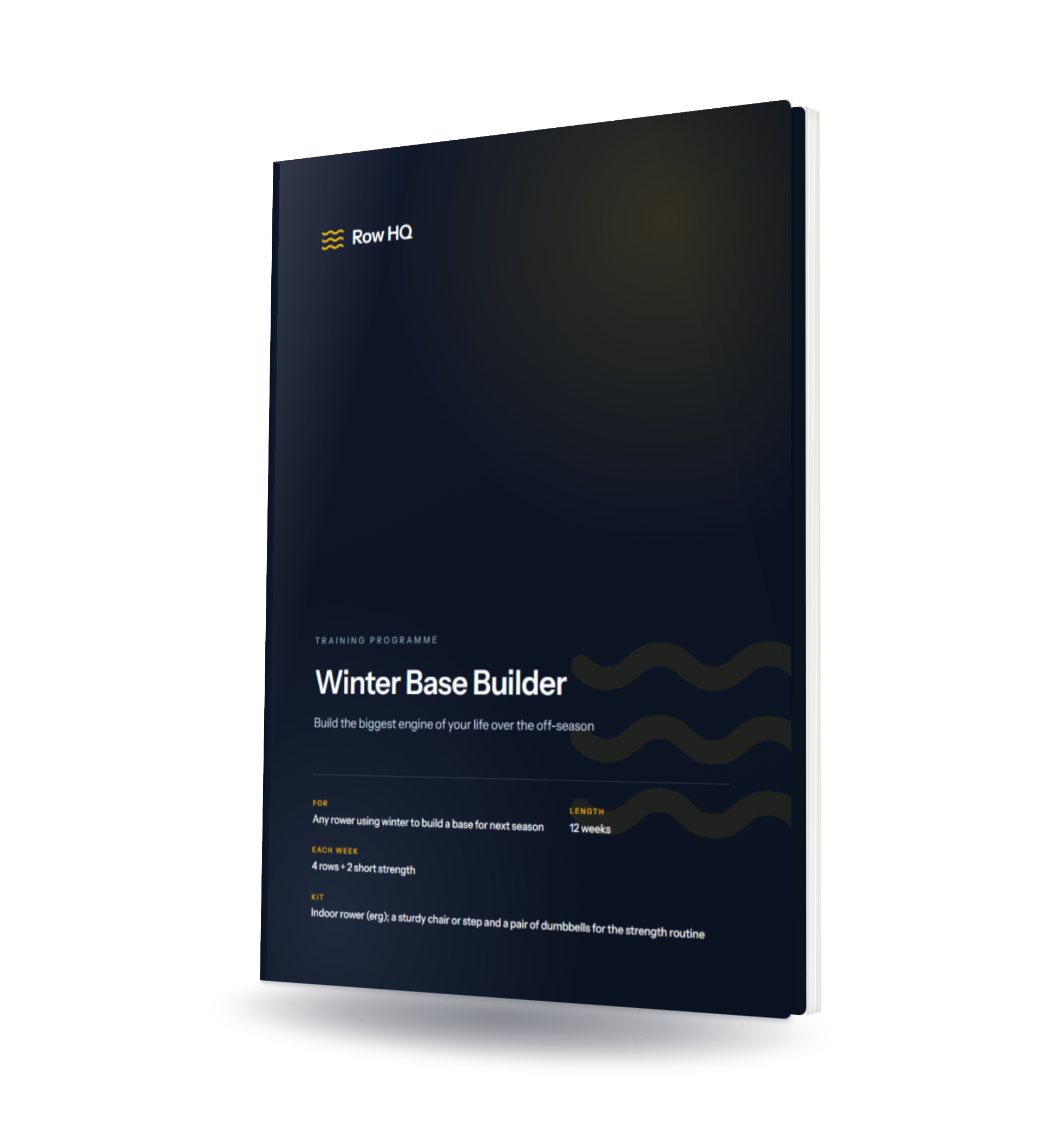
Winter Base Builder
Build the biggest engine of your life over the off-season - 12 weeks of mostly-easy volume plus a strength routine, so you arrive at spring fast.
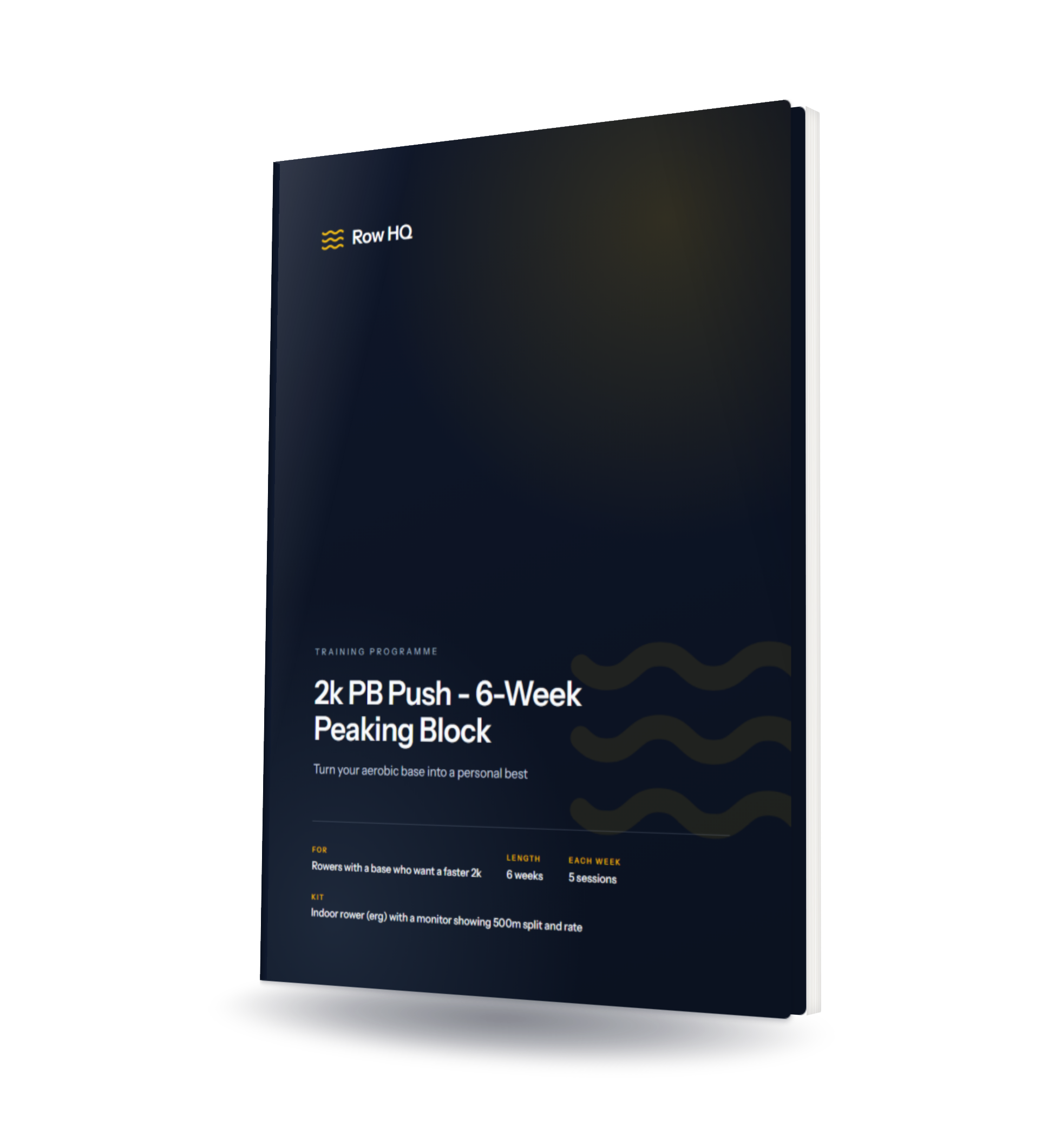
2k PB Push - 6-Week Peaking Block
Six weeks that turn an existing aerobic base into a 2k personal best - race-specific work, a proper taper, every pace scaled to your own time.
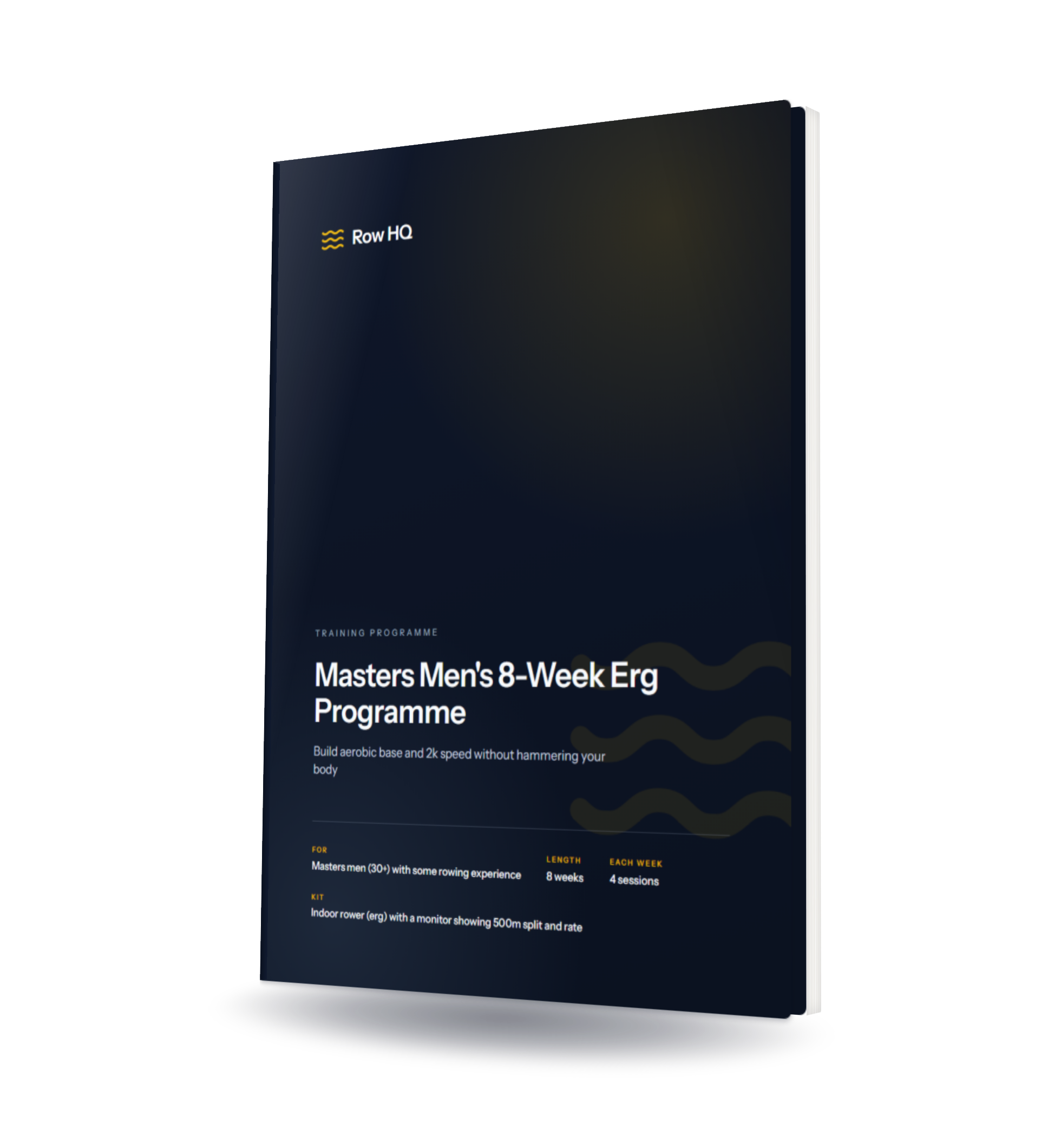
Masters Men's 8-Week Erg Programme
Eight weeks of structured erg training built around a masters body - science-backed, joint-friendly, and designed to protect your engine as you age.