Pick a session in 30 seconds
Looking for an erg session right now? Need fitness: pick from UT2 steady state (60-90 minute aerobic base, target 65-75% HRmax). Building toward a 2k: drop into TR lactate threshold (6x500m or 4x1k, 5-8 seconds off 2k pace). Testing: go to test pieces (2k, 5k, 30-min). Crew session in 45 minutes: pick a mixed-zone ladder. Set drag factor first (110-130 for most senior athletes), warm up for 10 minutes, and log the result.
This is the session library I wish I had when I started programming erg sessions for our crew. Thirty workouts, organised by training zone, with target paces sourced from British Rowing's PT Testing Protocols and Concept2's training guidance. Each session has a purpose, a target pace formula based on your 2k, and notes on how to modify it for a group. Bookmark it. Coaches can hand it to a new captain on day one; rowers can pick a session at 6:45am when the river is unsafe and the boathouse erg is the only option.
The 5 training zones
British Rowing's five-zone model is the language every UK coach speaks. Zones are anchored to your 2k pace (or your maximum heart rate if you have done a proper ramp test). Find your zone splits in the training pace calculator - it takes your 2k time and spits out the split target for every zone, no maths required.
| Zone | Purpose | Split (vs 2k) | % HRmax | RPE | Stroke rate |
|---|---|---|---|---|---|
| UT2 | Aerobic base, fat oxidation | +18 to +25 sec | 60-70% | 3-4/10 | 18-22 spm |
| UT1 | Aerobic capacity | +12 to +17 sec | 70-80% | 5-6/10 | 20-24 spm |
| AT | Aerobic threshold | +8 to +12 sec | 80-85% | 7/10 | 22-26 spm |
| TR | Lactate threshold | +4 to +8 sec | 85-92% | 8-9/10 | 26-32 spm |
| AN | Anaerobic capacity | -2 to +2 sec | 92-100% | 9-10/10 | 30-38 spm |
Worked example: a rower with a 7:00 2k (1:45 average split) trains UT2 at 2:03-2:10, AT at 1:53-1:57, and TR at 1:49-1:53. Convert wattage to split with the watts-to-split converter if your monitor is set to power mode.
UT2 steady state: 5 workouts
This is where 60-70% of your weekly volume should sit. It is unglamorous, it is slow, and it is the foundation everything else is built on. I have done 4x20 minutes more times than I want to count - it never gets exciting, and it works.
1. 60-minute steady state
Target: Continuous 60 minutes at UT2 pace
Purpose: Pure aerobic base. The single most useful session in a club's winter programme.
Notes: Hold a conversation throughout. If you cannot, you are too hard. Rate cap 22. Split should drift up 2-3 sec by the end - that is fine.
2. 4x20 minutes (UT2)
Target: 4 x 20 minutes, 3 min rest, UT2 split
Purpose: Same volume as a 90-min steady, but the breaks let you hold cleaner technique.
Notes: Useful for less-fit rowers who cannot hold steady form for 60 continuous minutes. Rate 18-20.
3. 3x30 minutes (UT2)
Target: 3 x 30 minutes, 5 min rest, UT2 split
Purpose: Bridge from 4x20 to 90-minute continuous work. Used heavily in winter pre-season.
Notes: Coaches often run this as a squad session: everyone starts together, splits are personal.
4. 90-minute steady state
Target: Continuous 90 minutes at UT2 pace
Purpose: Long aerobic block. Once a week max during base phase, ideally on a weekend.
Notes: Audiobook session. Bring water. Watch for technique drift past minute 60 - reset every 10 minutes.
5. UT2 fartlek (60 minutes)
Target: 60 minutes alternating 8 min UT2 + 2 min UT1
Purpose: Adds variety to long aerobic work without leaving the aerobic system.
Notes: Good for keeping crews engaged in a long session. Lift rate by 2 spm in the UT1 segments.
AT aerobic threshold: 5 workouts
Threshold work sits just below the point where lactate starts to accumulate. This is where you build the engine. Sessions should feel "comfortably hard" - you can speak in short phrases but not full sentences.
6. 4x10 minutes (AT)
Target: 4 x 10 minutes, 3 min rest, AT split
Purpose: Classic threshold block. Builds aerobic capacity and tolerance for sustained effort.
Notes: Rate 22-24. The third rep is the test - if you cannot hold split, you went too hard on rep 1.
7. 5x8 minutes (AT)
Target: 5 x 8 minutes, 2 min rest, AT split
Purpose: Slightly shorter intervals, slightly less total volume, easier to recover from.
Notes: Good Tuesday session after a hard Sunday. Rate 22-26.
8. 2x20 minutes (AT)
Target: 2 x 20 minutes, 5 min rest, AT split
Purpose: The benchmark threshold session. If you can hold AT for 2x20, your aerobic base is solid.
Notes: Pace conservatively for the first 10 minutes of rep 1 - this session punishes a fast start.
9. Pyramid 8-6-4-6-8 (AT)
Target: 8min, 6min, 4min, 6min, 8min at AT split, 2 min rest
Purpose: Builds mental focus through pace changes while staying in one zone.
Notes: Lift the rate by 1-2 spm on the 4-minute middle piece. Use the descending sets to build confidence.
10. Ladder 5-10-15 (AT)
Target: 5min, 10min, 15min at AT split, 3 min rest
Purpose: Progressive volume across a single session. Tests pacing discipline.
Notes: Most rowers blow the 15-min piece. Start it 2 sec slower than reps 1-2 and let it settle.
TR lactate threshold: 5 workouts
TR sessions are where 2k speed gets built. You are working at or just above lactate threshold - the burn is real, the technique discipline is the hardest part. These are the sessions that hurt to plan and hurt more to execute.
11. 6x500m (TR)
Target: 6 x 500m at 2k pace + 4-6 sec, 1:30 rest
Purpose: Bread-and-butter race-pace tolerance work. Used in every serious 2k build.
Notes: Rate 28-32. The split target is firm - if rep 1 is 2 sec under target, you will pay for it by rep 4.
12. 8x500m (TR)
Target: 8 x 500m at 2k pace + 6-8 sec, 1:30 rest
Purpose: Higher volume than 6x500 - builds the back-end of a 2k race profile.
Notes: Use this 3-4 weeks out from a 2k test, not in the final week.
13. 4x1k (TR)
Target: 4 x 1000m at 2k pace + 5-7 sec, 3 min rest
Purpose: Longer intervals test sustained 2k tolerance. Each rep is roughly half-race length.
Notes: Sit at rate 28-30. The transition from rep 2 to rep 3 is where most athletes crack.
14. 3x1500m (TR)
Target: 3 x 1500m at 2k pace + 7-9 sec, 4 min rest
Purpose: Long TR pieces. Brutal mental session - each piece is more than half a 2k.
Notes: Save for late in a build phase. Most coaches programme this once per cycle, not weekly.
15. Race-prep TR set
Target: 2x500m at 2k pace, 2 min rest, then 2x500m at 2k pace -2 sec, 2 min rest
Purpose: Race-rehearsal session. The second pair simulates pushing past 2k pace.
Notes: Best done 7-10 days out from a 2k test. Predict your 2k from this with the 2k prediction calculator.
AN anaerobic: 5 workouts
Anaerobic work is short, sharp, and not negotiable if you want a good 2k start. The first 30-45 seconds of a 2k race lives in this system. Sessions are intense, technique-heavy, and require full recovery between reps.
16. 8x250m (AN)
Target: 8 x 250m at 1k pace, 2 min rest
Purpose: Power and speed without going to total failure. Builds 2k start capability.
Notes: Rate 32-36. Hold the split, do not push past it - the goal is repeatability, not heroics.
17. 12x250m (AN)
Target: 12 x 250m at 1k pace, 90 sec rest
Purpose: High-volume anaerobic. The shorter rest makes this brutal by rep 6.
Notes: Cut the set early if split drops more than 4 sec - intensity matters more than volume here.
18. 10x500m at 1k pace
Target: 10 x 500m at 1k pace, 2 min rest
Purpose: Mixed AN/TR. The first 5 feel manageable; reps 6-10 are character building.
Notes: Most useful in race prep weeks. Rate 30-34. Predict outcomes via the erg score calculator.
19. 6x500m sub-1k pace
Target: 6 x 500m at 1k pace -2 sec, 3 min rest
Purpose: Pushes past 1k pace in short bursts. Builds raw watts output.
Notes: Long rests are essential - do not shorten them to make it "harder". The point is full output per rep.
20. 30s on / 30s off
Target: 20 minutes alternating 30 sec maximum effort + 30 sec light paddle
Purpose: Lactate tolerance, VO2 work. Brief, repeatable, devastating.
Notes: A favourite of CrossFit programmes but originally a rowing classic. Rate 32-38 on the work intervals.
Test pieces: 5 workouts
Tests give you the numbers everything else is built on. Run them in standard conditions, log them properly, and trust the trend over single results. The first time I did a 30-min test I went out at 5k pace and blew up at 18 minutes - tests teach you pacing the hard way.
21. 2k test
Target: All-out 2000m
Purpose: The gold-standard rowing benchmark. The number every coach wants.
Notes: Drag 110-130. Rate 30-36. Pace the first 500m 1-2 sec over average target; settle and grind through 500-1500m; lift in the final 250m. Find your starting split via the erg score calculator.
22. 5k test
Target: All-out 5000m
Purpose: Tests aerobic capacity. Less stressful than a 2k but a strong predictor of 2k fitness.
Notes: Run quarterly in the off-season. Most rowers split 5k at 2k pace + 8-12 sec. Rate 26-30.
23. 6k test
Target: All-out 6000m
Purpose: Used heavily in junior selection (GB Junior trials). Aerobic-dominant.
Notes: Pace at AT/TR transition. Rate 26-30. Hardest mental section is 2.5k-4k - the middle desert.
24. 30-minute test
Target: Maximum metres in 30 minutes
Purpose: Standard aerobic benchmark. Bridges 2k and 60-min capability.
Notes: Pace conservatively for the first 10 minutes. Rate 24-28. Total metres is the headline number.
25. 10k test
Target: All-out 10000m
Purpose: Long-form aerobic test. Used as a head-race fitness indicator.
Notes: Mental discipline session. Hold UT1/AT pace for the first 7k, then lift. Most British clubs run this in October ahead of the head-race season.
Mixed-zone sessions: 5 workouts
Mixed-zone work breaks the monotony and trains the body to shift between energy systems. Useful for coaches running shorter sessions, or rowers stuck for time who still want a quality stimulus.
26. Alternating set 4x(5min AT + 5min UT1)
Target: 40 minutes total, alternating 5 min at AT and 5 min at UT1, no rest
Purpose: Builds aerobic capacity and threshold tolerance in one block.
Notes: Most efficient session per minute in this library. Rate steps: 26 (AT), 22 (UT1), 26, 22, repeat.
27. Ladder 250-500-750-1k-750-500-250
Target: Pyramid at TR pace, equal rest to work
Purpose: Tests pacing across distances within a single session.
Notes: Most rowers crack on the descending 750. The trick is to nail the 1k as your "anchor" rep.
28. Broken 2k (1k + 500 + 500)
Target: 1000m at 2k pace, 1 min rest, 500m at 2k pace -2 sec, 1 min rest, 500m all-out
Purpose: Race-rehearsal session. Builds confidence at 2k speed without the full 2k cost.
Notes: Add the times and the rest to get an indicative 2k - usually 5-10 seconds faster than your actual 2k.
29. Broken 6k (4x1500m with 1min rest)
Target: 4 x 1500m at AT split, 1 min rest only
Purpose: Tolerance work for head-race style efforts. Short rests keep heart rate high throughout.
Notes: Most relevant for autumn training when head-race season looms. Rate 24-26.
30. Mixed pyramid 1k-2k-1k
Target: 1000m at 2k pace -2 sec, 5 min rest, 2000m at 2k pace, 5 min rest, 1000m at 2k pace -3 sec
Purpose: Tests speed before and after race-pace work. Severe session.
Notes: Reserve for race prep. The closing 1k tells you everything about your fitness reserve.
How to pick the right workout
Use the matrix below to match goal to session. The session number links back to the workout description. If you do not yet have a 2k benchmark to anchor zone paces, run workout #21 first - then come back here.
| Your goal | Best workouts | Frequency |
|---|---|---|
| General fitness, off-season | #1, #2, #4, #6, #26 | 3-4 per week |
| Race prep (2k focus) | #11, #14, #15, #28 | 2 per week, taper to 1 |
| Race prep (head race) | #3, #4, #24, #25, #29 | 2-3 per week |
| Power and start work | #16, #19, #20 | 1-2 per week |
| Technique session | #1, #5 (low rate) | Anytime |
| Recovery day | #1 capped at 30 min, UT2 pace | After hard session |
| Test week | #21, #22, #24, #25 | One test per week max |
| New to erg programming | #1, #6, #11, #21 in that order | Build over a month |
Coach-led variations
A 1:1 session prescription is one thing; running 12 athletes through the same workout on 12 different ergs at 7am is another. The patterns that work for crew sessions:
- Lineup grouping: Pair athletes within 5 sec of each other on their 2k. Crews self-pace as a unit which builds racing discipline. Use the coach tools to see ergo data by potential lineup.
- Split-target by 2k: Each athlete works to their own split, not a uniform pace. The session structure stays identical; the numbers are personal. This is what Row HQ's training pace calculator exists to solve - paste a 2k, get the zone targets, no whiteboard maths.
- Squad leaderboards: Run a 6x500 as a session-wide leaderboard. Best total time wins. This works brilliantly for #11 and #16. Log the results into the coach tools so PBs are tracked.
- Group progression: If 12 of 14 athletes hit target on a #8, the rep number goes up next cycle (5x20 next week). If 3 of 14 hit it, the target drops 2 sec.
- Novice modifications: Halve the volume, keep the structure. A novice 4x500 in place of #11. Time on the erg matters more than volume.
Pre-workout setup
Sessions only work if the machine is set up properly. Most rowers ignore drag factor; few rowers warm up properly. Both are session-quality killers.
- Drag factor: 110-130 for most senior athletes. Lighter (90-110) for women and junior rowers, heavier (130-140) for heavyweight men. Set it before every session via the PM5 menu - lever position alone does not guarantee drag. Use the drag factor calculator if you are unsure.
- Monitor settings: Display set to split (/500m) for steady-state and threshold work. Switch to watts for power work. Set up the workout in advance via "Select Workout" so the monitor counts down splits for you.
- Warm-up (10 min minimum): 3 min easy paddling rate 18-20, 3 min building to UT2 split, then 4 x (30 sec at rate 26 / 30 sec light). Skip this and your first rep on any TR/AN session is a write-off.
- Log immediately: Time, split, average watts, rate, body weight, and a one-line note ("legs felt fresh", "back from cold"). Two minutes of admin protects months of trend data. Row HQ's member portal handles this on the phone in 30 sec.
Common mistakes
These are the failure modes I see most often. Each one is fixable, but they bleed quality from your sessions when left unchecked.
- Going too hard on steady state. If your UT2 looks like UT1, you are not training the aerobic system you came for. Polarised-training research is now unambiguous: 80% easy, 20% hard works better than spending every session in the grey zone. Cap rate at 22 in UT2 if you are tempted to push.
- No warm-up. Jumping into 4x10 cold means the first 4 minutes of rep 1 are wasted - you are warming up at threshold pace, badly. 10 minutes properly warmed beats 15 minutes badly warmed.
- No split target. "I will see what I can hold" is not a workout, it is a free pass to coast or blow up. Set the target split before the first rep; use the training pace calculator to derive it from your 2k.
- Mixing zones within one session. A "UT2 with sprints" is not UT2. Pick a zone and stay in it. Mixed-zone work has its place (see #26-30) but every other session should sit cleanly in one zone.
- Not logging. Untracked sessions are training spent without compound interest. If you cannot show the trend you cannot prescribe the next phase. Free option: paper. Better option: your club's coach tools.
- Testing too often. A 2k a fortnight teaches you to pace 2ks, not to row faster. One real 2k test per training block (every 6-8 weeks), with broken 2ks and TR work in between.
FAQ
How many erg sessions per week should a club rower do?
Three to five depending on phase. Winter base (December to February) typically runs four to five erg sessions. Once on-water training resumes in March, two erg sessions per week is plenty for most senior club rowers. Juniors and university crews may push to six during exam periods or when the river is unrowable.
What is the best erg workout for beginners?
Start with workout #1 (60-minute steady state) at conversational pace, twice per week for the first month. Add workout #6 (4x10 minutes AT) once per week in month two. Run a first 2k test (workout #21) at the end of month two - that gives you the benchmark to set zone paces from.
How long should a club erg session be?
Most quality sessions land between 45 and 75 minutes including warm-up and warm-down. Below 30 minutes you cannot get enough quality work in once you account for warm-up. Above 90 minutes returns diminish for anyone not preparing for ultra-distance work.
Can these workouts be done on a WaterRower or Hydrow?
Yes, but split benchmarks change. WaterRower and Hydrow use different flywheel mechanics, so a Concept2 1:45 split is roughly a WaterRower 1:48 and a Hydrow 1:47 at equivalent power output. The session structure (intervals, zones, rest periods) transfers cleanly. Most clubs default to Concept2 because the wider rowing world benchmarks against it.
What is the difference between AT and TR?
AT (aerobic threshold) is the highest sustained pace where lactate stays cleared by the body. TR (lactate threshold or transport) is the pace where lactate begins to accumulate measurably. Practically: AT is "comfortably hard, I can speak short phrases", TR is "hard, I can only manage single words". Most club rowers underestimate the AT/TR boundary and train too hard on AT sessions.
Should I warm up with rate work?
Yes. After 6 minutes of easy paddling, include 4-6 short rate bursts (15 strokes at rate 26-28, 30 sec rest between). This primes the nervous system without burning glycogen. Most rowers skip rate bursts; the first hard interval suffers as a result.
How do I know if my drag factor is right?
For most senior club rowers, 110-130 is correct. Heavier rowers (90kg+) can run 130-140. Junior rowers and women typically sit at 100-120. Higher drag does not mean harder work - it means a heavier boat feel with a slower catch. If your stroke rate is dropping below 22 in a TR session, drag may be too high. Run our drag factor calculator (linked from the Tools hub) for a per-athlete recommendation.
Where can I track ergo scores across the squad?
Row HQ's coach tools include an ergo log built for clubs. Athletes log results from the member portal in 30 seconds, coaches see the squad-wide view with PB highlights, and the data feeds straight into crew selection. Concept2 Logbook entries import automatically.
- Jason
Sources & references
- PT Testing Protocols (November 2022 PDF) - zone definitions and Concept2 testing standards — British Rowing
- Concept2 indoor rower training guides and sample workouts — Concept2
- Concept2 PM5 monitor reference — Concept2
- Concept2 Online Logbook (rankings and reference) — Concept2
- Workouts of the Day archive (decades of programmed sessions) — Concept2
- Indoor rowing technique and drag factor reference — Concept2
- British Rowing coaching pyramid and athlete development — British Rowing
- USRowing performance testing standards — USRowing
- Rowing Australia high performance unit — Rowing Australia
- Polarised training research (Stoggl & Sperlich, Frontiers in Physiology 2014) — Frontiers in Physiology
- Bompa periodisation of training principles (academic overview) — Human Kinetics
- Row HQ training pace calculator (split targets from your 2k) — Row HQ
- Row HQ erg score calculator — Row HQ
- Row HQ 2k prediction calculator — Row HQ
- Row HQ watts-to-split converter — Row HQ
- Row HQ drag factor calculator — Row HQ
- Row HQ VO2 max calculator — Row HQ
Related articles & tools
Planning sessions for a whole crew? The Club Session Library includes 52 adaptable session plans, with 16 for the erg.
From the RowHQ shop
Printable PDFs written for club rowers. Buy once, keep forever.
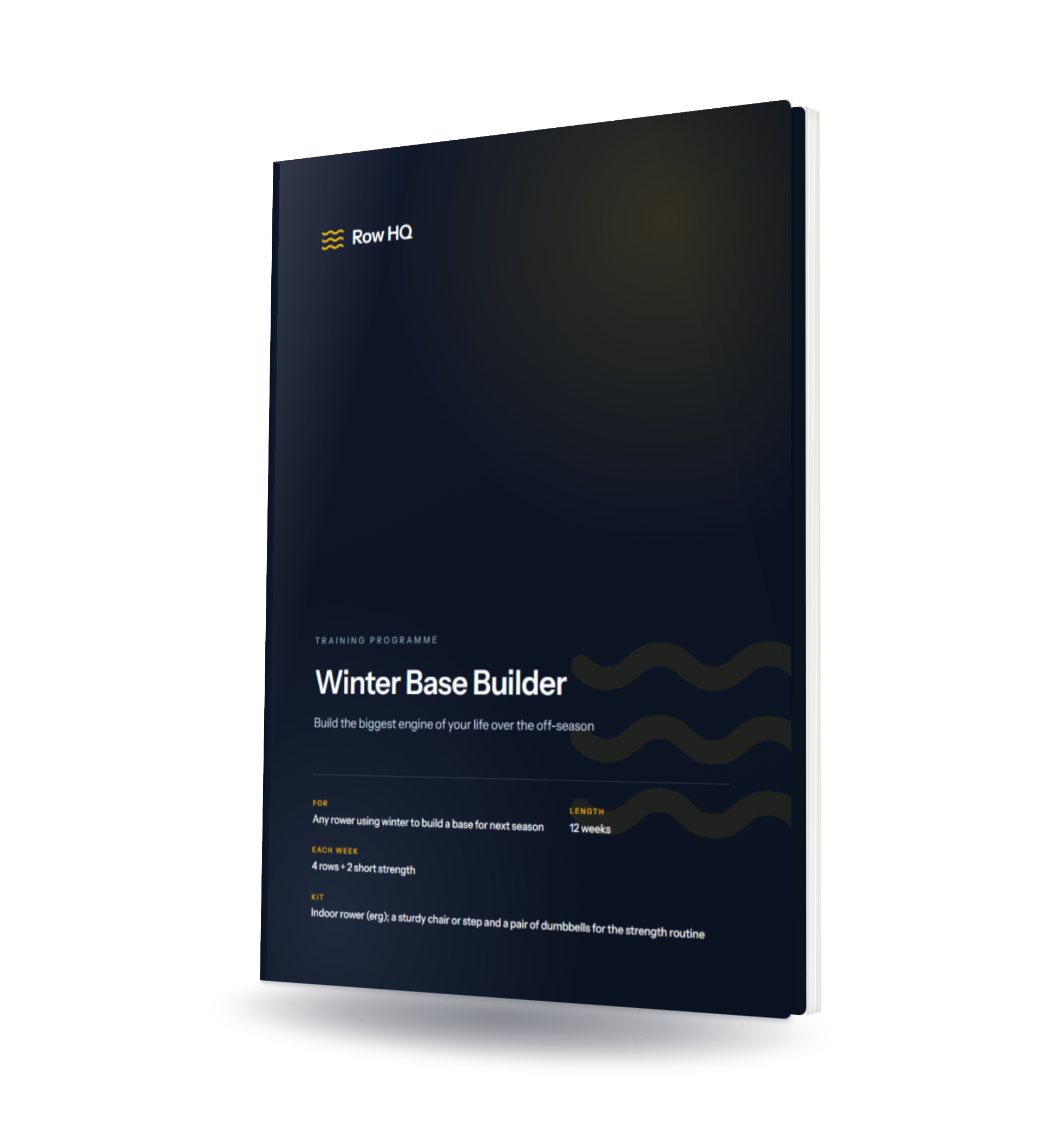
Winter Base Builder
Build the biggest engine of your life over the off-season - 12 weeks of mostly-easy volume plus a strength routine, so you arrive at spring fast.
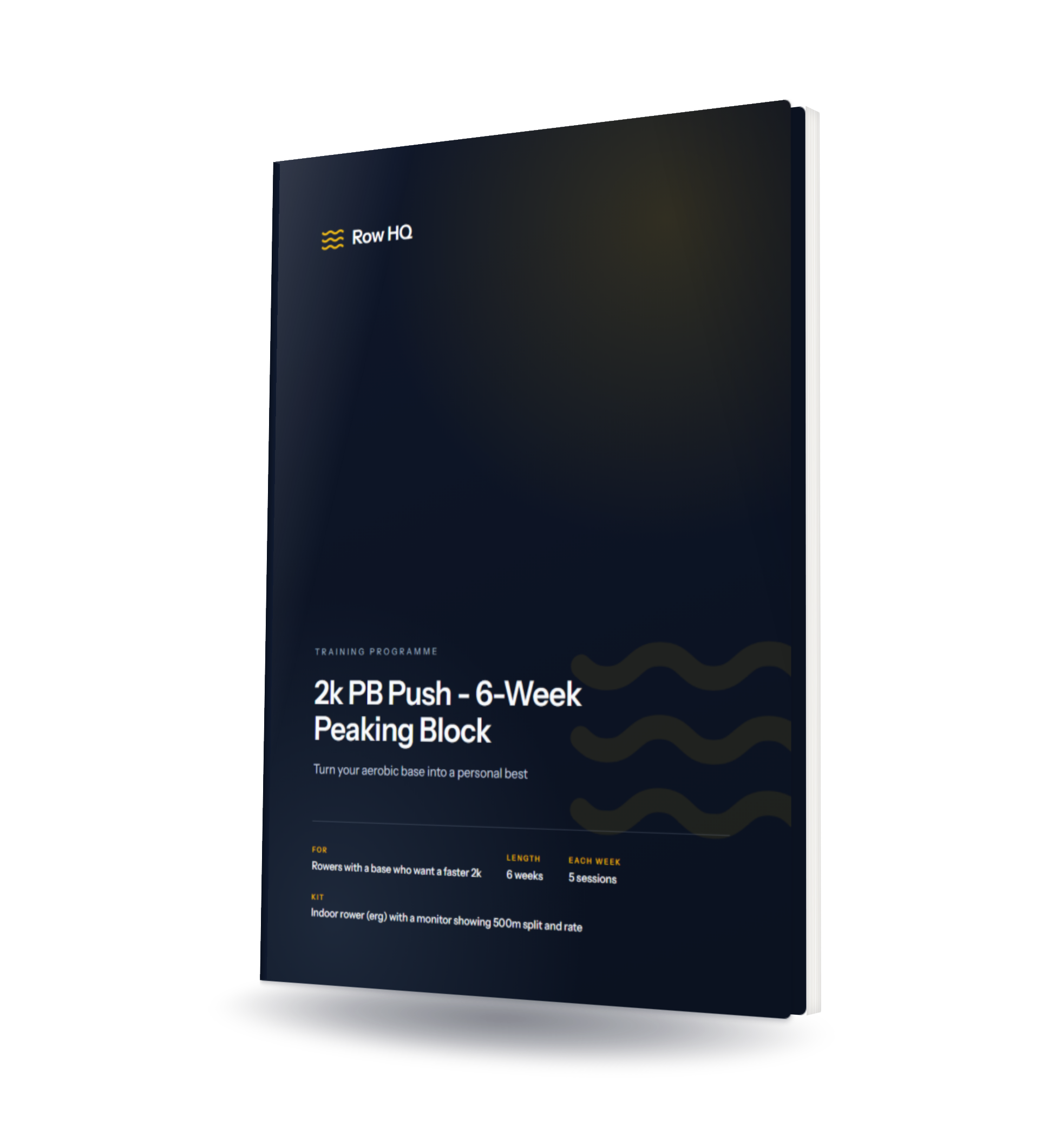
2k PB Push - 6-Week Peaking Block
Six weeks that turn an existing aerobic base into a 2k personal best - race-specific work, a proper taper, every pace scaled to your own time.
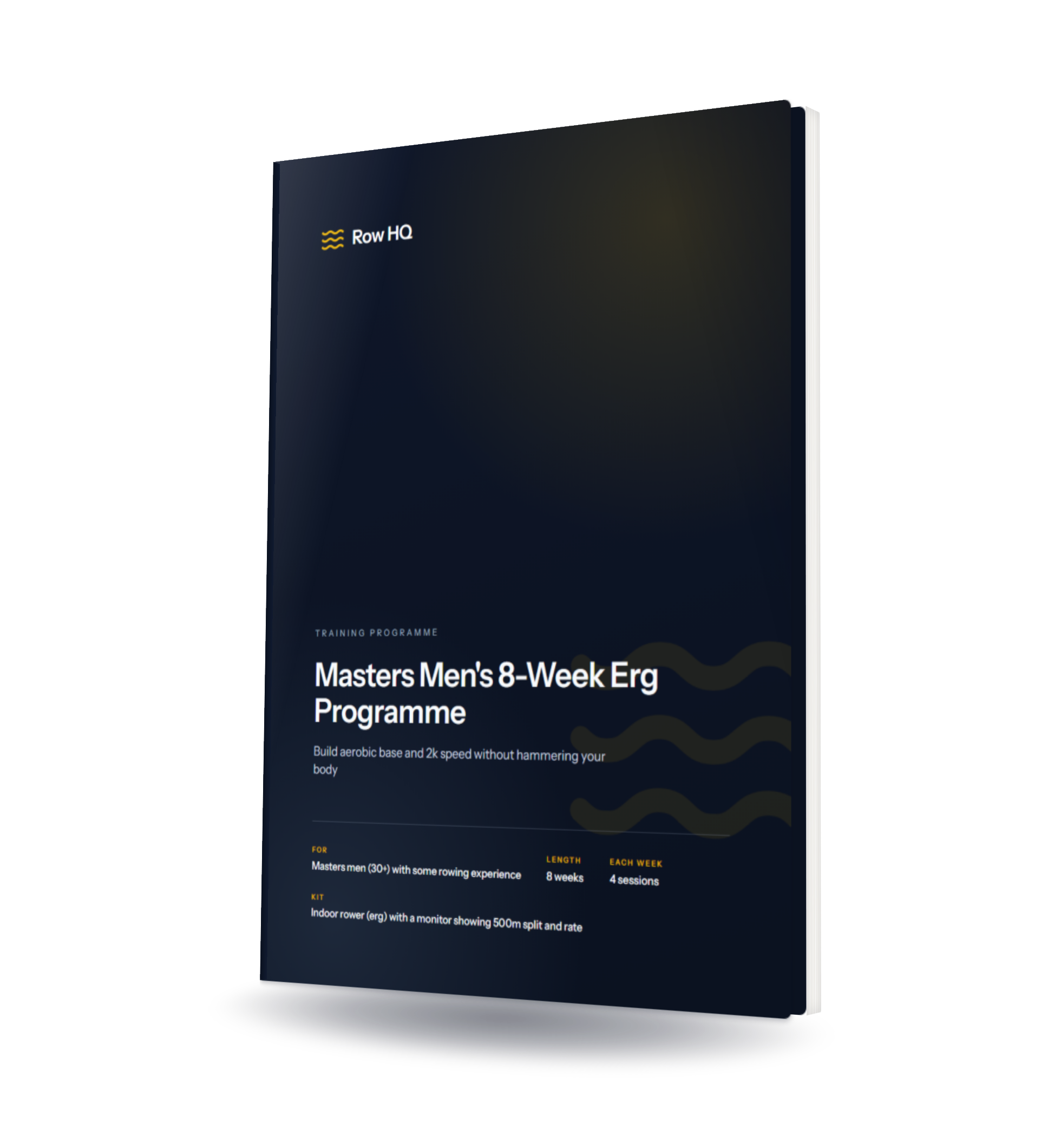
Masters Men's 8-Week Erg Programme
Eight weeks of structured erg training built around a masters body - science-backed, joint-friendly, and designed to protect your engine as you age.