Straight answer in 30 seconds
Four numbers do the heavy lifting in an Aussie programme: 2k time, 500m split, watts and stroke rate. Run a monthly 2k on a Concept2 RowErg with the drag factor locked (130-150 for openweight men, 110-135 for women), record the score with bodyweight and a one-line note from the athlete, then plot the trend right through the Schools season into Australian Rowing Championships and the Australian Indoor Rowing Championships. The state institutes (NSWIS, VIS, QAS, WAIS, SASI, TIS, ACTAS) all read off the same Concept2 sheet, so your numbers slot straight in. Anything else on the PM5 is noise once those four are sorted.
Every senior Aussie squad uses ergo testing to take a clean read on fitness, watch progress through the season, and find athletes who deserve a longer look. The same playbook works in a CAS, AGSV or GPS shed, in a club programme heading to Penrith, and in the masters group rowing four mornings a week. Capture the data properly and your training calls get sharper. Skip the capture and you are coaching on vibes.
What the ergo actually tells you
The Concept2 strips out everything that muddies on-water times. No tail wind, no slow boat, no seat-racing partner having an off morning. What you get back is one athlete against one machine, repeatable from Champion Lakes to West Lakes to the Yarra. Three jobs the ergo does well:
-
Benchmarking: Set a baseline you can defend at the selection meeting. Honest reads on each athlete sharpen crew selection, 1st VIII trials and squad streaming.
-
Progress tracking: Plot the trend week by week so you spot the athlete who has quietly added 8 watts of average power, and the athlete who has stalled, before either of them rocks up to the Head of the Yarra. The same record stands up against GPS and APS expectations, AGSV and CAS targets, the Australian Rowing Championships, the Australian Boat Race build, and NSWIS, VIS, QAS, WAIS or SASI talent ID windows. Pipe it all into the training log so the coaching team is reading off the same sheet.
-
Goal setting: Vague targets ("get fitter") rarely shift behaviour. A concrete one ("break 7:30 on the 2k by the start of camp") does. State institute and Rowing Australia squad standards give every athlete a real number to chase rather than a feeling.
Some scale on the database every state benchmark eventually traces back to. In 2025 alone the Concept2 Logbook clocked:
Four numbers worth chasing
The PM5 throws a lot of fields on the screen. Most of them you can ignore. Four reads off the Concept2 PM5 (which is what every Aussie school, club and state institute lines up on, ergo dynamic or static, see our ergometer glossary entry) do the work:
Key ergo metrics explained
2k time
The line on the spreadsheet that selectors look at first. Two thousand metres flat out reads aerobic ceiling and the willingness to hold pace when the legs are gone. Capture it to the tenth.
500m split
Average pace across each half-kilometre. The split pattern shows whether an athlete went out too hot, settled flat, or lifted the last 500. That is the bit you actually coach.
Watts
Power on the flywheel. Watts cut across machines (Concept2 RowErg, RP3 dynamic, ergo bike used for cross-training) so a sculler and a sweep rower can be compared cleanly.
Stroke rate
SPM. Rate next to split is your efficiency check: holding a tidy split at rate 28 is a different athlete to holding the same split at rate 34. Race rate sits somewhere in the 32-38 band.
It's the best all-round fitness machine in the world, and suitable for anybody, not just international athletes. No matter how hard I tried, I could never beat it. It never broke and it never let me down.
Where Row HQ takes the admin off
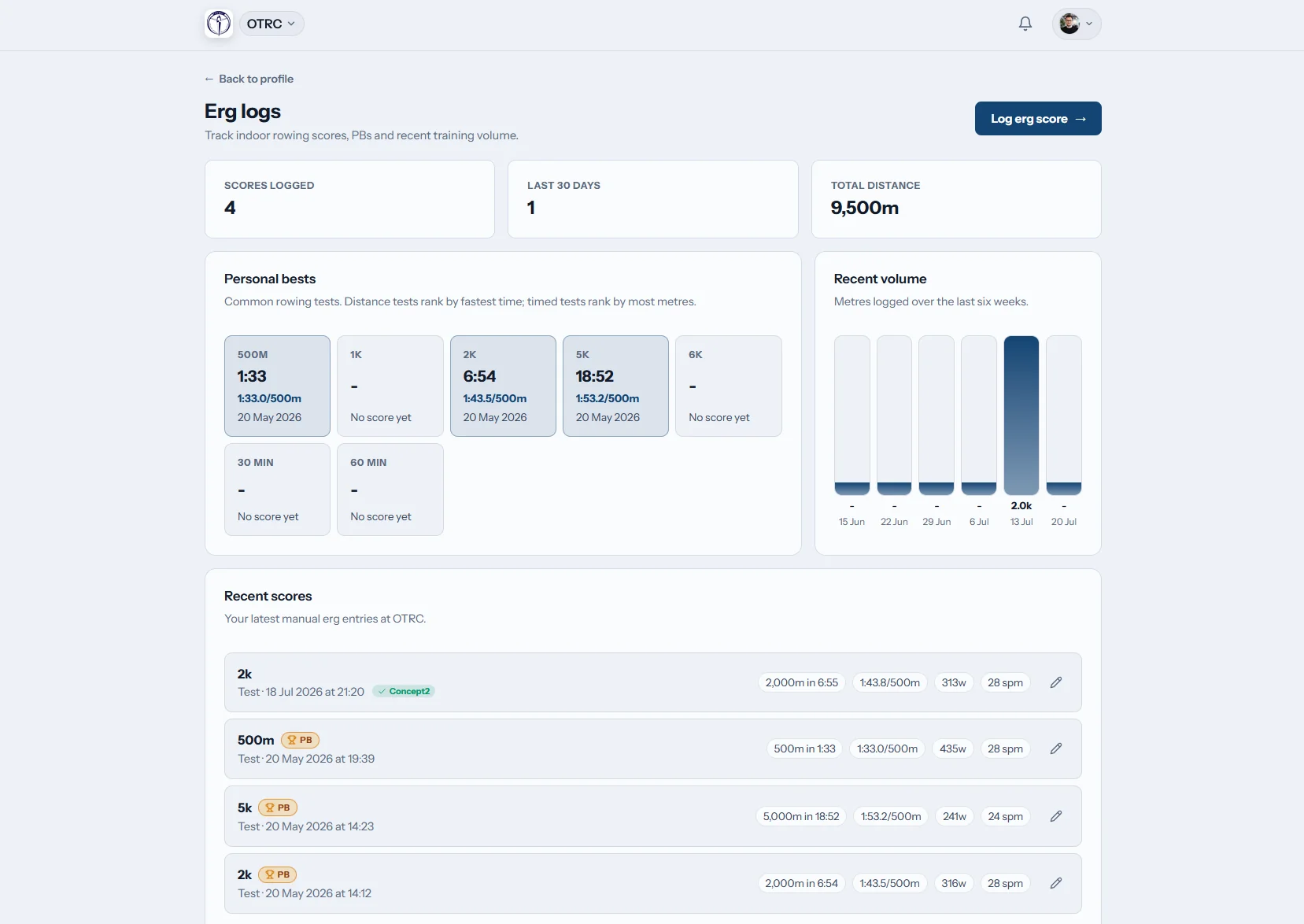
Pulling numbers off the PM5 takes a few seconds. Stitching those numbers into a squad picture, sorting trends, and walking into a selection meeting with something defensible is the part most programmes get bogged in. The Row HQ ergo log, part of the coach tools, sits between the monitor and the whiteboard. Athletes upload their Concept2 score via the member portal or CSV right now, and a proper Concept2 Logbook API sync is on the short roadmap so the score lands against the athlete without anyone retyping it.
-
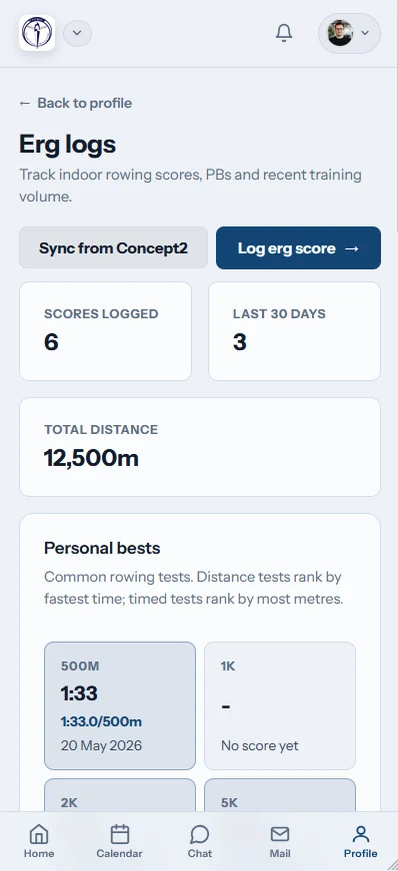
Easy logging: Athletes drop their score in from a phone after the test, through the member portal. No clipboard at the door, no shared spreadsheet that breaks when two people open it. Concept2 RowErg and RP3 pieces sit side-by-side on the same athlete profile.
-
Historical data: Every score stays on file and is one click away. Pull the trend across a Penrith camp, a winter block, or a full year against published age-group standards, and pick up regressions early.
-
Coach review: One admin dashboard view of the whole squad, sortable by date, weight, age group and event target. Selection conversations with athletes, parents and the director of rowing become a chat about the data on screen rather than a debate about who remembers what.
-
Personal bests: PBs flag automatically the moment a score beats one, which gives athletes a small win to chase outside of the formal test calendar. Each rower can see the full PB history through the member portal.
Turning a number into a behaviour
A score sitting in a spreadsheet does nothing on its own. What you do with it is the actual coaching. Patterns that hold up across Aussie sheds:
- Celebrate progress: Two seconds off a 2k is real graft. Recognise the gain in front of the squad, not just the top of the rankings.
- Create healthy competition: Year-group ladders and small-group leaderboards push athletes harder than a coach ever will. Wire the ergo data back to the training session tools so the conversation joins up with on-water work and seat-racing margins.
- Identify weaknesses: Splits that keep blowing out in the third 500, watts low for the technique, drag drift between testers. Numbers point at the thing to fix in the next training session.
- Track training load: Compare ergo scores against weekly volume. If pace stalls during a heavy build, periodisation needs a rethink before Nationals, not after.
Real progress: sample athlete journey
2k baseline
14s improvement
New PB
5.7% faster
Five rules for repeatable tests
Useful ergo data is repeatable ergo data. If conditions wander between tests, the numbers stop comparing and selection arguments stop sticking. Five habits keep your sheet clean:
- Standardise test conditions: Same time of slot, same warm-up, same drag factor (a sensible default sits 130-150 for openweight men and 110-135 for women, with the Australian Indoor Rowing Championships rowed below 130). Heat is a real variable at a Penrith summer camp, so log shed temperature too. The drag factor calculator pegs each athlete properly before the piece starts.
- Test regularly: A monthly 2k gives you a trend without burning the squad. Drop in 500m, 6k and the occasional 4 x 2k inside the cycle to keep the testing varied and expose how each athlete handles fatigue.
- Record everything: Final time, all four splits, average rate, bodyweight on the morning, and a one-liner from the athlete on how the piece felt. World Rowing publishes weight-adjusted lightweight formulas for a reason: context decides whether a score is genuinely good or just on paper.
- Create a supportive environment: A 2k hurts. Build a shed culture where every athlete who gets on the machine and empties the tank gets the same noise from the squad, regardless of where they sit on the 1st VIII shortlist.
- Review and discuss: Sit down one-to-one. Walk through the trend, agree the next milestone, lock in two or three specific actions for the next block. Run a recent 5k or 6k through the 2k prediction calculator when the most recent Olympic-distance score is too stale to anchor the chat.
When an athlete sees their own progress laid out cleanly rather than just feeling it in the legs, the way they show up to training changes. The numbers give them something tangible to push against ahead of GPS, Head of the Yarra and Nationals. Coaches at our pilot rowing programme saw exactly that shift.
Wrapping it up
Ergo data is not a replacement for coaching judgement or seat-racing on the water. It supports both. Hard numbers run through the coach tools tighten selection calls, make state institute and association standards real for the athlete, and put progress in front of parents and the director of rowing in a form nobody can argue with.
Row HQ logs the score, files it against the athlete, and tracks the trend. You stop hunting through old spreadsheets and start coaching off the picture. Need to flick a single split into watts and a projected 6k? The free ergo pace calculator handles it in a click. Browse the screenshot gallery, look over the pricing, or get started when you are ready. Anything unclear? The FAQ covers the usual questions.
That ergo log does not stand alone. It is part of Row HQ, the same system that runs the sessions, the squads and the rest of the club.
- The Row HQ Team
Sources & references
- Rowing Australia (national governing body) — Rowing Australia
- Concept2 PM5 monitor reference — Concept2
- Concept2 Online Logbook — Concept2
- Concept2 2025 Year in Review (141,735 new athletes, 79.7B m, 210+ countries) — Concept2 (accessed May 17, 2026)
- New 2k world record 5:35.8 (Josh Dunkley-Smith, Senior Australian Rowing Team Trials, 2018) — Concept2
- Trends in indoor rowing records — World Rowing
- Australian Indoor Rowing Championships — Rowing Australia
- Head of the Yarra — Head of the Yarra
- Why Sir Steve Redgrave uses the Concept2 rower — Fitness Etc
- Row HQ ergo pace calculator (split to watts, calories, predicted times) — Row HQ
- Row HQ 2k prediction calculator (from 5k/6k pieces) — Row HQ
- Row HQ drag factor calculator (per-athlete setup) — Row HQ
Related articles
From the RowHQ shop
Printable PDFs written for club rowers. Buy once, keep forever.
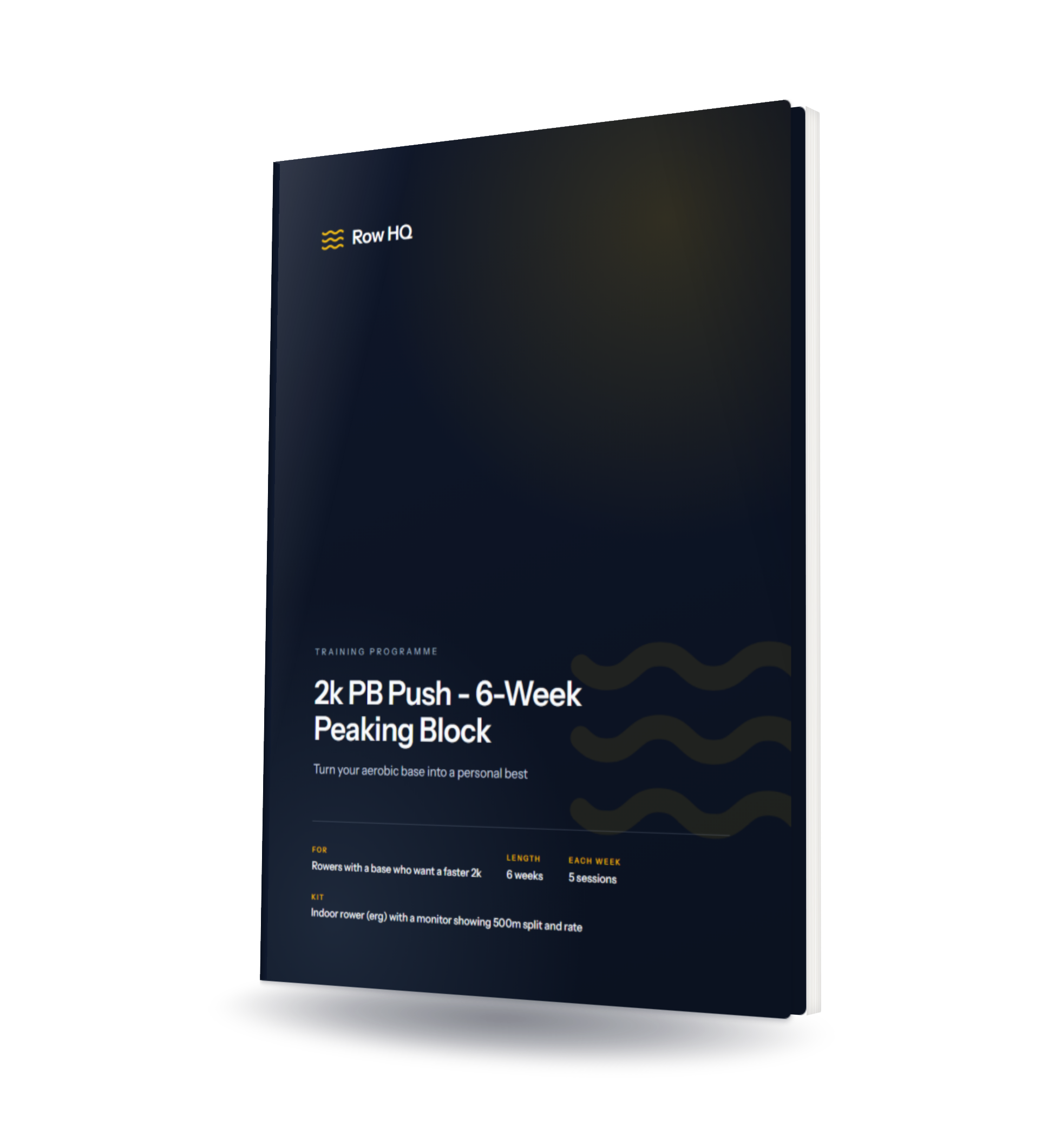
2k PB Push - 6-Week Peaking Block
Six weeks that turn an existing aerobic base into a 2k personal best - race-specific work, a proper taper, every pace scaled to your own time.
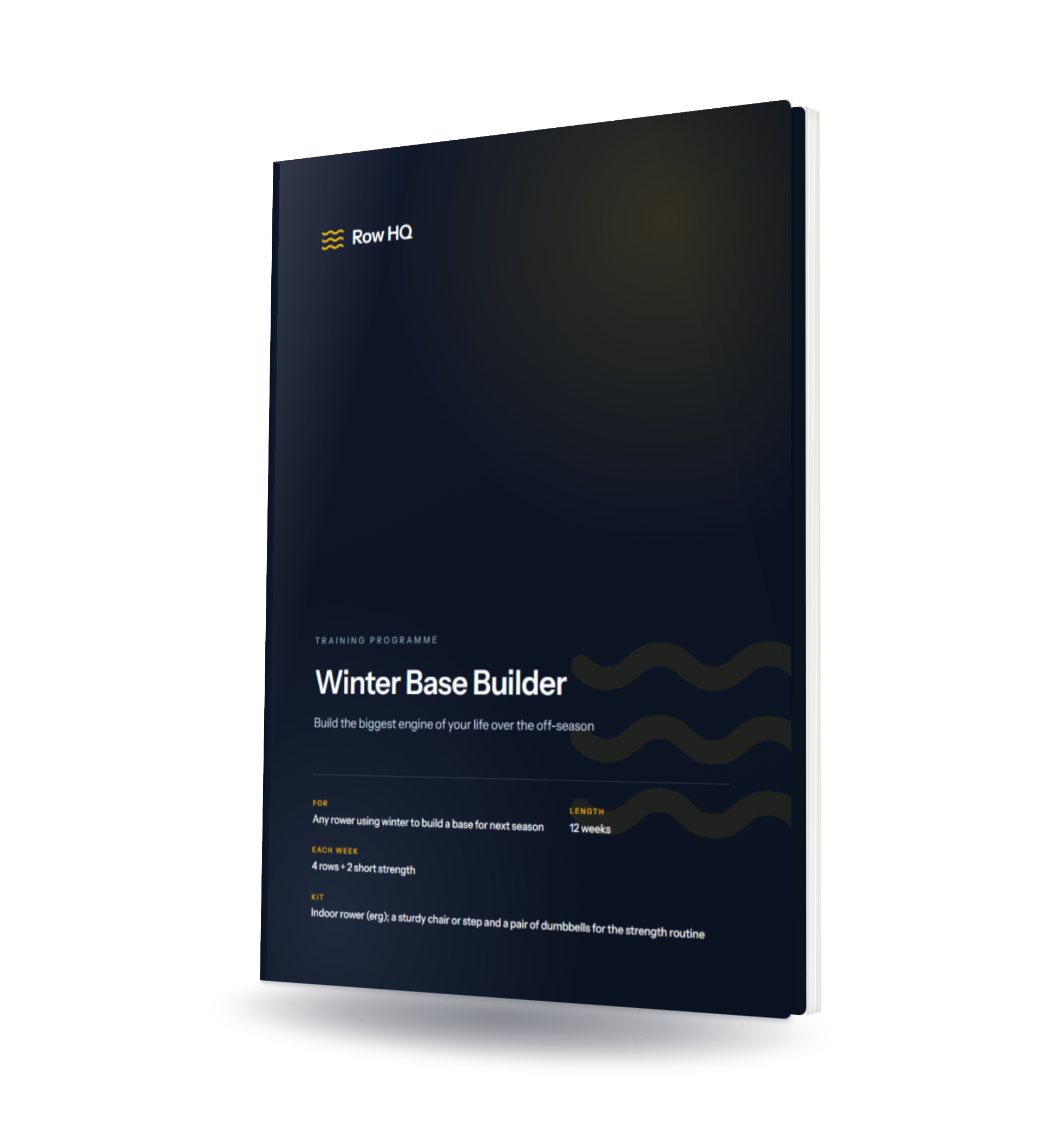
Winter Base Builder
Build the biggest engine of your life over the off-season - 12 weeks of mostly-easy volume plus a strength routine, so you arrive at spring fast.
The Club Session Library
52 rowing sessions for club coaches, with an illustrated coaching PDF, editable CSV plans, two seasonal blocks and a printable coaching cheat sheet.