Grab a session in 30 seconds
Need a session right now? HOCR base build: drop straight into UT2 steady state (60 to 90 minutes conversational, the bread and butter of any September block). Winter 2k push toward Boston: hit TR race pace (6 x 500 or 4 x 1k, four to eight seconds off 2k). Selection test day: see test pieces (2k, 5k, 30 minutes, the C.R.A.S.H.-B taper). 45-minute practice slot: pick a mixed-zone ladder. Confirm drag factor first (110 to 140 by weight class, C.R.A.S.H.-B caps at 130), warm up for 10 minutes, log every result on the spot.
This is the library I wish someone had handed me the year I started programming RowErg sessions for our squad. Thirty workouts grouped by training zone, with target paces traced back to Concept2 training guides and the published USRowing zone definitions. Every session has a purpose, a split target derived from your 2k, and notes on how to run it across a college roster of 30 to 60 athletes. Bookmark the page. Head coaches can hand it to a freshman assistant on their first morning; varsity rowers can pick a session at 5:30 a.m. when the Charles is iced over and the boathouse PM5s are the only option left. The arc here is the season the staff at Princeton, Cal, Washington and Yale run - fall HOCR base, December and January 2k trials, spring IRA prep. The labels shift between programs. The shape does not.
Five training zones, pegged to your 2k
The five-zone model is the universal language across American college boathouses (USRowing references it directly, NCAA programs use the same structure under various local names). Zones anchor to 2k pace or to max heart rate from a ramp test. The training pace calculator takes a 2k and returns split targets for every zone - drop in the number, no whiteboard math required.
| Zone | Purpose | Split (vs 2k) | % HRmax | RPE | Stroke rate |
|---|---|---|---|---|---|
| UT2 | Aerobic base, fat oxidation | +18 to +25 sec | 60-70% | 3-4/10 | 18-22 spm |
| UT1 | Aerobic capacity | +12 to +17 sec | 70-80% | 5-6/10 | 20-24 spm |
| AT | Aerobic threshold | +8 to +12 sec | 80-85% | 7/10 | 22-26 spm |
| TR | Lactate threshold | +4 to +8 sec | 85-92% | 8-9/10 | 26-32 spm |
| AN | Anaerobic capacity | -2 to +2 sec | 92-100% | 9-10/10 | 30-38 spm |
Worked example: a heavyweight man pulling 6:30 (1:37.5 average) trains UT2 at 1:55 to 2:02, AT at 1:46 to 1:49, TR at 1:42 to 1:45. If the PM5 is set to watts (common in lightweight rooms where rowers track power per kilogram), use the watts-to-split converter to switch between the two.
UT2 steady state - the HOCR base (5 workouts)
Sixty to seventy percent of weekly volume sits here. UT2 is the slow, repetitive, unglamorous block that builds the engine winning varsity seats in March and April. The fall HOCR build is almost entirely UT2 on the erg between water sessions. I have done 4 x 20 minutes more times than I want to count - never exciting, always works.
1. 60-minute steady state (the Conibear base)
Target: Continuous 60 minutes at UT2 pace
Purpose: Pure aerobic base. The session Washington has run since the Conibear era. Single most useful piece in a winter block.
Notes: Conversation pace throughout. Cap rate at 22. Split will drift up 2 to 3 seconds by the end - that is fine, not a failure.
2. 4 x 20 minutes (UT2)
Target: 4 x 20 minutes, 3 min rest, UT2 split
Purpose: Same volume as a 90-minute steady state, but breaks let novices hold cleaner body sequencing. Standard freshman fall session at most NCAA programs.
Notes: Useful for first-year rowers who cannot yet hold form for 60 continuous minutes. Rate 18-20.
3. 3 x 30 minutes (the Princeton 90)
Target: 3 x 30 minutes, 5 min rest, UT2 split
Purpose: Bridge from 4 x 20 to 90-minute continuous work. Heavy use across the Princeton winter base block in December and January.
Notes: Run as a squad piece: everyone hits the catch together at the start of each rep, splits are individual. The room dynamics matter.
4. 90-minute steady state (the Saturday long)
Target: Continuous 90 minutes at UT2 pace
Purpose: The long aerobic block. Once a week during base phase, usually Saturday morning before optional water.
Notes: Audiobook session. Bring water and a banana. Reset body sequencing every 10 minutes past minute 60 or technique drifts.
5. UT2 fartlek (60 minutes)
Target: 60 minutes alternating 8 min UT2 + 2 min UT1
Purpose: Variety inside long aerobic work without leaving the aerobic system. Useful when squad attention is dropping mid-January.
Notes: Lift rate by 2 spm on the UT1 segments. Keep splits honest at the handoffs.
AT threshold - the winter engine (5 workouts)
Threshold work sits just below the lactate accumulation line. This zone builds the engine that holds a body 6 down the Charles in October and a final 750 at Eastern Sprints in May. The feel is "comfortably hard" - short phrases work, full sentences do not.
6. 4 x 10 minutes (AT)
Target: 4 x 10 minutes, 3 min rest, AT split
Purpose: Classic threshold block. Builds aerobic capacity and sustained-effort tolerance.
Notes: Rate 22-24. Rep 3 is the diagnostic. Lose split there and you went too hot on rep 1. Used as a fall benchmark at most programs.
7. 5 x 8 minutes (AT)
Target: 5 x 8 minutes, 2 min rest, AT split
Purpose: Slightly shorter reps, slightly less total volume, easier to recover from inside a heavy week.
Notes: A solid Tuesday after a hard Sunday water session. Rate 22-26.
8. 2 x 20 minutes (the threshold benchmark)
Target: 2 x 20 minutes, 5 min rest, AT split
Purpose: The threshold session. Hold AT for 2 x 20 and the aerobic base is varsity material.
Notes: Pace conservatively the first 10 minutes of rep 1. The session punishes a fast start.
9. Pyramid 8-6-4-6-8 (AT)
Target: 8min, 6min, 4min, 6min, 8min at AT split, 2 min rest
Purpose: Mental focus through pace changes inside a single zone.
Notes: Lift rate by 1-2 spm on the 4-minute middle piece. Descending sets build confidence.
10. Ladder 5-10-15 (AT)
Target: 5min, 10min, 15min at AT split, 3 min rest
Purpose: Progressive volume across a single session. Pacing discipline diagnostic.
Notes: Most athletes blow the closing 15. Start it 2 seconds slower than reps 1 and 2, let it settle, hold to the end.
TR race pace - the IRA prep zone (5 workouts)
TR is where varsity 2k speed gets built. Working at or just above lactate threshold, the burn is the easy part. Technique discipline at the catch when the legs are screaming is the hard part. These are the sessions that hurt to program and hurt more to row. They are also the sessions that put boats in the IRA Grand Final.
11. 6 x 500m (the bread-and-butter Cal piece)
Target: 6 x 500m at 2k pace + 4-6 sec, 1:30 rest
Purpose: Bread-and-butter race-pace tolerance work. In every serious 2k build at every IRA program.
Notes: Rate 28-32. Split target is firm. Run rep 1 two seconds under target and you will pay by rep 4. Cal variant runs 8 x 500 with shorter rest in the heart of the winter cycle.
12. 8 x 500m (TR)
Target: 8 x 500m at 2k pace + 6-8 sec, 1:30 rest
Purpose: Higher volume than 6 x 500. Builds the back-half tolerance a 2k actually needs.
Notes: Three to four weeks out from a C.R.A.S.H.-B start, not in the taper week. Standard pre-Boston session.
13. 4 x 1k (the half-race rehearsal)
Target: 4 x 1000m at 2k pace + 5-7 sec, 3 min rest
Purpose: Longer reps test sustained 2k tolerance. Each rep is roughly half a race.
Notes: Sit at rate 28-30. Transition from rep 2 to rep 3 is where most rowers fall apart.
14. 3 x 1500m (TR)
Target: 3 x 1500m at 2k pace + 7-9 sec, 4 min rest
Purpose: Long TR work. Brutal mental session. Each piece is more than half a 2k.
Notes: Save for late in a build phase. Most staffs program this once per cycle, not weekly.
15. Race-prep TR set
Target: 2 x 500m at 2k pace, 2 min rest, then 2 x 500m at 2k pace -2 sec, 2 min rest
Purpose: Race-rehearsal session. Second pair simulates pushing past 2k pace.
Notes: Best 7 to 10 days out from a 2k test. Project your 2k off this with the 2k prediction calculator.
AN power - the C.R.A.S.H.-B start work (5 workouts)
Anaerobic work is short, sharp, non-negotiable. The first 30 to 45 seconds of any 2k lives here. Sessions are intense, technique-heavy, and need full recovery between reps. C.R.A.S.H.-B starts are won and lost on the work in this zone through December and January.
16. 8 x 250m (AN)
Target: 8 x 250m at 1k pace, 2 min rest
Purpose: Power and speed without going to total failure. 2k start capability.
Notes: Rate 32-36. Hold the split, do not chase past it. Repeatability beats heroics.
17. 12 x 250m (AN)
Target: 12 x 250m at 1k pace, 90 sec rest
Purpose: High-volume anaerobic. Short rest makes this brutal by rep 6.
Notes: Cut the set early if split drifts more than 4 seconds. Intensity matters more than total reps.
18. 10 x 500m at 1k pace
Target: 10 x 500m at 1k pace, 2 min rest
Purpose: Mixed AN/TR. The first five feel survivable. Reps 6 to 10 are character-building.
Notes: Most useful in race-prep weeks. Rate 30-34. Score it via the erg score calculator.
19. 6 x 500m sub-1k pace
Target: 6 x 500m at 1k pace -2 sec, 3 min rest
Purpose: Pushes past 1k pace in short bursts. Builds raw watt output.
Notes: Long rests are mandatory. Do not shorten them to feel harder - the point is full output per rep.
20. 30 on / 30 off (the Tabata classic)
Target: 20 minutes alternating 30 sec maximum effort + 30 sec light paddle
Purpose: Lactate tolerance, VO2 work. Brief, repeatable, devastating.
Notes: CrossFit picked this up. The session was originally a rowing piece. Rate 32-38 on the work intervals.
Test pieces - the selection numbers (5 workouts)
Tests are the numbers everything else is built on. Run them under standardized conditions, log every variable, trust the trend over a single result. The first time I did a 30-minute test I went out at 5k pace and unraveled at minute 18. Tests teach pacing the hard way.
21. 2k test
Target: All-out 2000m
Purpose: The gold-standard collegiate benchmark. The number every recruiting coach asks for first.
Notes: Drag 110-140 (C.R.A.S.H.-B caps at 130). Rate 30-36. First 500 1-2 seconds over target, body of the piece on target, lift the final 250. Use the erg score calculator for starting splits.
22. 5k test
Target: All-out 5000m
Purpose: Aerobic capacity benchmark. Less stressful than a 2k but a strong 2k predictor. Common winter target.
Notes: Run once a quarter in the off-season. Most rowers split 5k at 2k pace + 8 to 12 seconds. Rate 26-30.
23. 6k test
Target: All-out 6000m
Purpose: Heavily used in USRowing junior selection camp testing and most senior camp invites. Aerobic-dominant.
Notes: Pace at AT/TR transition. Rate 26-30. Hardest mental section is 2.5k to 4k - the middle desert.
24. 30-minute test
Target: Maximum meters in 30 minutes
Purpose: Standard aerobic benchmark. Bridges 2k and 60-minute capability.
Notes: Pace conservatively the first 10 minutes. Rate 24-28. Total meters is the headline that travels with the athlete.
25. 10k test
Target: All-out 10000m
Purpose: Long-form aerobic test. Common head-race fitness indicator before HOCR and the Head of the Schuylkill.
Notes: Mental discipline piece. Hold UT1/AT pace for the first 7k then lift. Most programs schedule this in early October.
Mixed-zone sessions (5 workouts)
Mixed-zone work breaks monotony and trains the body to shift between energy systems. Useful for shortened practice slots, or for athletes squeezing a quality stimulus around a heavy class load.
26. Alternating set 4 x (5min AT + 5min UT1)
Target: 40 minutes total, alternating 5 min AT and 5 min UT1, no rest
Purpose: Aerobic capacity and threshold tolerance inside a single block.
Notes: Most efficient session per minute in the library. Rate steps: 26 (AT), 22 (UT1), 26, 22, repeat.
27. Ladder 250-500-750-1k-750-500-250
Target: Pyramid at TR pace, equal rest to work
Purpose: Pacing discipline across distances inside a single piece.
Notes: Most athletes crack on the descending 750. The trick is to anchor the 1k as your reference rep.
28. Broken 2k (1k + 500 + 500)
Target: 1000m at 2k pace, 1 min rest, 500m at 2k pace -2 sec, 1 min rest, 500m all-out
Purpose: Race-rehearsal session. Confidence at 2k speed without paying the full freight.
Notes: Add the times plus rest to estimate a 2k - usually 5 to 10 seconds quicker than your actual test number.
29. Broken 6k (4 x 1500m, 1 min rest)
Target: 4 x 1500m at AT split, 1 min rest only
Purpose: Tolerance work for head-race efforts. Short rests keep heart rate elevated throughout.
Notes: Most relevant September and October ahead of HOCR. Rate 24-26.
30. Mixed pyramid 1k-2k-1k
Target: 1000m at 2k pace -2 sec, 5 min rest, 2000m at 2k pace, 5 min rest, 1000m at 2k pace -3 sec
Purpose: Speed before and after race-pace work. Severe session.
Notes: Reserve for race prep. The closing 1k tells you everything about your fitness reserve.
How to pick a session by goal
Match practice goal to workout via the table below. If no 2k benchmark is on file to anchor zone paces, run workout #21 first - then come back here.
| Your goal | Best workouts | Frequency |
|---|---|---|
| General fitness, off-season | #1, #2, #4, #6, #26 | 3-4 per week |
| IRA / C.R.A.S.H.-B 2k focus | #11, #14, #15, #28 | 2 per week, taper to 1 |
| HOCR head-race prep | #3, #4, #24, #25, #29 | 2-3 per week |
| Power and start work | #16, #19, #20 | 1-2 per week |
| Technique session | #1, #5 (low rate) | Anytime |
| Recovery day | #1 capped at 30 min, UT2 pace | After hard session |
| Test week | #21, #22, #24, #25 | One test per week max |
| Freshman year intro | #1, #6, #11, #21 in that order | Build over a month |
Squad practice variations
A 1:1 prescription is straightforward. Running 18 athletes through the same workout on 18 different RowErgs at 5:45 a.m. is a different problem entirely. Patterns that hold up in real college boathouses:
- Lineup grouping: Pair athletes within 5 seconds of each other on 2k. Lineups self-pace as a unit, which builds racing discipline. Use the coach tools to view ergometer data by potential lineup before the next depth-chart meeting.
- Personal split targets: Each rower works to their own split, not a uniform pace. Structure stays identical; numbers are personal. The training pace calculator exists for this - paste a 2k, get zone targets, no whiteboard math.
- Squad leaderboards: Run a 6 x 500 as a session-wide leaderboard. Best total time wins. Works brilliantly for #11 and #16. Log results in the coach tools so PRs are tracked across the season.
- Group progression: If 14 of 16 athletes hit target on a #8, rep count goes up next cycle (5 x 20). If 3 of 16 hit it, target drops 2 seconds.
- Freshman modifications: Halve the volume, keep the structure. A freshman 4 x 500 stands in for #11. Time on the RowErg matters more than total volume early in year one.
PM5 setup before you start
Sessions only deliver if the machine is set up correctly. Most rowers ignore drag factor. Few warm up properly. Both errors bleed quality from every session and show up in the score sheet.
- Drag factor: 110-140 for most varsity athletes (C.R.A.S.H.-B caps at 130 - train at 130 if competing in Boston). Lighter (90-110) for women, lightweights and juniors. Heavier (130-140) for heavyweight men. Set drag via the PM5 Display menu before every session - the damper lever alone does not guarantee a reading. Use the drag factor calculator if unsure.
- PM5 settings: Display on /500m split for steady state and threshold. Switch to watts for power work. Pre-configure the workout via "Select Workout" so the monitor counts down splits automatically.
- Warm-up (10 minutes minimum): 3 minutes easy paddling rate 18-20, 3 minutes building to UT2 split, then 4 x (30 sec at rate 26 / 30 sec light). Skip this and the first rep of any TR or AN session is a write-off.
- Log immediately: Time, split, average watts, rate, body weight, one-line note ("felt fresh", "coming off cold"). Two minutes of admin protects months of trend data. Row HQ's athlete portal handles this on the phone in 30 seconds.
Mistakes that bleed quality
These are the failure modes I see most often across college and junior programs. Each one is fixable. Left unchecked, each one steals quality from sessions and seconds from race results.
- Going too hard on steady state. If UT2 looks like UT1 on the trace, you are not training the system you came for. Polarized-training research (Stoggl and Sperlich, 2014) is unambiguous: 80 percent easy, 20 percent hard beats living in the gray zone. Cap rate at 22 in UT2 if tempted to push.
- Skipping the warm-up. Jumping into 4 x 10 cold means the first 4 minutes of rep 1 are wasted warming up at threshold pace, badly. Ten minutes properly warm beats 15 minutes scrambled.
- No split target. "See what I can hold" is not a workout. It is permission to coast or to blow up. Set the target before rep 1. Derive it via the training pace calculator.
- Mixing zones inside one piece. "UT2 with sprints" is not UT2. Pick a zone, stay in it. Mixed-zone work has its slot (#26 to #30); every other session should sit cleanly in one zone.
- Not logging. Untracked sessions are training spent without compound interest. No trend, no defensible prescription for the next phase. Paper works. Your program's coach tools work better.
- Testing too often. A 2k every two weeks teaches you to pace 2ks, not to row faster. One real 2k per training block (six to eight weeks). Broken 2ks and TR sessions in between.
FAQ
How many RowErg sessions per week for a college rower?
Three to five depending on phase. Winter base (December through February) typically runs four to five RowErg practices per week alongside light cross-training. Once on-water resumes in March, two RowErg practices per week is enough for most varsity athletes. Junior programs and lightweight rooms sometimes push higher during finals or when the river is iced over.
Best erg workout for a novice freshman?
Start with workout #1 (60-minute steady state) at conversation pace, twice per week for the first month. Add workout #6 (4 x 10 minutes AT) once per week in month two. Pull a first 2k test (workout #21) at the end of month two - that benchmark anchors every zone you will train from there. This is the standard freshman fall progression across NCAA programs.
How long should a college erg practice run?
Most quality practices land between 60 and 90 minutes including warm-up and cool-down. Below 45 minutes there is not enough quality work once warm-up is accounted for. Above 90 minutes the returns diminish for anyone not training for a marathon erg attempt.
Do these workouts run on a WaterRower or Hydrow?
Yes, but the split benchmarks shift. WaterRower and Hydrow use different flywheel mechanics, so a Concept2 1:45 is roughly a WaterRower 1:48 and a Hydrow 1:47 at equivalent power output. Session structure transfers cleanly. Most NCAA programs standardize on Concept2 because C.R.A.S.H.-B, IRA recruiting, and the entire collegiate rankings system benchmark against the RowErg.
What is the difference between AT and TR?
AT (aerobic threshold) is the highest sustained pace where lactate clears as fast as it accumulates. TR (lactate threshold or transport) is the pace where lactate begins to accumulate measurably. In practice: AT is "comfortably hard, I can manage short phrases", TR is "hard, single words only". Most varsity rowers underestimate the AT-TR boundary and accidentally train AT too hot.
Should the warm-up include rate work?
Yes. After 6 minutes of easy paddling, include 4 to 6 short rate bursts (15 strokes at rate 26-28, 30 sec rest between). This primes the nervous system without burning glycogen. Most athletes skip rate bursts; the first hard interval pays for it.
How do I know if drag factor is set correctly?
For most varsity athletes, 110-140 is the right range (C.R.A.S.H.-B caps at 130, so train at 130 if competing in Boston). Heavyweight men (90 kg+) can push 130-140. Lightweights, women and juniors typically sit 100-120. Higher drag does not mean harder training - it means heavier boat feel with a slower catch. If stroke rate drops below 22 in a TR session, drag is probably too high.
Where can a program track ergometer scores across the squad?
Row HQ's coach tools include an ergometer log built specifically for college boathouses. Athletes log results from the athlete portal in 30 seconds, coaches see the squad-wide view with PR highlights, the data feeds directly into varsity selection. Concept2 Logbook entries import automatically so historical results carry forward.
- Jason
Sources & references
- Concept2 indoor rower training guides and sample workouts — Concept2
- Concept2 PM5 monitor reference — Concept2
- Concept2 Online Logbook (rankings and reference) — Concept2
- Workouts of the Day archive (decades of programmed sessions) — Concept2
- Concept2 drag factor reference — Concept2
- C.R.A.S.H.-B. Sprints World Indoor Rowing Championships — CRASH-B
- USRowing high performance and athlete development — USRowing
- IRA National Championship Regatta — Intercollegiate Rowing Association
- Head of the Charles Regatta — HOCR
- Head of the Schuylkill Regatta — HOSR
- EARC - Eastern Association of Rowing Colleges — EARC
- British Rowing PT Testing Protocols (zone reference) — British Rowing
- Polarized training research (Stoggl & Sperlich, Frontiers in Physiology 2014) — Frontiers in Physiology
- Bompa periodization of training principles — Human Kinetics
- Row HQ training pace calculator — Row HQ
- Row HQ erg score calculator — Row HQ
- Row HQ 2k prediction calculator — Row HQ
- Row HQ watts-to-split converter — Row HQ
- Row HQ drag factor calculator — Row HQ
Read next
Planning sessions for a whole crew? The Club Session Library includes 52 adaptable session plans, with 16 for the erg.
From the RowHQ shop
Printable PDFs written for club rowers. Buy once, keep forever.
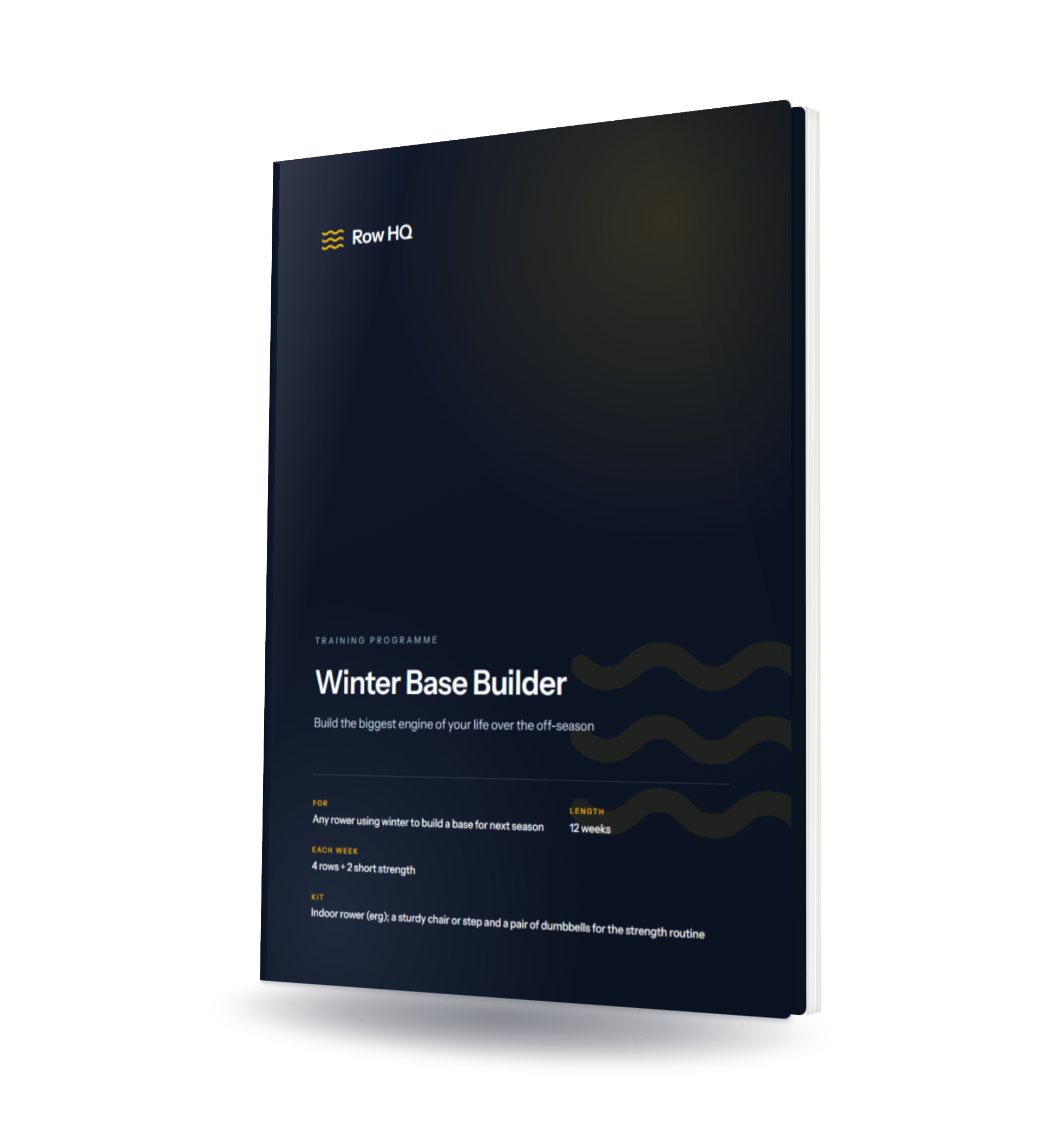
Winter Base Builder
Build the biggest engine of your life over the off-season - 12 weeks of mostly-easy volume plus a strength routine, so you arrive at spring fast.
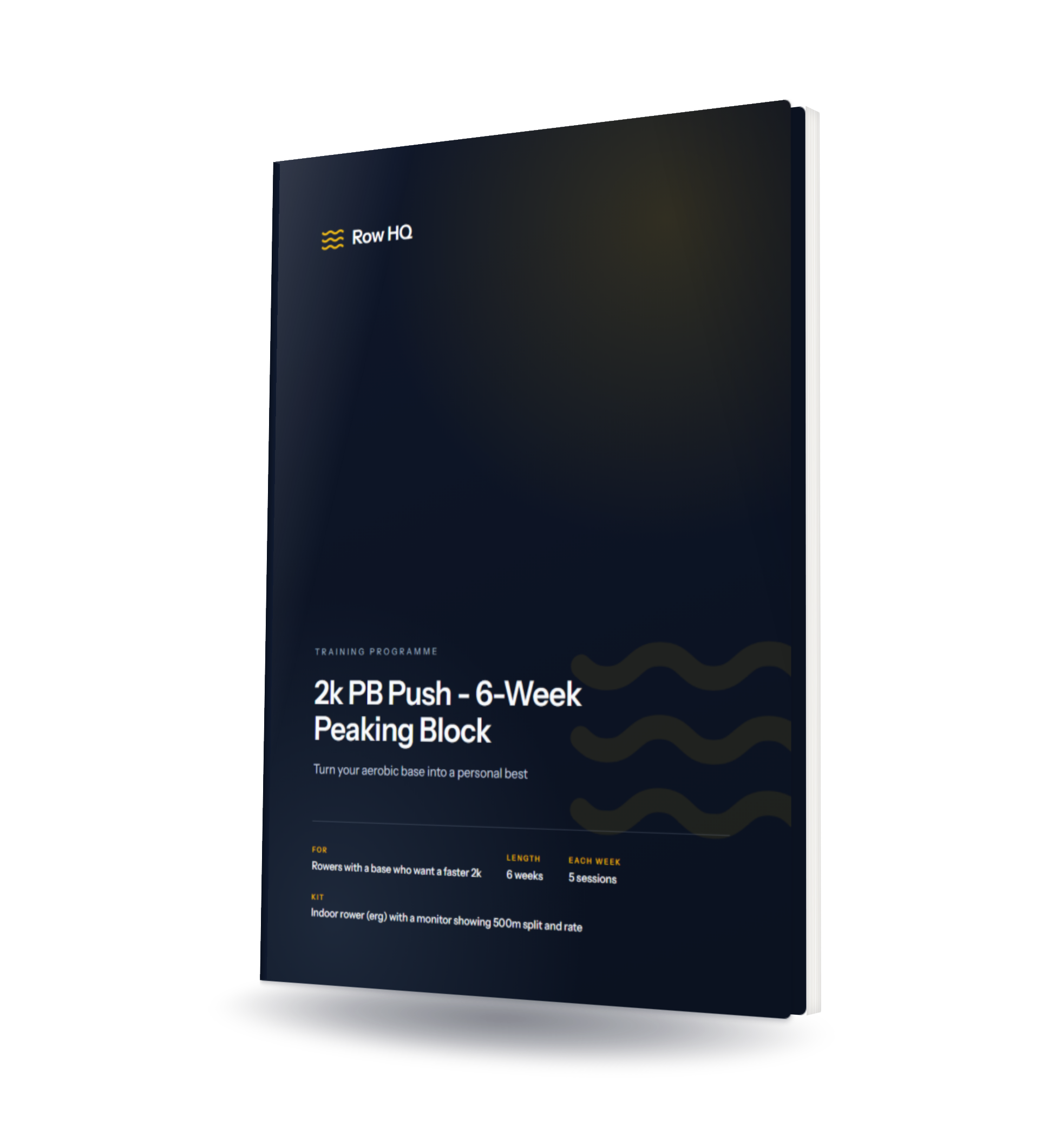
2k PB Push - 6-Week Peaking Block
Six weeks that turn an existing aerobic base into a 2k personal best - race-specific work, a proper taper, every pace scaled to your own time.
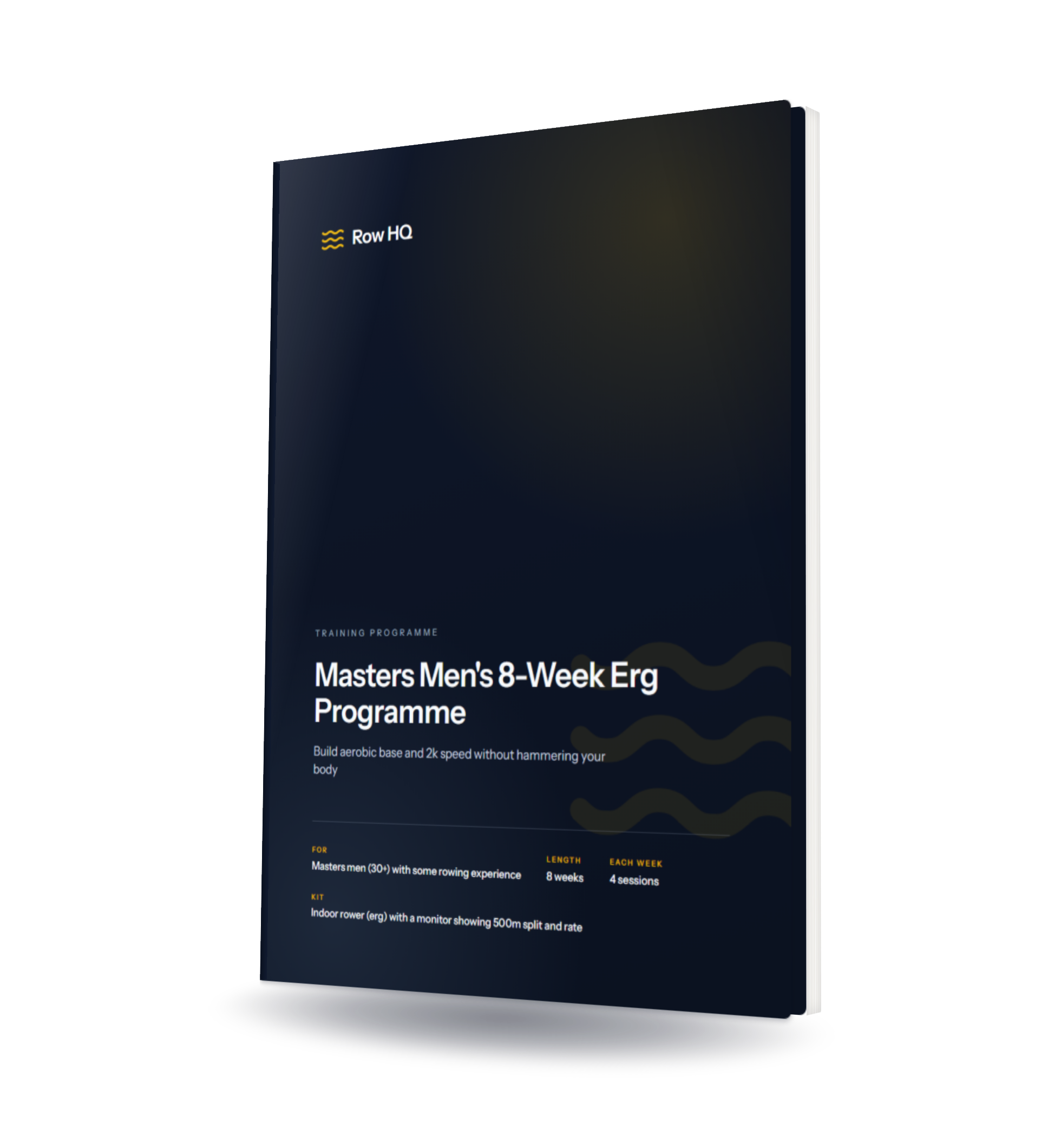
Masters Men's 8-Week Erg Programme
Eight weeks of structured erg training built around a masters body - science-backed, joint-friendly, and designed to protect your engine as you age.