Pick a session in 30 seconds
Open the boathouse, no session in mind. Winter base in January: pick from UT2 steady state. Sixty to ninety minutes at conversational pace, the bedrock of every Argonaut and Don RC winter sheet. Spring build toward the Royal Canadian Henley: drop into TR lactate threshold. 6x500m or 4x1k, held 5-8 seconds slower than your fresh 2k. Trial week: run a test piece. 2k for OUA selection, 6k for the winter benchmark, 30-min if the schedule says aerobic. Crew session squeezed into 45 minutes before class: pull a mixed-zone ladder. Confirm drag (110-130 for senior club athletes), spin up for ten minutes, log the result the same day.
I wrote this library because I never found a Canadian one in one place. Thirty sessions, grouped by zone, with target paces traced back to Rowing Canada Aviron's athlete development testing and Concept2's training material. Each entry tells you what it is for, the split target derived from your 2k, and how to fit it on a 14-athlete crew session. Bookmark the page. A coach can hand it to a new captain the first Saturday of October. A masters single sculler can open it at 5:30am in February when the Bay of Quinte is ice from shore to shore and the only option is the line of ergs upstairs in the boathouse. The structure mirrors what Argonaut Rowing Club, Leander Boat Club Hamilton, the Brentwood and St Andrew's CSSRA squads, and the OUA programmes at Western, Brock and Trent are already running. Club names move, the underlying scaffolding does not.
The 5 training zones
Five zones is the language Canadian coaches share from Elk Lake out west to Lake Banook in Halifax. Rowing Canada Aviron's high-performance pathway runs the same UT2-through-AN scale your club coach scribbles on the whiteboard at 5:45am. Zones anchor to your 2k pace, or to maximum heart rate if you have ever done a proper ramp test (most club athletes have not). Put your 2k into the training pace calculator and every zone split comes back without you doing any arithmetic in your head while still half asleep.
| Zone | Purpose | Split (vs 2k) | % HRmax | RPE | Stroke rate |
|---|---|---|---|---|---|
| UT2 | Aerobic base, fat oxidation | +18 to +25 sec | 60-70% | 3-4/10 | 18-22 spm |
| UT1 | Aerobic capacity | +12 to +17 sec | 70-80% | 5-6/10 | 20-24 spm |
| AT | Aerobic threshold | +8 to +12 sec | 80-85% | 7/10 | 22-26 spm |
| TR | Lactate threshold | +4 to +8 sec | 85-92% | 8-9/10 | 26-32 spm |
| AN | Anaerobic capacity | -2 to +2 sec | 92-100% | 9-10/10 | 30-38 spm |
Worked through: a rower whose 2k is 7:00 (average 1:45) trains UT2 between 2:03 and 2:10, AT between 1:53 and 1:57, TR between 1:49 and 1:53. If your PM5 is set to watts instead of split, run the number through the watts-to-split converter to get the equivalent pace.
UT2 steady state: 5 workouts
Sixty to seventy per cent of weekly volume lives in this zone. It is slow. It is repetitive. It is the first session club athletes skip when the rink schedule frees up on a Sunday morning. Everything sharper you do later this season sits on top of these hours. I have logged more 4x20 winter pieces in the Don RC erg room than I care to remember. None ever felt productive in the moment. All of them showed up in spring boat speed.
1. 60-minute steady state
Target: Continuous 60 minutes at UT2 pace
Purpose: Pure aerobic base. The most productive single session on any Canadian winter sheet from November to March.
Notes: Conversation should be possible start to finish. Stick a 22 cap on stroke rate. A two or three second split fade over the back half is fine, do not chase it back down.
2. 4x20 minutes (UT2)
Target: 4 x 20 minutes, 3 min rest, UT2 split
Purpose: Same total work as a 90-minute piece. The breaks make it easier to hold a clean drive sequence stroke after stroke.
Notes: A better choice for athletes who lose body posture after 45 continuous minutes. Rate 18-20 throughout.
3. 3x30 minutes (UT2)
Target: 3 x 30 minutes, 5 min rest, UT2 split
Purpose: The bridge from 4x20 toward a 90-minute continuous. Standard November to January building block in OUA and CSSRA programmes.
Notes: Works as a crew set. Everyone pushes off the same start time, each athlete rows to a split derived from their own 2k.
4. 90-minute steady state
Target: Continuous 90 minutes at UT2 pace
Purpose: A long aerobic block. Once per week during the base phase, Saturday morning being the natural slot. Don RC built its Saturday long-piece tradition on exactly this.
Notes: Cue up a podcast, bring two bottles, glance at the centre of the monitor every ten minutes and reset your sit position. Posture quietly collapses past minute 60 if you let it.
5. UT2 fartlek (60 minutes)
Target: 60 minutes alternating 8 min UT2 + 2 min UT1
Purpose: Keeps a crew engaged through an hour-long aerobic piece without leaving the aerobic system.
Notes: Lift the rate by 2 spm in each UT1 window. A solid choice for November sessions when the St Lawrence is days away from icing in.
AT aerobic threshold: 5 workouts
Aerobic threshold sits a step below the point where lactate starts piling up faster than your body can clear it. The engine gets built here. "Comfortably hard" captures the feel. Short phrases out loud are possible, full sentences are not.
6. 4x10 minutes (AT)
Target: 4 x 10 minutes, 3 min rest, AT split
Purpose: The classic threshold block. Builds aerobic ceiling and the ability to sit at it for sustained pieces.
Notes: Rate 22-24. Rep three tells the truth about your opening pace. If the split is climbing, rep one was too greedy.
7. 5x8 minutes (AT)
Target: 5 x 8 minutes, 2 min rest, AT split
Purpose: Shorter pieces, lighter total load, quicker bounce back into the next session.
Notes: A reasonable Tuesday after a heavy Sunday on the water at Hanlan or Argonaut. Rate 22-26.
8. 2x20 minutes (AT)
Target: 2 x 20 minutes, 5 min rest, AT split
Purpose: The benchmark threshold session in Canadian club programming. Holding AT pace for 2x20 is the cleanest signal that the aerobic base is in place.
Notes: Spend the opening ten minutes of rep one a touch below target. This session breaks anyone who blasts the first quarter.
9. Pyramid 8-6-4-6-8 (AT)
Target: 8min, 6min, 4min, 6min, 8min at AT split, 2 min rest
Purpose: Holds you in one zone through repeated pace changes. Drains focus quickly if you have not warmed up properly.
Notes: Bump the rate 1-2 spm on the four-minute centre. Coming back down the pyramid is where the head settles and the splits get cleaner.
10. Ladder 5-10-15 (AT)
Target: 5min, 10min, 15min at AT split, 3 min rest
Purpose: Builds workload progressively across one session. Honest test of whether your pacing instincts are calibrated.
Notes: Most rowers cook the 15-minute closer by matching split with reps one and two. Begin it two seconds back, let it find its rhythm.
TR lactate threshold: 5 workouts
TR is where 2k speed is built. You sit at or fractionally above lactate threshold for the work intervals. The burn is steady, technique under that load is the hardest part of the day. These are the sessions that hurt to type into a program and hurt more to row. They are also the sessions behind every Henley Island A-final boat from Leander, Argonaut and the OUA crews.
11. 6x500m (TR)
Target: 6 x 500m at 2k pace + 4-6 sec, 1:30 rest
Purpose: The core race-pace tolerance session. Every Royal Canadian Henley build passes through this one repeatedly.
Notes: Rate 28-32. Treat the target split like a wall on rep one. Two seconds under on the opener pays interest by rep four.
12. 8x500m (TR)
Target: 8 x 500m at 2k pace + 6-8 sec, 1:30 rest
Purpose: Heavier volume than 6x500. Develops the back half of the 2k race shape.
Notes: Sits three to four weeks ahead of a 2k test, never in the final week before trial.
13. 4x1k (TR)
Target: 4 x 1000m at 2k pace + 5-7 sec, 3 min rest
Purpose: Longer pieces that probe sustained 2k tolerance. Each rep is roughly half a 2k race.
Notes: Rate 28-30. The handover from rep two into rep three is where most athletes first encounter real difficulty.
14. 3x1500m (TR)
Target: 3 x 1500m at 2k pace + 7-9 sec, 4 min rest
Purpose: Long-form TR. Every rep crosses the halfway line of a 2k. Mentally heavy session, more than physically.
Notes: Reserved for the late stages of a build cycle. Most coaches program it once per block at most, never as a weekly fixture.
15. Race-prep TR set
Target: 2x500m at 2k pace, 2 min rest, then 2x500m at 2k pace -2 sec, 2 min rest
Purpose: Race rehearsal. The second pair simulates pushing through 2k pace in the closing 500.
Notes: Best placed 7 to 10 days out from a 2k test. Drop the result into the 2k prediction calculator for an honest forecast.
AN anaerobic: 5 workouts
Anaerobic work is short and sharp. Skip it and the first 30 to 45 seconds of any 2k race will leak boat speed you cannot get back. Sessions are intense, technique-sensitive, and demand full recovery between reps to be worth running at all.
16. 8x250m (AN)
Target: 8 x 250m at 1k pace, 2 min rest
Purpose: Builds power and speed without driving the system to failure. Aimed directly at 2k starts off Henley Island and the OUA championship line.
Notes: Rate 32-36. Repeatability beats heroics. Eight matching splits is a better result than three flying openers followed by five collapses.
17. 12x250m (AN)
Target: 12 x 250m at 1k pace, 90 sec rest
Purpose: Higher-volume anaerobic work. The 90-second rest turns this session brutal from rep six onward.
Notes: Cut the set short the moment split degrades by more than 4 seconds. The point is intensity per rep, never total rep count.
18. 10x500m at 1k pace
Target: 10 x 500m at 1k pace, 2 min rest
Purpose: Sits between AN and TR. The opening five feel survivable. Reps six through ten reveal character.
Notes: Slot into race prep weeks. Rate 30-34. Score the session through the erg score calculator.
19. 6x500m sub-1k pace
Target: 6 x 500m at 1k pace -2 sec, 3 min rest
Purpose: Pushes past 1k pace in short bursts. Targets raw watts on the flywheel.
Notes: Hold the long rest. Shortening it to feel more disciplined kills the purpose. Maximum output per rep is the only metric that matters.
20. 30s on / 30s off
Target: 20 minutes alternating 30 sec maximum effort + 30 sec light paddle
Purpose: Lactate tolerance with a VO2 stimulus. Compact, brutal, repeatable.
Notes: Rate 32-38 on the work pieces. The format predates the fitness industry by decades. Canadian rowing has run it since long before HIIT became a brand.
Test pieces: 5 workouts
Test scores are the numbers every other session traces back to. Run tests in consistent conditions, log them with the date and bodyweight, and read the seasonal trend rather than reacting to one bad result. My first 30-minute test, I went out at 5k pace and blew up at 18 minutes. Tests teach pacing in a way training pieces never will.
21. 2k test
Target: All-out 2000m
Purpose: The benchmark every Canadian coach references first. The number that anchors school 1st VIII trial sheets, OUA selection rosters, and Rowing Canada Aviron development pathway scores.
Notes: Drag 110-130. Rate 30-36. Take the opening 500m 1 to 2 seconds above average target, hold steady through 500-1500m, lift in the closing 250m. Pull your opening split out of the erg score calculator.
22. 5k test
Target: All-out 5000m
Purpose: Aerobic capacity test. Lower nervous-system tax than a 2k and a strong predictor of 2k fitness.
Notes: Run quarterly through the off-season. Most senior athletes settle into 2k pace +8-12 seconds across a 5k. Rate 26-30.
23. 6k test
Target: All-out 6000m
Purpose: The winter benchmark across Canadian programmes. Used in CSSRA selection and OUA squad calibration through November to February.
Notes: Pace at the AT/TR boundary. Rate 26-30. The mental crater of the piece sits between 2.5k and 4k. Hold the split through it and the closing 2k takes care of itself.
24. 30-minute test
Target: Maximum metres in 30 minutes
Purpose: Aerobic standard bridging the 2k and the 60-minute capability. Total metres is the headline figure.
Notes: Pace conservatively through the first ten minutes. Rate 24-28. Watch for the closing five-minute lift opportunity.
25. 10k test
Target: All-out 10000m
Purpose: Long-form aerobic test. Used as a fitness indicator before fall head-race events at clubs from Don RC through to Hanlan.
Notes: A mental piece more than a physical one. Sit at UT1/AT through the first 7k, then build. Most Canadian clubs run this in early October ahead of the fall head-race calendar.
Mixed-zone sessions: 5 workouts
Mixed-zone work breaks the monotony of single-zone weeks and trains the body to shift between energy systems. The right pick when the session window is tight, or when a crew needs a sharp stimulus without the full cost of an isolated TR or AN block.
26. Alternating set 4x(5min AT + 5min UT1)
Target: 40 minutes total, alternating 5 min at AT and 5 min at UT1, no rest
Purpose: Trains aerobic capacity and threshold tolerance inside one continuous block.
Notes: Minute for minute the most efficient piece in this library. Rate pattern is 26 (AT) into 22 (UT1), four cycles, no break.
27. Ladder 250-500-750-1k-750-500-250
Target: Pyramid at TR pace, equal rest to work
Purpose: Tests pacing accuracy across a range of distances inside a single session.
Notes: Athletes typically break on the descending 750. Anchor the 1k centre piece, calibrate the descent off that split.
28. Broken 2k (1k + 500 + 500)
Target: 1000m at 2k pace, 1 min rest, 500m at 2k pace -2 sec, 1 min rest, 500m all-out
Purpose: Race rehearsal in three pieces. Builds confidence at race pace without paying the nervous-system cost of a full 2k.
Notes: Add the work plus rest for an indicative 2k figure. Usually 5 to 10 seconds quicker than your real 2k.
29. Broken 6k (4x1500m with 1min rest)
Target: 4 x 1500m at AT split, 1 min rest only
Purpose: Head-race tolerance work. The minimal rest keeps heart rate elevated through the whole session, closer to actual head-course conditions than standard intervals.
Notes: Most relevant from late September through October when fall heads dominate the Canadian calendar. Rate 24-26.
30. Mixed pyramid 1k-2k-1k
Target: 1000m at 2k pace -2 sec, 5 min rest, 2000m at 2k pace, 5 min rest, 1000m at 2k pace -3 sec
Purpose: Tests whether speed holds before and after a full race-pace block. A severe session, programmed sparingly.
Notes: Reserved for race prep only. The closing 1k is the clearest read on what reserve you actually have on test day.
How to pick the right workout
Match the goal to a session in the table. If you do not yet have a 2k score on the board, run workout #21 first, then come back and pick from this list with a real anchor.
| Your goal | Best workouts | Frequency |
|---|---|---|
| General fitness, off-season | #1, #2, #4, #6, #26 | 3-4 per week |
| Race prep (2k focus) | #11, #14, #15, #28 | 2 per week, taper to 1 |
| Race prep (head race) | #3, #4, #24, #25, #29 | 2-3 per week |
| Power and start work | #16, #19, #20 | 1-2 per week |
| Technique session | #1, #5 (low rate) | Anytime |
| Recovery day | #1 capped at 30 min, UT2 pace | After hard session |
| Test week | #21, #22, #24, #25 | One test per week max |
| New to erg programming | #1, #6, #11, #21 in that order | Build over a month |
Coach-led variations
Writing a session for one athlete is easy. Running 14 of them through the same piece on 14 different machines at 5:45am in February at Argonaut is a different problem. What works in Canadian club boathouses:
- Lineup grouping: Pair athletes within 5 seconds of each other on their 2k. Crews pacing together as a unit build the kind of racing discipline that shows up at Henley Island in August. Use the coach tools to view ergo scores grouped by potential lineup.
- Split-target by 2k: Every athlete works to a personal split off their own zone bands rather than a single squad number. The session structure stays uniform, the targets are individual. The training pace calculator exists so coaches stop doing this on a whiteboard at 5am. Drop the 2k in, the zones come back.
- Squad leaderboards: Run a 6x500 as a club-wide leaderboard. Best total time across the six reps wins. Particularly effective for sessions #11 and #16. Push results into the coach tools so personal bests stay tracked across the year.
- Group progression: When 12 of 14 athletes hit target on session #8, the rep count climbs next cycle. 5x20 the following week. When only 3 of 14 hit it, the target split eases by 2 seconds and the same rep count repeats.
- Novice modifications: Keep the session shape, cut the volume in half. The novice version of #11 is 4x500. Time accumulated on the machine matters more than rep totals for an athlete in their first October.
Pre-workout setup
A session is only as good as the setup before the first stroke. Drag factor is the most ignored variable in club rowing. The warm-up is the most skipped step. Both quietly compromise every rep that follows them.
- Drag factor: 110-130 for most senior club athletes. Lighter (90-110) for women and junior rowers, heavier (130-140) for heavyweight men. Confirm it through the PM5 menu before every session. Lever position alone is not a reliable proxy. Use the drag factor calculator when the right number is unclear.
- Monitor settings: Split (/500m) on the main display for steady-state and threshold work. Watts for power pieces. Build the workout through "Select Workout" beforehand so the PM5 counts intervals down for you mid-piece.
- Warm-up (10 minutes minimum): 3 minutes of light paddling at rate 18-20, 3 minutes building toward UT2 split, then 4 x (30 seconds at rate 26 / 30 seconds light). Skip this ahead of a TR or AN session and the opening rep is a write-off no matter how hard you push it.
- Log it immediately: Time, split, average watts, stroke rate, bodyweight, one honest sentence about how the body felt. Two minutes of admin protects months of trend data. Row HQ's member portal takes the entry off the phone in 30 seconds.
Common mistakes
These are the failure patterns I see most across Canadian club programmes. Every one of them is fixable. Left alone they slowly drain quality from a season.
- Going too hard on steady state. If your UT2 looks and feels like UT1, you are skipping the system you came to train. Polarised training research is clear at this point. 80% easy, 20% hard outperforms grinding the middle on every session. Put a rate cap of 22 on UT2 pieces when the temptation to lift creeps in.
- No warm-up. Launching into 4x10 cold means the first four minutes of rep one are spent warming up at threshold pace, badly. Ten minutes properly warmed up beats fifteen poorly warmed up every single time.
- Rowing without a split target. "I will see what I can hold" is not a session, it is permission to either coast or blow up. Decide the target split before the first rep. Derive it from your 2k through the training pace calculator.
- Mixing zones inside a single session. A UT2 with sprints sprinkled in is not UT2. Pick a zone, stay in it. Mixed-zone pieces have their slot (see #26-30) but every other session should sit cleanly inside one zone.
- Not logging. Untracked training is effort spent without compound interest. No log means no trend, no trend means no informed call on what comes next. Paper works. Your club's coach tools work better.
- Testing too often. Running a 2k every fortnight teaches you to pace 2ks, not to row faster. One real 2k test per training block (every 6 to 8 weeks) with broken 2ks and TR work between them.
FAQ
How many erg sessions per week should a Canadian club rower do?
Three to five depending on the phase. Winter base (November through March, the months ice locks in everything from the Bay of Quinte to the St Lawrence) typically lands at four or five erg sessions. Once on-water training returns in April or May at clubs like Argonaut and Don RC, two erg sessions a week is plenty for most senior club athletes. CSSRA juniors and OUA squads may climb higher during exam periods or when waterways are still frozen on the calendar.
What is the best erg workout for beginners?
Start with workout #1 (60-minute steady state) at conversational pace, twice a week through the first month. Bring workout #6 (4x10 minutes AT) in once a week from month two. Run a first 2k test (workout #21) at the end of month two. That number gives you the anchor every zone calculation needs.
How long should a club erg session be?
Most useful sessions fall between 45 and 75 minutes including warm-up and cool-down. Under 30 minutes there is not enough room left for quality work once the warm-up is done. Over 90 minutes returns diminish for anyone who is not specifically building toward an ultra-distance event.
Can these workouts be done on a WaterRower or Hydrow?
Yes, but split benchmarks do not transfer cleanly. WaterRower and Hydrow run different flywheel mechanics, so a Concept2 1:45 split lands around 1:48 on a WaterRower and 1:47 on a Hydrow at equivalent power. The session structure (intervals, zones, rest) carries across machines without trouble. Canadian clubs default to Concept2 because Concept2 is what RCA testing protocols, CSSRA results sheets and the global rowing rankings all benchmark against.
What is the difference between AT and TR?
AT (aerobic threshold) is the highest sustained pace at which the body clears lactate as fast as it produces it. TR (lactate threshold) is the pace at which lactate starts accumulating in measurable quantities. Day to day: AT feels comfortably hard, short phrases out loud are possible. TR is hard, you can manage single words at best. Most club rowers misread the boundary and end up rowing AT sessions at TR intensity without realising it.
Should I warm up with rate work?
Yes. After 6 minutes of easy paddling, add 4 to 6 short rate bursts. 15 strokes at rate 26-28, 30 seconds rest between. This primes the neuromuscular system without burning real glycogen. Most rowers skip the bursts and pay for it on the opening hard interval.
How do I know if my drag factor is right?
For most senior club rowers, 110-130 is the working range. Heavier athletes (90kg or above) can sit at 130-140. Junior rowers and women typically land at 100-120. Higher drag is not equivalent to harder work. It changes the catch feel without proportionally raising the power demand. If stroke rate keeps dropping below 22 in a TR session, drag is probably too high. The drag factor calculator on the Tools hub returns a per-athlete recommendation.
Where can I track ergo scores across the squad?
Row HQ's coach tools include an ergo log built for clubs. Athletes log results from the member portal in under 30 seconds, coaches see the squad-wide view with personal-best highlights, and the data flows directly into crew selection. Concept2 Logbook entries import on their own.
- Jason
Sources & references
- Rowing Canada Aviron athlete development and high-performance pathway — Rowing Canada Aviron
- Concept2 indoor rower training guides and sample workouts — Concept2
- Concept2 PM5 monitor reference — Concept2
- Concept2 Online Logbook (rankings and reference) — Concept2
- Workouts of the Day archive (decades of programmed sessions) — Concept2
- Indoor rowing technique and drag factor reference — Concept2
- British Rowing coaching pyramid and athlete development — British Rowing
- USRowing performance testing standards — USRowing
- Rowing Australia high performance unit — Rowing Australia
- Polarised training research (Stoggl & Sperlich, Frontiers in Physiology 2014) — Frontiers in Physiology
- Bompa periodisation of training principles (academic overview) — Human Kinetics
- Row HQ training pace calculator (split targets from your 2k) — Row HQ
- Row HQ erg score calculator — Row HQ
- Row HQ 2k prediction calculator — Row HQ
- Row HQ watts-to-split converter — Row HQ
- Row HQ drag factor calculator — Row HQ
- Row HQ VO2 max calculator — Row HQ
Related articles & tools
Planning sessions for a whole crew? The Club Session Library includes 52 adaptable session plans, with 16 for the erg.
From the RowHQ shop
Printable PDFs written for club rowers. Buy once, keep forever.
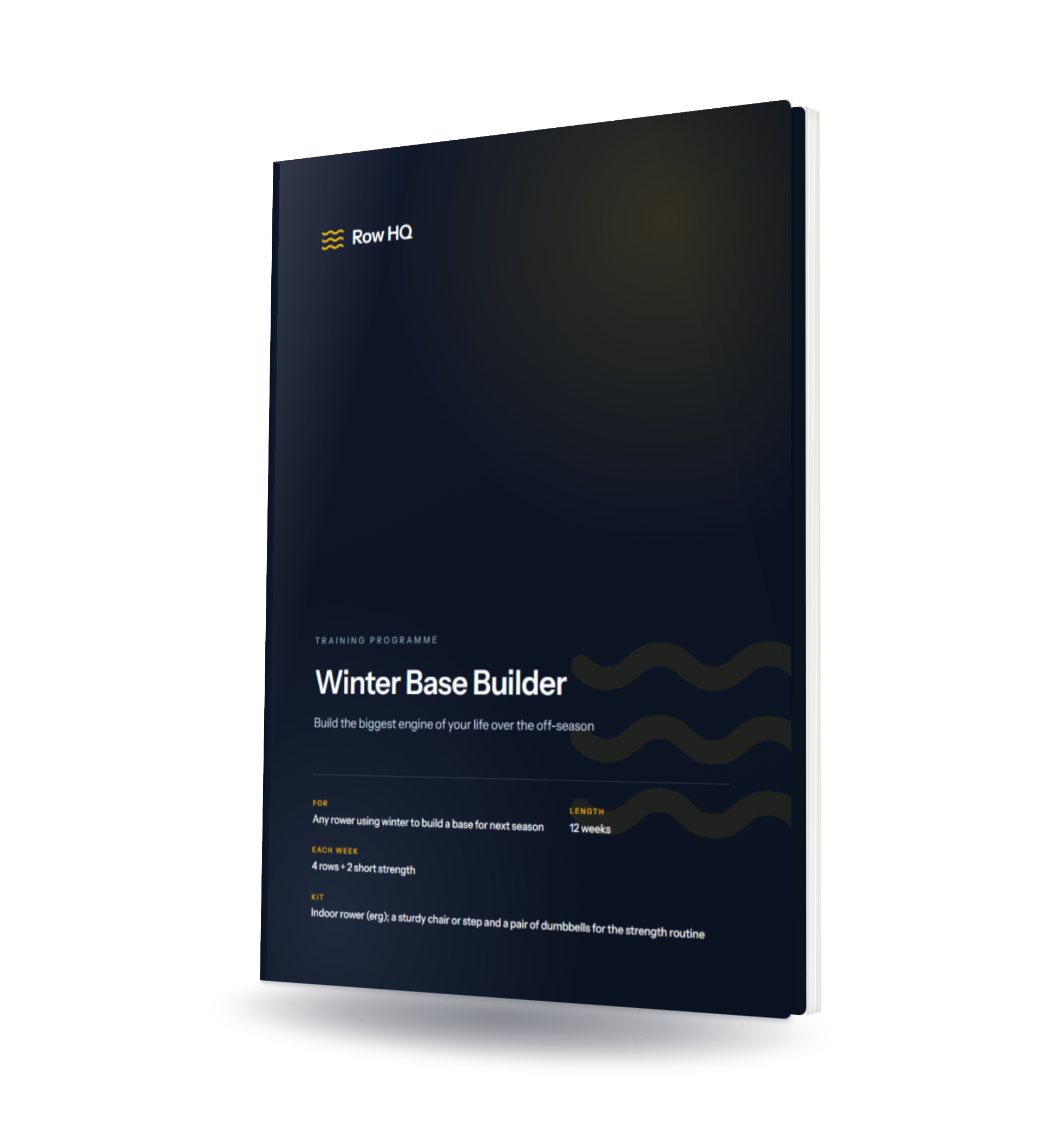
Winter Base Builder
Build the biggest engine of your life over the off-season - 12 weeks of mostly-easy volume plus a strength routine, so you arrive at spring fast.

2k PB Push - 6-Week Peaking Block
Six weeks that turn an existing aerobic base into a 2k personal best - race-specific work, a proper taper, every pace scaled to your own time.
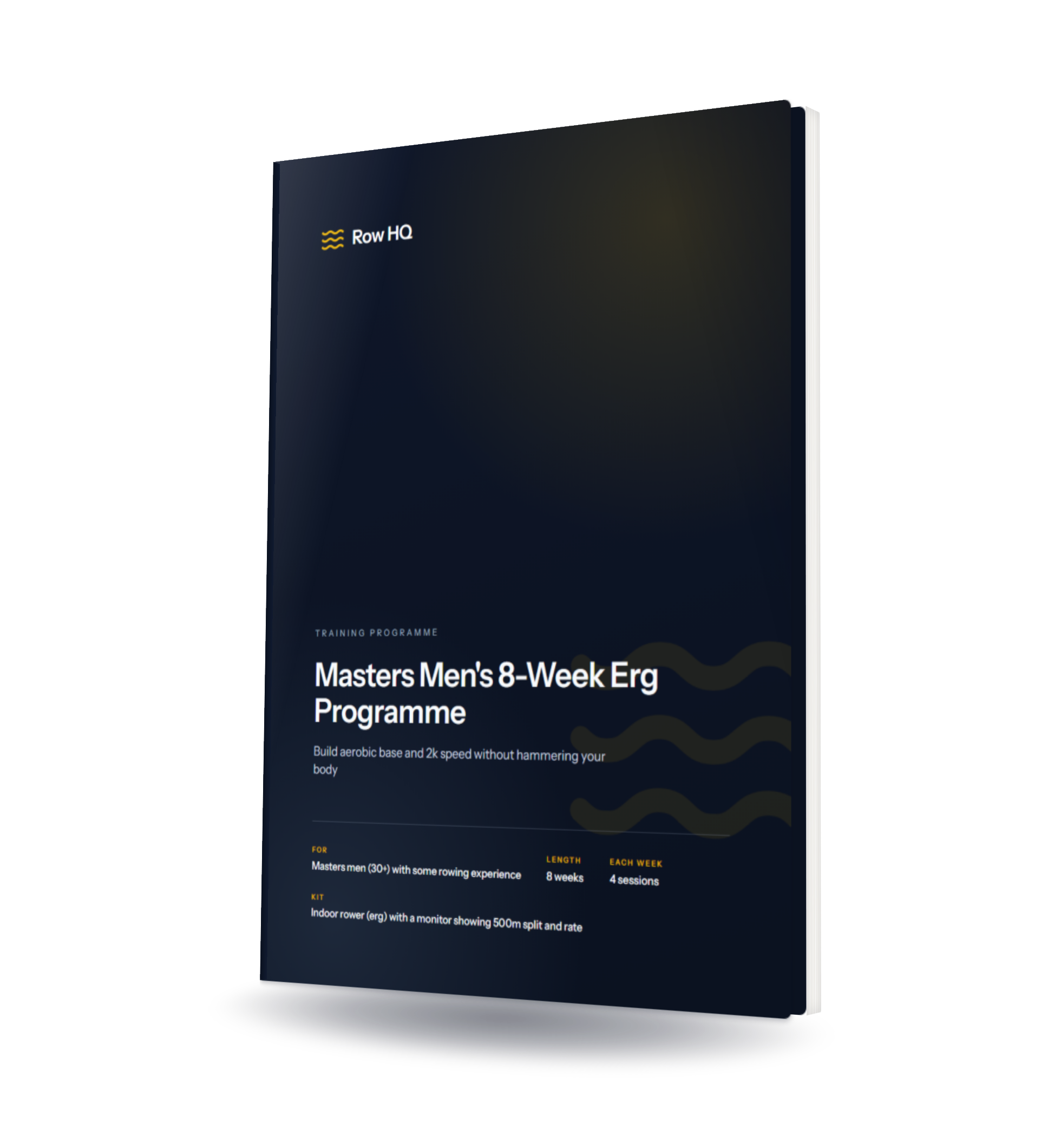
Masters Men's 8-Week Erg Programme
Eight weeks of structured erg training built around a masters body - science-backed, joint-friendly, and designed to protect your engine as you age.