Head Race
A head race is the autumn time-trial format of Australian rowing. Crews leave the start in single file at 10 to 15 second intervals, race the clock down a long river course (anywhere from 4 to 9 kilometres depending on the venue), and the fastest aggregate time in each division takes the win. Head of the Yarra, run in late April through central Melbourne, is the Aussie benchmark and the largest single-day rowing fixture in the southern hemisphere.
What is a Head Race?
A head race is a time-trial style rowing event in which crews start in single file at 10 to 15 second intervals and race the clock down a winding river. Aussie head racing runs through the southern-hemisphere autumn (April to June) and contrasts with the lane racing of the spring and summer championship season. Head of the Yarra in Melbourne, at roughly 8.6 kilometres from Hawthorn Bridge to Princes Bridge, is the largest single-day rowing event in the southern hemisphere by entries.
Also called: Head, Long Distance Rowing Race
How a head race runs from boat shed to finish line
Crews nominate into a division well before race day, usually seeded against the previous year's result or a published draw. On the morning, boats marshal upstream of the start in number order. At Head of the Yarra the marshalling queue routinely stretches the better part of a kilometre back through Burnley, with several hundred eights and small boats slowly winding toward the bridge. Marshals release crews one at a time, every 10 to 15 seconds, on a count from the start tower.
Each crew rolls down at a steady cruising rate, lifts to race pressure in the last few strokes before the line, and the timing system captures the moment the bow crosses. From there the crew goes flat out for the full course. Timing chips or a video camera at the finish stop the clock. Aggregate times inside each division decide medals and pennants - so the gap to the crew that started 10 seconds in front means nothing on its own. The clock is the only opponent that counts.
Overtaking is part of the format. The faster crew calls a clear instruction from astern (usually the cox or stroke), and the slower crew is expected to give way to the inside of the river. On a narrow, turning course like the Yarra those passes get tight, and the etiquette is taken seriously - umpires hand out time penalties when crews ignore the calls.
Distance, course and the Yarra problem
Australian head races sit across a much wider distance band than UK or US heads. What you see in the calendar depends entirely on the river:
- Head of the Yarra: roughly 8.6 kilometres from Hawthorn Bridge down through Toorak, Burnley and Cremorne to the finish below Princes Bridge in central Melbourne. The longest senior head on the international circuit.
- Head of the Brisbane / Brisbane River Head: around 6 kilometres on the Brisbane River through the Toowong reach.
- Head of the Derwent / Murray Bridge head: typically 4 to 6 kilometres on the Derwent in Tasmania and the Murray in South Australia.
- School and junior heads (AGSV, CAS, GPS): generally 3 to 5 kilometres, sized to the squad's race fitness and the host river.
The Yarra is the defining course of Australian head racing for a reason - it is narrow, deep and full of bends. A crew that picks a clean line through each turn saves boat lengths over one that drifts wide and washes through the dirty water on the outside. Sweep crews with bow-loader coxes get a strong steering advantage on a river like that, and a sharp cox who has walked the course is worth real seconds. South Australian heads on the Torrens and Brisbane heads through Toowong reward the same instinct.
The head-race calendar at a glance
Head racing through April, May and June is the busiest stretch of the Aussie club calendar. Clubs running a full squad through the autumn block lean on entry tracking and trailer logistics for weeks ahead of each race weekend.
United Kingdom
Worth flagging for Aussie crews travelling north: the British head season runs in the northern winter, so it is the seasonal mirror of the Aussie autumn block. Head of the River Race on the Tideway in London (6,779 metres, Mortlake to Putney) is the senior eights championship, with the Schools Head, Women's Head and Veterans Head on the same course at different points across January, February and March.
United States
Head of the Charles on the Charles River in Boston each October is the largest head race on the planet by entries, with around 11,000 athletes across 80-plus events. Head of the Schuylkill in Philadelphia and Head of the Hooch on the Tennessee River sit alongside it. None of them clash with the Aussie autumn block, so dual-hemisphere athletes will often pencil a US head in during the off-season.
Australia
Head of the Yarra (late April, Melbourne) is the marquee event - roughly 8.6 kilometres from Hawthorn Bridge to the finish below Princes Bridge, hosted by Mercantile Rowing Club, with a start list that runs to the high hundreds of crews and a race day that fills the better part of a Saturday. Head of the Brisbane and the Brisbane River Head out of Toowong are the headline Queensland fixtures. Head of the Derwent draws the Tasmanian and Victorian clubs to Hobart, and the Murray Bridge head is the South Australian centrepiece. Sydney clubs race the long-running Parramatta River heads through the autumn, with North Shore, Mosman and Sydney Rowing Club regulars on the start sheet. The school season is anchored by the AGSV and CAS Head of the Schoolboy/Schoolgirl Yarra fixtures, which work as the unofficial seeding meet for 1st VIII and 2nd VIII shortlists. GPS school heads in Queensland and New South Wales feed the same selection cycle.
Pacing a head race and steering the Yarra
Head racing rewards sustained aerobic capacity over short-burst speed. Crews that try to win the race in the first kilometre blow up by 3 or 4k and bleed back through the second half. The trained Aussie crew pattern is much the same wherever you race: a controlled high-rate start for the first 90 seconds to settle the boat and pass the boat in front, drop to a sustainable cruise pace through the long middle, then build a steady push for the last 1,000 metres to the line. On a 6 or 8 kilometre course like the Yarra or the Brisbane that middle section is brutally long, and the crew that holds shape through it wins.
Steering decides nearly as many places as pace, especially on the Yarra. Coxes walk the course or pull up GPS tracks from previous years, mark the line through every bend, plan which side of every bridge arch to take, and call the passes early. A good cox in a sweep eight is the single best piece of equipment a club can put on the water on Yarra weekend.
For the coaching staff piecing the autumn block together, the daily work of putting crews together and tracking who is in form matters more in head season than at any other point in the year. A whole winter of training gets tested over 20 to 30 minutes on race day, so the call on who is in the boat and what target split they are holding (worked through the training pace planner) is the difference between a pennant and a quiet bus home.
Equipment and boat prep
Boat-side, head-race kit is mostly the same as regatta kit. Eights, fours, pairs and quads all race. The practical differences are cold-weather: warmer one-piece zoot-suits, longer cox covers to keep the cox dry through a 30-minute race, weather covers on the speaker boxes in coxless boats. Bow numbers are the big A4-sized stickers that video timing systems need to read cleanly from the bank as the boat passes.
Cox boxes are universal in coxed boats. Coxmate GPS, designed and built in Melbourne and now standard kit across most Aussie sheds since the 1990s, gives the cox a running readout of rate, stroke count and 500 metre splits without taking their eyes off the river. Rudders get a lookover the day before, steering wires are checked end to end, and the riggers come off for transport but go back on with a torque wrench rather than a guess.
What clubs actually do in the fortnight before
Head-race entry kicks off two weeks of admin. Crews need to be locked in writing, entries paid through Rowing Australia's state-association portals or the host club's entry system, the marshalling draw checked against the published start list, trailers loaded and labelled, weather plans pulled together, and parents or partners briefed on where to be at what time. For a school squad running 12 crews into Head of the Yarra it is a serious chunk of work.
This is where the club admin earns their coffee. Row HQ's events module tracks every entry against the right athlete, pulls crew lists straight out of the squad's coach tools, handles the transport rota, and pushes member portal notifications so rowers know when the trailer leaves Hawthorn, where the boating area is and what time their division is called.
Track upcoming Australian head races in our competition calendar - the autumn block, school heads, and the local club time-trials on the Yarra, Brisbane River, Parramatta, Derwent and Torrens.
Where the format came from
The modern head race is a Steve Fairbairn idea from 1925. Fairbairn was a Geelong-born oarsman who rowed for Jesus College in Cambridge before becoming one of the most influential coaches of the 20th century, and he proposed a long winter time-trial on the Tideway as a counterpoint to the summer Henley regatta tradition. The first Head of the River Race ran in March 1926 on the Thames. The format crossed back to Australia gradually over the following decades, and Head of the Yarra was first run in 1989. It has grown since into the largest single-day rowing fixture in the southern hemisphere, with the autumn calendar now built around it.
Head race FAQs
How is a head race different from a regatta?
A head race is a time trial. Crews leave the start one after another at 10 to 15 second gaps, race a long river course of anywhere from 4 to 9 kilometres, and the fastest aggregate time in each division takes the win. A regatta is the lane-racing format - side-by-side sprints over 1,000 or 2,000 metres, first across the line wins. In the Aussie calendar the two sit at opposite ends of the year. Head racing fills the cooler autumn and early winter weekends from April through June, then crews pivot onto buoyed water for the summer championship block that runs through to the Australian Rowing Championships in March.
How long is an Australian head race?
Distance varies more in Australia than almost anywhere else. Head of the Yarra is the outlier at roughly 8.6 kilometres from Hawthorn Bridge down through Toorak, Burnley and Cremorne to the finish below Princes Bridge, which makes it the longest senior head on the international calendar. Head of the Brisbane on the Brisbane River sits closer to 6 kilometres. The Murray Bridge head and Head of the Derwent are typically in the 4 to 6 kilometre band. School and junior heads run shorter, often 3 to 5 kilometres. An eight will be on the water for anywhere from 15 minutes at a short Parramatta River head to a touch over half an hour down the full length of the Yarra.
Why does Australian head racing run in autumn and winter?
It is the seasonal mirror image of UK head racing. Aussie clubs hit the summer regatta block from October through to the National Championships in March, then need a long-course format to keep the squad honest through the cold months and rebuild the aerobic base. April to June is the window. The autumn head circuit is a fitness audit on the way back from the summer break, and a stepping stone to the King's Cup interstate trials and the next national championship cycle. Conditions also help: the Yarra, Brisbane River, Parramatta and Torrens are usually at their flattest in autumn, which is when long time-trials work best.
Which head races matter on the Aussie calendar?
Head of the Yarra in late April, hosted by Mercantile Rowing Club, is the headline event - roughly 8.6 kilometres through central Melbourne, and routinely the largest single-day rowing event in the southern hemisphere by entries. The start list runs into the high hundreds of crews and the day stretches from morning to dusk. Head of the Brisbane on the Brisbane River, Brisbane River Head out of Toowong, the Murray Bridge head in South Australia, Tasmania's Head of the Derwent and the long-running heads on the Parramatta River in Sydney round out the senior calendar. School heads, particularly the AGSV and CAS Head of the Schoolboy/Schoolgirl Yarra fixtures, are the unofficial seeding meet for 1st VIII and 2nd VIII shortlists going into the summer.
How does the start of a head race actually work?
Every crew nominates a target division by category and age, pays the entry, gets a bow sticker with its start number, and lines up in single file above the start line. The marshalling queue at Head of the Yarra can stretch the better part of a kilometre back upstream toward Burnley. Marshals release crews in order, one every 10 or 15 seconds. Each crew rolls down at a steady cruising rate, picks up to race pressure in the final strokes before the line, and the timing system records the exact instant the bow crosses. Timing chips or video cameras at the start and finish do the actual maths. Overtakes happen on the outside of bends, and the slower crew is expected to give way to the inside the moment the call comes from astern.
Related
What Is a Regatta in Australian Rowing?
In Australian rowing, a regatta is a sprint side-by-side meet on a flat-water buoyed course, every crew starting on the...
The Coxswain: Steering, Race Plan and Crew Direction
The coxswain is the person in the stern of a rowing boat steering the line, calling the race plan and managing the crew...
Stroke Rate: Cadence in Strokes per Minute
Stroke rate is the cadence of the rowing stroke in strokes per minute (spm). Aussie training bands run 18 to 22 for stea...
Stroke Seat Explained
The stroke seat owns the boat's clock. Sitting at the stern of the shell, this athlete sets the cadence every other rowe...
From the RowHQ shop
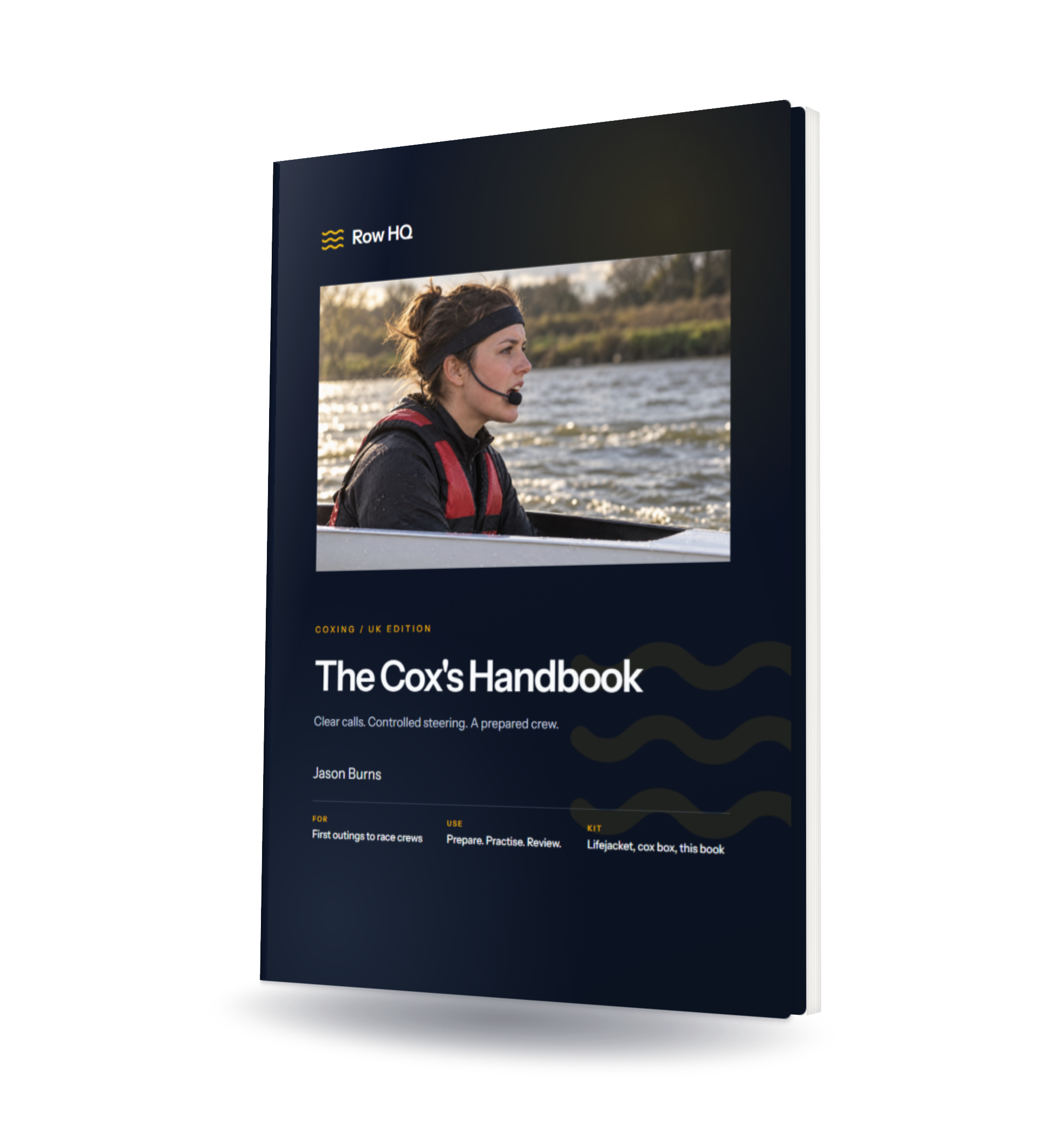
Printable PDFs written for club rowers. Buy once, keep forever.
Keep learning
Preparing for a head race means settling crews, trailer plans and start details well before push-off. club software for Australian rowing clubs gives the squad one place to find the latest plan. Read through the rowing glossary for more racing language.
Race day is hard enough. Entries, trailers and bow numbers shouldn't be.
Row HQ runs head race entries, crew assignments, marshalling lists and trailer logistics in one place. Sized for Aussie clubs racing the autumn block from Yarra weekend through to the Brisbane River head.