Head Race
A head race is a processional time trial. Crews leave the start every 10 to 15 seconds, race the clock over 4 to 6km of river or lake, and the fastest aggregate time wins. The format runs in pockets of the NZ calendar - Lake Karapiro long-course pieces, regional winter events, training time trials - but in Aotearoa it sits behind the sprint regattas (Maadi, Bond Cup, NZ Championships) that anchor the season.
What is a Head Race?
A head race is a long-course time trial in which boats launch one after another at roughly 10 to 15 second intervals and race the clock over 4,000m to 6,000m of river or lake water. The fastest aggregate time takes the win. In Aotearoa the format exists (Lake Karapiro long-course pieces, occasional regional heads, club winter time trials) but it is not the spine of the Kiwi season the way it is in the UK - sprint regattas at Karapiro and Ruataniwha, the Maadi Cup and the Bond Cup carry that weight here.
Also called: Head, Long Distance Rowing Race
How a head race works
The day begins with a draw and a seeded start order, typically built from previous results or a submitted ranking. Boats marshal upstream of the line, the marshal calls each wave forward, and crews wind from a rolling paddle up to race pressure before crossing the start under power. Once the bows cross, the clock runs and does not stop until the finish line passes overhead.
There are no lanes. The course is whatever river or lake the host club has chosen, with the racing line wandering through bends, bridges and other crews on the water. Aggregate times within each event class produce the result - medals, pennants, or just the next year's start position.
Overtaking is part of the format. The faster crew calls clearly that they are coming through; the slower crew moves to the inside of the bend or to one side of the channel. On busy water with multiple divisions sharing a course, a calm cox who reads traffic and picks a clean line saves seconds the boat will never get back from extra strokework alone.
Distance and course
Long-course time trials in NZ typically run between 4,000m and 6,000m, with the exact length set by the host venue:
- Lake Karapiro long-course pieces: the 5 to 6km flat-water time trials Rowing NZ and visiting club squads run between regattas, on the world championship rowing course.
- Regional and club head events: the smaller winter pieces a handful of NZ clubs put on, usually 3,500m to 5,000m on a local river or lake stretch.
- School and junior pieces: 3,000m to 4,500m, shortened to suit younger rowers and shorter winter daylight.
- Overseas calendar: Head of the Charles (Boston) at 4,800m and Head of the Yarra (Melbourne) at roughly 8.6km draw periodic Kiwi entries.
Flat lake water at Karapiro, Ruataniwha and Lake Hood gives a clean course with almost no flow effect, which makes a long piece nearly pure fitness. River courses are different - bends cost distance for any crew that drifts wide, and current adds or subtracts seconds depending on direction. A cox who has rehearsed the line on the water beforehand will routinely beat a cox of equal skill who has only studied the map.
Where head-race pieces sit in the NZ season
In NZ, long-course time-trial racing is mostly a winter training thread inside a season pointed at sprint regattas. The sprint calendar (Maadi Cup, the Bond Cup, NZ Championships, the North and South Island regattas) is where most clubs put their planning effort. Head-style pieces still feature, both at home and overseas, and the admin around them - entry tracking, marshalling lists, transport rotas - is the same job. Row HQ's events module handles that side regardless of whether the day is a 2km regatta or a 5km time trial.
Long-course pieces in NZ
Lake Karapiro winter pieces at Rowing NZ's high-performance base are the closest thing to a regular long-course time trial on the NZ calendar - squads from across the country run timed 5 to 6km pieces between regattas. Regional winter heads appear sporadically on club programmes, usually as 3 to 5km efforts on local water. Internal training time trials at Lake Ruataniwha (Twizel) and Lake Hood (Ashburton) are routine inside high-performance and university squads. Head-style racing is not a season-long calendar in Aotearoa the way it is in the UK; clubs that want a competitive head race usually look overseas.
Overseas head races NZ crews target
The Head of the Charles Regatta in Boston (October) is the largest head race in the world, with around 11,000 athletes across 80+ events, and pulls Kiwi club and university entries most years. Head of the Schuylkill in Philadelphia and Head of the Hooch on the Tennessee River are other US head races on the international map, though most NZ clubs sending athletes overseas look at Boston first.
Closer to home: Head of the Yarra
Head of the Yarra in Melbourne is the headline Australasian head race, an 8.6km piece on the Yarra River and one of the longest senior head races on the international calendar. A small contingent of NZ senior crews target it each year, treating it as a step-change in distance from anything they would race at home. The Riverview Gold Cup on the Lane Cove River in Sydney and other state head events occasionally see NZ schools entries as well.
Strategy and pacing
Head-race pacing is the opposite of a sprint. The pieces reward sustained aerobic output, not raw acceleration, and the crew that wins is almost never the crew that crossed the start fastest. A clean head-race profile looks like a controlled 90-second build at the line (high rate, contained pressure), a long steady block at race pace through the middle, and a sustained lift from the last 1,000m home. Crews that go out too hot bleed time through the back half in a way no boat-of-the-day finish can save.
Line through the water matters as much as splits on the screen. A cox who threads bends on the inside and stays in the cleanest channel saves seconds that no extra stroke pressure will recover. Kiwi coxes racing long pieces on the Waikato or on tidal water will usually walk or scout the course beforehand, or pull a previous year's GPS track to plan the racing line metre by metre.
For coaches stitching this together across a squad, crew lineup tools and training pace planning earn their keep on head-race week. A long piece is the audit of an entire winter block, and the lineup the boat goes out in needs to match what the data actually says about each athlete.
Equipment
The boats are the same shells the squad uses for sprint regattas: eights, fours, pairs, quads and singles. The kit changes are seasonal and practical. Winter water in NZ means warmer gear in the boat, full cox covers, and on coxless shells sometimes a weather cover over the bow speaker. Bow numbers for a head piece are larger than the sprint sticker because the timing system has to read them at speed from the bank.
Coxed shells run a cox box (NK CoxBox, Coxmate GPS or similar), normally with GPS feeding split and rate continuously through the piece. Steering wires and rudder alignment get a closer look before a 5km piece than they would before a 2km final - small steering errors that wash out across a sprint compound into real seconds across a long course.
How clubs prepare for a head piece
A long-course event is a fortnight of admin even when the racing is only an hour. Crew composition has to be locked, entries submitted through Rowing NZ's entry pathway or the host club's event system, the draw checked against the marshalling order, the boat trailer loaded, transport rostered and a weather contingency drawn up.
For the person doing that work, Row HQ's events module tracks entries, pulls crew assignments from the squad's coach tools, holds the transport rota, and pushes member portal notifications so rowers know exactly when the trailer leaves and where the marshalling area sits. Oundle Town RC runs Row HQ through head-race weekends in the UK; the workflow is identical for a Kiwi club running a winter long piece at Karapiro or on local water.
See long-course pieces and head-style events in the competition calendar - the Karapiro winter time trials, regional NZ heads where they run, and the overseas heads Kiwi squads occasionally target.
Origin and history
The format itself goes back to 1925, when Cambridge coach Steve Fairbairn proposed a winter time trial on the river in London as an alternative to the sprint-regatta tradition built around Henley. The first Head of the River Race ran in March 1926, and the format spread through British rowing as the spine of the autumn-winter calendar. Head of the Charles, founded in Boston in 1965, took the format to North America. In NZ the format arrived later and never fully displaced the sprint-regatta calendar that the Maadi Cup, the Bond Cup and the NZ Championships were built around - head racing here exists as a training tool and as a handful of regional events, rather than as a season-long circuit. Kiwi crews looking for a flagship head race usually travel for Head of the Charles or Head of the Yarra.
Head race FAQs
What is the difference between a head race and a regatta?
Format and grouping. A head race is a processional time trial: shells leave the start one after another, every 10 to 15 seconds, over a long stretch of water (usually 4 to 6km), and the clock decides the winner. A regatta is side-by-side racing in marked lanes on a 1,000m or 2,000m course. In NZ the head-race format does exist (long-course training pieces, occasional regional heads, Lake Karapiro winter time trials), but it sits well behind the sprint-regatta calendar that anchors the Kiwi season: <a href=":regatta_url">regatta racing</a> at Karapiro and Lake Ruataniwha, the Maadi Cup, the Bond Cup and the NZ Championships are the events most clubs build around.
How long is a head race?
The international norm is 4,000m to 6,000m, sometimes longer. Karapiro long-course pieces typically sit inside that bracket. The Head of the Yarra across the Tasman is an outlier at roughly 8.6km. School and junior pieces are shorter, often 3,000m to 4,500m. An openweight eight covers a 5km head race in around 18 to 22 minutes depending on flow, wind and water state. Finishing time scales with the rate the crew can hold, the conditions on the day, and the line the cox picks through bends and bridges.
Why is the head-race format less central in NZ than in the UK?
Different season shape, different flagship events. British clubs structure the year around an autumn-winter head circuit because the rivers and the calendar there suit it. NZ rowing is organised the other way: the headline events are sprint regattas, with the Maadi Cup, the Bond Cup, NZ Championships and the North and South Island regattas dominating the calendar. Long-course time-trial pieces still happen here, mostly as training tests at Karapiro or one-off club events through the winter, but they are not the centre of gravity for a Kiwi club season.
What does long-course time-trial racing look like in NZ?
Mostly it sits inside the training calendar rather than the race calendar. Squads use Lake Karapiro (Rowing NZ's HQ on the Waikato), Lake Ruataniwha at Twizel, Lake Hood near Ashburton and stretches of the Waikato River to run timed long pieces between regattas. A handful of regional clubs put on small head-style events through the colder months. International head racing draws Kiwi entries too: Head of the Charles in Boston pulls in NZ club and university crews most years, and Head of the Yarra in Melbourne is on the radar of a few senior squads. For the closer-to-home competitive calendar, see the <a href=":calendar_url">competition listings</a>.
How does a head race start work?
Crews are seeded into a start order before the day, usually from previous results or a draw. Boats marshal on the water upstream of the line and the marshal calls crews forward in waves. Each shell builds from a paddling pace to full pressure and crosses the line at race speed - timing chips or a finish-line video capture the exact moment the bows cross. The crew then races flat out to the finish, with overtaking handled on the outside of the river or harbour and the slower crew giving way to the inside.
Related
What is a Regatta?
A regatta is the side-by-side sprint format of rowing. Crews race in buoyed lanes over 2,000 metres (1,000 metres for ma...
The Coxswain: Steering, Strategy and the Other Voice in the Boat
A coxswain (cox) is the non-rowing crew member in the stern of a coxed shell who steers, calls the race plan and holds t...
Stroke Rate: The Cadence Number That Doesn't Equal Boat Speed
Stroke rate is the cadence number - strokes per minute (spm). NZ crews run anywhere from 18 spm in winter base work to 4...
What is the Stroke Seat?
Stroke is the rower at the stern of the shell, sitting nearest the coxswain in a coxed boat. Every other rower behind st...
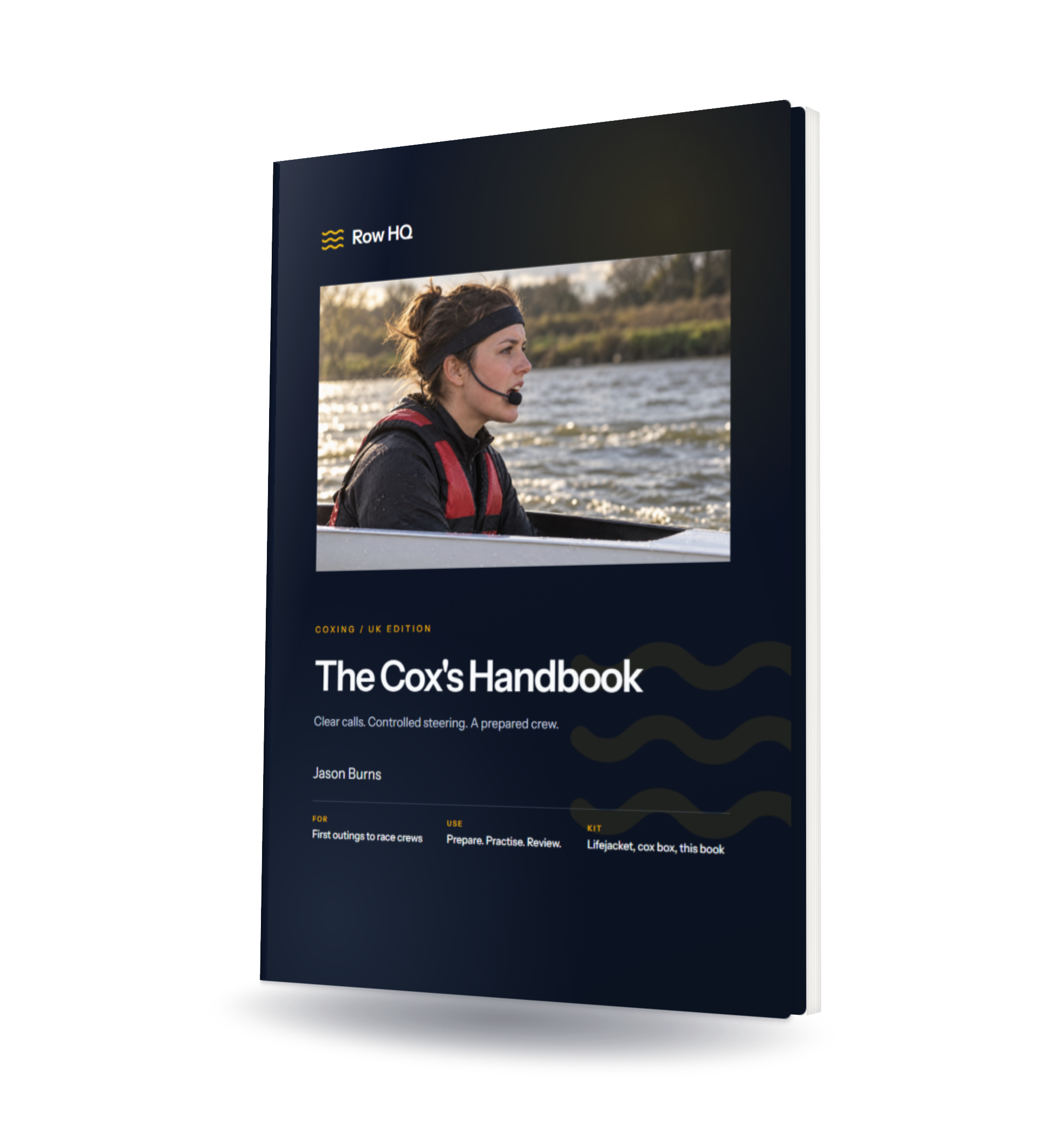
From the RowHQ shop
Printable PDFs written for club rowers. Buy once, keep forever.
Keep learning
A head race can involve several crews sharing boats, transport and tight launch windows. rowing club software for New Zealand clubs keeps the current plan in front of the whole squad. The rowing glossary covers the terms that connect this format to the rest of rowing.
Head race day is hard. The admin around it doesn't have to be.
Row HQ handles entries, crew assignments, marshalling lists and trailer logistics in one place. Built by rowers, used at Oundle Town Rowing Club in the UK and ready for any Kiwi club running long-course pieces through the winter.