Head Race
A head race is the long-course fall time-trial format that anchors US rowing. Each shell pushes off at 10 to 20 second intervals, races down 4,800 to 5,000 meters of winding river with a bow number and timing chip onboard, and the fastest aggregate time per event takes the medals. The Head of the Charles Regatta in Boston is the marquee example. The spring season switches to the 2,000 meter side-by-side sprint format known as a regatta.
What is a Head Race?
A head race is the long-course autumn time-trial format that anchors US rowing. Shells push off the line at 10 to 20 second intervals, race the clock down a winding river course of roughly 4,800 to 5,000 meters, and the fastest aggregate time per event takes gold. The Head of the Charles Regatta in Boston is the canonical example. The spring season switches to the side-by-side 2,000 meter sprint format known as a regatta.
Also called: Head, Long Distance Rowing Race
How a head race works
Entries close weeks before race day. The host regatta posts a seeded start order with the previous year fastest finisher pulling bow number one. The rest of the field is strung out behind in slowest-fastest order so faster crews catch slower ones as the field stretches down the course. Crews stage above the start in packs of fifteen or twenty shells, called forward by marshals on a megaphone or VHF radio.
Each shell rolls toward the line at a cruising 18 to 20 strokes per minute, picks up to full racing pressure about thirty strokes out, and crosses the start under power as the bow-mounted timing chip pings the line. From there it is a long pull at race rate. The clock stops at the finish line crossing, aggregate times within each event determine the medals, and HOCR also tracks who set the new course record in each category for the record board at Cambridge Boat Club.
Passing happens on the outside of bends. The faster crew calls "yield" or names the boat ahead by bow number, and the slower coxswain holds the line on the inside of the river while the passer carves around it. Coxswains on the Charles work an established right-of-way grammar for the seven bridge passages, the hairpin around Eliot Bridge, and the narrow Weeks Footbridge arches where a misjudged line costs a full boat length.
Distance and course
Most US head races run between 4,500 and 5,000 meters. The exact figure depends on the river, the bridge spans and the local geometry:
- Head of the Charles: 4,800 meters from Boston University Boathouse to a hair past Eliot Bridge in Cambridge, the largest head race in the world.
- Head of the Schuylkill: roughly 4,500 meters on the Schuylkill River from the Strawberry Mansion Bridge down to the Fairmount Dam, late October.
- Head of the Hooch: approximately 5,000 meters on the Tennessee River through downtown Chattanooga, the largest US head race by raw entry count.
- Princeton Chase, Head of the Connecticut and the Textile River Regatta: 4,000 to 4,800 meters of lake or river course at each, anchoring the fall schedule for Princeton, Trinity, Dartmouth and the Merrimack Valley programs.
A US head-race course is almost never a straight line. The Charles winds through seven bridges with a hairpin at Eliot that can swing a race result by ten seconds, depending on how cleanly the coxswain carries speed through the arch. Steering matters more than most novice coxswains realize. A shell on the racing line through a bend gains ground on a shell that drifts wide. A hard slap on the cox-box rudder coming out of a bridge loses meters that the engine room cannot get back.
The biggest head races
Head racing is the cornerstone of the US rowing calendar from late September through the second weekend of November. Managing entries, staging logistics, athlete fueling plans and the day-of communications eats up weeks for any program fielding more than a couple of boats.
United Kingdom
The British championship eights head is the Head of the River Race (HORR) on the Thames Tideway, a 6,779 meter run from Mortlake to Putney each March. The Eights Head of the River, Fours Head of the River, the Pairs Head and the Schools Head of the River all use the same Tideway course at staggered points in the British autumn-to-spring head-racing window.
United States
The Head of the Charles Regatta (HOCR) in Boston on the third weekend of October is the largest two-day rowing event in the world, with around 11,000 athletes across 80 plus events on the Charles River. Riverside Boat Club organizes it. The championship singles and championship eights events run on qualified time, with the rest of the field allocated through the entry lottery. The Head of the Schuylkill in Philadelphia draws the East Coast college fleet a week later. The Head of the Hooch in Chattanooga is the largest US head race by raw entry count, with eight thousand boats split across two November days. The Princeton Chase, the Head of the Connecticut, the Textile River Regatta on the Merrimack and the Foot of the Charles at the front of the spring season fill out the schedule.
Australia
The headline Australian head race is the Head of the Yarra in Melbourne, an 8.6 kilometer course that holds the title of the longest senior head race on the international calendar. The Riverview Gold Cup on the Lane Cove River in Sydney is the marquee Australian schoolboy head.
Strategy and pacing
Head races reward sustained output, not bursts. A varsity 1V that hammers the first 90 seconds at a 34 stroke rate and slows three strokes by halfway loses to a crew that locks in at race pace and holds it. The classical pacing model is a controlled high-rate start for the opening minute and a half, a settle into a sustainable race pace through the long middle, then a stride up plus a sprint from the last 500 meters into the finish line.
Steering is the other half of the race. A coxswain on the racing line through a bend banks seconds on a coxswain who drifts wide, and the cumulative effect across seven bridges and the Eliot hairpin at HOCR runs into a full margin between medal and tenth place. Senior coxswains walk the course the morning of race day, study GPS tracks from prior years, and rehearse the rate-and-pressure calls for every bridge passage long before they step into the shell.
For coxswains and coaches, lineup tools and training pace planning matter more in head racing than in any other format. An entire fall of mileage gets tested across 16 to 18 minutes of unbroken effort.
Equipment
Head racing equipment looks the same as 2,000 meter sprint kit. Eights, fours, quads, doubles, pairs and singles all race. The differences are practical. Crews layer up for early-morning launches in 40 degree air. Longer cox covers keep spray off the coxswain. The regulation bow number is a letter-sized adhesive panel that the host hands out at boat check, and most programs add a backup velcro strap in case the adhesive lets go in a cold rain.
Cox boxes from NK or Coxmate are standard in coxed boats, usually with the GPS module switched on so the coxswain can verify rate and split through the run. Rigging gets a once-over the night before. Steering wires are checked, the rudder is aligned, the tracks are cleaned and the foot stretchers double-pinned. Nothing breaks like a heel cable popping at 3,500 meters on the Charles.
How programs prepare for a head race
Entry day kicks off three weeks of logistics. Lineups need to be locked, entries pushed through RegattaCentral or the host regatta entry system, the boat trailer loaded with the right shells in the right rack order, staging assignments cross-checked against the published draw, athlete fueling plans posted, weather contingencies set. A varsity program fielding ten boats at HOCR is moving a roster of eighty plus coxswains, equipment for ten shells, oars, slings, water and the coaching launch through Boston traffic.
For the program admin running this, Row HQ's events module handles entry tracking, lineup assignments piped from the squad's coach toolkit, transport rosters, and the athlete portal notifications that tell rowers what time the trailer leaves the boathouse and where in the staging area the crew is supposed to muster.
Find head races in our competition calendar, including the major fall events on the Charles and the Schuylkill, regional heads across the Northeast and Mid-Atlantic, and the program-organized fall time trials that fill the calendar between the marquee weekends.
Origin and history
Head racing was invented in 1925 by Steve Fairbairn, the influential Cambridge coach in England, as a winter alternative to the British summer regatta tradition. The Head of the Charles Regatta is the format's American cornerstone. It was founded in 1965 by D'Arcy MacMahon and his Cambridge Boat Club colleagues in Boston, who wanted a fall race for Boston-area scullers off the back of the Henley summer tradition. The first running drew about 200 entries. By 1970 the event had outgrown the local fleet. Through the 1970s and 1980s the format spread across US college and scholastic programs as the structuring backbone of the fall season, with the Princeton Chase, Head of the Schuylkill and Head of the Hooch following in its wake.
Head race FAQs
What is the difference between a head race and a regatta?
A head race is a long-course time trial. Each shell pushes off the start at a 10 to 20 second interval, races down roughly 4,800 to 5,000 meters of river with a bow number and timing chip onboard, and the fastest aggregate time per event wins. A regatta is the spring side-by-side sprint format, run over 2,000 meters in lanes on a buoyed course, where the first bow across the line wins straight up. Almost every US college and scholastic program races both formats across the school year. Fall is reserved for head racing, spring for the 2k.
How long is a head race?
US head races typically run between 4,500 and 5,000 meters. The Head of the Charles covers 4,800 meters on the Charles River from Boston University Boathouse to a hair past Eliot Bridge. Head of the Schuylkill in Philadelphia is roughly 4,500 meters. Head of the Hooch on the Tennessee River clocks in around 5,000 meters. The Princeton Chase on Lake Carnegie is about 4,000 meters. Junior and novice events trim down to the 3,000 to 4,000 meter range. A varsity 1V eight typically finishes the Charles in 14 to 16 minutes depending on the wind and the line through Eliot.
Why are head races run in the fall?
The US collegiate and scholastic calendar is built around it. Fall is the platform-building stretch where programs stack base mileage, work through lineup experimentation, post one long fitness benchmark and ease freshmen onto the water without a championship hanging on every piece. Spring is reserved for 2,000 meter sprint preparation, conference championships like Eastern Sprints and the Pac-12 Heads, then the IRA Regatta and the NCAA Championship for the women. Northern rivers run high, cold and crowded in October and November, so a staggered time-trial start handles three hundred shells per event without the buoy infrastructure a six-lane sprint course demands.
What are the most famous head races?
The Head of the Charles Regatta in Boston is the largest two-day rowing event in the world, with around 11,000 athletes across 80 plus events on the third weekend of October. Riverside Boat Club organizes it. Head of the Schuylkill in late October draws the East Coast college fleet. Head of the Hooch in Chattanooga is the largest US head race by raw entry count, with eight thousand boats split across two November days. The Princeton Chase on Lake Carnegie opens the Ivy fall calendar. The Head of the Connecticut, the Textile River Regatta on the Merrimack and the Foot of the Charles at the front of the spring season fill out the rest of the schedule. Boston University, Harvard, Northeastern, MIT and Brown anchor the Charles weekend on home water.
How does a head race start work?
Crews stage in start order based on the previous year finishing time, with the defending fastest seed bow number one and the rest of the field strung out behind by entry rank. At HOCR the staging zone reaches back almost a mile above the Magazine Beach start line. Marshals push groups forward at the call. Each shell rolls toward the line at a cruising 18 to 20 strokes per minute, picks up to race pressure roughly thirty strokes out, and crosses the start under full power as the bow-mounted timing chip pings the line. The clock stops when the bow breaks the finish line. Slower boats yield to the inside of the river when a faster crew calls a pass.
Related
What is a Regatta?
A regatta, in US rowing, is the spring and early summer sprint format. Six lanes, a buoyed straight, a 2,000m course for...
What is a Coxswain?
A coxswain is the human in the stern of a coxed rowing shell who steers, runs the race plan, motivates the lineup and st...
What is Stroke Rate?
Stroke rate is the per-minute cadence the cox box, NK SpeedCoach and Concept2 PM5 monitor display, in strokes per minute...
What is the Stroke Seat?
Stroke seat is the rower nearest the coxswain at the stern end of the shell. Stroke carries the rate (in strokes per min...
From the RowHQ shop
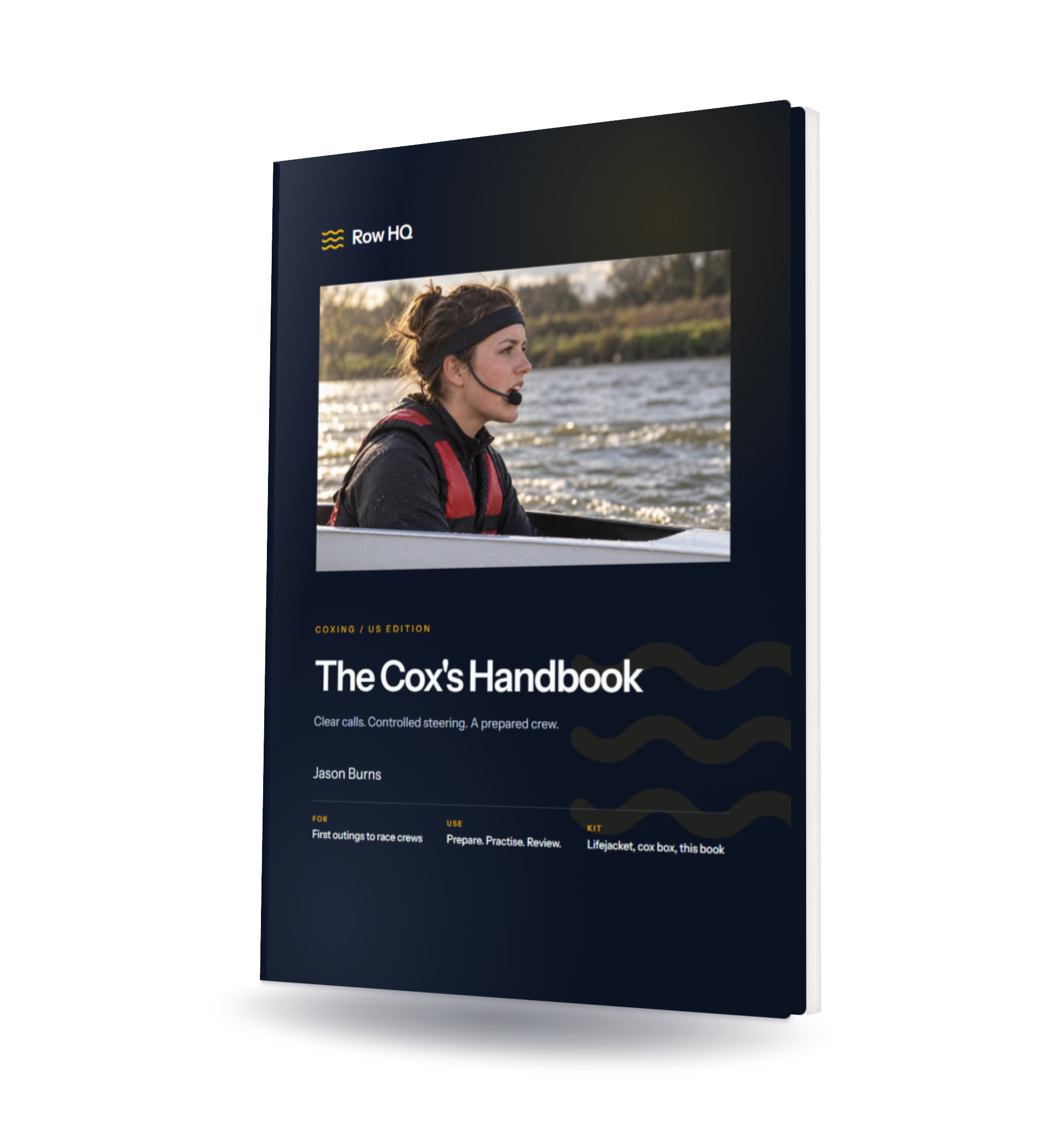
Printable PDFs written for club rowers. Buy once, keep forever.
Keep learning
Bow numbers, launch windows, and lineup changes all matter before a head race starts. Teams can keep that work together with rowing team management software. The rowing glossary explains the other race terms your athletes will hear.
Head race weekend is hard. The admin around it does not have to be.
Row HQ handles head race entries, lineup assignments, staging lists and trailer logistics in one place. Built for US college, scholastic and club programs.