Rowing Club Incident Report Form
A one-page form for recording incidents and near misses properly - on the day, while people remember. Download the PDF, keep blank copies in the boathouse, and file every completed one. Free. Enter your email and we send you the download link.
What should an incident report capture?
Date, time and exact location; who was involved and who witnessed it; the boats and equipment concerned; water and weather conditions at the time; a factual description of what happened; any injuries and treatment given; and the follow-up actions with a named owner and date. Near misses get the same form as injuries - they are the cheapest safety lessons a club ever gets. Clubs affiliated with Rowing Canada Aviron through their provincial association should also report incidents through whatever channels their association and insurer require.
Download the form
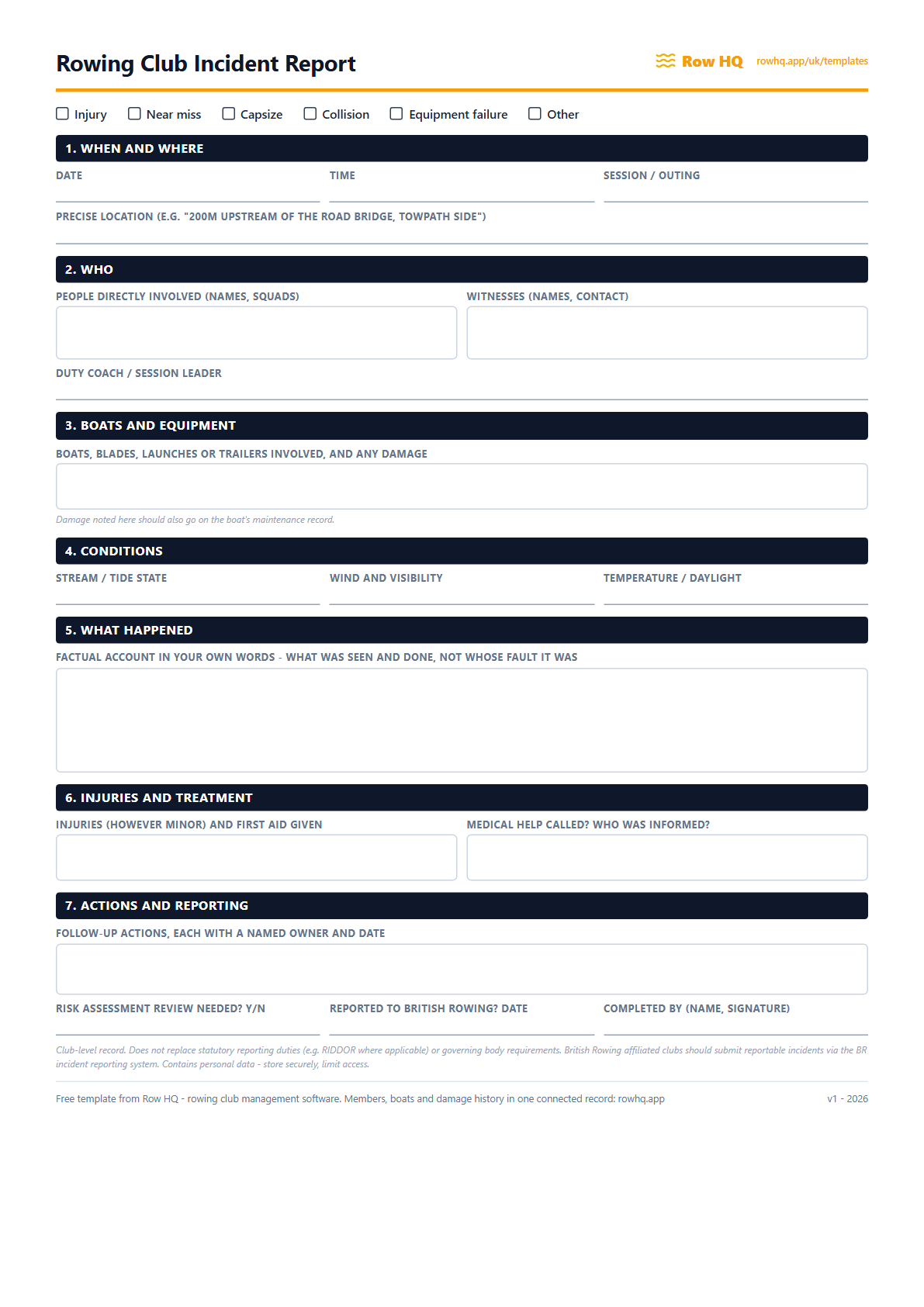
What is on the form
One page, seven sections. Designed to be completed in five minutes on the day, not reconstructed a week later.
1. When and where
Date, time, and precise location - "200m north of the club dock, near the west shore marker", not "on the lake".
2. Who
People directly involved, their crews, and witnesses with contact details. Include the coach on duty or session leader.
3. Boats and equipment
Which shells, oars, coach boats or trailers were involved, and any damage - this feeds your maintenance log.
4. Conditions
Water temperature and current, wind, visibility, air temperature, daylight. The pattern across incidents is where the safety lessons hide - and in Canada, water temperature is usually the line that matters.
5. What happened
A factual account in the writer's own words. What was seen and done - not whose fault it was.
6. Injuries and treatment
Any injury however minor, first aid given, whether medical help was called, and who was informed.
7. Actions and reporting
Follow-up actions with a named owner and a date, whether the risk assessment needs updating, and whether the incident was reported to your provincial rowing association or insurer.
This form is a club-level record. It does not replace any reporting your club owes elsewhere - workplace reporting where the club has employees, your insurer's claim requirements, or the incident reporting your provincial rowing association and Rowing Canada Aviron expect from affiliated clubs. Check what applies to your club and note the submission in section 7.
The form is for the day. The pattern is the point.
One incident report tells you what happened on Saturday. Fifty of them tell you which stretch, which conditions and which boats keep coming up. That needs the incident, the people and the equipment to be connected records rather than paper in a binder - which is what Row HQ does: members, boats, damage history and outing logs in one place, so when something happens the who-had-which-boat-when question answers itself. Print this form for the boathouse; keep the system of record in Row HQ; coach with the time you get back.
Set up your club freeFree for clubs of up to 20 active members.
Incident reporting FAQs
Should near misses be reported as well as injuries?
Yes - always. A near miss is an incident where nobody happened to get hurt this time: the eight that missed the sculler in morning fog, the sling that collapsed with no boat on it, the crew that launched into water far colder than anyone had checked. Near misses are far more common than injuries and show you exactly where the next injury is coming from. Use the same one-page form, mark it as a near miss, and review the pattern at committee level each season.
When does an incident need reporting beyond the club?
Three channels matter for Canadian clubs. Your provincial rowing association sets incident reporting expectations for affiliated clubs - capsizes, collisions, injuries and safety-relevant near misses are typically in scope, so check its current requirements. Your insurer will have its own notification rules, and late notice can complicate a claim. And Rowing Canada Aviron's safety guidance treats incident reporting as part of how affiliated clubs learn. The club form on this page is your own record on the day; note in section 7 where it was sent so nothing falls through the gap.
How long should incident reports be kept?
Keep them for as long as a claim could realistically arise. Limitation periods vary by province, and claims involving minors can be brought years after they reach the age of majority - so keep records involving juniors well into their adulthood, and ask your insurer what retention it expects. Many clubs simply keep all incident records for the life of the club: they are also the club's institutional safety memory. Store them securely - they contain personal information, so access should be limited to those who need it.
Related
The incident log is the feedback loop for your risk assessment - review one against the other at least annually. Browse the full templates library for more club documents.