Stroke Rate
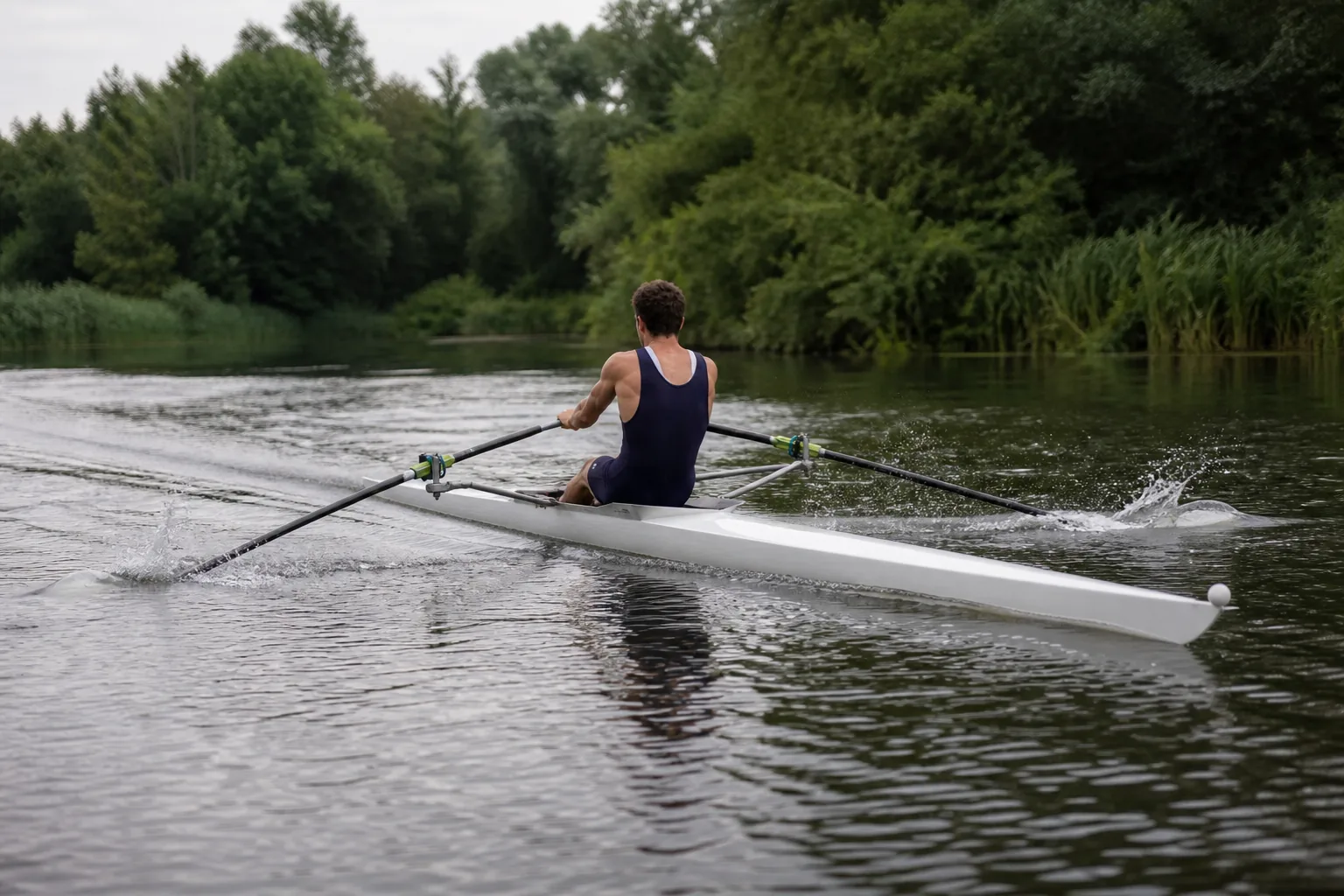
Stroke rate is the cadence number - strokes per minute (spm). NZ crews run anywhere from 18 spm in winter base work to 44 spm off the start at the Maadi Cup. Rate is not the same thing as boat speed - the two are linked through distance per stroke, and faster is not always faster.
Stroke Rate: The Cadence Number That Doesn't Equal Boat Speed
Stroke rate is the cadence number - how many complete stroke cycles a crew completes in one minute, expressed in spm. Cox boxes, ergometer monitors and NK Speedcoach GPS units all display it live. Stroke rate is not the same as boat speed - a crew can travel faster at a lower rate by lengthening each stroke (high distance per stroke), or at a higher rate by shortening them. Rates typically span from 18 spm in UT2 winter base work to 44 spm in the opening strokes off the start at the Maadi Cup or the NZ Championships.
Also called: Rate, SPM, Stroke Rating, Cadence
Definition and units
Stroke rate is expressed in strokes per minute (spm). One stroke is one complete cycle: catch, drive, finish, recovery. A crew rating 34 spm completes 34 full stroke cycles every 60 seconds. The number is purely a cadence measurement - it says nothing on its own about how fast the boat is actually moving.
Cox boxes, ergometer monitors and GPS units all display rate live, updating every few strokes. Most current units show rate to one decimal place - 34.2 spm - though whole numbers are typically used when calling rate during training. Coaches and coxes work in whole numbers; the readout is rounded mentally to the nearest spm in the field.
How stroke rate is measured
In a coxed shell, a magnetic sensor on the stroke seat's slide fires each time the seat reaches the front stop. The cox box counts those pulses and displays the rate in real time. Coxes at clubs across Aotearoa - from Hawkes Bay RC on the Tukituki to Otago RC on the harbour - use the readout to confirm the crew is on the target rate during each piece.
On an ergometer the rate is derived from flywheel and chain pull timing rather than a slide sensor. The Concept2 PM5 monitor shows rate alongside split, watts and calories through every session, and the long pulldown of an erg test is the most common environment where rowers actually watch their own rate live.
GPS units such as the NK Speedcoach can infer rate from the hull's velocity trace - the boat surges forward on each drive, and individual strokes show up as repeating peaks in the speed graph even when no slide sensor is fitted. Useful for singles, doubles and pairs where no cox box is in the shell.
Typical stroke rates by training type
Standard training and racing rates used at NZ club and national level:
- UT2 (steady state): 18-22 spm. The long aerobic base that forms the foundation of winter training volume for crews on Lake Karapiro, the Avon, the Whanganui River and waterways across Aotearoa.
- UT1 (firm aerobic): 22-26 spm. Higher quality aerobic work that lifts lactate threshold.
- AT (anaerobic threshold): 26-30 spm. Threshold pieces, sustained race-pace efforts.
- Head race pace: 28-32 spm. The settled rate over the 4-7km of head racing on courses like the Head of the Waikato or the Head of the Harbour in Auckland.
- Regatta race pace: 36-40 spm. The rate crews hold through the body of a 2km race at the Maadi Cup on Lake Karapiro, the NZ Championships at Lake Ruataniwha or the North and South Island Championships.
- Sprint or start: 40-44 spm. The burst rate crews push through the first 20 strokes off the line and the final 250m of a 2km race.
Junior and club crews typically race 1-2 spm below senior national crews in equivalent boat classes. Robbie Manson, NZ's former world record holder in the single, demonstrated how elite scullers carry high distance-per-stroke at controlled rates rather than spinning at higher cadences with shorter strokes. Use the free training pace calculator and erg pace calculator to turn pace targets into splits and training rates.
Drive-recovery ratio
Every stroke has two phases: the drive (blade in the water, applying power) and the recovery (blade clear, sliding back to the catch). The proportion of each shifts with rate.
At base training rates (18-22 spm) the recovery is two to three times longer than the drive - a 1:2 or 1:3 ratio. The crew has space to set each catch cleanly. At race rate (36-40 spm at the Maadi Cup finals on Lake Karapiro or the NZ Championships at Lake Ruataniwha) the recovery compresses sharply and the ratio approaches 1:1. The crews that hold a long, deliberate recovery at race rate carry more hull run between strokes and outrun the ones who collapse it under fatigue.
How rate affects boat speed
Stroke rate and boat speed connect through distance per stroke (DPS). DPS = boat speed divided by stroke rate. A crew can reach the same hull speed at a lower rate by making each stroke longer and more powerful (high DPS), or at a higher rate with shorter strokes (lower DPS but more frequent power application). The trade-off depends on the crew's power profile, technique and conditioning.
Above roughly 40 spm for most crews, extra rate starts to cost boat speed because the recovery is too short to load the catch with full force on every drive. The boat slows down rather than speeding up. Coaches find each crew's optimal race rate empirically through timed pieces at different cadences - that rate is what they target on race day, not the highest number the crew can physically hit.
Training rate progressions
Rate ladders are a cornerstone of NZ club training. The crew rows 5 minutes at 18 spm, 5 minutes at 20, 5 at 22, 5 at 24 - building familiarity with each rate that will appear in racing. Rate-locked pieces (such as 4 x 1km at 32 spm) develop the crew's ability to lock and hold a target rate under fatigue, which is what separates a clean race plan from a ragged one.
Stroke seats and coxes use the cox box to verify the rate is accurate through each piece. Crew lineup and session planning tools let coaches assign rate targets per piece before the session, and the cox confirms execution from the cox box display while the crew is on the water.
Stroke rate FAQs
What stroke rates do NZ crews typically use?
By training zone: UT2 base work runs 18-22 spm, UT1 firm aerobic 22-26 spm, AT threshold work 26-30 spm, head race pace 28-32 spm, 2km race pace 36-40 spm, and start/sprint bursts 40-44 spm. Senior NZ eights at the Maadi Cup finals on Lake Karapiro typically settle race pace around 38-40 spm. Junior and club crews race 1-2 spm below that. Lightweight events trend slightly higher than heavyweight equivalents.
What is the difference between stroke rate and boat speed?
Stroke rate counts cycles per minute. Boat speed measures how fast the hull moves through the water, expressed as metres per second or a 500m split. The two are connected through distance per stroke - boat speed divided by rate. A crew can reach the same speed by taking longer, more powerful strokes at a lower rate (high distance per stroke) or shorter, more frequent strokes at a higher rate (lower distance per stroke). Distance per stroke is often a cleaner measure of crew efficiency than rate alone.
What is the drive-recovery ratio at different rates?
At base training rates (18-22 spm) the recovery is two to three times longer than the drive - a 1:2 or 1:3 ratio. At race rate (36-40 spm) the recovery compresses and the ratio approaches 1:1. Crews that protect a longer recovery at high rates - holding the boat run between strokes - reliably go faster than crews that rush the slide and crash back to the catch.
How is stroke rate measured?
A small magnetic sensor on the stroke seat's slide pulses each time the seat reaches the catch position. The cox box counts those pulses and shows the cadence in real time on its display. Ergometer monitors derive rate from the flywheel and chain pull timing - the Concept2 PM5 shows it alongside split, watts and calories. GPS units like the NK Speedcoach can infer rate from the hull's velocity trace without a slide sensor, picking out the surge of each drive.
Does a higher stroke rate always mean a faster boat?
No, and this is one of the most common misreadings at school and club level. Beyond roughly 40 spm for most crews, additional cadence starts to cost power because the recovery becomes too short to load the catch cleanly on every drive. The boat begins to slow rather than speed up. Coaches find each crew's optimal race rate empirically through timed pieces at different rates - that rate, not the highest possible number, is what they target on race day at Lake Ruataniwha or Lake Karapiro.
Related
What is the Stroke Seat?
Stroke is the rower at the stern of the shell, sitting nearest the coxswain in a coxed boat. Every other rower behind st...
The Coxswain: Steering, Strategy and the Other Voice in the Boat
A coxswain (cox) is the non-rowing crew member in the stern of a coxed shell who steers, calls the race plan and holds t...
The Cox Box: The Coxswain's On-Water Electronics
A cox box is the electronics package a coxswain runs every outing - voice amplification through the hull's speaker syste...
What is an Ergometer?
Every boatshed from the Rowing NZ high-performance centre at Lake Karapiro down to a school gym in Ashburton runs the sa...
What is a Head Race?
A head race is a processional time trial. Crews leave the start every 10 to 15 seconds, race the clock over 4 to 6km of...
What is a Regatta?
A regatta is the side-by-side sprint format of rowing. Crews race in buoyed lanes over 2,000 metres (1,000 metres for ma...
From the RowHQ shop
Printable PDFs written for club rowers. Buy once, keep forever.
2k PB Push - 6-Week Peaking Block
Six weeks that turn an existing aerobic base into a 2k personal best - race-specific work, a proper taper, every pace scaled to your own time.

The Club Session Library
52 rowing sessions for club coaches, with an illustrated coaching PDF, editable CSV plans, two seasonal blocks and a printable coaching cheat sheet.
Keep learning
Rate targets make more sense when every cox and rower sees the same session plan. rowing club software for New Zealand clubs keeps each ladder and race piece clear before crews reach the water. Read the rowing glossary for the stroke terms behind the numbers.
Stop scribbling rate targets on whiteboards.
Row HQ's session planning lets coaches set rate targets per piece in advance, and members see the programme in their portal before they get to the boatshed.