The honest answer in 30 seconds
Race a split you can sit on for the full seven minutes, not one you can flash for three. The shape that wins at the Skibbereen erg trial and at the IURC Championships is the J-pattern. Fifteen to twenty hard strokes to lift the wheel (four seconds quicker than target), settle onto base by 250 metres, then a flat held line through 1500. The last 500 climbs back through the rate ladder. Skip the positive split. Going out at 1k pace is the single biggest predictor of an ugly back half. Anchor your target with the 2k prediction calculator off a recent 5k or 6k, sanity-check it on the watts-to-split converter, and pin that figure to the whiteboard before warm-up. Rowing Ireland-affiliated programmes at Skibbereen, Commercial, Trinity, UCD, UCC, NUIG and UL all use 2k results to set zones and pick crews for Irish Champs.
Every Irish rower has a 2k war story. Mine involves a Sunday morning Skibbereen trial circa nothing-to-write-home-about, blowing through 1500 with the legs already gone and trying to claw back six seconds in the final ninety. The blow-ups are rarely a fitness problem. They are a pacing problem. What follows is the working pattern Irish coaches teach: where to put the rate on the start, the four shapes you can spot on the Concept2 PM5 screen, the protocol Rowing Ireland and IURC squads pull under, and the back-half mental cues you can pre-script so the rational brain has a script when it stops being rational. Read it alongside our guide to the four ergo numbers worth tracking across a winter erg block at Inniscarra for the longer view.
Why pacing wins or loses a 2k
The 2k is awkward by design. It is longer than a power piece and shorter than an aerobic test. Roughly three-quarters of the energy is aerobic, the rest anaerobic, with the exact mix shifting by athlete. That ratio punishes the wrong call ferociously. Open up under target and lactate spills out faster than the aerobic system can scrub it; the wall arrives somewhere in the 1200 to 1500 window and the back kilometre stops being a race. Open up over target and you cross the line with petrol in the tank. The second mistake is just the polite version of the first.
Fitness does not bail you out. Athletes who can erg sub-six in a controlled piece blow up at 1500 if they race it sloppy. The pattern Dominic Casey teaches at Skibbereen, and every coach at IURC level repeats in some form, is this: the 2k is a discipline test more than a fitness test. The first 500 decides whether the second 1k is racing or surviving. The hard part is not finding a target split. The hard part is sitting on it through 1100 metres when the monitor is whispering that you could shave two seconds off if you just leaned in a touch.
The four 2k pacing profiles
Watch enough Irish trial sheets get logged into the Concept2 Logbook and four shapes appear over and over again. Coaches read them straight off the splits-per-500 view in ErgData. Three of the four shapes leak time. The fourth produces the PB.
The four shapes of a 2k erg piece
Positive split - the blow-up
Fastest 500 is the first; every quarter that follows slips. Looks heroic for three minutes, then the wheels come off after 1200. This is the default failure mode at every Irish trial. Avoid.
Flat split - the metronome
Four 500m splits stacked within half a second of each other. Boring. Repeatable. The right shape for a first 2k of the year or a piece sandwiched between two heavy sessions. Will not deliver a PB but will deliver an honest number.
Negative split - the back-end push
Second 1k faster than the first. Efficient for lactate clearance, hard on the ego because you leave seconds on the table in the opening half. Irish university coaches use it for early-season fitness checks where the trend matters more than the headline figure.
J-pattern - the racing shape
Hot first 500 a second or two under target off the flyer, then a flat middle 1k locked on target, then a building final 500 with the last thirty strokes opened up. The shape behind nearly every meaningful Irish 2k PB. The catch: you need pacing discipline through the 1000 to 1500 dark zone.
The J-pattern wins on the mental ledger. The seconds banked early carry you when the legs go. The held middle protects against the lactate cliff. The final lift uses the anaerobic capacity you guarded for the back half. Irish university coaches typically ask first-year squad rowers to run a flat split for their opening trial of the season, then move them to a J-pattern once they have felt the piece a couple of times. Junior 16s at Skibbereen often skip straight to the J-pattern - small-club erg culture there means the kids have watched it dozens of times before they touch the seat.
The ergometer is the great equaliser. Out on the Lee, on the Shannon or at Inniscarra, conditions, run, swing and timing all blur individual performance. On the erg, the only variable is you.
Step-by-step: first 500, middle 1k, final 500
A 2k is three jobs, not one. The start, the body, the sprint. Each one needs its own split target, its own rate window and its own mental cue. Coaches at NUIG and UL routinely write the three numbers on a whiteboard before the squad warms up. Two minutes of pre-piece planning is worth four seconds at the line.
First 500m - controlled flyer, then settle
Five hard strokes at rate 42 to 44 to break the inertia. Then ten to fifteen power strokes at 36 to 38, sitting four to five seconds under your target split. By stroke thirty you should be on base rate (32 to 34 for senior openweight men, 30 to 32 for senior women, two beats lower if you are a J16, J18 or master), and the split should be a second or two under target. Sitting four seconds under target at 250 metres is not racing. That is a confession that you went too hard, and you will pay for it across the back kilometre. Settle now or settle later, but settle.
Middle 1000m - hold the boring line
From 500 through 1500 your job is to be uninteresting. Hold the split. Hold the rate. Resist every urge to "see what is in there" by lifting for ten strokes. There always feels like more in the tank at 700. There is not. Around the 1000 mark the discomfort steps up sharply as lactate bites - the dark place every Irish coach has watched a rower walk into. The only correct answer is the same answer it has been all piece: stay on target split, let the rate do the work. Crews at Commercial RC, the O'Donovan-era Skibbereen squad and every IURC programme are taught the same line. Hold.
Final 500m - 30 strokes to the line
At 500 to go, rate goes up by two (34 to 36 for the build). Commit to dragging the split down by a second or two, and accept that the next ninety seconds will hurt at a level the rest of the piece did not. At 250 to go, sprint. Rate up to 38 to 42, drive everything through the foot stretcher, let the split fall as far as it will fall. The last twenty strokes will not look pretty on the camera. Nobody is watching. Cross the line and post the score.
Worked example: an honest 7:00 2k via the J-pattern
Target 1:45.0. Rate ladder 36-32-32-34-38-42 across start, body, build and sprint.
Flyer settles to base
Held at target
The dark place
Build, then sprint
How to set your target split
The right target split is one you have evidence for. Guessing produces blow-ups. Four reliable ways to anchor it, ranked roughly by how much weight Irish coaches put on each one:
-
Predict from a longer piece: The cleanest method. A recent 5k or 6k score fed through the Riegel endurance model lands within a couple of seconds of your real 2k for most trained athletes. Drop the score into the 2k prediction calculator. This is the method coaches at Skibbereen, Commercial, UCD and Trinity reach for when an athlete has not pulled a 2k in eight to twelve weeks - the long pieces at Inniscarra winter block give the predictor plenty of grist.
-
Anchor to training paces: Your UT2, UT1 and AT splits should sit in known ratios to the 2k. If your AT work has been settling around 18 to 20 seconds outside the target you are eyeing, the target is plausible. If your AT is 25 seconds outside it, the target is wishful thinking. The training pace calculator hands you the full UT2-UT1-AT-TR-AN band off one 2k input.
-
Sanity-check the wattage: A 1:45 split equals 313 watts; a 1:40 split equals 363 watts. The Concept2 maths runs as 2.80 divided by the cube of (split seconds over 500). If the target you set implies a wattage you have never sustained for six minutes, the target is fiction. The watts-to-split converter runs both ways.
-
Compare to VO2 max: 2k pace tracks closely with VO2 max - Hagerman established the relationship for rowers back in the seventies, and Irish exercise physiologists have replicated it ever since. The VO2 max calculator takes a 2k time and returns predicted VO2; running it backwards is a plausibility check on a goal. The full rowing calculator suite is here.
Race-day mental approach
Past 1000 metres the 2k is more mental than physical. Cardio limits matter but so does the capacity to keep pulling when the rational brain is shouting stop. Five mental tools that hold up at IURC trial level and the Skibbereen kids erg league alike:
- Chunk the piece: Race four 500s, not one 2k. Reset the countdown each quarter. "One done." "Halfway." "One to go." Each split is its own deadline.
- Pre-script the painful moments: Decide in advance what you will tell yourself at 1000, 1500 and 250 to go. "Hold." "Build now." "Empty it." Pre-written self-talk beats anything you invent on the fly because the inventing-brain has gone offline by 1500.
- Tunnel onto the split, not the metres: Stare at the split line. Distance remaining is demoralising at 1200; the split is something you can actually act on.
- Use a coach call: A coach or training partner calling rate at 1500, 1000, 500 and 250 to go is worth real seconds. The booking also locks you in - bailing on a piece someone is watching is hard.
- Breathe to the stroke pattern: Two-stroke breathing (in on the drive, out on the recovery, then in on the recovery, out on the drive) keeps the oxygen feed steady through the back half. Most blow-ups have a respiratory tell about thirty strokes before the split surrenders.
Common pacing mistakes
Five errors account for almost every botched 2k an Irish coach has watched a rower pull. Catch them in your own racing and the next trial gets cleaner:
-
Going out at 1k pace: The default error. Adrenaline plus fresh legs produces a first 500 that is five to eight seconds under any sensible target. The arithmetic is unforgiving. Every second you bank early costs two to three in the back half.
-
The 1500m fade: Split holds through 1000, drifts two or three seconds across 1000 to 1500, and then the sprint is gone because the legs are cooked. Almost always traceable to a fast first 1k. Hold the middle on target and the sprint returns.
-
Late sprint: Saving the kick for the final 250. The maths does not work - shaving four seconds off the last 500 cannot rescue a back half that drifted six seconds outside target. Start the build at 500 to go, not 250.
-
Rate creep through the middle 1k: Athletes losing split try to recover by lifting rate. It feels productive and burns fuel. Watch base rate every quarter - if it has climbed two beats between 750 and 1250, the piece is unravelling and you need to consciously walk the rate back.
-
Staring at time remaining: "How long left?" is the wrong question past 1000. "Is the split where I planned?" is the right one. The first invites you to bail. The second invites you to grind.
Federation testing protocols
A 2k that needs to count for selection, scholarship, talent ID or pathway placement has to be pulled under a published protocol. Anything pulled in a hoodie on a draughty gym erg with the drag factor unrecorded does not compare to a benchmark - it compares only to itself.
-
Rowing Ireland - High Performance and Pathway: Rowing Ireland-affiliated clubs and the IURC programmes at Trinity, UCD, UCC, NUIG and UL all anchor on the Concept2 2k for zone setting and crew selection into Irish Champs at Inniscarra. The Rowing Ireland performance programme uses the RowErg as the standard indoor benchmark across categories. Drag factor is logged with every recorded score - the National Rowing Centre default sits around 125 for openweight men, lower for lightweights and Juniors.
-
World Rowing - the international yardstick: World Rowing sets the international comparison points for open and lightweight categories. Ireland's Olympic gold medallists in the lightweight men's double - Paul O'Donovan and Fintan McCarthy at Tokyo and Paris, with Gary O'Donovan and Paul before that - sit inside the smallest population of erg scores ever produced by Irish athletes, but the published Skibbereen training erg numbers are the most-discussed benchmarks in Irish rowing for a reason. The piece is the same piece for everyone.
-
British Rowing - PT Testing Protocols: The British Rowing PT Testing Protocols (November 2022) sit alongside the Rowing Ireland framework for most Irish coaches. Concept2 RowErg, standardised warm-up, drag factor logged. Irish university programmes that aligned with British Rowing methodology under previous coaching staff still recognise it as a reference document, particularly for Junior pathway work feeding into Queen's Belfast, Bann and the cross-border squads.
Frequently asked questions
What is a good 2k erg time for an Irish club rower?
Weight, age, sex and training age all matter. For a fit adult openweight man at Irish club level, sub-7:00 is competitive. For an openweight woman, sub-8:00 sits comfortably in the upper tier. IURC squad rowers at Trinity, UCD, UCC, NUIG and UL routinely target sub-6:30 (men) and sub-7:30 (women) by championship season. Rowing Ireland pathway openweight men sit under 6:15 and Skibbereen senior men have historically gone under 6 flat. The Concept2 World Rankings give the full age-graded picture for every category. For masters, always run the raw score through the Concept2 age-grade tables before drawing any conclusion against the open columns.
What is the best 2k erg pacing strategy?
The J-pattern. Five-stroke start at rate 42 to 44, settle into base rate 32 to 34 sitting a second or two under target across the first 500, hold target right through to 1500, then lift the rate two beats and build the split down across the final 500 with the last 250 ridden out at maximum. This is the shape behind nearly every meaningful PB and the shape Irish university coaches teach once an athlete has outgrown a flat split.
How fast should I go out in the first 500m?
One to two seconds under your target average split. Not more. If the target is 1:45 and you are sitting at 1:43 by 250, you are on track. If you are at 1:40, you went out at 1k pace and you will pay for it somewhere between 1200 and 1500. The first five strokes can be sharp (rate 42 to 44) to get the wheel moving, but by 250 metres the rate has to be settled and the split has to be on a leash.
What stroke rate should I use for a 2k erg test?
Senior openweight men typically settle at 32 to 34 through the body, lift to 36 to 38 for the build and 38 to 42 for the sprint. Senior openweight women sit at 30 to 32 base, lift to 34 to 36, sprint at 36 to 40. Juniors and masters rate two beats lower across the board. Higher rate does not equal faster split. Watts per stroke does most of the talking.
How do I avoid blowing up at 1500m on a 2k erg test?
Three rules. Hold the first 500 one to two seconds under target, not four or five. Do not chase the split through the middle 1k - sit on target even when the monitor says you have more. Pre-script your self-talk for the 1000 and 1500 markers so the rational brain has something to grab when it stops working. The 1500 blow-up is almost always the bill for a fast first 500.
Should I negative-split a 2k?
For fitness testing or your first 2k of the year, yes. The negative split is forgiving and reliably produces a clean score. For a peak test where you are chasing a PB, the J-pattern beats it - the controlled fast start banks one or two seconds you would otherwise leave behind. Irish university coaches typically use negative splits to teach pacing confidence then graduate athletes onto the J-pattern for tested PBs.
What drag factor should I use for a 2k erg test?
Senior openweight men typically pull at 130 to 140. Lightweight men, J18s and senior women sit at 110 to 130. The standard club default in Ireland is 125 to 130 for most rowers. Inconsistency between tests destroys your trend data. Set it the same number every time and write that number on the score. British Rowing protocols leave drag factor open within sensible bands but require it logged with the score for comparability.
How long should I rest before a 2k erg test?
Most Irish coaches taper for two or three days before a peak 2k. Volume drops 30 to 50 percent, one short sharp piece (a 2 x 500 at 2k pace plus one) sits 48 hours out, the day before is rest. A twenty-minute warm-up on the day is standard - fifteen minutes UT2, three rate ladders, two power tens. Pulling a 2k cold or off heavy training in the previous 24 hours is the quickest path to a disappointing score. Trinity and UCD both schedule trial weeks at the end of a recovery block; Skibbereen runs the same principle through their winter erg league.
The bottom line
The 2k rewards pacing discipline more than it rewards courage. Athletes who PB consistently are the ones who set a defensible target, sit on the boring middle and trust the back-half push. Athletes who fold at 1500 are nearly always the ones who decided at the 250 mark that today felt like a fast day. Anchor the target with the 2k prediction calculator, cross-check the wattage on the watts-to-split converter, and run the J-pattern.
Coaches running a club or university squad: the real win is logging every 2k under a consistent protocol so you can compare scores honestly across a season. Row HQ's coach tools and member portal handle the logging and ranking automatically so the test-day debrief can be about pacing shape and pre-scripted self-talk rather than chasing test sheets across three group chats. Get started, book a walkthrough or take a look at the pricing. The FAQ covers the common setup questions.
- The Row HQ Team
Sources & references
- Rowing Ireland - Performance and Development — Rowing Ireland
- Rowing Ireland coaching resources — Rowing Ireland
- Rowing Australia — Rowing Australia
- Concept2 PM5 monitor reference — Concept2
- Concept2 ErgData app (free splits and stroke data capture) — Concept2
- Concept2 Online Logbook — Concept2
- Concept2 watts calculator (2.80 / (split_seconds / 500)^3) — Concept2
- Mikulic P et al. - Erg test validity in rowing (Journal of Human Kinetics) — Journal of Human Kinetics
- Hagerman - Applied physiology of rowing (foundational VO2-to-2k research) — PubMed / Sports Medicine
- Garland (2005) - An analysis of the pacing strategy adopted by elite competitors in 2000 m rowing — PubMed / British Journal of Sports Medicine
- Concept2 World Rankings — Concept2
- Riegel endurance model (basis for distance/time prediction) — Riegel
- C.R.A.S.H.-B. Sprints (World Indoor Rowing Championships), Boston — C.R.A.S.H.-B.
- Row HQ 2k prediction calculator — Row HQ
- Row HQ training pace calculator — Row HQ
- Row HQ watts-to-split converter — Row HQ
Related articles
From the RowHQ shop
Printable PDFs written for club rowers. Buy once, keep forever.
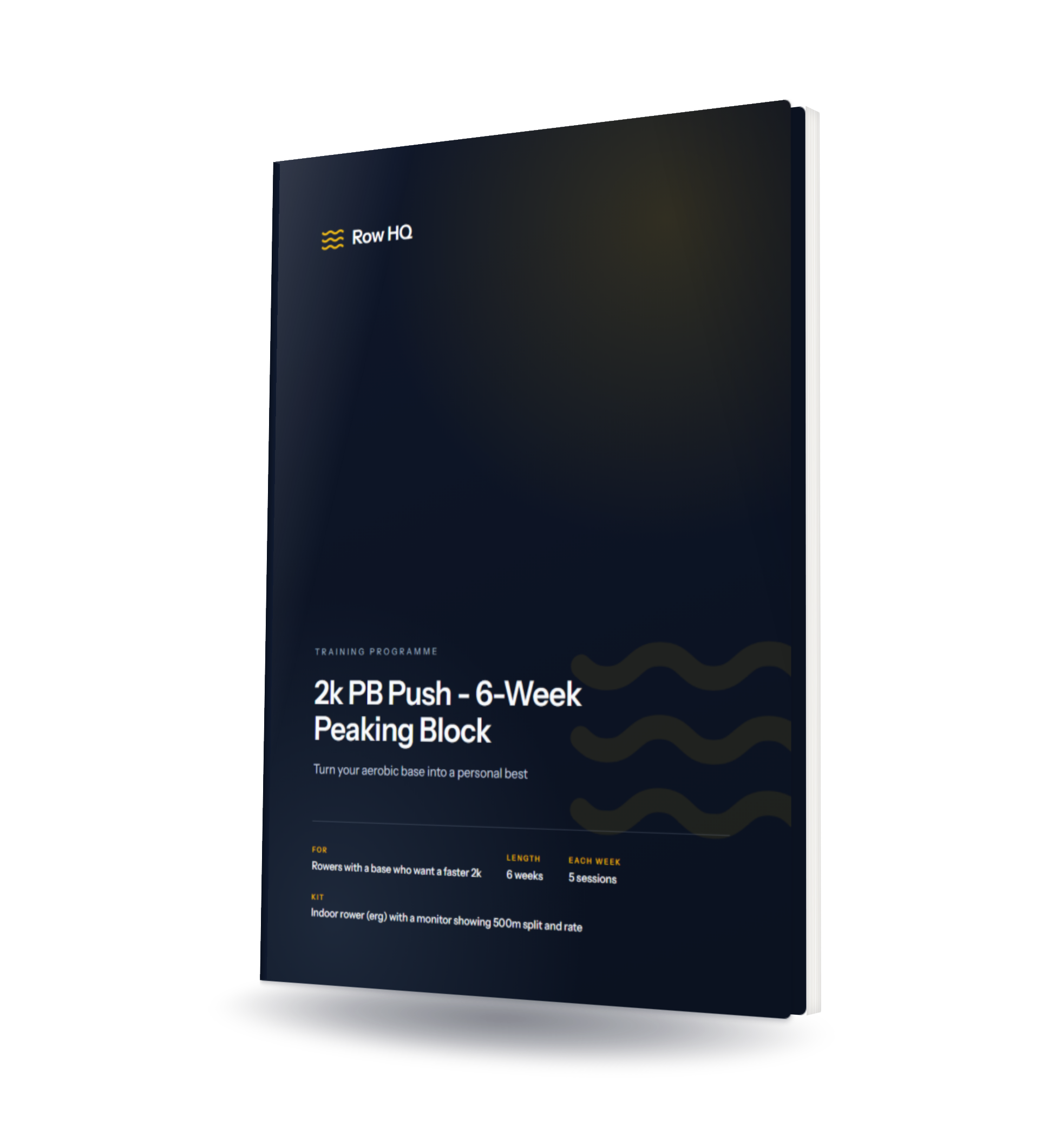
2k PB Push - 6-Week Peaking Block
Six weeks that turn an existing aerobic base into a 2k personal best - race-specific work, a proper taper, every pace scaled to your own time.
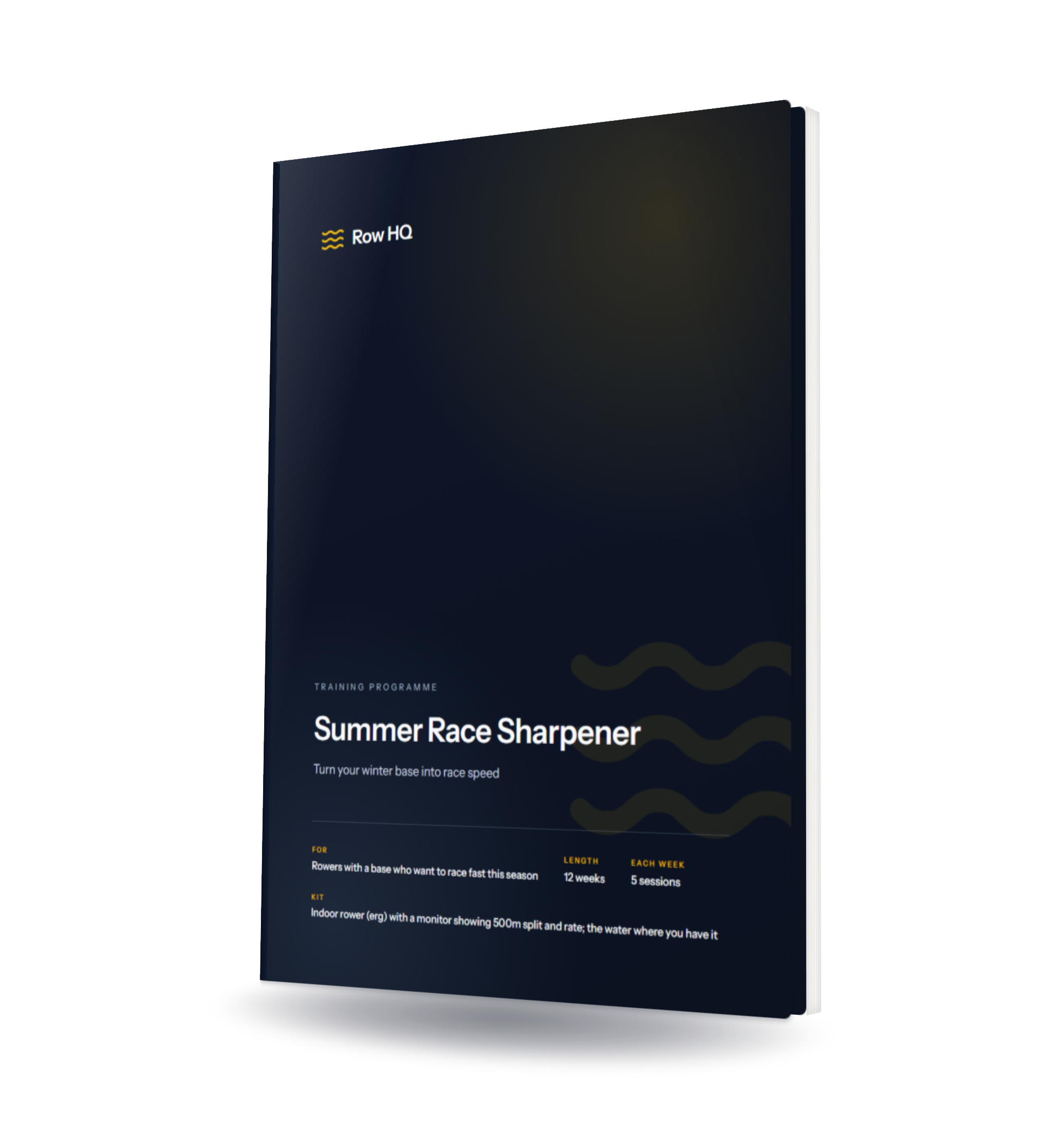
Summer Race Sharpener
Turn your winter base into race speed - 12 weeks that sharpen a big aerobic engine and peak you for a target regatta or 2k, every pace set from your own 2k.