Short answer for the bus home
Lock a split you have evidence you can hold for seven minutes flat, not the one you can pop for three. The shape that wins seats at AGSV, CAS, GPS and King's Cup trials is the J-pattern: a controlled punch for 15 to 20 strokes (3 seconds quicker than target), settled base by 250m, flat as a Penrith dawn through 1500m, then a 30-stroke wind home. Going out at 1k pace costs more seats than any other single error. Anchor the target with our 2k projection tool, cross-check the watt figure on the watts-to-split utility, and pull the score under your state institute or Rowing Australia protocol if it has to count for selection.
The 2k ergometer is the only currency every Aussie rowing programme accepts. GPS schools, AGSV / CAS / IGSSA squads, university 1st VIIIs, masters scullers chasing age-graded gold, and every NSWIS, VIS, QAS, WAIS and SASI scholar all live or die by this seven-minute piece. One athlete, one Concept2 PM5, one number on the printout the rowing master pins to the noticeboard. This guide walks through how to race the thing properly. J-pattern split shape, AIS-style federation protocols, the back-half mistakes Year 10 schoolboys repeat at their first Australian Indoor Rowing Championships, and the mental cues that hold when the legs are gone. Pair it with our four-metric guide to reading ergo data.
Why the middle 1k decides the score
A 2k sits in physiological no-man's-land. Too long for a clean alactic effort, too short for a pure aerobic test. Sport-science estimates put the mix at 75 percent aerobic, 25 percent anaerobic for trained Aussie rowers, varying with body mass and lactate handling. Pacing rewards patience harshly. Crack the first 500m and lactate stacks faster than the aerobic system can shift it. The wheels come off between the 1200 and 1500 marks. The back half stops being racing and turns into damage control all the way to the line.
The fittest scholar in the SASI tank goes backwards if the pacing is wrong. The lesson coaches at Mosman Rowing Club drill into novice schoolboys is the same one Sam Beltz wrote about in her W2- prep notes: discipline beats bravery on this piece. A controlled opening 500 is the single biggest predictor of whether the second 1k feels like racing or surviving. Pick the right shape. Then keep the discipline when the monitor flashes a number you could "easily" beat by two seconds at the 700m mark.
Four split shapes selectors see
Watch enough piece replays on ErgData or the Concept2 Online Logbook and the same four shapes appear. AGSV / CAS coaches use the splits-per-500 view to clock them inside ten seconds of finish. Three shapes leak time. One bags PBs.
The four shapes a 2k can take
Positive split: the blow-up
Quickest 500 first, every quarter slower. Strong for three minutes, brutal from 1200m on. The mistake every Year 9 makes on debut and plenty of senior club rowers never quite shake. Avoid at all costs.
Flat split: the metronome
All four quarters land within half a second of each other. Boring, repeatable, honest. The safe play for first piece of pre-season or any test bookended by heavy water sessions. Will not crown a PB but will not embarrass anyone either.
Negative split: the back-end build
Second 1k quicker than the first. Physiologically tidy and friendly to lactate clearance. Mentally it concedes free seconds early. AIS-style protocols use this for repeatable fitness benchmarks where peak is secondary to data consistency.
J-pattern: the racing shape
Quick first 500 from a controlled punch, held middle 1k at target, building final 500 with a 30-stroke wind to the line. Lifts almost every meaningful PB off Aussie ergos and is the shape behind most AIRC podium scores.
J-pattern wins because it concedes the smallest sliver of efficiency for the biggest mental lift. Bank a couple of seconds early via a tidy punch, then guard the middle 1k against lactate flood, then cash the alactic reserve in the closing 500. Most school programmes work the flat shape for the first two trials of pre-season, then graduate to the J-pattern once an athlete has a 6k benchmark to peg the target off. Coaches at Sydney Rowing Club and the Banks BBC Boat Club follow the same progression. Sam Beltz of W2- fame drilled the same pattern with her Melbourne crews.
Elite male rowers in our analysis adopted a fast-start, even-pace strategy in the 2,000m on-water race, with the first 500m the fastest section and the middle 1,000m held at a remarkably even pace - a pattern that maximises performance under the energetic demands of the event.
Three-phase race plan
A 2k is three pieces of work bolted together, not one unbroken effort. Split it into the punch, the body and the wind-home, and carry a split, a rate and a feel target into each.
Punch (0 to 500m): launch then settle
Open with five hard strokes at rate 42 to 44 to spin the wheel up, then 10 to 15 power strokes at rate 36 to 38 about four seconds quicker than target. By stroke 30 the rate should have dropped to base. For senior men that lands around 32 to 34, senior women 30 to 32, Year 9 and 10 schoolboys and schoolgirls usually 28 to 30 because school programmes race lower rates. Split should read 1 to 2 seconds under target by the 250 marker. Reading 4 seconds under? Going out way too hot. Settle now or pay between 1200 and 1500.
Body (500 to 1500m): do nothing memorable
From the 500 buoy to 1500m the brief is simple. Sit on target split. Sit on base rate. Resist the urge to "feel out" the piece by hammering ten strokes to see if there is more in the tank. There always feels like more at 700m. There almost never is. Around 1000m the discomfort jumps a level because lactate starts bouncing back into the bloodstream. Adrian Cassidy calls this the bury zone in his AIS coaching notes. Right answer: stay locked on the target number. Let the rate carry the boat.
Wind-home (1500 to 2000m): 30 strokes to the line
At 500m to go, lift rate by two beats (typically into the 34 to 36 band for the main push), commit to dragging the split down 1 to 2 seconds, and accept the next 90 seconds will hurt past anything the body got served earlier. At 250m to go, full sprint. Senior men 38 to 42, senior women 36 to 40, drive everything through the foot stretcher, and chase the split as low as it will go. Last 20 strokes will look ugly on video. No one watching the printout cares.
Worked example: a 6:30 piece on the J-pattern
Target average 1:37.5. Rate plan 36-32-32-34-38-42 across punch, body, build, wind. King's Cup squad shortlist standard for an openweight man.
Punch then settle
Locked at target
Bury zone
Build into sprint
Setting a target you can defend
Race the split you have evidence you can hold. Guessing kills 2ks. State institute coaches like Ross Smith at NSWIS lean heavily on the 6k as the anchor test for the 2k. Most school programmes pull a 6k benchmark every six to eight weeks for the same reason. Four ways to land a target you can argue for in front of the rowing master:
-
Project from a longer piece: The honest method. A recent 5k or 6k pumped through the Riegel endurance relation lands a 2k inside two seconds for most trained Aussie rowers. Our 2k projection tool takes the input and spits out the defensible target. NSWIS, VIS and most school programmes lean on this when an athlete has not pulled a 2k in two months.
-
Cross-check with training paces: UT2, UT1 and AT splits should sit in known relationships to the 2k. AT work settling 18 to 20 seconds slower than your target? The target holds. AT closer to 25 seconds slower? The target is fiction. Run the maths via the training pace tool, which derives the full five-zone band from a single 2k input.
-
Sanity-check the wattage: 1:37.5 is roughly 400 watts. 1:35 is 433 watts. Concept2 pegs watts to split via the canonical 2.80 / (split_seconds / 500)^3 relation. If the target watt figure exceeds anything held for a six-minute interval by 30 percent or more, the target is implausible and the back half will fold. The watts-to-split utility runs both ways.
-
Map back from VO2 max: 2k pace correlates strongly with VO2 max in oarsmen. Fred Hagerman established the relationship across elite-standard rowers in the 1970s and 1980s. Our VO2 max tool takes a 2k time and returns a projected VO2 max; run it the other direction as a plausibility check on a target. Browse the wider free ergo toolkit for the rest.
Mind game past the 1k buoy
The 2k turns mental past 1000m. Cardio limits matter. The capacity to keep pulling when the rational brain has packed it in matters more. Five tools that hold up for most Aussie rowers:
- Chunk the piece: Race four 500s, never a 2k. Reset the countdown each quarter. "One done." "Halfway." "One to go."
- Pre-script the brutal moments: Decide ahead of time what the inner voice says at 1000, 1500 and 250 to go. "Hold target." "Build now." "Empty it." Pre-written self-talk beats invented self-talk because the thinking brain has already checked out by 1500m.
- Tunnel onto split, never metres: Stare at the split line on the PM5, not the metres counter. Metres remaining is poison at 1200m. Split is something the body can act on right now.
- Use a coach call: A coach or training partner calling rate at 1500, 1000, 500 and 250 to go is worth real seconds. Locks the athlete into the piece too because nobody bails with eyes watching.
- Breathe to the stroke cycle: Two-stroke breathing (in on drive, out on recovery, then in on recovery, out on drive) keeps oxygen flow steady through the back half. Almost every blow-up has a respiratory tell 30 strokes before the split slips.
Where Year 10s lose their first one
Five errors account for nearly every botched 2k at AGSV / CAS / GPS schoolboy and schoolgirl level, plus a fair chunk of the club ones too. Spot them in your own racing and the next test goes better:
-
Launching at 1k pace: Most common error of the lot. Adrenaline plus fresh legs spits out a first 500 five to eight seconds quicker than any sensible target. Maths is unforgiving. Every second banked in the punch costs two to three seconds in the back half.
-
The 1500m fade: Split holds to 1000m, drifts two to three seconds between 1000 and 1500, then the sprint is impossible because the legs are cooked. Almost always traces back to a positive-split first 1k. Lock the middle and the wind-home returns.
-
Late sprint: Saving everything for the closing 250. Maths does not work. Shaving four seconds off the final quarter cannot rescue a back half that drifted six over target. Build from 500 to go, never from 250.
-
Rate creep through the body: Athletes leaking split tend to lift rate because it feels productive. Watch base rate at every quarter. Climbed two beats between 750 and 1250? Wheels are about to come off. Back the rate down deliberately.
-
Watching metres remaining: "How much left?" is the wrong question past 1000m. "Is the split where I said it would be?" is the right one. First question invites bailing. Second invites the discipline that holds the J-pattern together to the line.
Selection protocols that actually count
If a 2k score has to count for state institute selection, King's Cup shortlisting or Rowing Australia talent identification, the piece needs to be pulled under a published standard. Three governing standards Aussie rowers race against:
-
Rowing Australia plus the state institutes: Rowing Australia runs talent identification and squad selection through NSWIS, VIS, QAS, WAIS and SASI. Concept2 2k scores get benchmarked against published age-group and weight-class standards. King's Cup squad shortlisting and senior international representation route through these institutes. A 2k pulled in the school gym does not count toward selection unless it lands under their protocol.
-
Australian Indoor Rowing Championships: The AIRC is the headline 2k race on the Aussie calendar. Drag factor sits inside published limits for record verification. AIRC times act as the public comparison benchmark for school programmes and the score athletes reference when chasing state institute attention. Penrith International Regatta Centre often hosts feeder events on the way through.
-
British Rowing PT Testing Protocols: Many Aussie coaches reference the British Rowing PT Testing Protocols (November 2022 PDF) as a clean published standard. The document specifies Concept2 RowErg for every fitness piece, sets warm-up protocols, and locks down drag factor expectations. Useful as a default standard for any programme that has not yet committed to its own written rules.
Questions captains ask us
What is a respectable 2k ergo score for an Aussie rower?
Depends on age, sex and weight class. As a rough yardstick: senior openweight men under 6:30 is competitive club; under 6:00 lands national squad consideration; under 5:50 is King's Cup grade. Senior openweight women under 7:15 club, under 6:50 national squad, under 6:35 international. GPS, APS and AGSV Year 12 schoolboys typically need under 6:30 (heavyweight) for serious 1st VIII selection; schoolgirls under 7:30 (heavyweight). Lightweight men under 6:30 and lightweight women under 7:20 are strong scores. Concept2 World Rankings carry the full age-graded picture.
Which pacing shape produces the most PBs?
J-pattern. Five hard strokes at rate 42-44 off the start, settle into base rate 32-34 (senior men) or 30-32 (senior women) at 1 to 2 seconds under target for the first 500, hold target through 1500m, then lift rate two beats and build the split down across the final 500, sprinting the closing 250. The shape behind almost every meaningful PB and the one NSWIS, VIS and most school 1st VIII coaches teach.
How quick should the opening 500 be?
1 to 2 seconds quicker than target average split. Not 5. Target 1:38.8 and the monitor reads 1:37 at 250m? On track. Reading 1:33? Going way too hot and the back half will fold between 1200 and 1500. First five strokes can spike to rate 42-44 to spin the wheel up, but by the 250 marker the rate must have settled and the split must be locked.
What rate should the body of the piece sit at?
Senior men typically settle at 32-34 through the middle, lifting to 36-38 across the final 500 and 38-42 in the sprint. Senior women sit at 30-32 base, lifting to 34-36 then 36-40. Year 9 and 10 schoolboys and schoolgirls usually rate two beats lower across the board. High rate does not move the wheel. Watts per stroke matters more, and ErgData logs both for post-piece review.
How do I stop blowing up at 1500m?
Three things. First, hold the opening 500 to 1 to 2 seconds under target, never 5. Second, do not chase the split through the middle 1k. Sit on target even when the monitor whispers there is more. Third, pre-script the inner voice at 1000m and 1500m so the thinking brain has a plan once it stops working. Blow-ups almost always pay the price for a hot opening 500. This is exactly why Year 9 and 10 schoolboys lose their first AIRC attempt right here.
Is a negative split ever the right call?
For fitness benchmarking or the first 2k of pre-season, yes. Forgiving, reliable, produces a clean score. For a peak test chasing a PB or trialling for state institute selection, the J-pattern beats a pure negative because the controlled punch banks 1 to 2 seconds you would otherwise leave on the table. Coaches typically use negative splits to build pacing confidence, then move athletes to J-pattern for tested PBs.
What drag factor should the lever be on?
Senior heavyweight men typically pull at 130-150; lightweights, women and junior schoolboys at 110-135. Higher drag does not equal quicker splits for most athletes. It just burns the legs out and shortens the stroke. Check the Display menu for the actual drag factor reading (the lever position number on the side of the flywheel cage is only a rough guide). Whatever drag chosen, log it with the score so the piece is comparable across the testing block.
How long should the taper before a peak 2k be?
Most coaches taper for two to three days before a peak 2k. Drop volume by 30-50 percent, keep one short sharp piece (a 2 x 500 at 2k pace +1) 48 hours out, rest the day before. A 20-minute warm-up on the day, 15 minutes UT2, three rate ladders, two power 10s, is standard. Pulling a 2k cold or off heavy training in the previous 24 hours is the quickest route to a disappointing score and a war story on the bus home from the regatta.
Pulling it together
The 2k rewards pacing discipline ahead of pacing bravery every single time. Aussie rowers who PB consistently, from Year 11 schoolgirls at SCEGGS to King's Cup heavyweights at Sydney Uni Boat Club, set a defensible target off a recent 6k, hold the bury zone, and trust the back-half build. Athletes who explode at 1500m mostly decided at the 250 marker that today felt like a fast day. Set the target via our 2k projection tool, sanity-check the watt figure on the watts-to-split utility, and race the J-pattern.
Coaching a school or club squad? The lever is logging every 2k under one consistent protocol so scores compare honestly across the GPS, APS, AGSV or CAS season and selection calls hold up in front of parents and the rowing master. Row HQ's coach toolkit and member portal handle the recording and ranking, so the test debrief is about pacing shape and pre-scripted self-talk, not chasing dog-eared test sheets. Get started, book a walkthrough, or browse the pricing tiers. The FAQ covers the usual setup questions.
- The Row HQ Team
Sources & references
- Rowing Australia — Rowing Australia
- Australian Indoor Rowing Championships (AIRC) — AIRC
- British Rowing PT Testing Protocols (November 2022 PDF) — British Rowing
- USRowing - testing protocols (cross-reference standard) — USRowing
- Concept2 PM5 monitor reference — Concept2
- Concept2 ErgData app (free splits and stroke data capture) — Concept2
- Concept2 Online Logbook — Concept2
- Concept2 watts calculator (2.80 / (split_seconds / 500)^3) — Concept2
- Mikulic, Smoljanovic & Bojanic (2009) - Pacing strategy in international rowing — PubMed / Journal of Strength and Conditioning Research
- Hagerman - Applied physiology of rowing (foundational VO2-to-2k research) — PubMed / Sports Medicine
- Garland (2005) - An analysis of the pacing strategy adopted by elite competitors in 2000 m rowing — PubMed / British Journal of Sports Medicine
- New 2k world record 5:35.8 (Josh Dunkley-Smith, AUS, 2018) — Concept2
- Riegel endurance model (basis for distance/time prediction) — Riegel
- Row HQ 2k projection tool — Row HQ
- Row HQ training pace tool — Row HQ
- Row HQ watts-to-split utility — Row HQ
Related articles
From the RowHQ shop
Printable PDFs written for club rowers. Buy once, keep forever.
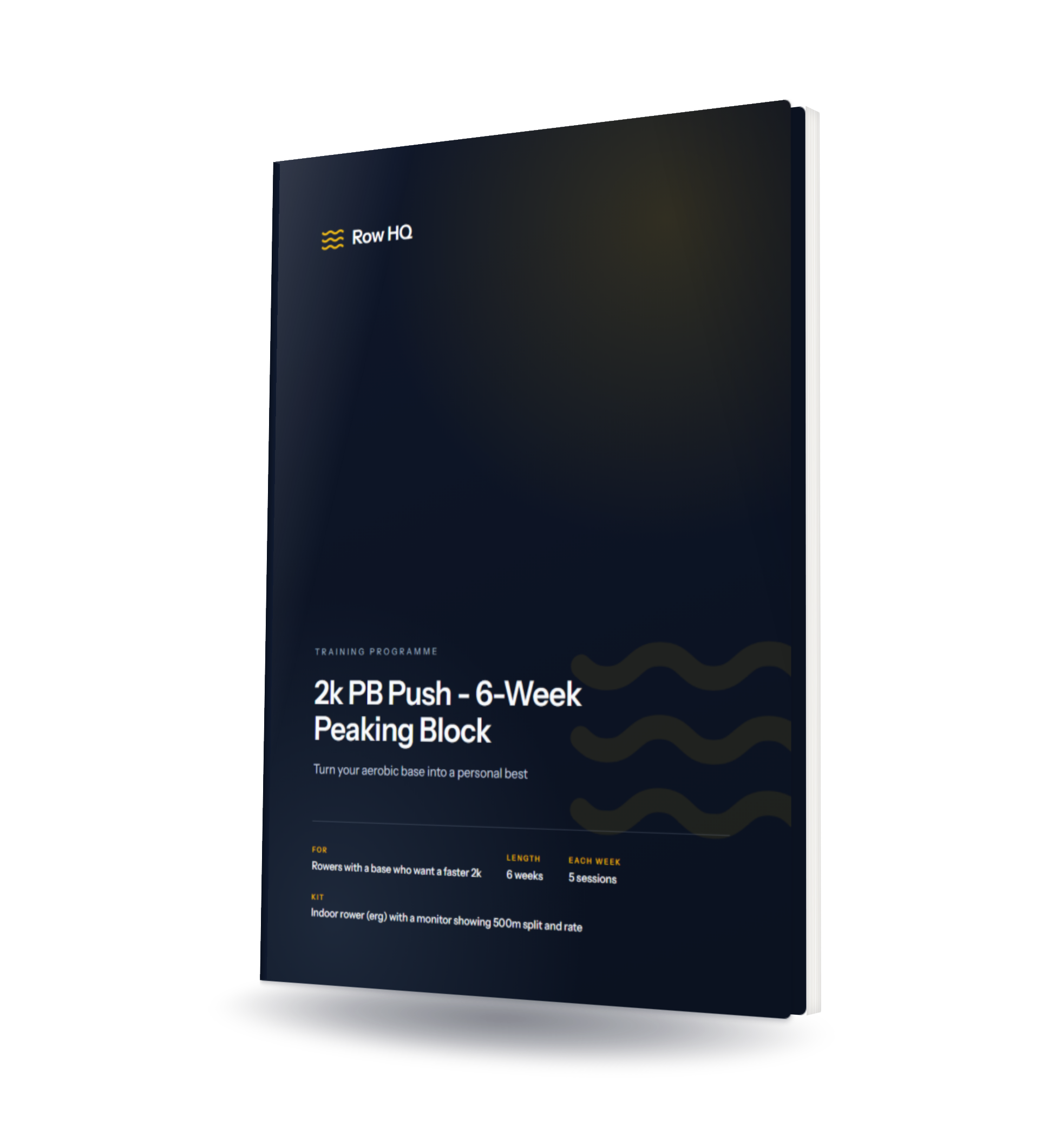
2k PB Push - 6-Week Peaking Block
Six weeks that turn an existing aerobic base into a 2k personal best - race-specific work, a proper taper, every pace scaled to your own time.
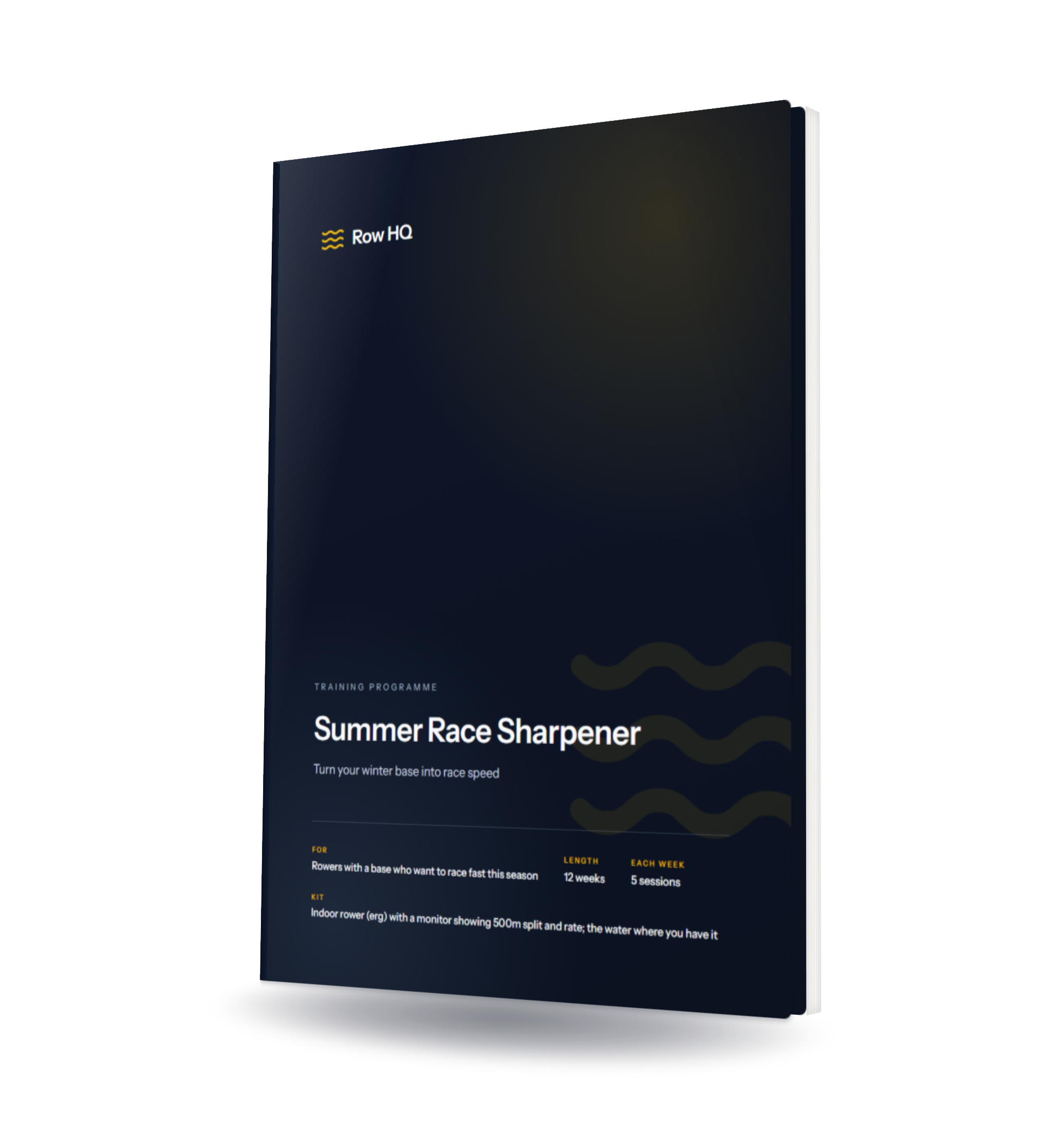
Summer Race Sharpener
Turn your winter base into race speed - 12 weeks that sharpen a big aerobic engine and peak you for a target regatta or 2k, every pace set from your own 2k.