Pacing plan in 30 seconds
Race a split you can defend for seven minutes flat, not a split you can flash for three. The shape that puts athletes in 1V conversations is the J-pattern: a controlled flyer under target for the first 15 strokes, drop to base rate by stroke 30, sit on target through 1500m, then climb the rate by 2 beats and bring the split down across the final 500. American rowers lose more pieces to a fast first quarter than to any other single error. Plug a recent 6k into the 2k prediction calculator, double-check the wattage on the watts-to-split converter, and pull the test under USRowing testing protocols so the number actually counts.
Boston in February. Forty-three rowers warming up on lined-up RowErgs at the C.R.A.S.H.-B Sprints in the Reggie Lewis Center. Same routine at every IRA-bound boathouse a month earlier for trials. Same routine at every Mid-Atlantic high school program sending Stotesbury and SRAA scores to college coaches in the spring. Seven minutes on a Concept2 PM5 decides scholarships, varsity 1V seats, recruiting profiles, and how the depth chart reads for the rest of the season. This post is the pacing plan: J-pattern split targets, the federation rules your score lives or dies under, the freshman trap at 1250m, and the back-end push that turns a brave attempt into a number the coaching staff acts on. Pair it with our four PM5 metrics worth tracking if you want the season-long view.
Why the 2k punishes a hot start
A 2k erg piece is the awkward middle distance. Too long for raw power output, too short for a clean aerobic test. The fuel mix is roughly four-fifths aerobic and one-fifth anaerobic for a heavyweight man under 6:00, slightly more anaerobic share for lightweights and women under their own benchmarks. The exact ratio matters less than what it means in practice: open at 1k pace and lactate floods faster than the aerobic engine can buffer it, the third 500 collapses, and the score lands six to ten seconds outside what your training said you could do. Hold back too far and you finish with watts unused, which the coach reads as either poor pacing or insufficient grit. Neither plays well in selection meetings.
Fitness sets the ceiling. Pacing decides whether you reach it. A freshman pulling 6:55 with a clean J-pattern moves up the depth chart faster than a sophomore pulling 6:58 off a hot start that turned into a death march at 1250m. The IRA-level head coaches I have watched debrief test sheets care about pacing shape more than they care about peak split, because shape predicts what an athlete will do under boat pressure in a Grand Final at Mercer Lake. A controlled first 500 is the strongest signal an athlete sends about whether the next 1500m will be racing or surviving.
Four split shapes coaching staffs watch for
Pull a season of test sheets off the Concept2 Logbook for any varsity program and four pacing shapes show up across hundreds of pieces. Coaching staffs reviewing seat-race candidates and recruits can name the shape by the second 500. Three of the four cost the athlete; the fourth puts them in boats.
How a 2k looks in four splits
Positive split - the unravelling
First 500 fastest, each subsequent quarter slower. Strong through three minutes, ugly from 1200m forward. The default pattern for any freshman pulling a first competitive 2k, and the most common reason JV athletes never break into 1V. Drop this and the rest of the test is damage control. Avoid at every level.
Flat split - the metronome
All four 500m quarters within roughly half a second of each other. Honest and unflashy. The right call for a freshman pulling a first 2k, or for a senior testing between two championship weekends. Will not deliver a PR but will not blow up either, which has its uses early in a fall trials cycle.
Negative split - the cautious returner
Second 1k faster than the first 1k. Physiologically clean and friendly to lactate clearance, but it concedes time in the first half that the back half cannot fully recover. Coaches at programs like Brown and Princeton sometimes prescribe this shape for a September baseline where stable scores matter more than absolute peaks.
J-pattern - the racing shape
Hot first 500 under target by a second or two, locked middle 1k on target, building 500 to the line with a 30-stroke sprint. The shape behind almost every NCAA varsity PR and most C.R.A.S.H.-B podium scores. Demands discipline through the third 500, which is where most attempts at the J fall apart and revert to a positive split.
The J-pattern wins because it pays for a small mental bonus with a small physiological cost. The opening seconds bank time you would otherwise have to chase when smoked; the held middle 1k keeps lactate inside what the aerobic system can clear; the back-half climb cashes in the alactic and aerobic reserves you protected. Coaches at Cal under Mike Teti, and Tom Terhaar with the US women, drill this profile from the moment an athlete clears the freshman year. A first-year rower might race two or three flat splits before the staff lets them attempt a J, but once an athlete can hold the J under pressure they are racing the piece properly.
Elite male rowers in our analysis adopted a fast-start, even-pace strategy in the 2,000m on-water race, with the first 500m the fastest section and the middle 1,000m held at a remarkably even pace - a pattern that maximizes performance under the energetic demands of the event.
Quarter by quarter: opener, body, kicker, sprint
Stop racing a 2k. Race four 500s glued together. Each quarter gets a split target, a rate target, and a feel target, plus a single mental cue you committed to before the warm-up.
First 500 - controlled flyer, then settle
Open with five strokes hard at rate 42-44 to spin the flywheel up. Then 10 to 15 power strokes at rate 36-38 about four seconds under target split while the watt-per-stroke number on the PM5 climbs and stabilizes. By stroke 30 you want to be at base rate (32-34 for heavyweight men, 30-32 for heavyweight women, 30-32 for lightweight men, 28-30 for lightweight women) and the split should read one to two seconds under target. If the screen says four seconds under at 250m you went too hot and the third 500 will eat you alive. Settle the rate now. The flyer banked you the seconds. Spending them all early defeats the entire point.
Middle 1000m - hold the boring line
From 500m to 1500m the assignment is dull. Sit on target split. Sit on base rate. Refuse the temptation to "explore" the piece by pulling harder for 10 strokes to find out if there is more. There always feels like there is more at 750m. There is not. Around the 1000m mark the discomfort grades up sharply because lactate accumulation crosses the threshold the aerobic system can clear. This is the spot coaches watch for in the Concept2 stroke trace, because it is where most positive splits get launched. Stay on split. Let the rate do the work it agreed to do.
Final 500 - the climb and the kicker
At 500m to go, lift rate by 2 (typically into the 34-36 range for heavyweights, 32-34 for lightweights), commit to bringing the split down by one to two seconds, and accept that the next 90 seconds are going to feel categorically worse than anything that came before. At 250m to go, sprint. Rate goes to 38-42 for heavyweight men, 36-40 for women and lightweights, drive every gram of body weight onto the foot stretcher, hammer the split as low as the flywheel will accept. The final 20 strokes are ugly. The score is the score. Cross the line and post.
A worked 6:34.0 via the J-pattern
Target 1:38.5. Rate plan 36-32-32-34-38-42 across opener, body, kicker and sprint. Varsity heavyweight man, late February C.R.A.S.H.-B build.
Flyer to base rate
On target, refuse the explore
The kicker, hold the rate
Build then sprint
Anchoring the target off a fall 6k
Target the split you have actual evidence you can hold. American programs rely heavily on the 6k as the anchor piece for any subsequent 2k - USRowing camp testing, every IRA program winter cycle, and most varsity recruiting calendars use it. Four ways to land a defensible target before you sit on the erg:
-
Project from a longer piece: The most reliable method. Drop a recent 5k or 6k into the Riegel endurance model and the 2k target lands within two seconds for any trained athlete. Our 2k prediction calculator runs the math - paste the 6k split and it returns a target that holds up in a coach meeting. Coaching staffs at Yale, Stanford and Washington use this approach for any rower who has not pulled a 2k inside the last eight weeks.
-
Anchor against training zones: Your UT2, UT1 and AT splits should sit in predictable ratios to 2k pace. If AT work has been settling around 18 to 20 seconds slower than the target 2k, the target is defensible. If AT sits 25 seconds slower, the target is invented. The training pace calculator derives the full UT2-UT1-AT-TR-AN zone band from one input. Concept2 publishes the same zone structure in its training program library.
-
Cross-check the wattage: A 1:38.5 split is 384 watts on the flywheel. A 1:35 split is 433. Concept2 derives watts from split as P = 2.80 / (split_seconds / 500)^3. If the target implies wattage 30 percent or more above what an athlete has ever held for a six-minute interval, the target is fiction and the back end will collapse on cue. The watts-to-split converter runs the conversion both directions.
-
Reverse against VO2 max: 2k pace correlates tightly with VO2 max in rowers - Fritz Hagerman documented this in American oarsmen at the US senior team level back in the 1970s. Our VO2 max calculator takes a 2k and returns a predicted VO2 max; running it backwards becomes a plausibility check on a target you are kicking around. The full rowing calculator suite covers every step from training zone to race-day target.
What to say to yourself at 1250m
After the first 1000m, the 2k becomes a mental piece. Cardio-respiratory limits set the ceiling, but the capacity to keep producing watts when the rational brain has clocked out is what separates two athletes with identical 6k scores. Five techniques that show up in interview after interview with NCAA varsity rowers and US senior team members:
- Race four 500s, not a 2k: Reset the mental countdown on every split line. "One quarter in." "Halfway." "Last quarter, eyes up."
- Script the painful moments in advance: Pick your line for 1000m, for 1250m and for the 250m kicker before you warm up. "On the split." "Build now." "Empty the tank." Pre-decided self-talk works because the rational brain is unavailable at 1250m and the option of inventing something new on the fly is not really an option.
- Lock onto the split number, not the meters remaining: Stare at the /500 line on the PM5. Meters remaining is psychologically expensive at 1300m; the split is something you can act on right now with the next stroke.
- Use a coach call: A coach or training partner calling rate and split at 1500m, 1000m, 500m and 250m to go is worth measurable seconds. Booking the call in advance also locks you into the test - nobody bails on a coach who showed up to read for you.
- Pattern your breath to the stroke: Two-stroke breathing keeps oxygen exchange steady through the third 500. Most blow-ups have a respiratory tell about 30 strokes before the split walks - if you catch it, you can sometimes save the piece.
Five mistakes that cost varsity seats
Five errors account for the majority of underperformed 2ks at every level from scholastic 4+ to senior national team trials. Spot them in your own test and the next one goes better:
-
Opening at 1k pace: The most common error at every level. Adrenaline plus a fresh body produces a first 500 five to eight seconds under target. The math is unforgiving. Every second banked in the first 500 costs roughly two to three seconds in the back half. Settle by 250m.
-
The 1250m fade: Split holds clean through 1000m, drifts two to three seconds in the third 500, then the sprint is impossible because the legs are toast. Almost always traces to a positive-split first 1k. Hold the body of the piece on target and the sprint survives.
-
Saving the sprint for 250m to go: The arithmetic does not work. Shaving four seconds off the closing 500m cannot rescue a third 500 that drifted six seconds. Start the build at 500m to go, kick at 250m, do not invert that order.
-
Rate creep through the body: Athletes losing split tend to compensate by lifting rate, which feels like work and consumes glycogen without producing watts. Watch the base rate every quarter. If it has climbed two beats between 750m and 1250m the wheels are coming off. Consciously bring rate back down.
-
Staring at meters remaining: "How long left?" is the wrong question after 1000m. "Is the split where I said it would be?" is the right one. The first invites bailing; the second invites the discipline that holds the J together.
USRowing, CRASH-B, IRA and NCAA testing rules
If a 2k needs to count for selection, scholarship review, recruiting profile, or trials consideration, it has to be pulled under a published protocol. Three governing bodies and one indoor championship set the standards American rowers race against, and any score outside those rules is not comparable to the benchmarks coaches and recruiters lean on.
-
USRowing - National Team Testing Standards: USRowing testing protocols publish 2k, 5k and 6k benchmarks for senior, U23 and U19 national team selection. The 2k score is required for trials and is treated as gospel by the high-performance staff in Princeton. Recorded with body weight, drag factor, and verification from a credentialed coach.
-
C.R.A.S.H.-B Sprints (Boston): The World Indoor Rowing Championships run every February at the Reggie Lewis Center. Drag factor capped below 130 for record verification. C.R.A.S.H.-B times double as the public 2k that high school recruits send to college coaches and as comparison benchmarks for varsity programs against each other.
-
NCAA Division I and IRA programs: Every D1 boathouse runs its own internal 2k cycle, typically quarterly: fall preseason baseline, winter base, spring race prep, IRA or NCAA selection. Programs that hold up to athletic-department review log split, weight, drag factor and conditions for every test - which is precisely what Row HQ's coach tools automate end to end.
Frequently asked questions
What 2k score makes a varsity 1V at an IRA-level program?
Heavyweight men at IRA finalist programs (Washington, Cal, Yale, Harvard, Brown, Princeton) typically sit between 5:50 and 5:58 for V8+ selection. Heavyweight women at NCAA D1 finalist programs target 6:42 to 6:55 for V8+. Lightweight men under 6:25 and lightweight women under 7:15 are competitive lightweight benchmarks. High school recruits getting serious looks from coaches usually need to be inside 6:30 (heavyweight male) or 7:25 (heavyweight female). C.R.A.S.H.-B age-group rankings remain the public reference point.
What pacing strategy actually works for a 2k erg test?
The J-pattern. Five strokes hard at rate 42-44 to spin the flywheel, settle to base rate (32-34 for heavyweight men, 30-32 for heavyweight women) at one to two seconds under target for the first 500m, hold target through 1500m, lift rate by 2 across the kicker, sprint from 250m to go. This is the shape behind almost every meaningful NCAA varsity PR and most C.R.A.S.H.-B podium times since the early 2000s.
How hard should the first 500m of a 2k be?
One to two seconds under your target average split. Not five. If target is 1:38.5 and the screen reads 1:37.0 at 250m, you are racing it correctly. If it reads 1:33, you are going too hot and the third 500 will hand you the bill between 1200m and 1500m. The opening five strokes can rate 42-44 to spin the flywheel up, but by 250m the rate must have settled and the split must be defensible. American freshmen lose more 2ks at this point on the piece than anywhere else.
What rates should I use on a 2k?
Heavyweight men typically settle at 32-34 through the body, lift to 36-38 for the kicker, and sprint at 38-42. Heavyweight women sit 30-32 base, lift to 34-36, sprint 36-40. Lightweights typically rate one to two beats lower across the board. Rate alone does not move the flywheel - watts per stroke is the variable that matters. Concept2 ErgData logs both metrics, so review the watt-per-stroke trace after every test.
How do I stop blowing up on the third 500?
Three changes. First, keep the opening 500 to one or two seconds under target rather than four or five. Second, refuse to chase the split through the body of the piece - sit on target even when the PM5 says you have more. Third, pre-script the cues you will deliver at 1000m and 1250m so the rational brain has somewhere to go when it stops working. The third 500 collapse is almost always paid back for a hot first 500 - that single failure mode accounts for the majority of freshmen scores landing six to eight seconds outside actual fitness.
Should I negative-split a 2k?
For a September fitness baseline or a first piece of the year, yes - it is forgiving and produces a clean baseline. For a C.R.A.S.H.-B race or a peak selection test, the J-pattern beats a pure negative split because the controlled opener banks one to two seconds you would otherwise leave on the table. Coaching staffs commonly use negative splits to build pacing confidence in September, then move athletes to the J for tested PRs by January.
What drag factor should I pull at?
Heavyweight men typically sit at 130-140. Lightweights and women at 110-130. C.R.A.S.H.-B caps drag at 130 for record verification, so anyone competing in Boston in February trains at 130 to avoid surprises. USRowing testing protocols leave drag open within sensible bands but require it logged with the score. The Concept2 default flywheel position 5 lands around 130 for most athletes - check the Display menu for the actual reading before pressing start.
How long should the taper be before a peak 2k?
Most coaching staffs taper for two to three days: drop volume by 30 to 50 percent, retain one short sharp piece (a 2 x 500 at 2k pace plus one) 48 hours out, rest entirely the day before. A 20-minute warm-up the morning of - 15 minutes UT2, three rate ladders, two power 10s - is the conventional warm-up structure. Pulling a 2k cold or off heavy training in the previous 24 hours is the fastest path to a slow score and a missed seat.
Pulling it together
The 2k rewards pacing discipline more than it rewards courage. The athletes who post repeat PRs in college boathouses are the ones who set a defensible target off a recent 6k, hold the third 500 on target when the screen says they could push, and trust the back-end build. The athletes who unravel at 1250m are almost always the ones who decided at 250m that today felt like a fast day. Set the target via the 2k prediction calculator, cross-check the wattage on the watts-to-split converter, and race the J.
If you coach a college or scholastic program, the win is logging every 2k under a consistent protocol so scores compare honestly across the season and selection calls hold up under athletic-director review. Row HQ's coach tools and athlete portal handle the logging, ranking and trend lines, so the test debrief is about pacing shape and pre-scripted cues rather than tracking down sheets. Get started, book a walkthrough, or scan the pricing. The FAQ covers procurement questions ADs usually ask.
Jason Burns, Row HQ
Sources & references
- USRowing - testing protocols and national team standards — USRowing
- C.R.A.S.H.-B. Sprints (World Indoor Rowing Championships), Boston — C.R.A.S.H.-B.
- NCAA Division I Rowing Championship — NCAA
- IRA National Championship Regatta — IRA
- EARC - Eastern Association of Rowing Colleges (Eastern Sprints) — EARC
- British Rowing PT Testing Protocols (November 2022 PDF) — British Rowing
- Concept2 PM5 monitor reference — Concept2
- Concept2 ErgData app (free splits and stroke data capture) — Concept2
- Concept2 Online Logbook — Concept2
- Concept2 watts calculator (2.80 / (split_seconds / 500)^3) — Concept2
- Mikulic, Smoljanovic & Bojanic (2009) - Pacing strategy in international rowing — PubMed / Journal of Strength and Conditioning Research
- Hagerman - Applied physiology of rowing (VO2 max in elite American oarsmen) — PubMed / Sports Medicine
- Garland (2005) - An analysis of the pacing strategy adopted by elite competitors in 2000 m rowing — PubMed / British Journal of Sports Medicine
- New 2k world record 5:35.8 (Josh Dunkley-Smith, AUS, 2018) — Concept2
- Riegel endurance model (basis for distance/time prediction) — Riegel
- Row HQ 2k prediction calculator — Row HQ
- Row HQ training pace calculator — Row HQ
- Row HQ watts-to-split converter — Row HQ
Read next
From the RowHQ shop
Printable PDFs written for club rowers. Buy once, keep forever.
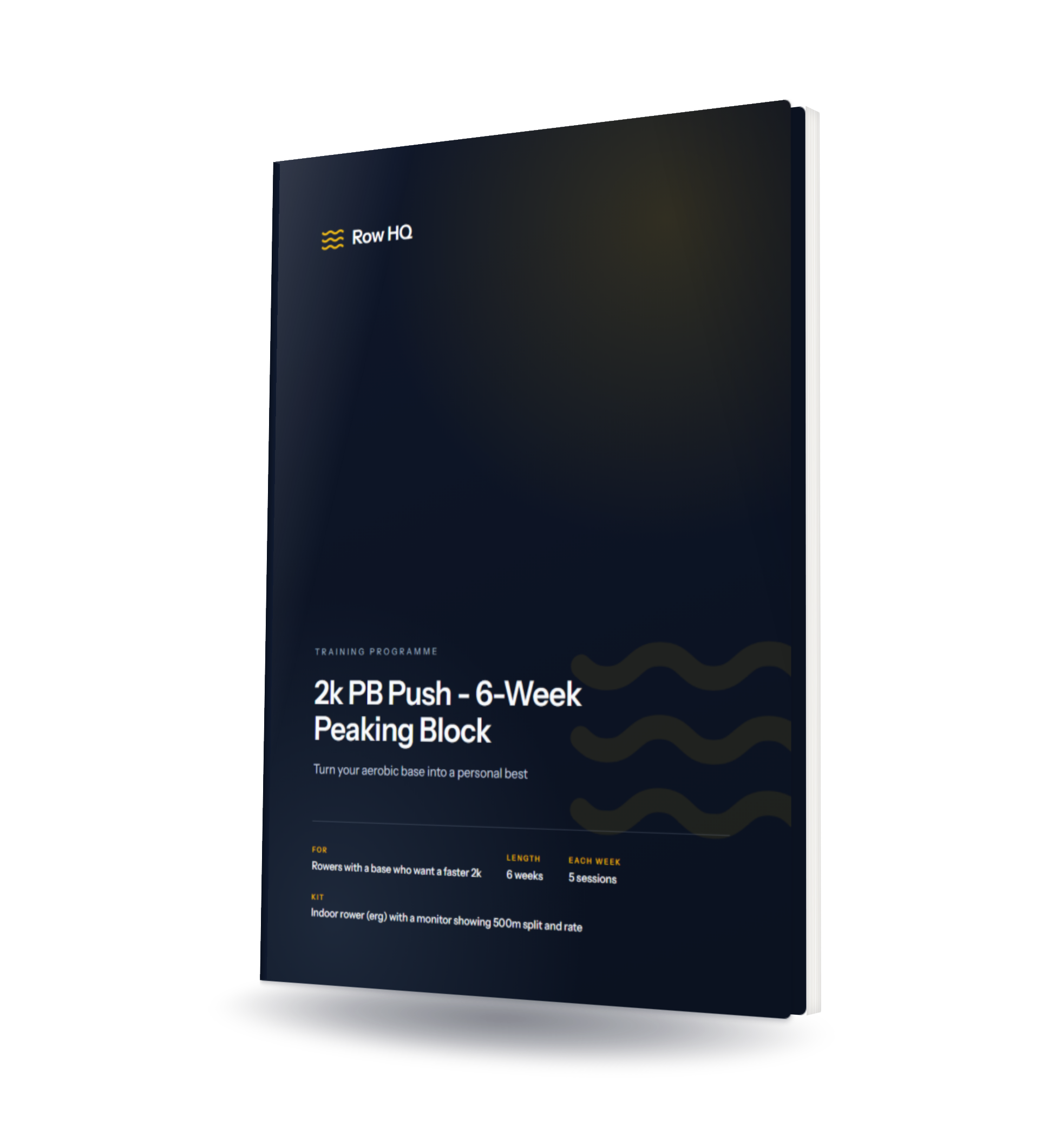
2k PB Push - 6-Week Peaking Block
Six weeks that turn an existing aerobic base into a 2k personal best - race-specific work, a proper taper, every pace scaled to your own time.
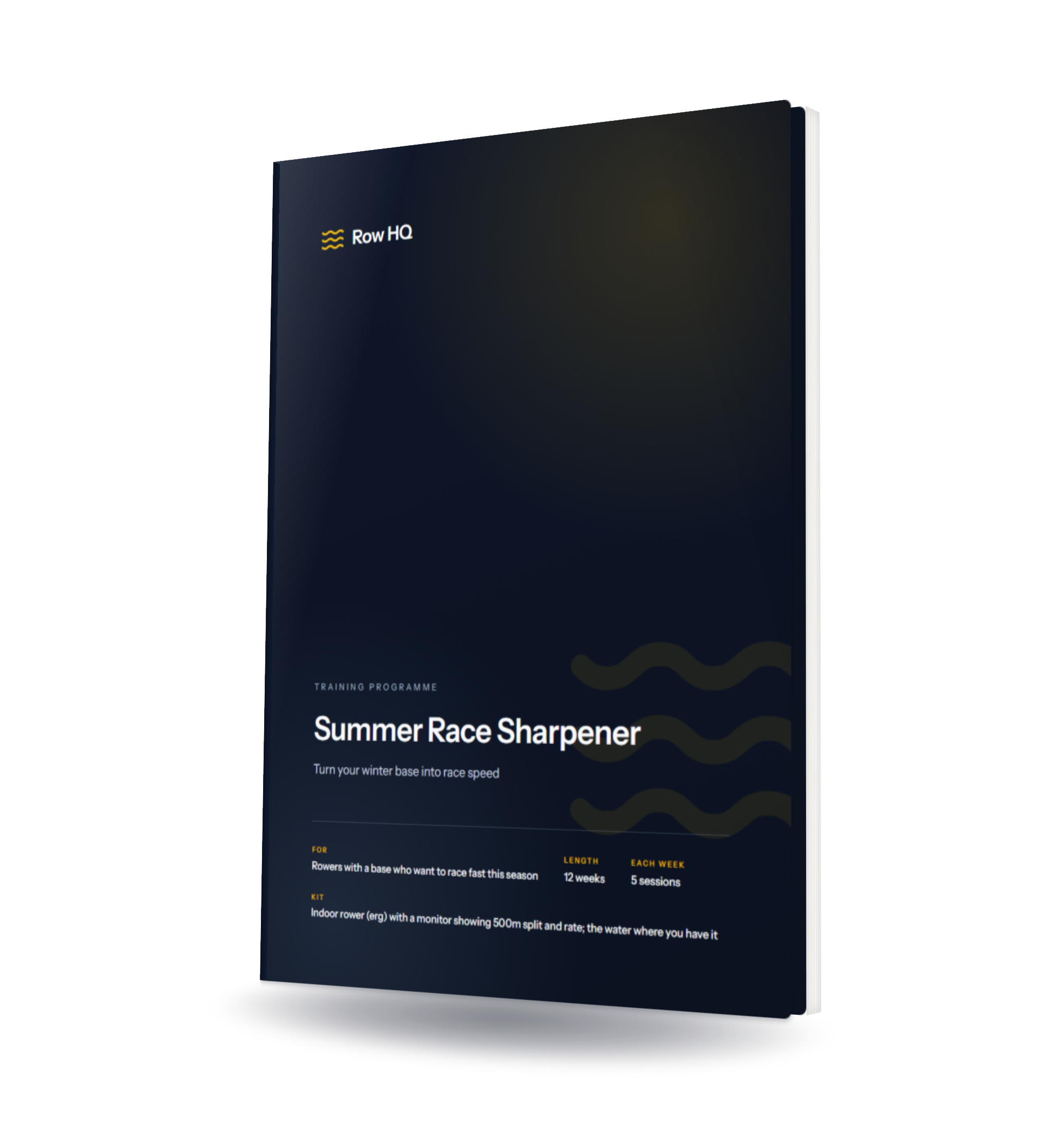
Summer Race Sharpener
Turn your winter base into race speed - 12 weeks that sharpen a big aerobic engine and peak you for a target regatta or 2k, every pace set from your own 2k.